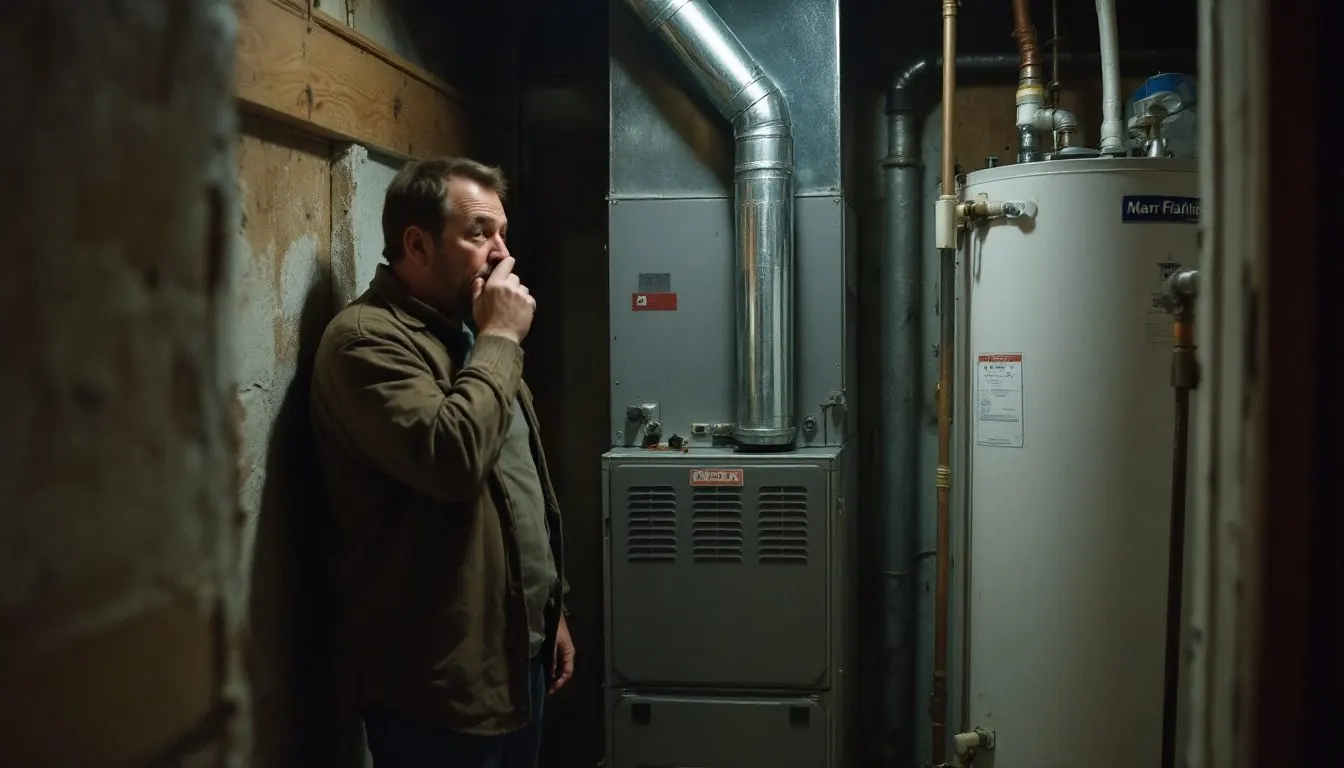
A furnace exhaust smell in the house means flue gas is escaping before it reaches outdoors: spillage at a water heater or furnace draft hood, a disconnected or blocked vent, an unsealed PVC joint, or a heat exchanger breach. Carbon monoxide has no smell, so check the CO alarm, shut the furnace off and ventilate.
What should you do first when the house smells like furnace exhaust?
Check for an alarm and for symptoms first, then stop the burners and air the house.
- Alarm sounding, or anyone with a headache, nausea or dizziness: The First Alert CO5 manual says to call “911” and “Immediately exit to fresh air,” and not to re-enter until responders arrive and the alarm is back to normal. EPA lists “flu-like symptoms that clear up after leaving home” as a CO sign.
- Rotten egg or sulfur smell instead: that is fuel gas, a different emergency. Leave without touching switches; our page on a furnace that smells like gas covers it.
- No alarm, no symptoms: set the thermostat to OFF, switch off the dryer, range hood and bath fans, and open windows near the furnace room.
- Do not read a silent alarm as all clear. UL 2034, as quoted in First Alert’s manual, lets an alarm take between 60 and 240 minutes to sound at 70 ppm.
- Book a combustion and venting check before the furnace or gas water heater runs again.
Step 4 matters most for a faint smell: the alarm must sound between 4 and 15 minutes only at 400 ppm, so a slow leak can sicken people while the alarm stays quiet. Where to mount alarms is in our carbon monoxide detector placement guide, and what each beep pattern means is in carbon monoxide detector beeping.
Where is the exhaust smell strongest, and what does each spot point to?
The place and the moment you notice it narrow the source more than the smell does. The DOE fact sheet lists “leaky flues, cracked heat exchangers, or backdrafting” as the ways exhaust gets in unnoticed.
| Where and when | Likely source | What proves it |
|---|---|---|
| Top of the gas water heater or an 80% furnace’s draft hood, worse with the dryer or range hood on | Spillage or backdraft from house depressurization | Spillage test at the draft hood after 5 minutes of burner run, fans on |
| Basement, soon after an old furnace was replaced by a 90%+ unit | Water heater left alone in the old chimney (orphaned) | Chimney sizing check plus the same spillage test |
| Along white PVC exhaust pipe of a condensing furnace | Unglued or cracked joint in a positive pressure vent | Joint inspection; CO reading at the joints while running |
| At supply registers, only while the blower runs | Breach in the heat exchanger, or a return pulling from the furnace room | Combustion analysis and a CO reading in supply air |
| Oil furnace: smoky or oily smell near the barometric damper | Chimney blockage pushing flue gas back | Overfire draft and smoke test |
| Outdoors, then inside through a window or a fresh air intake | Vent terminal too close to an opening, or exhaust recirculating | Tape measure from terminal to openings |
Compiled by The HVAC Brief from DOE, Building America, Lennox, Goodman, Beckett and fuel gas code documents (Sources 1 to 6).
Why does the exhaust smell show up when the dryer or range hood is running?
Those fans lower the air pressure around the appliances until the vent stops drawing; DOE says household fans can depressurize a room enough to “cause it to backdraft.” The risk “increases the closer the fan is to the appliance, when several fans run simultaneously,” and when the appliance cannot be closed off from the fan.
DOE also names “a return register that is too close to the combustion appliance” and leaky supply ducts as causes.
Appliances differ widely in how much suction they tolerate. The Building America Solution Center publishes depressurization limits adapted from Minnesota Energy Code 7672.0900 and Canadian standard CGSB 51.71, charted below. The orphaned natural draft water heater is the weak link at -2 Pa, against -15 Pa for a sealed direct-vent furnace. That is why the smell often starts at the water heater, not the furnace. The fix for an orphaned heater is usually a correctly sized chimney liner, and room air supply rules are in our combustion air guide.
Does an exhaust smell near a high efficiency furnace mean the PVC vent is leaking?
Often, yes: a condensing furnace pushes its exhaust out under pressure, so any open joint leaks into the room. Lennox’s ML196UHE installation manual says the exhaust vent pipe “operates under positive pressure and must be completely sealed to prevent leakage of combustion products into the living space.”
The same Lennox manual says the exhaust pipe “MUST be glued to furnace exhaust fitting” unless its glueless adapter kit 17H92 is used. Look for a joint pulled apart, a fitting pushed on dry, or a crack at a hanger. Pipe types and slope rules are on our furnace vent pipe page; a gurgle in the same pipe is a drainage problem covered in furnace exhaust pipe gurgling.
Can a cracked heat exchanger make the house smell like exhaust?
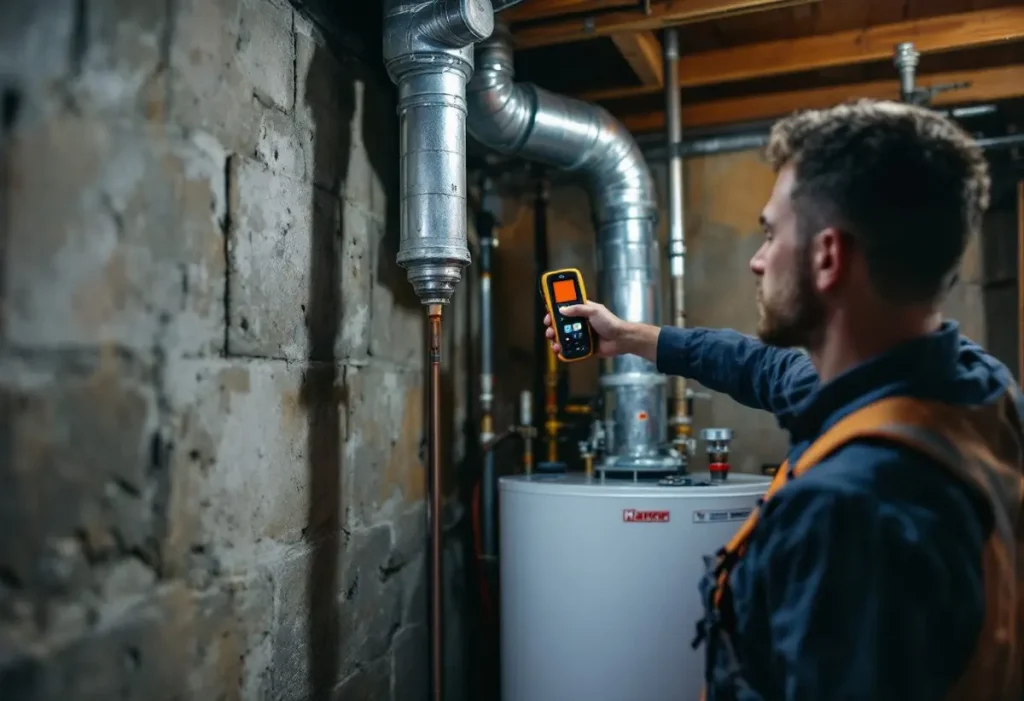
It can, but a smell at the registers is not proof of a crack: a leaky return near a spilling draft hood can carry flue gas into the blower too. Our cracked heat exchanger page covers the CPSC case review showing that CO incidents usually involve two failures at once, and how cameras and combustion readings settle it.
Why does furnace exhaust smell outside, or smell like gas, propane or chlorine?
Outdoors, a faint odor at the terminal is the vent working; the problem is exhaust getting back in. In the 2021 Seattle Fuel Gas Code (an IFGC adoption), Table 503.8 puts a nondirect-vent terminal 4 feet below or beside an openable window or door, or 1 foot above it, 12 inches above grade, and 10 feet horizontally from a mechanical air supply inlet. Lennox adds: “Care must be taken to avoid recirculation of exhaust back into intake pipe.”
A gas smell at the outside pipe usually traces to ignition. In the Lennox ML196UHE sequence the inducer runs a 15-second prepurge, then a 4-second trial for ignition; with no flame the control retries four more times, then waits 60 minutes. Our reading: gas from a failed trial leaves the vent unburned. Gas carries odorant by law, readily detectable at one-fifth of the lower explosive limit under 49 CFR 192.625. A vent buried by a storm is covered in furnace vent blocked by snow.
Propane is harder to judge by nose. Lennox warns that propane odorant “can lose its scent” and that leaking propane “will settle close to the floor.” A chlorine smell points at the air the burner breathes: the Lennox manual lists “Chlorinated waxes and cleaners” and “Chlorine base swimming pool chemicals” among substances to keep out of combustion air. Move them away from the furnace room.
What is different about an oil furnace exhaust smell in the house?
An oil burner has a second escape route: the barometric damper on the flue pipe. The Beckett AF/AFG burner manual explains that cooler flue gas condenses with sulphur into acid that attacks chimney liners, and that a resulting blockage means “the flue gases could vent out the barometric damper into the living space.”
Beckett has technicians set overfire draft, “typically” -0.01 or -0.02 inch w.c. on natural draft units, and adjust until the smoke reading is zero. Soot around the burner door after a bang points to oil furnace puffback.
What will the technician test, and which readings matter?
- Worst case spillage test. Goodman’s GM9S80 installation manual has: doors and windows closed, dryer and exhaust fans at maximum speed, then a match flame at the draft hood after 5 minutes of main burner operation.
- Depressurization reading in the furnace room, compared with the Building America limits: -3 Pa for a water heater sharing a vent with an atmospheric furnace, -5 Pa for a Category I furnace.
- Vent inspection for “blockage or restriction, leakage, corrosion,” Goodman’s words, plus every PVC joint on a condensing unit.
- Combustion analysis in the flue and a CO reading in supply air, or draft and smoke on oil.
For comparison, EPA puts average CO in homes without gas stoves at 0.5 to 5 parts per million. Local code editions vary; the inspector decides.
Frequently asked questions
What does furnace exhaust smell like?
It is usually described as car tailpipe exhaust, unlike the toasty dust smell of the first heat of the season. A DOE fact sheet names carbon monoxide, water vapor, and nitrogen oxides as the troublesome exhaust components, and calls CO “colorless, tasteless, and odorless,” so the smell is only a clue that exhaust is present.
Is it normal for furnace exhaust to smell?
Outdoors at the vent terminal, a faint combustion odor is expected. Indoors it is not. Lennox says a condensing furnace’s exhaust pipe must be “completely sealed to prevent leakage of combustion products into the living space,” and a Category I furnace should pass a spillage test at the draft hood after 5 minutes of burner operation.
How do I tell if my furnace is leaking carbon monoxide?
Not by smell. Use a listed CO alarm, knowing that under UL 2034, as quoted by First Alert, an alarm may take between 60 and 240 minutes to sound at 70 ppm. Symptoms that clear up after leaving home are a sign EPA lists. A technician’s combustion analysis and supply air CO reading is the real test.
Why is the exhaust smell worst in the basement furnace room?
The furnace room is where draft hoods spill. The Building America table gives an orphaned natural draft water heater a limit of just -2 Pa of depressurization, the lowest of any appliance listed, so a dryer or range hood running upstairs can reverse its draft first. Ask for a worst case spillage test.
How we researched this
In November 2026 we read the nine documents listed under Sources, plus the Lennox SL280UHV manual. We excluded contractor blogs and forums, including a claim that a little gas smell at start-up is typical, and a “60 second” spillage pass mark we could not find in any document we opened.
Sources
- U.S. Department of Energy (Southface Energy Institute and Oak Ridge National Laboratory). “Combustion Equipment Safety.” https://www1.eere.energy.gov/buildings/publications/pdfs/building_america/26464.pdf. Accessed November 2026.
- Building America Solution Center (PNNL). “Depressurization Analysis.” https://basc.pnnl.gov/redcalc/tool/depressurization-analysis. Accessed November 2026.
- Lennox Industries. “ML196UHE Merit Series Gas Furnace Installation Instructions” (2024). https://www.lennox.com/dA/2a12f2b40e/507966-04g.pdf. Accessed November 2026.
- Goodman. “Installation Instructions for *M9S80 and *C9S80* Gas Furnace.” https://documents.alpinehomeair.com/product/goodmangm9s8gc9s8installationmanual.pdf. Accessed November 2026.
- Seattle Department of Construction and Inspections. “2021 Seattle Fuel Gas Code, Chapter 5: Chimneys and Vents.” https://www.seattle.gov/documents/Departments/SDCI/Codes/FuelGasCode/2021SFGCChapter5.pdf. Accessed November 2026.
- R.W. Beckett and Weil-McLain. “Beckett AF/AFG Burner Manual for Ultra Oil.” https://www.weil-mclain.com/wp-content/uploads/RW-Beckett-AFG-Burner-Manual-for-Ultra-Oil-VBL-0321.pdf. Accessed November 2026.
- First Alert. “CO5-B10D Carbon Monoxide Alarm User Manual.” https://www.firstalertstore.com/store/images/pdf/co5-b10d-first-alert-carbon-monoxide-detector-user-manual.pdf. Accessed November 2026.
- U.S. Environmental Protection Agency. “Carbon Monoxide’s Impact on Indoor Air Quality.” https://www.epa.gov/indoor-air-quality-iaq/carbon-monoxides-impact-indoor-air-quality. Accessed November 2026.
- Electronic Code of Federal Regulations. “49 CFR 192.625 Odorization of gas.” https://www.ecfr.gov/current/title-49/subtitle-B/chapter-I/subchapter-D/part-192/subpart-L/section-192.625. Accessed November 2026.
Leave a Reply