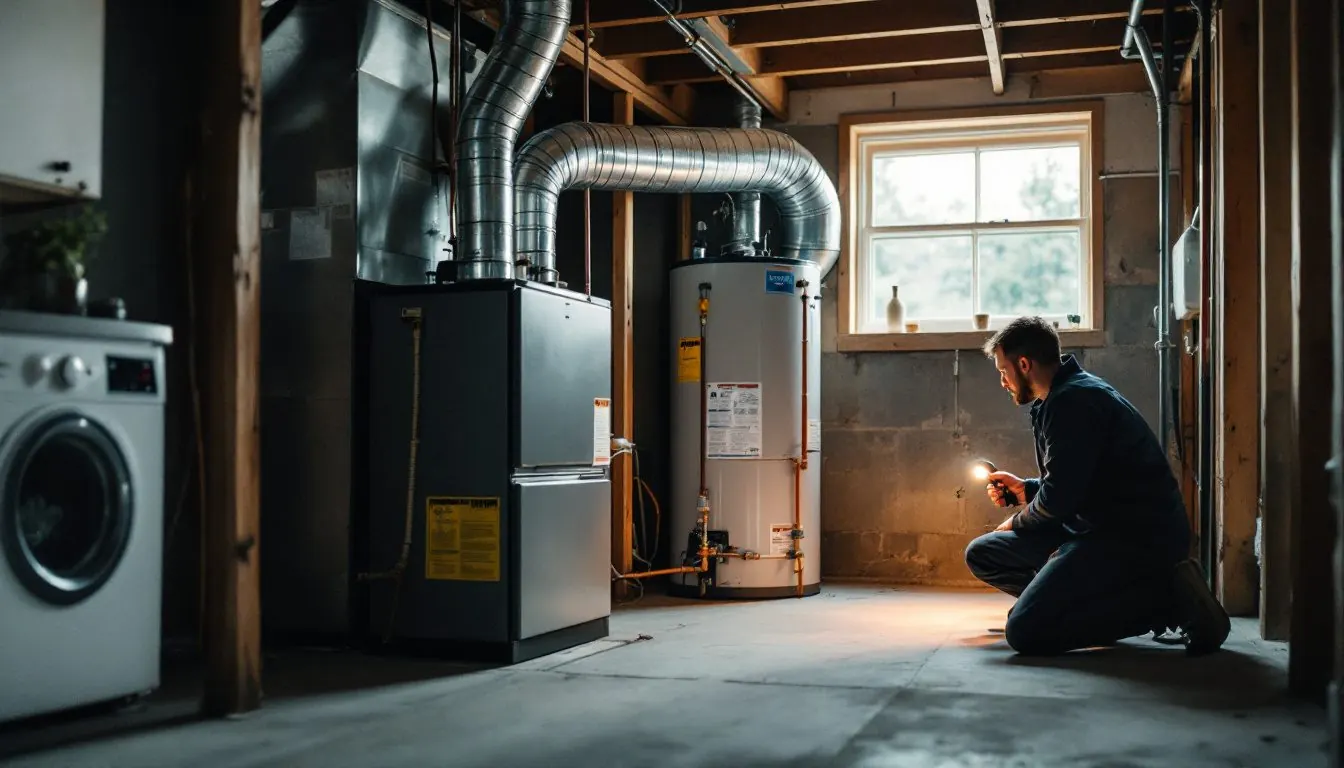
What is combustion air? Combustion air is the air a gas furnace, boiler or water heater burns, plus the air its draft hood needs. The 2021 IRC and IFGC require 50 cubic feet of room per 1,000 Btu/h, or openings to other rooms or outdoors.
Key Takeaways
- The standard method needs 50 cubic feet of room volume per 1,000 Btu/h of total appliance input (IRC G2407.5.1, 2021).
- Where a house is known to leak less than 0.40 ACH, the code makes the known-infiltration method mandatory (IFGC 304.5, 2021).
- Outdoor openings run 1 square inch per 4,000 Btu/h direct, 1 per 2,000 through horizontal ducts and 1 per 3,000 for a single high opening (IFGC 304.6).
- A 100,000 Btu/h furnace plus a 40,000 Btu/h water heater needs 7,000 cubic feet; a 10 by 12 by 8 foot room holds 960 (our arithmetic from IRC G2407.5.1).
- DOE and PNNL list a -5 Pa depressurization limit for a Category I furnace or boiler and -2 Pa for an orphaned natural draft water heater (Building America Solution Center).
- CPSC estimated 76 non-fire CO deaths tied to heating systems in 2022 and names inadequate combustion air as a possible cause of soot-blocked vents (CPSC, May 2026).
What is combustion air?
The IRC defines combustion air as “air necessary for complete combustion of a fuel, including theoretical air and excess air.” The governing section also covers ventilation air around the appliance and dilution air that a draft hood mixes into the flue gases.
The rules sit in IFGC Section 304 and its residential twin, IRC Section G2407. We quote Seattle’s reprint of the 2021 IRC fuel gas chapter; your jurisdiction may use another edition. Oil appliances fall outside these sections: the Mechanical Code’s Chapter 7 user note refers oil-fired appliances to NFPA 31.
A starved burner makes carbon monoxide, so this topic sits next to where CO alarms go and what flame color means.
Which appliances need combustion air from the room?
Natural draft and Category I gas appliances that pull room air need combustion air sized by IRC G2407. G2407.1 sends four other groups to the manufacturer’s instructions instead: direct-vent appliances, gas appliances “of other than natural draft design,” vented appliances not designated Category I, and appliances with power burners.
The IRC defines a direct-vent appliance as one where “all air for combustion is derived directly from the outside atmosphere and all flue gases are discharged directly to the outside atmosphere.” It never draws room air. For its piping, see our furnace vent pipe explainer.
Location rules overlap: G2406.2 bars appliances from sleeping rooms, bathrooms, toilet rooms and storage closets, with the first exception being a direct-vent appliance. The same Section G2407 governs boiler rooms and vented gas fireplaces.
How do you calculate combustion air from room volume?
Add the input ratings of every appliance in the space, then compare the room volume with the required volume. The code gives two ways to get the required number, and rooms connected through doorless openings or sized combustion air openings count toward the volume (G2407.5).
- Standard method (G2407.5.1): 50 cubic feet per 1,000 Btu/h of input.
- Known air-infiltration-rate method (G2407.5.2): 21 cubic feet divided by ACH, per 1,000 Btu/h, for appliances other than fan-assisted; 15 cubic feet divided by ACH, per 1,000 Btu/h, for fan-assisted appliances.
- Cap and floor: an infiltration rate greater than 0.60 ACH “shall not be used,” and where the rate is known to be below 0.40 ACH the second method is required.
The 21 cubic foot equation equals 50 cubic feet at 0.42 ACH, and the 15 cubic foot equation equals it at 0.30 ACH (our division). In a tighter house the standard method undersizes the room, which is why the code forces the infiltration method there. If you have a blower door number, our piece on air changes per hour explains the units.
How big must combustion air openings be?
Combustion air openings are sized by free area per 1,000 Btu/h of total input, and the ratio depends on where the air comes from. Rows are from IFGC 304 (IRC G2407 matches); every opening must be at least 3 inches across.
| Method | Rule | Placement | Section |
|---|---|---|---|
| Indoor, same story | 1 sq in per 1,000 Btu/h each opening, 100 sq in minimum | One within 12 in of the top, one within 12 in of the bottom | IFGC 304.5.3.1 |
| Indoor, different stories | 2 sq in per 1,000 Btu/h total | Openings in doors or floors | IFGC 304.5.3.2 |
| Outdoor, two openings, direct or vertical ducts | 1 sq in per 4,000 Btu/h each | Top and bottom, within 12 in | IFGC 304.6.1 |
| Outdoor, two openings, horizontal ducts | 1 sq in per 2,000 Btu/h each | Top and bottom, within 12 in | IFGC 304.6.1 |
| Outdoor, one opening | 1 sq in per 3,000 Btu/h, and not less than all vent connector areas combined | Within 12 in of the top; appliance 1 in from sides and back, 6 in from front | IFGC 304.6.2 |
| Combination indoor and outdoor | Outdoor size times (1 minus available over required volume) | As outdoor | IFGC 304.7.3 |
| Mechanical supply | 0.35 cfm per 1,000 Btu/h from outdoors, interlocked | Not by area | IFGC 304.9 |
Free area is the open area after the grille: when the design is unknown, IFGC 304.10 assumes 25 percent for wood louvers and 75 percent for metal. Under 304.11, exterior intakes sit at least 12 inches above grade, and the space around a liner inside a chimney cannot supply combustion air.
Correction: the mechanical rate on top pages
A top-ranking technician page gives mechanical combustion air as 1 cfm per 2,400 Btu/h. IFGC 304.9 says 0.35 cfm per 1,000 Btu/h, or 1 cfm per about 2,857 Btu/h. The 2,400 figure errs safe, but it is not the code number.
Worked combustion air example: furnace and water heater in a 10 by 12 room
A 100,000 Btu/h furnace and a 40,000 Btu/h water heater in a 10 by 12 foot utility room with an 8 foot ceiling fail the room-volume test by a wide margin. The appliances total 140,000 Btu/h, so the standard method requires 7,000 cubic feet; the room holds 960.
We assumed a fan-assisted Category I furnace and a natural draft water heater. The arithmetic is ours.
- Borrow indoor air: connect enough rooms to reach 7,000 cubic feet, or 875 square feet of floor at an 8 foot ceiling, through two openings of 140 square inches each.
- Two outdoor openings: 35 square inches each through a wall or vertical duct; 70 square inches each through horizontal ducts.
- Grille allowance: 35 square inches free takes about 46.7 square inches of metal grille or 140 of wood louver.
- One high opening: 46.7 square inches, unless the vent connectors add up to more.
- Combination method: 960 divided by 7,000 is a ratio of 0.137, so each outdoor opening can shrink to about 30.2 square inches.
- Mechanical supply: 49 cfm of outdoor air, interlocked with both burners.
With a known 0.40 ACH, the pair needs 5,850 cubic feet; at the 0.60 ACH cap, 3,900; at 0.30 ACH, 7,800. Swap in a direct-vent furnace and, in our reading of G2407.1, only the water heater is sized by volume: 2,000 cubic feet, still more than double the 960 available. The same logic shows up in what inspectors check on a tank water heater.
Why do tight houses backdraft without combustion air?
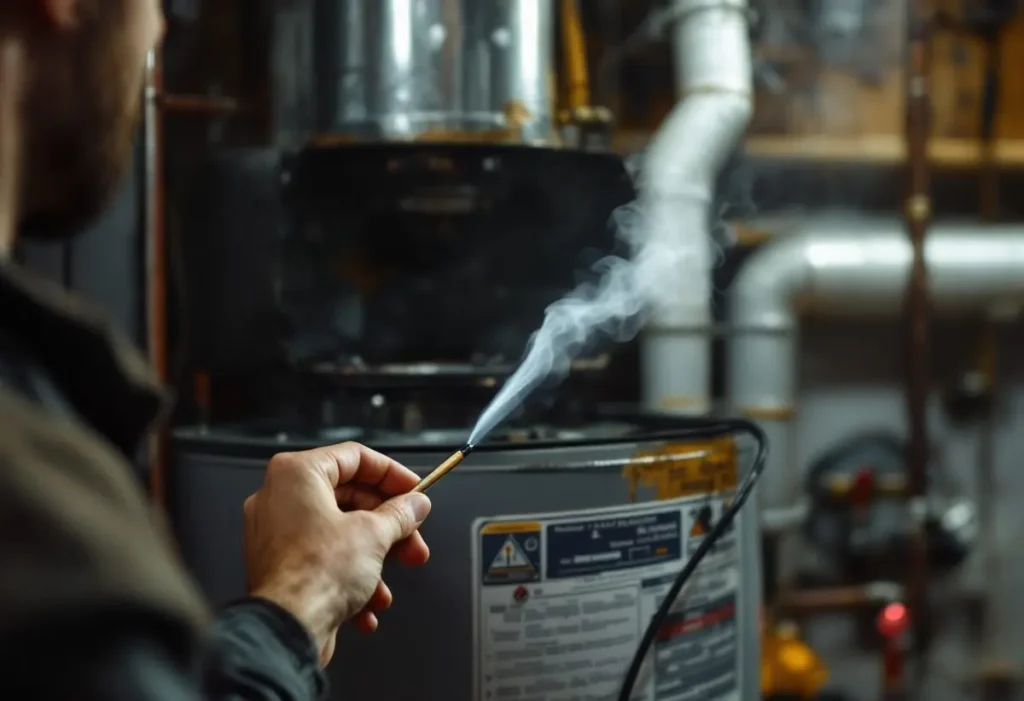
Exhaust fans, dryers and duct leaks lower indoor pressure until an atmospheric vent reverses. A DOE combustion equipment safety fact sheet (October 2000) says atmospheric-vent appliances are “most susceptible to backdrafting,” and that the risk rises when several fans run simultaneously.
The PNNL depressurization tool sets limits by appliance type, adapted from Minnesota Energy Code 7672.0900 and CGSB 51.71. Replacing exhausted air is a separate requirement; see our make up air explainer.
CPSC’s latest estimate puts 11 of 15 natural gas heating deaths in 2022 on installed furnaces. Its incident notes describe detached vents and vents blocked by soot, which it says may have been caused by factors including “inadequate combustion air.” The same notes list backdraft conditions and compromised heat exchangers; see our guide to a cracked heat exchanger.
How do you test whether combustion air is adequate?
Run a worst-case draft test with every exhaust device on. The NFPA 54 procedure, summarized by its AGA administrator in a 2012 DOE Building America presentation, checks draft 5 minutes after start.
- Close all doors and windows and close the fireplace damper.
- Operate all air exhausting equipment and turn on the first appliance.
- Check the burner flame, then check draft after 5 minutes.
- If draft fails, correct the combustion air supply; if it passes, turn on the other appliances in the room and recheck.
Blower door and house pressure readings, the inputs for the PNNL limits above, are part of a home energy audit. A failed draft test can also trace to the vent itself, such as an unlined masonry flue; see when code calls for a chimney liner.
How we researched this
Researched October 31, 2026. Code text is quoted from Seattle’s 2021 Fuel Gas, Residential and Mechanical Code chapters, which reprint IFGC 304, IRC G2407 and IMC Chapter 7 (codes.iccsafe.org blocks fetches). Limits are from DOE/PNNL, deaths from CPSC. Seven sources cited; three ranking pages and one unreadable DOE file consulted but not cited. Excluded: contractor blogs for numbers, and Reddit (combustion safety).
Frequently asked questions
How much combustion air does a gas furnace need?
Under the standard method in IRC G2407.5.1, a furnace needs 50 cubic feet of room volume per 1,000 Btu/h of input. A 100,000 Btu/h furnace alone needs 5,000 cubic feet, and other appliances in the space add to it. A smaller room needs openings.
Does a high efficiency furnace need combustion air?
A direct-vent condensing furnace pipes all combustion air from outdoors, so IRC G2407.1 sends it to the manufacturer’s instructions rather than the room-volume rules. A condensing furnace installed with one pipe is also outside those rules, since it is not Category I, but it still burns room air, so follow its installation manual before closing it in.
What is a confined space for combustion air?
The 2021 IRC and IFGC text we read never uses the phrase. Trade pages use it for a room below the standard method’s 50 cubic feet per 1,000 Btu/h. The code itself says that where the indoor volume rules of G2407.5 are not met, outdoor air must be introduced by one of the methods in G2407.6 through G2407.9.
Can I use a louvered door for combustion air?
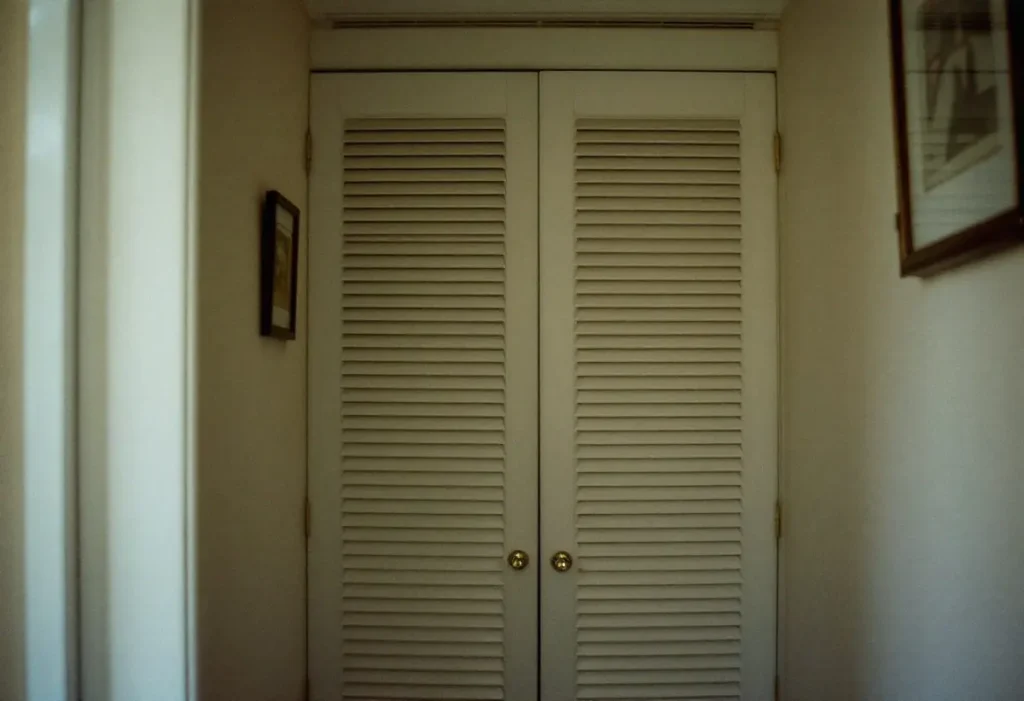
Possibly, if its free area meets the opening sizes and openings land within 12 inches of the top and bottom. IFGC 304.10 assumes wood louvers have 25 percent free area when the design is unknown, so a wood louver needs four times the net area. Each same-story opening needs 100 square inches minimum.
Do combustion air vents let cold air in?
Yes. Outdoor openings bring in unconditioned air, and IFGC 304.10 requires nonmotorized louvers and grilles to be fixed open. Motorized louvers must be interlocked to prove open before the main burner ignites. A direct-vent appliance avoids the hole by using a sealed pipe.
Can I block a combustion air opening?
No. Blocking a required opening can starve the burner or reverse the vent. CPSC’s 2022 report estimated 76 heating system CO deaths and names inadequate combustion air as one possible cause of soot-blocked vents in those incidents. Ask a licensed technician to resize or relocate the supply instead.
Sources
- City of Seattle SDCI. “2021 Seattle Fuel Gas Code, Chapter 3: General Regulations” (IFGC Section 304). https://www.seattle.gov/documents/Departments/SDCI/Codes/FuelGasCode/2021SFGCChapter3.pdf. Accessed October 2026.
- City of Seattle SDCI. “2021 Seattle Residential Code, Chapter 24: Fuel Gas” (IRC Sections G2404 to G2407). https://www.seattle.gov/documents/Departments/SDCI/Codes/SeattleResidentialCode/2021SRCChapter24.pdf. Accessed October 2026.
- City of Seattle SDCI. “2021 Seattle Mechanical Code, Chapter 7: Combustion Air.” https://seattle.gov/documents/Departments/SDCI/Codes/MechanicalCode/2021SMCChapter7.pdf. Accessed October 2026.
- US Consumer Product Safety Commission. “Non-Fire Carbon Monoxide Deaths Associated with the Use of Consumer Products, 2022 Annual Estimates.” https://www.cpsc.gov/s3fs-public/Non-Fire-Carbon-Monoxide-Deaths-Associated-with-the-Use-of-Consumer-Products-2022-Annual-Estimates.pdf. Accessed October 2026.
- DOE/PNNL Building America Solution Center. “Depressurization Analysis.” https://basc.pnnl.gov/redcalc/tool/depressurization-analysis. Accessed October 2026.
- US Department of Energy. “Combustion Equipment Safety” technology fact sheet, DOE/GO-102000-0784. https://www1.eere.energy.gov/buildings/publications/pdfs/building_america/26464.pdf. Accessed October 2026.
- American Gas Association, Paul Cabot, for DOE Building America. “Fuel Gas Appliances: Combustion Air and Inspection.” https://www1.eere.energy.gov/buildings/publications/pdfs/building_america/aga_combustion_safety.pdf. Accessed October 2026.
Leave a Reply