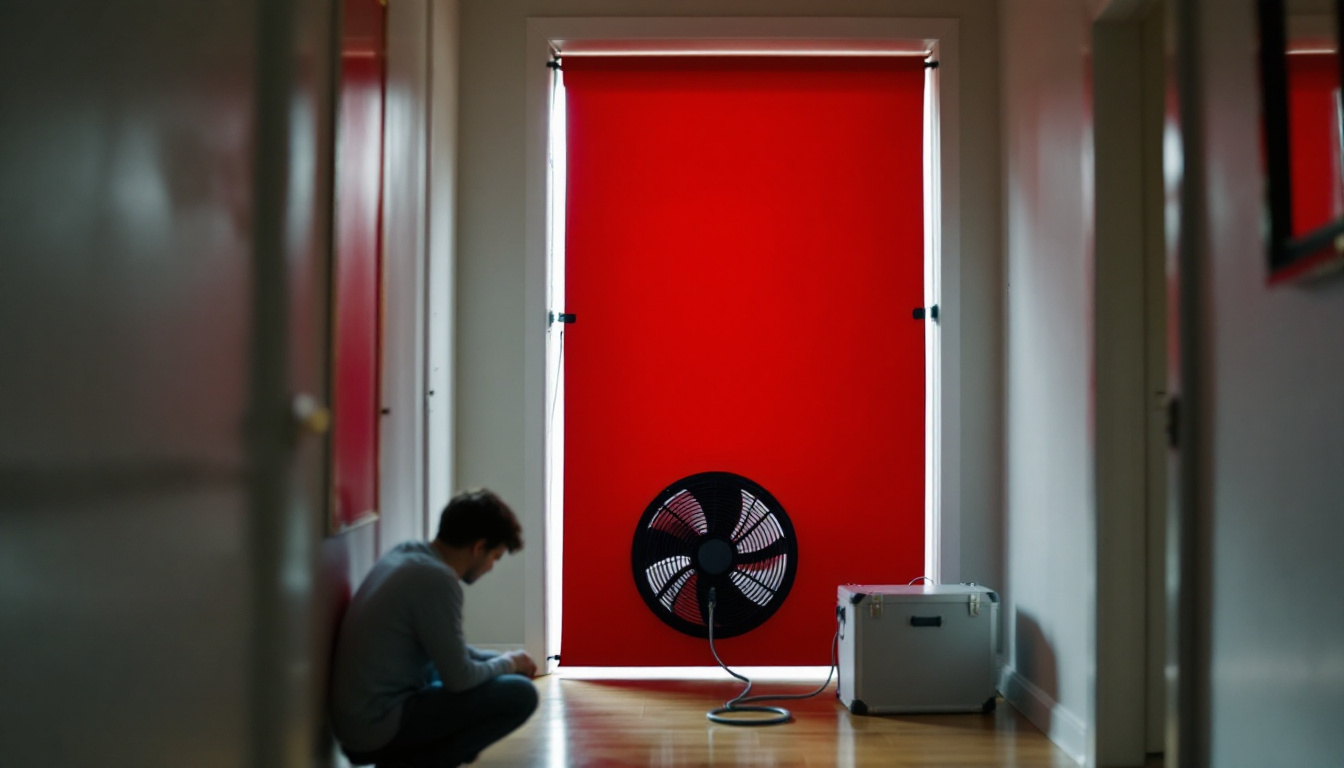
What is a home energy audit? A home energy audit is a professional test of where a house loses energy: a blower door measures air leakage in CFM50 and ACH50, infrared finds the gaps, combustion tests check safety, and a report ranks the fixes.
Key Takeaways
- DOE says many professional assessments (archived copy) include a blower door test and a thermographic scan.
- The 2015 IECC caps new homes at 3 ACH50 in climate zones 3 to 8 and 5 ACH50 in zones 1 and 2.
- Blower door data analyzed by Lawrence Berkeley National Laboratory show retrofits cut air leakage by 20% to 30%.
- DOE’s Home Energy Score rates homes 1 to 10; a 10 ranks among the 10 percent of US homes expected to use the least energy.
- The $150 section 25C audit credit is gone: the IRS says the credit covers work through December 31, 2025.
- The modeled path to HOMES rebates under IRA section 50121 needs at least 20% savings from a BPI 2400 energy model.
What does a professional home energy audit actually measure?
It measures air leakage, heat loss, combustion safety and annual energy use. DOE says the assessor does “a room-by-room examination of the residence, as well as a thorough examination of past utility bills,” using tools such as blower doors, infrared cameras and furnace efficiency meters.
The output is a report with ranked fixes. DOE’s common recommendations start with air sealing and insulation, then moisture repair, then more efficient heating, cooling and hot water equipment: envelope first, equipment second.
An audit tests the building around the system, a different job from the three kinds of HVAC inspection sold under that name.
What do CFM50 and ACH50 mean on a blower door report?
CFM50 is the airflow, in cubic feet per minute, the blower door fan moves to hold the house 50 pascals below or above outdoors. ACH50 converts that flow into air changes per hour at the same pressure, using the home’s volume. Codes and certification programs use both.
The arithmetic: CFM50 times 60, divided by house volume in cubic feet. A 16,000 cubic foot house needing 2,000 CFM50 tests at 7.5 ACH50.
DOE’s blower door guide (archived copy) says the test takes “up to an hour or more,” needs a calibrated door to quantify tightness, and helps determine “proper sizing and airflow requirements of heating and cooling equipment.” It also shows whether a sealed house needs mechanical ventilation.
| Benchmark | Climate zones | Air leakage limit | Source |
|---|---|---|---|
| 2015 IECC, new homes | 1 and 2 | 5 ACH50 | DOE Building Energy Codes, R402.4.1 |
| 2015 IECC, new homes | 3 to 8 | 3 ACH50 | DOE Building Energy Codes, R402.4.1 |
| 2024 IECC, new homes | 0 to 2 | 4.0 ACH50 | DOE 2024 IECC determination analysis |
| 2024 IECC, new homes | 3 to 5 | 3.0 ACH50 | DOE 2024 IECC determination analysis |
| 2024 IECC, new homes | 6 to 8 | 2.5 ACH50 | DOE 2024 IECC determination analysis |
| Existing homes | All | No code limit; measured, not mandated | LBNL ResDB, 134,000 homes |
DOE’s 2024 IECC analysis shows the newer edition tightening zones 1 and 2 to 4.0 ACH50 and zones 6 to 8 to 2.5 ACH50. Which edition applies depends on local adoption.
Existing homes face no limit. LBNL’s study of 134,000 homes used normalized leakage, a different metric from ACH50, and predicted a US range of 0.22 to 1.95 with a median of 0.67. Retrofits cut leakage by 20% to 30%, and homes rated for efficiency averaged 30% lower.
What else does the auditor test besides air leakage?
Three things: surface temperatures by infrared camera, duct leakage, and the safety of fuel burning appliances. DOE says interior scans are usually more accurate and work best with at least a 20°F indoor to outdoor difference; with the blower door running, leaks “appear as black streaks.”
For new construction, DOE’s summary of 2015 IECC Section R403.3.4 caps total duct leakage at 4 cfm per 100 square feet of conditioned floor area. What a failing result means is covered in what a duct leakage test should show.
Combustion testing matters most with natural draft furnaces, boilers or water heaters. The Building America Solution Center calls for a worst case depressurization test, a spillage check after 5 minutes of burner operation, and carbon monoxide readings before and after the work.
Sealing a house can pull exhaust back in
DOE warns an exhaust fan “may pull the combustion gases back into the living space, increasing indoor levels of carbon monoxide.” Building America says to repeat combustion testing at the end of each workday during air sealing. Pair the work with properly placed carbon monoxide alarms.
What is a Home Energy Score, and who can issue one?
It is DOE’s 1 to 10 rating of a home’s expected energy use, issued only by a Certified Assessor working through a DOE partner. The Home Energy Score FAQ (archived copy) says a 5 is average, a 10 ranks in the most efficient 10 percent, and a 1 uses more than 85 percent of homes, after adjusting for climate.
It is an asset rating. Assessors collect about 40 pieces of information in under an hour; occupant behavior and appliances are left out. Its recommendations are expected to pay back in 10 years or less.
Assessors need a prior credential, such as a qualifying BPI certification, RESNET HERS Rater or NATE certification, then 8 to 12 hours of DOE simulation training and a mentored first score. Partners rescore 5% of homes for quality assurance.
DOE recorded its 250,000th score in August 2024, and says a score can sometimes stand in for missing utility bill data in a rebate application.
Do federal programs still pay for a home energy audit in 2026?
The tax credit does not; the rebate program can, where your state runs it. Section 70505 of Public Law 119-21, signed July 4, 2025, ended section 25C for property “placed in service after December 31, 2025.” The IRS says the credit covers “improvements made through December 31, 2025.”
That credit included up to $150 for a home energy audit. A 2026 audit earns no 25C credit, part of the loss explained in what the expired 25C credit costs.
HOMES rebates, created by IRA section 50121 (42 U.S.C. 18795), require modeled savings “calibrated to historical energy usage for a home consistent with BPI 2400.” That modeling is, in practice, an audit.
- Modeled savings of 20% to under 35%: up to $2,000 or 50% of project cost, whichever is less.
- Modeled savings of 35% or more: up to $4,000 or 50% of project cost.
- Measured pathway: savings of at least 15%, verified with weather normalized meter data.
- A contractor certificate, certified by a third party, stating projected energy savings.
DOE says households can save up to $8,000, because states may raise rebates below 80% of area median income. DOE’s Program Notice 26-1, effective May 29, 2026, dropped proof of commissioning testing and the onsite post install inspection. Retrofits must finish by September 30, 2031; ask your state energy office which pathway it runs.
What does DOE’s DIY home energy audit checklist cover?
DOE’s do it yourself walk through (archived copy) is less thorough than a professional assessment but finds the easier problems; DOE puts savings from reducing drafts at 10% to 20% a year. Its checklist:
- List drafts at baseboards, windows, doors, outlets and open fireplace dampers.
- Check fuel burning appliances for air: one square inch of vent opening per 1,000 Btu of input; soot signals poor draft.
- Inspect the attic: hatch insulated and weatherstripped, penetrations sealed, vents clear, floor covered to the recommended attic R-value.
- Probe one exterior wall through a switched off outlet.
- Check basements and crawlspaces; DOE calls R-25 the recommended minimum in most areas and R-19 for conditioned foundation walls.
- Service equipment yearly, change filters every month or two, and consider replacing units over 15 years old.
- Seal dirty duct seams with mastic and insulate ducts in unheated space to at least R-6.
How should home energy audit results change HVAC sizing and replacement?
They change the load the new system is sized to. DOE’s Building America renovation guide says “many older furnaces and central air conditioning systems are oversized,” and that software can determine heating and cooling needs “after air sealing and insulation improvements are made.”
The guide frames the job as test in, do the work, test out. The sequencing is set out in why insulation comes first, and the load math in why square footage fails.
Building America points to ACCA Manual J for loads and Manual S for equipment, and says variable speed equipment makes oversizing “less of an issue,” the trade in single stage versus variable speed. Where testing finds a natural draft appliance in a tightened house, the Solution Center recommends direct vent, sealed combustion or non combustion equipment. Ask bidders for the load calculation, as covered in what to verify in a contractor.
How we researched this
Every figure comes from a federal or national laboratory source opened for this piece: DOE Energy Saver (archived copies), the Building America Solution Center, DOE Building Energy Codes material in place of ICC code text, LBNL, DOE Home Energy Score pages, P.L. 119-21, IRS guidance and DOE rebate rules. Audit prices and contractor ACH50 rules of thumb were excluded: no federal series. Reddit was skipped because combustion safety is in scope. Research completed September 2026.
Frequently asked questions
How long does a home energy audit take?
DOE says the blower door portion alone can take “up to an hour or more,” depending on the home. A Home Energy Score walk through takes under an hour. Infrared scans may need up to four hours of pre-conditioning.
What is a good ACH50 number?
For new homes, the 2015 IECC sets 5 ACH50 in climate zones 1 and 2 and 3 ACH50 in zones 3 to 8, and the 2024 IECC tightens some zones to 4.0 and 2.5. Existing homes have no code limit.
Can I still get a tax credit for a home energy audit?
No. Public Law 119-21 ended the section 25C credit for property placed in service after December 31, 2025, and the IRS says the credit covers improvements made through that date. The up to $150 audit credit no longer applies to 2026 audits.
Is a Home Energy Score the same as an energy audit?
No. The score is a standardized asset rating from about 40 data points that ignores occupant behavior. An audit adds diagnostic testing such as a blower door and combustion safety checks.
Why does an auditor test my furnace and water heater?
Air sealing changes house pressure, and DOE warns an exhaust fan “may pull the combustion gases back into the living space.” The Building America Solution Center calls for a worst case depressurization test and carbon monoxide readings before and after the work on natural draft appliances.
Should I get an audit before replacing my HVAC system?
Yes, where time allows. DOE’s Building America guide says many older systems are oversized and that heating and cooling needs should be set after air sealing and insulation. The results feed the Manual J load calculation.
Sources
- U.S. DOE Energy Saver. Home energy assessment, blower door, thermographic and DIY pages. Archived copies at https://web.archive.org/web/2025id_/https://www.energy.gov/energysaver/. Accessed September 2026.
- U.S. DOE Building America Solution Center. “Enclosure Leakage Test” and “Combustion Appliance Zone (CAZ) Testing.” https://basc.pnnl.gov/resource-guides/. Accessed September 2026.
- U.S. DOE Building Energy Codes Program. “2015 IECC Residential Provisions.” https://www.energycodes.gov/sites/default/files/2019-09/2015_IECC_residential_requirements.pdf. Accessed September 2026.
- U.S. DOE Building Energy Codes Program. “Energy Savings Analysis: 2024 IECC.” https://www.energycodes.gov/sites/default/files/2024-12/2024_IECC_Determination_TSD.pdf. Accessed September 2026.
- Lawrence Berkeley National Laboratory. “Analysis of Air Leakage Measurements.” https://homes.lbl.gov/publications/analysis-air-leakage-measurements. Accessed September 2026.
- U.S. DOE. “Home Energy Score FAQs” (archived copy) and “Home Energy Scores Surpass 250,000.” https://www.energy.gov/cmei/buildings/articles/home-energy-scores-surpass-250000. Accessed September 2026.
- Public Law 119-21, section 70505. https://www.govinfo.gov/content/pkg/PLAW-119publ21/html/PLAW-119publ21.htm. Accessed September 2026.
- Internal Revenue Service. “Energy Efficient Home Improvement Credit.” https://www.irs.gov/credits-deductions/energy-efficient-home-improvement-credit. Accessed September 2026.
- 42 U.S.C. 18795 and U.S. DOE “Home Energy Rebates Program Notice 26-1.” https://www.energy.gov/documents/program-notice-26-1. Accessed September 2026.
- U.S. DOE Building America Best Practices Series, Vol. 14. “Energy Renovations: HVAC.” https://www1.eere.energy.gov/buildings/publications/pdfs/building_america/hvac_guide.pdf. Accessed September 2026.
Leave a Reply