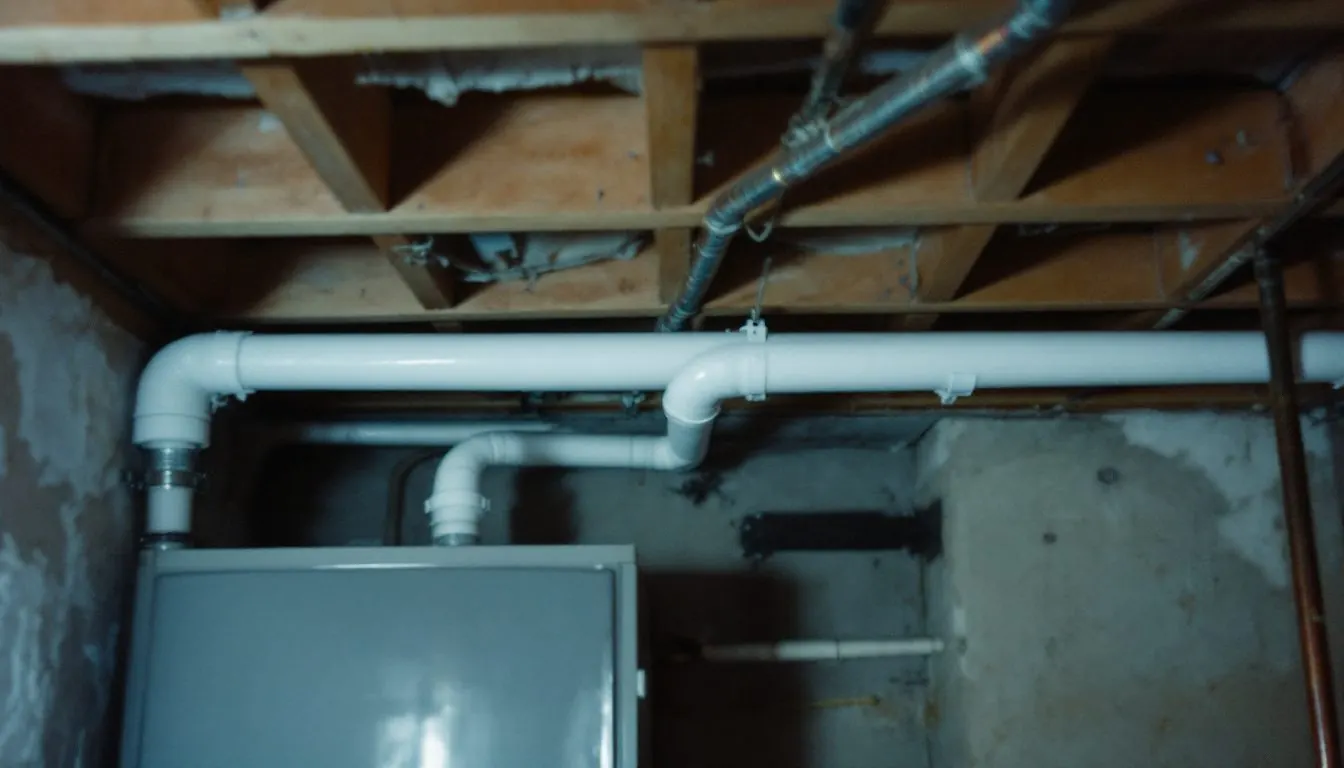
Furnace exhaust pipe gurgling on a 90%+ condensing furnace means condensate is standing where it should drain: a sag between hangers, a flat or back-pitched run, a short 90 degree offset, or a trap and drain hose that cannot empty. Re-pitch the PVC to fall 1/4 inch per foot toward the furnace, then clean and prime the trap.
Is a gurgling furnace exhaust pipe ever normal, or is water standing in the vent?
Water in the pipe is normal; water that sits there long enough to gurgle is not. A condensing furnace is built to send vent condensate back down the PVC: Goodman requires a 1/4 inch per foot slope “back towards the furnace, to properly return condensate to the furnace’s drain system” (Goodman GCVC96 instructions). Gurgling is the inducer pushing exhaust through a puddle.
Carrier treats it as a fault, not a quirk. In the 59TP6A manual, status codes 32 and 43 (low-heat pressure switch problems) both list “Water in vent piping, possible sagging pipe” and “Plugged condensate drain” among the checks (Carrier 59TP6A-10SI).
| What you hear, and where | Most likely cause | What the maker document says | First fix |
|---|---|---|---|
| Mid-run on a horizontal section, while the inducer runs | Sag between hangers holding a puddle | Carrier 59TP6A: “no sags between hangers”; Lennox: no “sags or low spots” | Add a hanger at the low point and re-pitch |
| At an elbow pair where the pipe jogs around a joist | Short 90 degree offset that cannot drain | Carrier 59TP6A: short 90 degree offsets “may trap condensate” | Rebuild the offset with 45s |
| Where the pipe changes size in a horizontal section | Reducer forming a dam | Goodman GCVC96: a horizontal 2 to 3 inch transition “may create a water trap” | Move the transition to a vertical section |
| At the furnace top, near the inducer | Trap or drain hose backing water toward the inducer | Goodman RS6612022r1: “Drain trap prime and clear” | Clear the drain, then re-prime the trap |
| At the trap or drain hose | Dry trap, or a hose that sags and traps water | Goodman GCVC96: “Do not allow drain hose to sag or trap water” | Prime the trap; shorten or support the hose |
| Starts in a cold snap, on attic, garage or crawl space pipe | Extra condensate, or ice, in uninsulated pipe | Goodman GCVC96: insulate pipe exposed below 35°F | Insulate; check the exposed length limit |
Compiled by The HVAC Brief from Goodman GCVC96 and RS6612022r1, Carrier 59TP6A-10SI and Lennox 507966-04, read November 2026. A row applies to the series named; other models follow their own manual.
Where is the gurgle coming from: the horizontal run, the furnace top, or the trap?
Stand under the pipe with the furnace firing and move along it; the loudest point is usually the low point. The drawing shows the three trouble spots Goodman, Carrier and Lennox warn about.
A gurgle at the cabinet top points to the drain side, which our inducer motor guide also flags for water noise in the housing; out on the run it points to pitch and hangers.
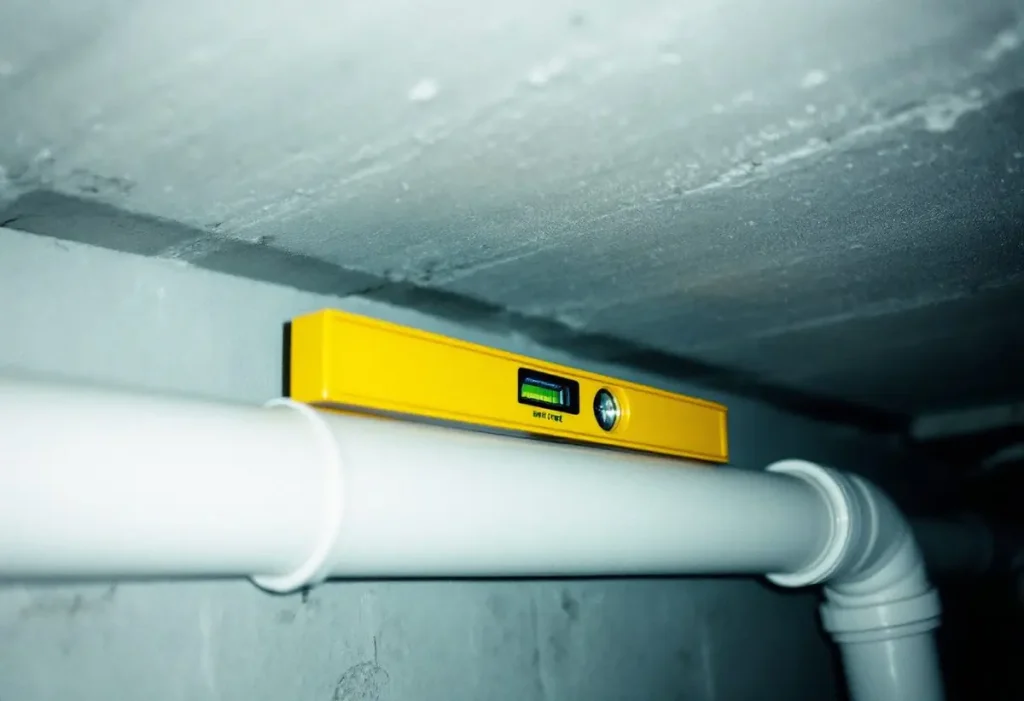
How do you check the slope of a furnace exhaust pipe with a level?
Lay a level on each horizontal section: the furnace end must be lower. All three makers set the same minimum. Goodman and Carrier 59TP6A call for 1/4 inch per foot back to the furnace, Carrier adds “1-in (25 mm) per 4 ft”, and Lennox calls a 1/4 inch drop per 12 inches “mandatory for drainage” (Lennox 507966-04).
| Where you measure | Length | Minimum fall toward the furnace |
|---|---|---|
| 24 inch level | 2 ft | 1/2 inch |
| 48 inch level | 4 ft | 1 inch |
| Between hangers, 2 inch Sch 40 PVC (Carrier 59TP6A Table 13) | 3 ft | 3/4 inch |
| Between hangers, 3 inch Sch 40 PVC (Carrier 59TP6A Table 13) | 3 1/2 ft | 7/8 inch |
| Between hangers at Lennox’s Schedule 40 spacing | 5 ft | 1 1/4 inches |
| Whole horizontal run | 10 ft | 2 1/2 inches |
| Digital level or phone app | Any | 1.19 degrees, or 2.08% grade |
HVAC Brief calculation: fall = 0.25 inch × length in feet; angle = arctan(0.25/12). Script and output kept with this article’s research files.
The hanger rows matter most for gurgling. Carrier’s newer 59TP6A table spaces 2 inch Schedule 40 PVC hangers at 3 ft, tighter than the every 5 ft of its 2008 58MVC manual (Carrier 58MVC-4SI), and Lennox’s support guide allows 5 ft for Schedule 40 PVC but 3 ft for “all other pipe”. A level resting on two hangers can read correctly while the pipe droops between them, so check mid-span too. The full slope, length and clearance rules sit in our furnace vent pipe rules.
Why is there water in my furnace exhaust pipe, and when does it shut the furnace down?
The water is condensate from the exhaust itself; it shuts the furnace down once it blocks enough gas flow or fills the collector box that the pressure switch cannot prove draft. Goodman’s service manual sets the inducer pressure switch on a *M9S960803 model to open at -1.27 ± .07 inches of water column (Goodman RS6612022r1); draft that weak is easily upset by standing water.
Goodman’s chart lists a “blocked drain system” as a cause of an inducer that runs with no furnace operation. On Carrier boards the result is usually code 32; our Carrier furnace error codes page has the full 59TP6B checklist, and the furnace pressure switch guide covers the switch itself. Carrier’s caution for an unsloped vent names the outcomes: “nuisance short cycling, frozen vent termination, and/or no heat.”
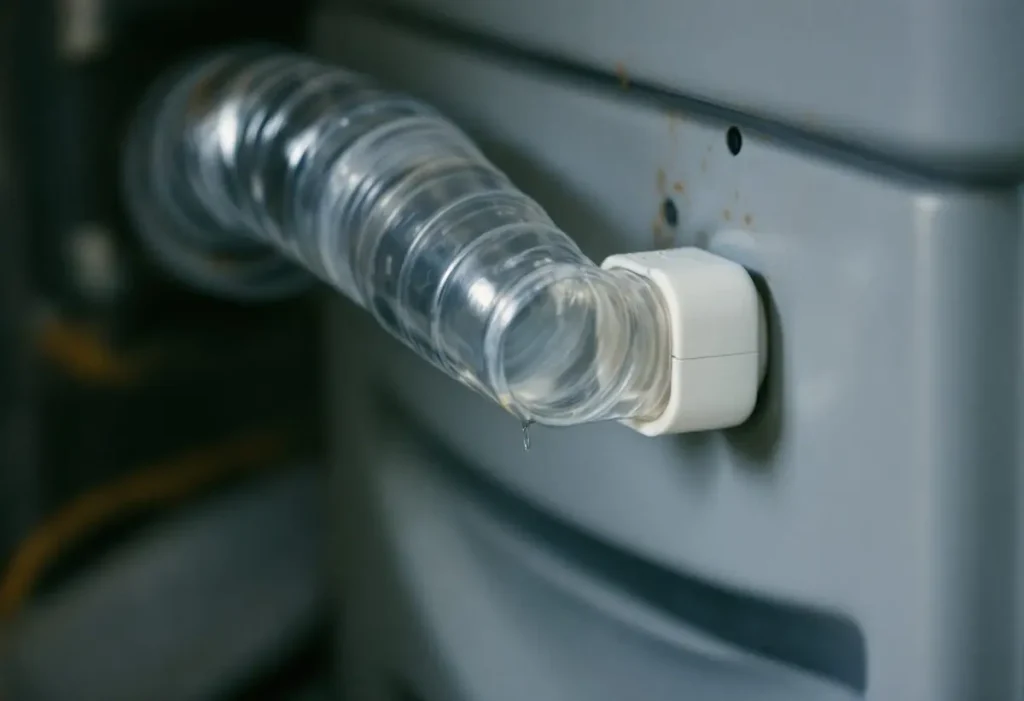
Is the gurgle coming from a plugged condensate trap or drain hose?
If the noise is at the cabinet and the drain hose to the floor drain or pump is dry while the burners run, yes, start there. Goodman says the trap “must be primed at time of installation”, that both sides of the trap must be primed before start up, and that the drain line must not be trapped anywhere except at the furnace’s own trap. Its service manual says the drain tubes, standpipe and field line “must be checked annually.”
Carrier’s 59TP6A trap has two internal chambers that can “ONLY be primed by pouring water into the inducer drain side”, and its start up step pours 1 quart of water through the inducer housing until it overfills the trap and runs to the drain.
A failed condensate pump backs water up the same way, and an iced line needs the frozen condensate line thaw sequence. Water on the floor is covered under furnace leaking water.
How do you fix a gurgling furnace exhaust pipe, step by step?
Work from the drain outward, because a perfectly pitched vent still gurgles if the trap cannot empty.
- Confirm the drain flows while the furnace fires; if not, clear the hose and trap and re-prime it.
- Find the low spot with a level, including mid-span.
- Re-hang and re-pitch at your maker’s hanger spacing until every span falls at least 1/4 inch per foot.
- Rebuild short 90 degree offsets with 45s, as Carrier 59TP6A recommends, and move any 2 inch to 3 inch reducer out of a horizontal section (Goodman).
- Add a vent drain only where the manual shows one. Goodman’s down-vent figure uses a field-supplied drain tee on the vent with the condensate “trapped to prevent flue gas from escaping”; Lennox kit 51W18 can serve as “a supplemental drain for installations with condensate run back in the vent pipe.”
- Insulate cold runs. Goodman specifies 1/2″ thick closed cell foam on pipe exposed below 35°F for extended periods.
Stop line. Never drill a weep hole in the exhaust. Lennox states the exhaust vent “operates under positive pressure and must be completely sealed to prevent leakage of combustion products into the living space.” A separated joint, a crushed pipe or any exhaust smell is a shut-off-and-call job; our sibling guide on furnace exhaust smell in the house sets the order. Re-cementing vent PVC is installer work in many jurisdictions; the technician should finish with a combustion and draft check.
Does a cold snap make a furnace exhaust pipe gurgle more?
It can: pipe in a cold attic, garage or crawl space condenses more water and can freeze at the low point. Carrier’s 58MVC Table 6 caps exposed pipe by winter design temperature: on the 060 unit with 2 inch pipe at 0°F, 11 ft uninsulated or 29 ft with 1/2 inch insulation; at -20°F, 4 ft uninsulated. Lennox caps uninsulated exhaust in unconditioned space in its Table 7 and says screens or perforated metal in terminations “will cause freeze-ups.”
A lockout after snowfall can be the termination itself: see furnace vent blocked by snow.
Frequently asked questions
Why is my furnace exhaust pipe gurgling with water dripping out of it?
Water is pooling in the vent and being blown out instead of running back to the trap. Carrier’s 59TP6A manual requires 1/4 inch per foot of fall back toward the furnace with no sags between hangers; a run that is flat or pitched outward sends condensate to the termination. Re-pitch it and confirm the furnace drain flows.
Why is my furnace exhaust pipe leaking water at a joint indoors?
A joint drips when condensate pools against it at a sag or a back-pitched section. Lennox says the exhaust runs under positive pressure and must be completely sealed, so a leaking joint can also leak exhaust. Shut the furnace off and have the joint cut out and re-cemented, then fix the slope that let water collect there.
Can I put a cap, cover or screen on the furnace exhaust pipe?
Only the termination parts listed in your manual. Lennox’s ML196UHE instructions say not to use screens or perforated metal in exhaust terminations because doing so will cause freeze-ups and may block them. Goodman says a 90 or 45 degree elbow used as the termination must point downward.
How much does it cost to replace a furnace exhaust pipe?
No federal or national lab source publishes an installed price for re-hanging or replacing condensing furnace vent pipe, so we give none. Ask for the quote to itemize hangers at Carrier 59TP6A’s 3 ft spacing for 2 inch PVC, any offsets rebuilt with 45 degree elbows, and insulation on pipe in cold space.
How we researched this
We read the Goodman GCVC96 installation instructions and RS6612022r1 service manual, Carrier 59TP6A-10SI and 58MVC-4SI, and Lennox ML196UHE 507966-04. Forum threads (Appliantology, Home Improvement Stack Exchange) supplied questions, not figures; Reddit was skipped for a combustion topic; no prices appear because no federal series covers this repair. Maker rules apply to the series named. Researched November 17, 2026.
Sources
- Goodman Manufacturing. “Installation Instructions for *CVC96*BA and *MVC96*BA Two-Stage Gas Furnace.” https://cdn.shopify.com/s/files/1/0748/4745/3475/files/GCVC96-Install_11e55e78-9b7a-49aa-bc24-d8f803e9a9af.pdf. Accessed November 2026.
- Goodman Manufacturing. “Service and Troubleshooting, GM9S92/GM9S96/GC9S96 (RS6612022r1).” https://mobile.goodmanmfg.com/mobileapp/stellent/pdf/infoPdf/Lit/RS6612022R1.pdf. Accessed November 2026.
- Carrier. “59TP6A Installation, Start-up, Operating and Service and Maintenance Instructions (59TP6A-10SI).” https://www.shareddocs.com/hvac/docs/1009/Public/0A/59TP6A-10SI.pdf. Accessed November 2026.
- Carrier. “58MVC Installation, Start-up, Operating and Service and Maintenance Instructions (58MVC-4SI).” https://www.shareddocs.com/hvac/docs/1009/Public/03/58MVC-4SI.pdf. Accessed November 2026.
- Lennox Industries. “ML196UHE Installation Instructions (507966-04).” https://www.lennox.com/dA/2a12f2b40e/507966-04g.pdf. Accessed November 2026.
Leave a Reply