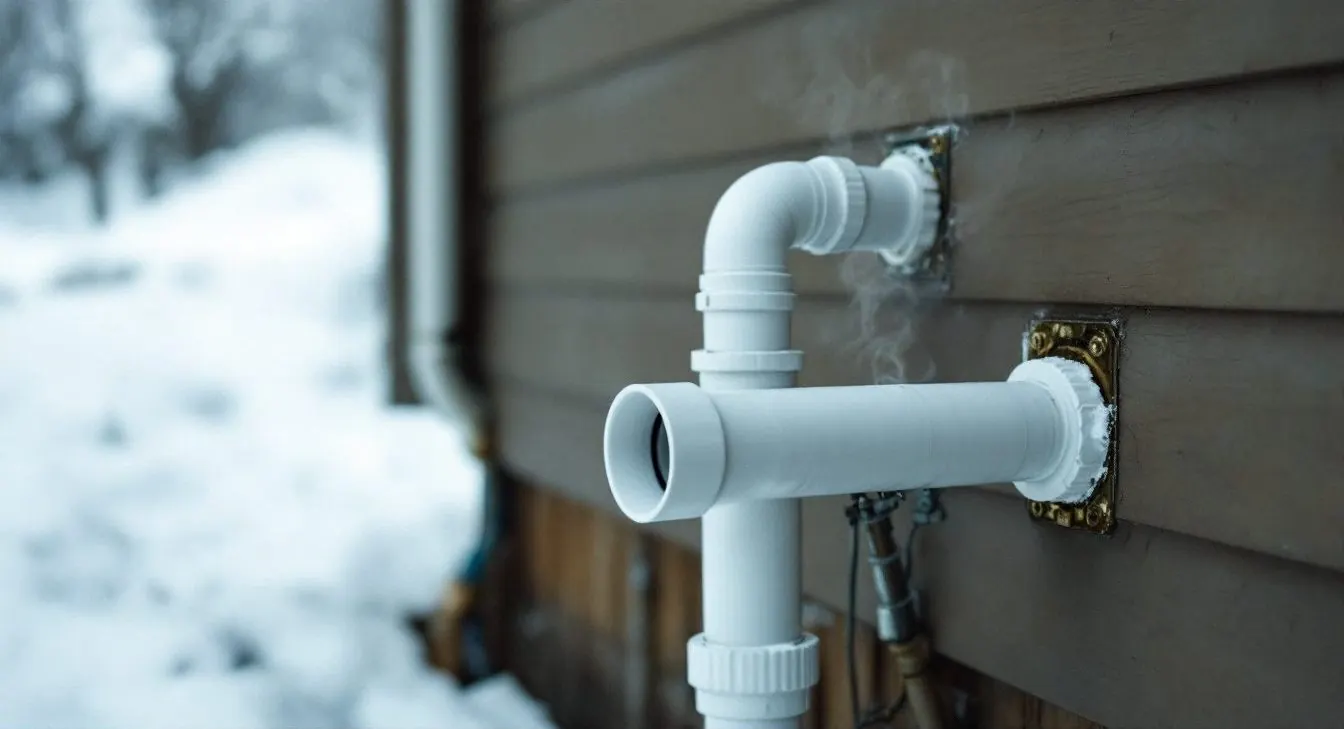
Furnace intake vs exhaust pipe: on a 90%+ furnace the exhaust pipe leaves the inducer fan and blows out a warm, wet plume while the burner runs; the intake pipe feeds the sealed burner box and pulls outdoor air in. Outside, the intake is usually the lower pipe with its elbow turned down.
Goodman’s GCVC96 manual calls the exhaust the “vent” or “flue” pipe and the other the “intake” or “combustion air” pipe (Goodman GCVC96 instructions). Both are usually white PVC, and Lennox’s ML196UHE manual says “Exhaust pipe and intake pipe must be the same diameter,” so size is no clue.
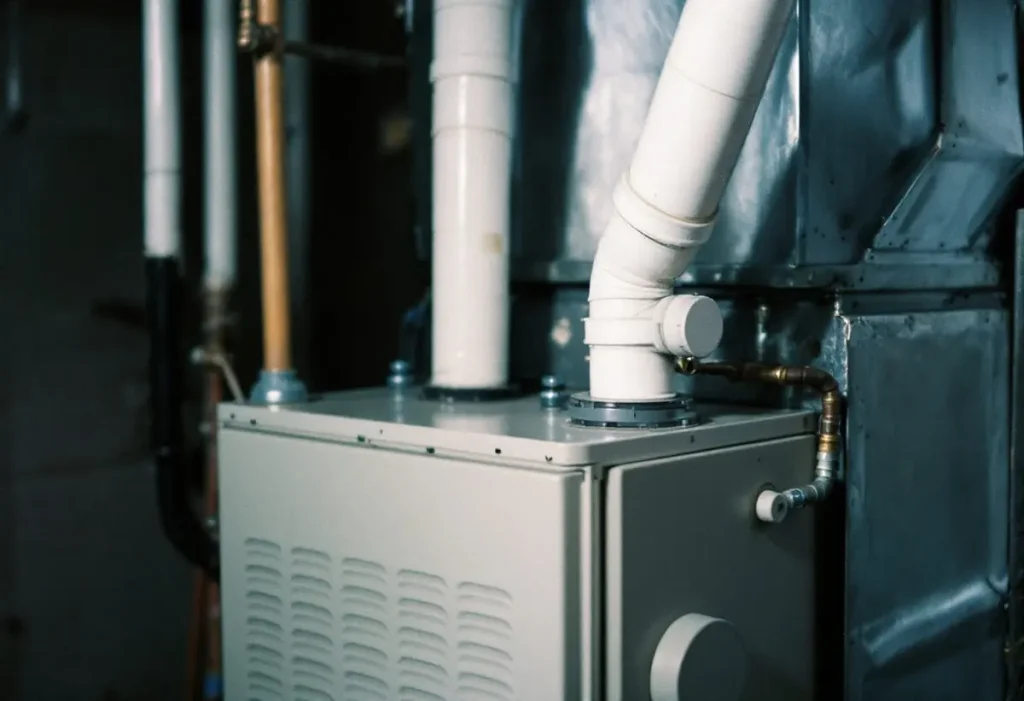
Which PVC pipe is the exhaust? Six clues, from the furnace cabinet to the wall
Follow each pipe back to the furnace: the exhaust plugs into the inducer fan housing and the intake into the burner box or a combustion air coupling on the cabinet. That check settles it on Goodman, Lennox and Carrier condensing furnaces.
| Clue | Intake (combustion air) | Exhaust (vent or flue) |
|---|---|---|
| Connection at the furnace | Combustion air intake housing or coupling feeding the burner box | Inducer housing outlet; Goodman’s alternate vent hole is “directly in line with the induced draft blower outlet” |
| How it is fastened | Carrier: not cemented permanently, because it comes off for igniter or flame sensor service | Carrier: rubber coupling on the inducer, clamps at 15 in. lb.; Goodman: glued into the furnace fitting |
| Burner running | Air moves in; pipe stays near outdoor temperature | Warm and wet; Category IV exhaust leaves “under 140°F” (PNNL) |
| Drain fittings | Optional RF000142 coupling or tee only “if condensation is a concern” (Goodman) | Drain tee on the vent pipe (Goodman Figure 13); condensate is pH ≤3 (PNNL) |
| Shape outside | Turned down: Goodman Figure 14 “intake facing down”; Lennox roof intakes end “straight down using two 90° elbows” | Lennox: “must terminate straight out or up,” sometimes with a 1-1/2 in. accelerator |
| Height outside | The lower opening (Carrier Fig. 36, Goodman Figure 17) | The upper opening; Carrier shows 12 in. between the bottoms |
Compiled by The HVAC Brief from Goodman GCVC96, Lennox 507966-04 (ML196UHE) and Carrier 58MVC installation instructions and the DOE/PNNL furnace guide.
The touch test works only while the burner is lit: the inducer motor can move air through both pipes with no heat in either, and only burning gas warms the exhaust. On a cold morning the plume is the easy tell: our page on white smoke from furnace exhaust explains why that cloud is water vapor and only the exhaust makes it.
Why does the intake sit lower and point down on the outside wall?
So the furnace does not breathe its own exhaust. Lennox puts it plainly in the ML196UHE manual: “Care must be taken to avoid recirculation of exhaust back into intake pipe,” and it may require a reducer on the exhaust “to improve the velocity of exhaust away from the intake piping” (Lennox 507966-04).
The exact spacing is where makers part ways, and fuel gas codes send you back to them: Section 503.2.3 of the IFGC-based 2021 Seattle Fuel Gas Code says listed direct-vent appliances “shall be installed in accordance with the manufacturer’s instructions” (Seattle Fuel Gas Code Chapter 5). Pipe material, slope and clearances to windows and doors are in our furnace vent pipe rules; this table covers how the two pipes relate.
| Rule | Goodman GCVC96 | Lennox ML196UHE | Carrier 58MVC |
|---|---|---|---|
| Single-pipe option | Yes: “non-direct vent (single pipe) or direct vent (dual pipe)” | Yes: non-direct takes air “from indoors or ventilated attic or crawlspace” | Yes: “(2-pipe) direct vent or (1-pipe) non-direct vent” |
| Same pressure zone | Required: “must be in the same atmospheric pressure zone” | “not required”; intake may exit one side of the house and exhaust another | Pipes must end “exactly as shown” in Fig. 36, all on one wall or roof face |
| Sidewall spacing | Fig. 17: 3 to 24 in. apart, intake at least 12 in. below vent | 6 in. maximum apart; pipe ends at least 8 in. apart, or 6 in. with a termination elbow | 12 in. between bottom of intake and bottom of vent |
| Roof layout | Fig. 14: 12 in. minimum height difference, 3 to 96 in. apart | 3 in. maximum apart; intake turned straight down | 12 in. above highest anticipated snow, 24 in. maximum above roof |
| Screen on the intake | None named in the venting sections we read | Supplied 2 in. debris screen is for indoor air only; “must not be used in direct vent applications” | Attic and crawlspace intake elbows get mesh no smaller than 3/8 in. |
Compiled by The HVAC Brief from the three installation manuals linked in Sources, read November 2026. Figure numbers are each maker’s own.
Goodman and Lennox disagree outright on pressure zones, so a split layout that is correct for a Lennox ML196UHE would be wrong for a Goodman GCVC96. And inspector blogs that call any 1/2 in. mesh intake screen fine conflict with Lennox’s ban on its own screen outdoors. On a roof, Lennox allows only 3 in. between the pipes; in attic or closet installs it says “vertical termination through the roof is preferred.”
Does a furnace need an intake pipe, or can it use one pipe?
Not always: all three condensing furnaces above are certified to run with only the exhaust pipe, taking combustion air from the room. In that “non-direct” or single-pipe setup, Goodman still wants “a minimum of one 90° elbow” on the combustion air intake coupling “to guard against inadvertent blockage,” so a short stub elbow on top of the cabinet is the intake.
A single-pipe furnace borrows house air, so Lennox points non-direct installs to the National Fuel Gas Code rules our combustion air page works through. Carrier’s 58MVC can instead end the intake in a vented attic or crawlspace, at least 12 in. above attic insulation, or 3 in. below crawlspace joist insulation, with a screen. PNNL’s Building America guide says Category IV furnaces “should be installed as sealed-combustion/direct vent appliances.” (DOE Building America Solution Center).
Can the intake and exhaust share one pipe through the wall?
Yes, through a listed concentric kit: one penetration, pipe inside a pipe. PNNL describes the intake as “the outer circle of a concentric pipe-within-a-pipe where the inner pipe is the exhaust vent.” Kits are model-specific: Goodman names its DCVK, and says its sidewall kits are “NOT intended for use with single pipe (indirect vent) installations”; Lennox lists 71M80, 69M29 or 60L46 for the ML196UHE in the US. Carrier adds that each furnace “must have its own set of combustion-air and vent pipes,” so two furnaces never share one kit.
What happens if the furnace intake and exhaust pipes are swapped?
The furnace may still light, so it gets missed. Crossed at the wall, the exhaust leaves through the low, turned-down fitting and the intake, now the higher straight pipe, sits in the rising plume: the recirculation Lennox warns about. Likely signs: frost at the low fitting and condensate staining the siding below it. A technician confirms it with what Lennox’s maintenance list calls “a complete combustion analysis”: flue gas oxygen and carbon monoxide compared with the service literature.
To check without tools, run the furnace and watch which termination plumes; it should be the upper, straight pipe in the Carrier Fig. 36 layout, tracing back to the inducer. If the plume comes from the turned-down elbow, shut the furnace off and have the pipes re-terminated.
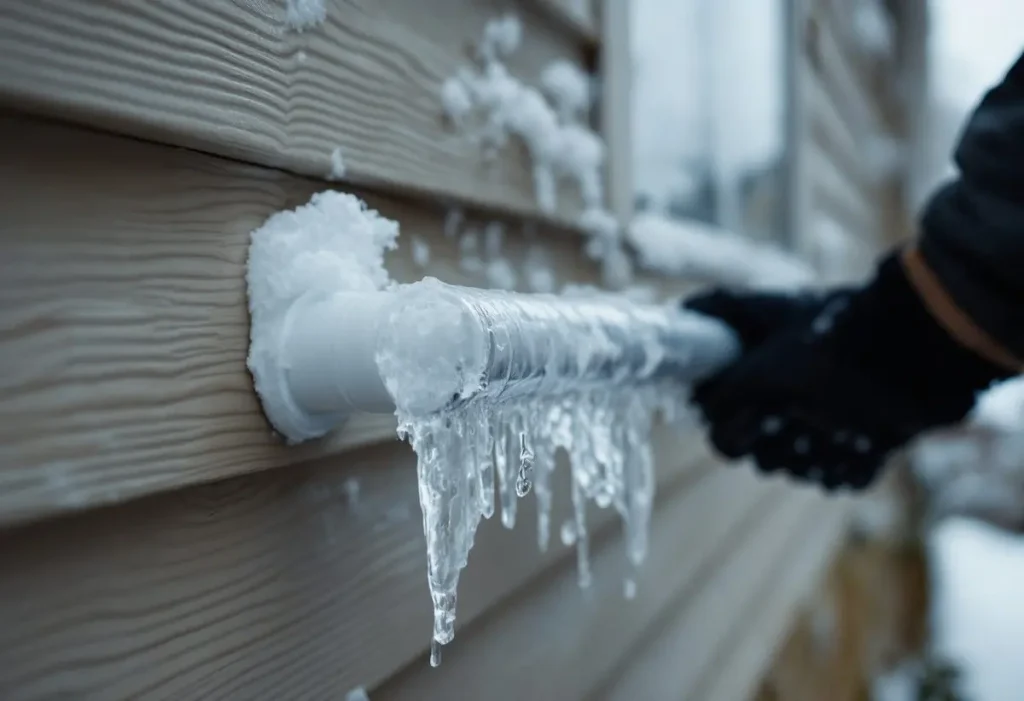
What happens when the intake or exhaust pipe is blocked?
The furnace shuts itself off before the burner lights. Lennox’s troubleshooting chart says “Obstructed exhaust pipe will cause unit to shut off at pressure switch,” and that an “Obstructed pipe or termination may cause rollout switches to open.” A plugged intake trips the same furnace pressure switch, because the inducer pulls combustion air through the intake on a sealed furnace; Lennox’s first check is “exhaust and air intake connections for tightness and to make sure there is no blockage.”
In November and December the usual plug is snow or ice at the termination, covered step by step in furnace vent blocked by snow. Water in a sagging exhaust run shows up first as furnace exhaust pipe gurgling. A blocked exhaust is also a carbon monoxide question: Goodman’s GCVC96 warns that vent leaks can cause “exposure to flue gases, including carbon monoxide.” A cracked joint, a disconnected pipe or a CO alarm is a stop line: turn the furnace off and have a technician check the vent and measure CO.
How hot does a furnace exhaust pipe get, and should the intake ever feel warm?
Under 140°F on a condensing furnace, per the DOE/PNNL guide, which is why PVC is allowed: warm to the hand, not hot. The intake should feel like outdoor air; a warm intake is a recirculation sign. Mind the condensate too: Lennox recommends keeping the exhaust outlet 6 feet from an outdoor AC unit because the condensate “can damage the painted coating.”
Frequently asked questions
Should a furnace intake be outside?
On a direct-vent (two-pipe) install, yes: combustion air comes from outdoors through its own pipe. Goodman, Lennox and Carrier also certify single-pipe use, drawing air from the room, a ventilated attic or crawlspace, but PNNL’s Building America guide says Category IV furnaces should be sealed-combustion direct vent.
Is the HVAC intake the same as the return?
No. The furnace intake is a small PVC pipe (2 in. connections on the Goodman GCVC96) that feeds combustion air to the burner and never touches house air on a direct-vent unit. The return is the large grille and duct that pull room air back to the blower to be heated, explained in our supply and return vents guide.
How do you clean furnace intake and exhaust pipes?
From outside, clear leaves, nests, snow and ice from both pipe ends by hand with the thermostat off. Goodman’s annual inspection item is “Flue pipe system. Check for blockage and/or leakage,” including the outside termination and the joints at the furnace. Inside runs are cleaned by a technician, who also checks slope and the condensate drain tee.
What is a furnace exhaust pipe called?
Goodman’s GCVC96 manual calls it the “vent” pipe or “flue” pipe, and calls the other one the “intake” or “combustion air” pipe. Carrier uses “vent pipe” and “combustion-air pipe,” and Lennox says “exhaust” and “intake.” On an 80% furnace the metal pipe to the chimney is usually called the vent connector or flue pipe.
How we researched this
On 21 November 2026 we read the venting, termination and troubleshooting sections of the Goodman GCVC96, Lennox ML196UHE (507966-04, April 2024) and Carrier 58MVC manuals, rendering their termination figures to read dimensions, plus 2021 Seattle Fuel Gas Code Chapter 5 and the DOE/PNNL furnace guide. Blogs were read for SERP analysis only. Paywalled NFPA 54 text was not read. Where makers disagree, the table shows each rule rather than averaging.
Sources
- Goodman Manufacturing. “GCVC96 / GMVC96 Installation Instructions.” https://cdn.shopify.com/s/files/1/0748/4745/3475/files/GCVC96-Install_11e55e78-9b7a-49aa-bc24-d8f803e9a9af.pdf. Accessed November 2026.
- Lennox Industries. “ML196UHE Installation Instructions, 507966-04.” https://www.lennox.com/dA/2a12f2b40e/507966-04g.pdf. Accessed November 2026.
- Carrier Corporation. “Infinity 58MVC Series 100 Direct Vent Condensing Gas Furnace Installation Instructions.” https://www.shareddocs.com/hvac/docs/1009/Public/03/58MVC-4SI.pdf. Accessed November 2026.
- U.S. Department of Energy, Building America Solution Center (PNNL). “Combustion Furnaces.” https://basc.pnnl.gov/resource-guides/combustion-furnaces. Accessed November 2026.
- City of Seattle. “2021 Seattle Fuel Gas Code, Chapter 5: Chimneys and Vents.” https://www.seattle.gov/documents/Departments/SDCI/Codes/FuelGasCode/2021SFGCChapter5.pdf. Accessed November 2026.
Leave a Reply