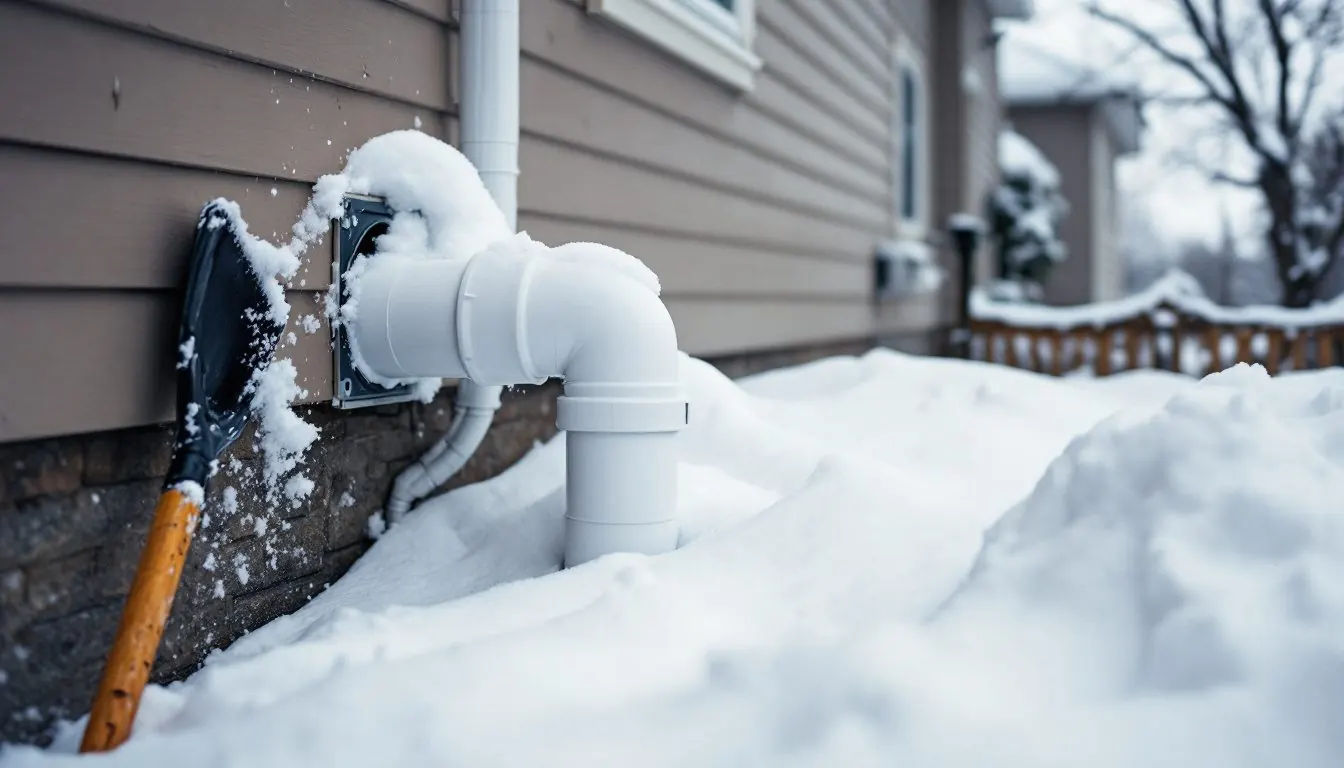
A furnace vent blocked by snow makes a high-efficiency furnace refuse to light: the inducer cannot pull a draft through the plugged PVC pipe, the pressure switch stays open and the board flashes a fault. Turn the thermostat off, clear both pipe ends by hand, then restart. If a CO alarm sounds, get out first.
What does a furnace do when snow blocks its exhaust or intake pipe?
It refuses to light. Goodman’s GM9S service manual describes the pressure switch as “a safety device to prevent the combustion cycle from occurring with inadequate venting caused by a restricted or blocked vent pipe” (Goodman RS6612022R1). The draft inducer starts, the snow plug stops it from pulling enough suction, the switch never closes, and the gas valve is never opened. That switch is what people searching for a “furnace blocked vent switch” are looking for; our furnace pressure switch guide covers its setpoints and how a technician tests it.
What you see depends on the board. The table pairs Lennox and Goodman wording with the symptom at the furnace, so you can match the light in the sight glass before you go outside.
| Furnace and document | What the control shows | Maker’s wording | What it means for a snow-blocked vent |
|---|---|---|---|
| Lennox ML196UHE (507966-04) | 9 flashes | “Pressure Switch failed to close or opened during heat demand, inducer on” | The classic snow lockout: inducer running, no flame |
| Lennox ML196UHE (507966-04) | 10 flashes | “Watchguard: Pressure switch opened 5 times during a single heating demand” (punctuation ours) | Partly blocked vent, or snow drifting back in |
| Goodman and Amana GM9S, AM9S (RS6612022R1) | E2 | “Pressure switch circuit open when it should be closed” | Same fault on a Goodman display board |
| Goodman GM9S troubleshooting chart | Inducer runs, burners never light | “Induced draft blower runs continuously with no furnace operation” | First listed cause: “Blocked flue and/or inlet air pipe” |
Compiled by The HVAC Brief from Lennox 507966-04 and Goodman RS6612022R1. Other brands number the same fault differently; check the Lennox flash code table or your brand’s page.
How do you clear snow and ice from furnace vent pipes without breaking them?
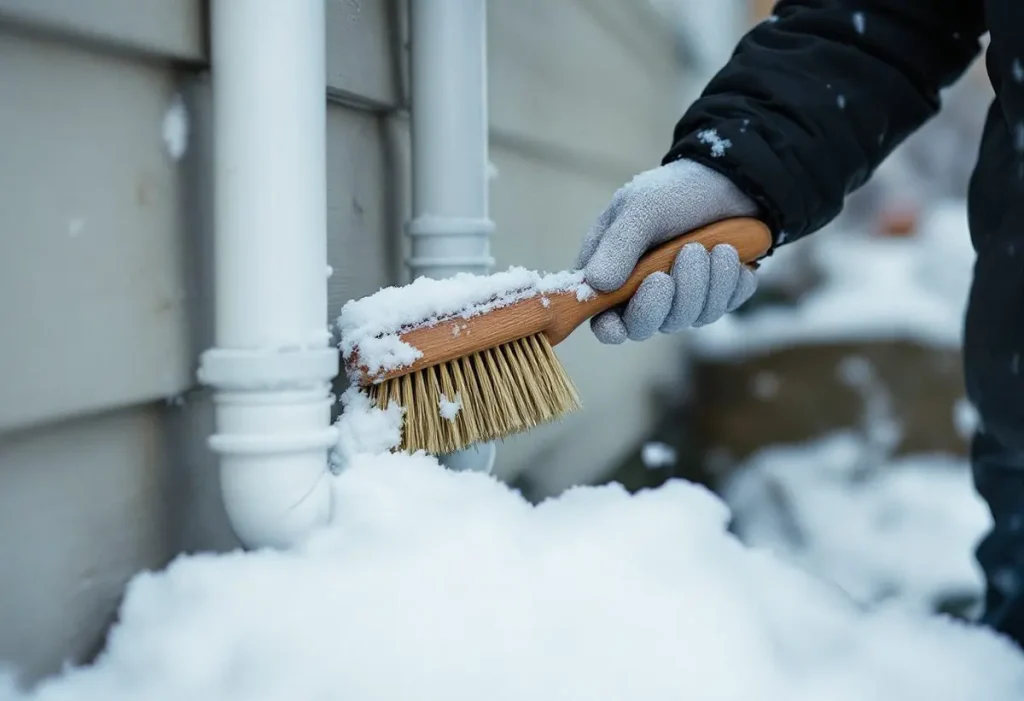
By hand, with the furnace not calling for heat. Consumers Energy tells high-efficiency furnace owners to keep the “two white plastic pipes coming out of the side of the home” free of drifting snow, after which the furnace “can then be re-cycled and should operate properly” (Consumers Energy, January 2016).
- Set the thermostat to OFF so the inducer is not pulling snow into the intake.
- Find both pipes. On a two-pipe (direct vent) Lennox, combustion air “is taken from outdoors,” so both ends matter (Lennox 507966-04).
- Scoop snow from each opening with a gloved hand or soft brush, and clear a pocket below the pipes. Consumers Energy’s rule for gas meters, snow removed “only by hand,” suits thin-wall PVC too.
- Shine a flashlight into each pipe. Frost on the exhaust lip is common; ice packed deeper than you can reach is a technician job.
- Set the thermostat to HEAT and watch one start: inducer, igniter, flame, blower.
Will the furnace turn back on by itself after the vent is cleared?
Often yes, but not always at once. A board that hit its retry limit waits: on the Lennox SL280DFNV, Watchguard “automatically resets the control to relight the furnace” after one hour of continuous demand (Lennox 508150-02).
To skip the wait, cycle power or the thermostat as in our guide on how to reset a furnace. If the code returns twice with the pipes clear, stop. Goodman’s chart sends the technician to the pressure switch hose, the flue piping (“blockage, proper length, elbows, and termination”) and a “blocked drain system.” A frozen drain throws the same fault; our frozen condensate line guide shows where that ice forms.
Can snow over the vent let carbon monoxide into the house?
It can, which is why the furnace is built to quit. National Fuel says snow-clogged exhaust vents can shut the furnace off, and “Blocked vents also can lead to a buildup of carbon monoxide gas inside a residence” (National Fuel, November 2022).
The furnace is rarely the only appliance at risk. The U.S. Fire Administration says vents “for the dryer, furnace, stove and fireplace” must be clear of snow, and generators kept away from doors, windows and vents (USFA).
A half-buried exhaust can also turn the plume back into the intake. Carrier’s 58MVC instructions keep terminations clear of “recirculation of flue gases, airborne leaves, or light snow” (Carrier 58MVC). Goodman sets vent terminations at least 3 feet above any forced air inlet within 10 feet (Goodman GCVC96).
The stop line is a CO alarm or symptoms: National Fuel says open windows and doors, move outside and call 911. Do not restart the furnace first; our carbon monoxide detector beeping guide decodes the beeps by brand, and the guide to furnace exhaust smell in the house covers a smell without an alarm.
How high above the snow should a furnace vent terminate?
Twelve inches above the snow in the Lennox, Goodman and Carrier manuals, a higher bar than the code’s 12 inches above grade. Row A of Table 503.8 in the 2021 Seattle Fuel Gas Code, an IFGC adoption, sets “12 inches” above finished grade and says nothing about snow (Seattle Fuel Gas Code Chapter 5). Section 503.8 even exempts a direct-vent intake from the table, while Goodman applies its snow rule to “All terminations (flue and/or intake).”
- Lennox ML196UHE: 12 inches above grade or 12 inches “above average snow accumulation.”
- Goodman GCVC96: “at least 12 inches above ground level or the anticipated snow level”
- Carrier 58MVC: “12 in. (305mm) minimum clearance above highest anticipated snow level or grade whichever is greater.”
Carrier’s wording is strictest: highest expected snow, not average. Snow depth adds to the 12 inches, so a pipe at the code minimum is buried by the first foot of drift.
| Expected snow or drift depth at the wall | Minimum height of opening above grade (maker rule) | Code Table 503.8 row A | How far a code-minimum pipe sits below the maker line |
|---|---|---|---|
| 0 in | 12 in | 12 in | 0 in |
| 6 in | 18 in | 12 in | 6 in |
| 12 in | 24 in | 12 in | 12 in |
| 18 in | 30 in | 12 in | 18 in |
| 24 in | 36 in | 12 in | 24 in |
| 36 in | 48 in | 12 in | 36 in |
HVAC Brief calculation: maker minimum = snow depth + 12 in (Carrier 58MVC, Goodman GCVC96); code column from Seattle Table 503.8 row A. Your inspector and model manual decide; window, door and regulator clearances are in our furnace vent pipe rules.
Why does the exhaust pipe ice over when there has been no snowstorm?
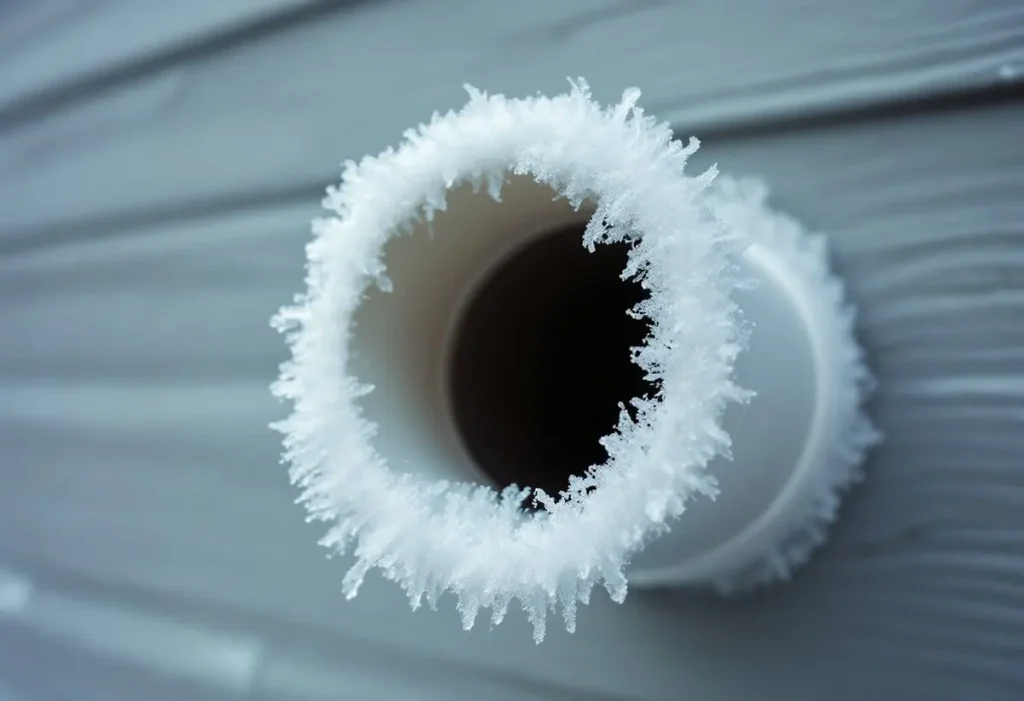
Because condensing exhaust is wet, and below freezing that water freezes at the tip and in cold runs. Goodman requires vent pipe exposed “below 35°F for extended periods” to get 1/2 inch closed cell foam; Carrier’s 58MVC calls for Armaflex-type insulation through unheated space. The plume itself is mostly water vapor; our explainer on white smoke from furnace exhaust shows when it is normal.
Intake ice usually means the plume is being drawn back in; Carrier says moisture in the intake “may be a result of improper termination.” Chipping ice from inside a pipe can crack a joint, which is why packed ice goes to a technician. Knowing which pipe is which helps here, and the furnace intake and exhaust pipe guide notes that the intake is usually the lower pipe with its elbow turned down, while only the exhaust makes the warm, wet plume.
Can you cover or raise a furnace vent to keep snow out?
Raise it with maker-listed parts; never improvise a cover. Carrier says on direct vent systems “A factory accessory termination kit MUST be used,” and Lennox wants the termination “free from any obstructions.” A bucket or cap not in the manual is an obstruction that can trip the same switch the snow did.
The permanent fix is re-terminating higher on the wall or through the roof, which Carrier calls “preferred since it is less susceptible to damage or contamination.” The contractor must recheck the maker’s maximum vent length and opening clearances, and many jurisdictions require a mechanical permit.
Frequently asked questions
Will the furnace shut off if the vent is blocked?
A modern induced-draft furnace should not light at all. Goodman’s GM9S manual calls the pressure switch a safety device that prevents combustion “with inadequate venting caused by a restricted or blocked vent pipe.” Lennox ML196UHE boards flash 9 times when the switch fails to close or opens during a heat call.
What vents should not be covered by snow?
The U.S. Fire Administration lists the dryer, furnace, stove and fireplace vents; sidewall water heater and boiler vents that exhaust through the same wall belong on that list too. On manufactured homes, Consumers Energy says the chimneys, intakes and exhaust pipes are often on the roof.
What happens if the furnace vent is blocked by ice?
The result is the same lockout as snow, but ice inside the pipe will not brush out. Goodman requires 1/2 inch closed cell foam on vent pipe exposed below 35°F for extended periods to limit this freezing. Clear ice at the opening only; leave ice deeper in the pipe to a technician.
Is an HVAC vent block off plate the same thing as a blocked furnace vent?
No. A block off plate covers an indoor supply register or duct opening and never touches the flue; our guide on closing an air vent covers what it does to airflow. A blocked furnace vent is outside: Goodman lists a “Blocked flue and/or inlet air pipe” first when the inducer runs with no furnace operation.
How we researched this
On November 17, 2026 we read the venting and troubleshooting sections of Lennox 507966-04 (ML196UHE) and 508150-02 (SL280DFNV), Goodman GCVC96 and RS6612022R1 (GM9S), Carrier 58MVC, and Chapter 5 of the 2021 Seattle Fuel Gas Code, plus National Fuel, Consumers Energy and U.S. Fire Administration advisories. We excluded contractor blogs, forums and videos, which cited no maker document, and did not cite NFPA 54 because we did not read its text.
Sources
- Goodman Manufacturing. “GM9S Service and Troubleshooting, RS6612022R1.” https://mobile.goodmanmfg.com/mobileapp/stellent/pdf/infoPdf/Lit/RS6612022R1.pdf. Accessed November 2026.
- Goodman Manufacturing. “GCVC96 Installation Instructions.” https://cdn.shopify.com/s/files/1/0748/4745/3475/files/GCVC96-Install_11e55e78-9b7a-49aa-bc24-d8f803e9a9af.pdf. Accessed November 2026.
- Lennox Industries. “ML196UHE Installation Instructions, 507966-04.” https://www.lennox.com/dA/2a12f2b40e/507966-04g.pdf. Accessed November 2026.
- Lennox Industries. “SL280DFNV Installation Instructions, 508150-02.” https://www.lennox.com/dA/78477aadd3/508150-02a.pdf. Accessed November 2026.
- Carrier. “Infinity ICS 58MVC Series 100 Installation Instructions.” https://www.shareddocs.com/hvac/docs/1009/Public/03/58MVC-4SI.pdf. Accessed November 2026.
- Seattle Department of Construction and Inspections. “2021 Seattle Fuel Gas Code, Chapter 5: Chimneys and Vents.” https://www.seattle.gov/documents/Departments/SDCI/Codes/FuelGasCode/2021SFGCChapter5.pdf. Accessed November 2026.
- National Fuel Gas Distribution. “Stay Safe This Winter Season.” https://www.nationalfuel.com/news/stay-safe-this-winter-season/. Accessed November 2026.
- Consumers Energy via PR Newswire. “Winter Weather Brings Safety Reminder from Consumers Energy: Keep Meters, Furnace Intakes Free of Snow and Ice.” https://prnewswire.com/news-releases/winter-weather-brings-safety-reminder-from-consumers-energy-keep-meters-furnace-intakes-free-of-snow-and-ice-300201390.html. Accessed November 2026.
- U.S. Fire Administration. “Carbon monoxide.” https://www.usfa.fema.gov/prevention/life-safety-hazards/carbon-monoxide/. Accessed November 2026.
Leave a Reply