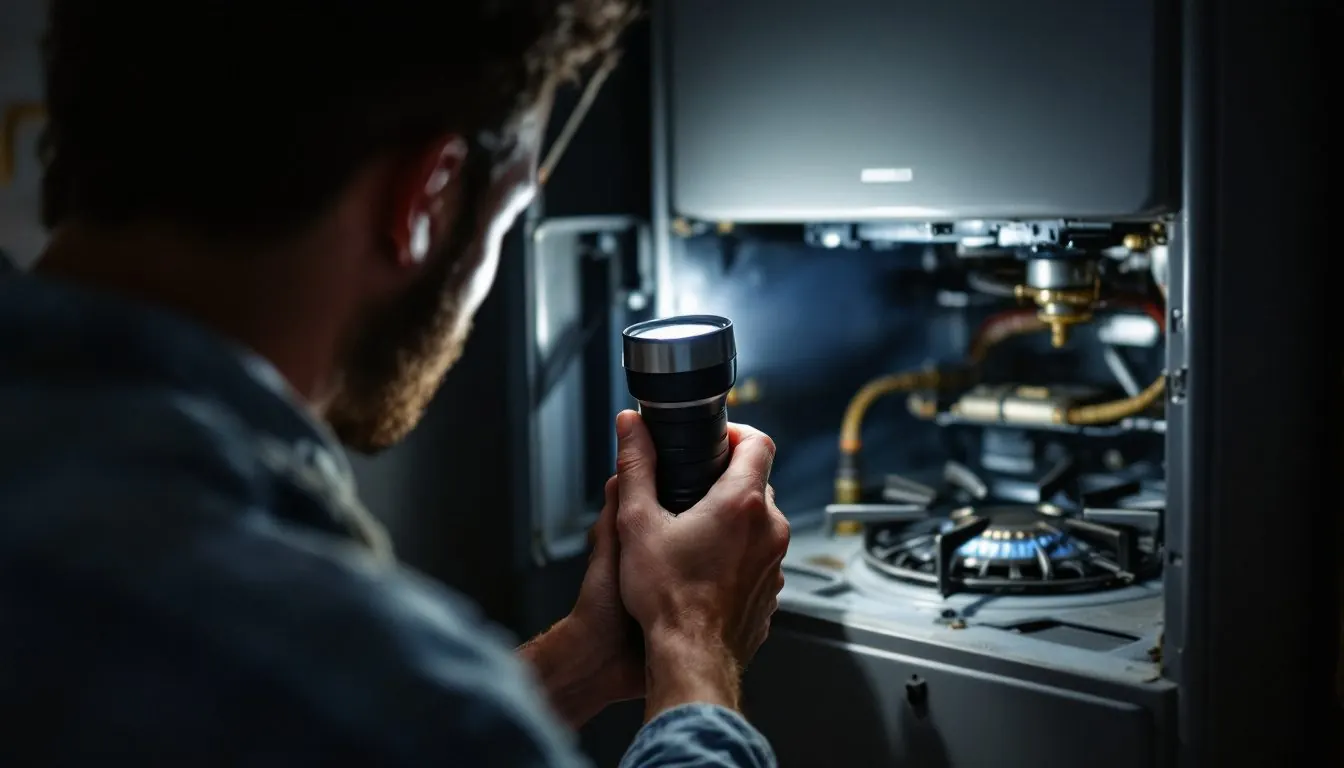
A furnace clicking but not turning on is a control board that starts the heat call and then stops at a failed safety check. Count the clicks: one click and silence is power or the inducer; a hum with no flame is the pressure switch; ticking or a glow without flame is ignition or gas; a flame that dies in seconds is the flame sensor.
Almost every click you hear is a relay or a switch doing its job. The White-Rodgers 50M56D-751 board for Carrier single-stage furnaces lists relays for the gas valve (1.5 A), the igniter (1.2 A) and the inducer (2.8 A) in its instruction sheet,, each closing with an audible snap. The useful question is which step clicked last. Set the thermostat 3°F above room temperature, watch the burner window and time what you hear.
| What you hear and see | Step where the sequence stopped | What the control does next | First suspect |
|---|---|---|---|
| Thermostat clicks; furnace silent; status light off | No 120 V or 24 V at the board | Nothing; there is no sequence to run | Service switch, breaker, blower door switch, board fuse |
| One click at the furnace, no hum | Inducer relay closed, inducer did not start | Waits for a pressure switch that cannot close | Inducer motor or its wiring |
| Click, inducer hums, no glow or spark, then stops | Pressure switch never closed | S9200U1000: drops the inducer after 150 seconds, idles 5 minutes, repeats | Blocked vent or intake, hose, switch, condensate |
| Rapid ticking at the burner, no flame | Spark trial on a spark-ignition appliance | S8610U: sparks for 15 or 90 seconds, then waits 5 minutes | Gas off, pilot orifice, spark gap, module |
| Orange glow, a click, no flame | Gas valve opened, no gas or no light-off | Retries; lockout after 3 tries on all three HSI boards | Gas supply, gas valve, weak igniter |
| Flame lights, then a click and it goes out in seconds | Flame not proved | Retries; lockout after 3 tries | Dirty flame rod, poor ground |
One click at the furnace and then silence: what stopped before the inducer?
One click and no motor means the board took the call and the next device never started, or the board has no power. Check the status light first. Resideo says the S9200U1000 accepts a heat request only after approximately 20 seconds from power-up, so a just-powered furnace may pause by design (Resideo 69-2075EF).
If the light is dark, power is not reaching the board. Goodman’s service manual for the GM9S92 and GM9S96 notes that the blower door interlock switch “interrupts unit voltage when the blower door is opened,” and that about 13 volts between R and C, with 24 volts at the transformer, means a blown board fuse (Goodman RS6612022R1). A thermostat that clicks while the furnace stays silent is the case covered step by step in thermostat says heat on but no heat; a fuse that blows again after replacement means a short in the 24 V wiring that a technician has to find.
Light on, relay click, no inducer hum: the board sent 120 V to a motor that did not run. Goodman’s test is 120 volts between the inducer pin and neutral at the board during the heat call: voltage present with a still motor points at the inducer motor; no voltage points at the board.
Click, inducer hum, then nothing for minutes: is the pressure switch the problem?
Yes, in most cases. The board will not light anything until the pressure switch confirms inducer draft with a small click of its own. Goodman’s sequence has the control check the switch is open at the start, energize the inducer, and begin prepurge “once the pressure switch is detected closed.”
The Resideo S9200U1000 gives the pressure switch 150 seconds after the inducer starts. If it has not closed, the board shuts the inducer off, flashes the pressure switch code, idles for five minutes and tries again, and that loop “continues indefinitely” until the switch closes or the heat call ends. We calculated the cycle at 7.5 minutes: 150 seconds of hum, then 5 minutes of silence.
In November, look outside first: snow or frost in the PVC intake or exhaust of a 90%+ furnace keeps the switch open. If the switch is instead already closed when the call starts, the S9200U1000 waits five seconds and flashes a stuck-closed code. Hoses, condensate traps and switch testing belong to our furnace pressure switch guide.
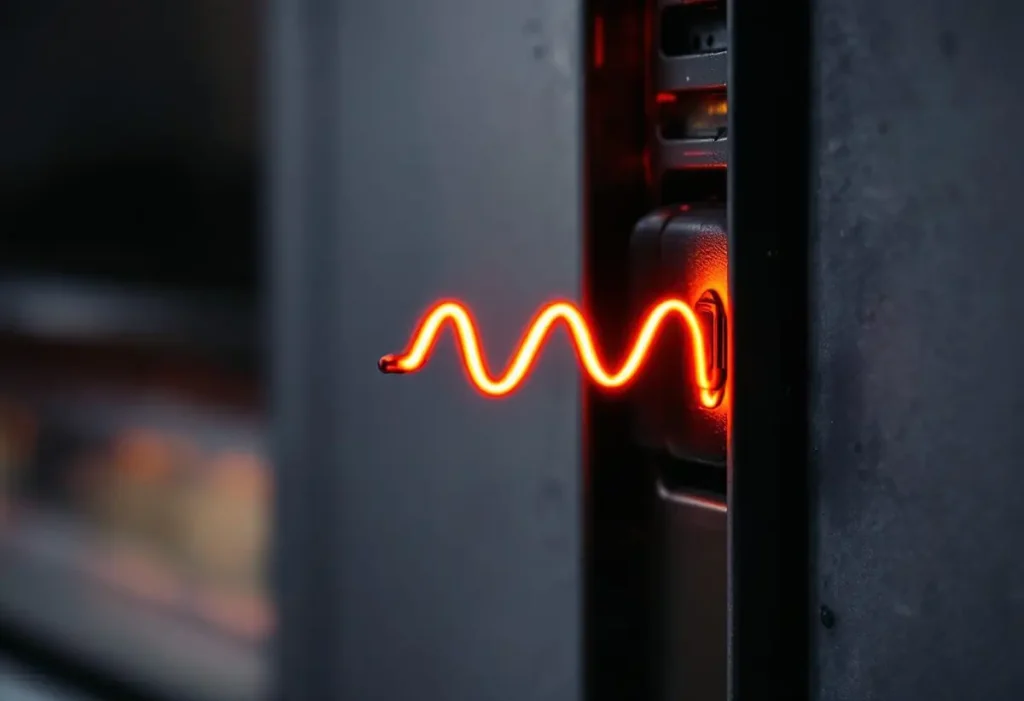
Furnace clicking but not igniting: what does an orange glow with no flame mean?
The sequence got past draft and the igniter works, so the failure is the gas valve or gas supply. All three furnace boards we read drive a hot surface igniter, which glows silently. On the S9200U1000 the igniter warms for 17 seconds on the first try (27 seconds on later tries), then the gas valve relay clicks and the board allows a trial for ignition of 4, 6 or 8 seconds, set by DIP switch. Goodman prints a 4 second trial for its single-stage boards.
Glow, click, no flame: check that the furnace gas valve is at ON, the gas line shutoff is open, and a gas stove still lights (ruling out an empty propane tank or utility shutoff).
A valve that receives 24 V and does not open is the case in our furnace gas valve article. A glow that looks dim or patchy is an igniter problem, tested with an ohmmeter in our furnace igniter guide. The full ignition chain, beyond the clicks, is laid out in why a furnace will not ignite.
Stop line: if you smell gas, do not reset, do not flip switches; leave and call the gas utility from outside. Manifold pressure and gas valve outlet readings are a technician’s test with a manometer.
Rapid tick-tick-tick for up to 90 seconds: is that the spark igniter?
Only if your appliance uses spark ignition. Hot surface furnaces do not tick; continuous ticking comes from intermittent pilot or direct spark controls, which Resideo says are used on central heating equipment and on appliances such as pool heaters. On the Resideo S8610U intermittent pilot module, “spark and pilot gas” stay on until the pilot lights or the trial ends, and the trial is field set to 15 or 90 seconds (Resideo 69-1955).
If the pilot never lights, the S8610U shuts off spark and pilot gas, waits five minutes, and starts another trial, and this “continues until lightoff or ‘Call for Heat’ is removed.” A spark appliance with the gas off ticks, goes silent for 5 minutes, and ticks again. Spark that continues after the pilot lights points Resideo to the flame rod, ground wire and insulator, then the module.
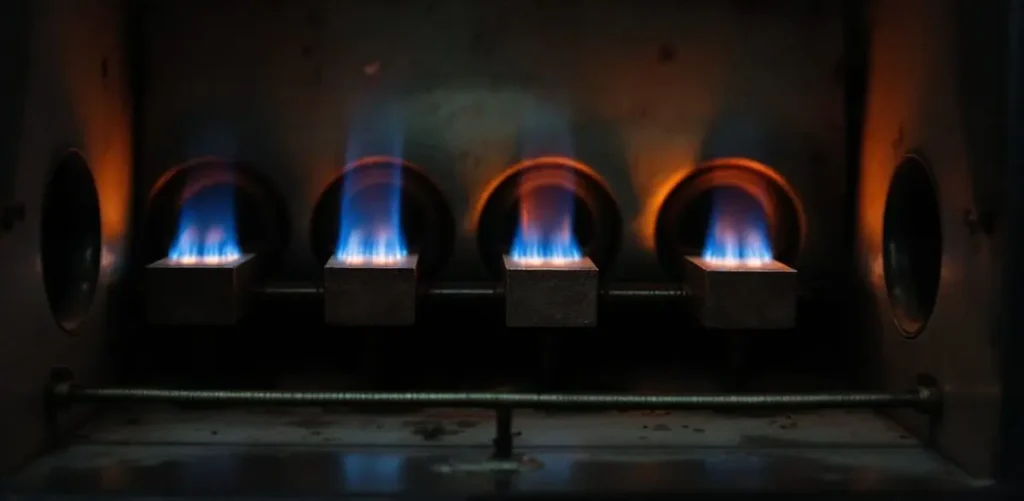
Flame lights, then a click and it goes out: why does the flame sensor shut it down?
The board must see flame current through the flame rod within seconds or it closes the gas valve. Resideo gives the S9200U1000 a 3 second flame recognition period and a 2 second maximum flame failure response time. White-Rodgers specifies a minimum of 0.25 μA DC for flame detection on the 50M56D-751, and rates readings of 1.0 to 5.0 μA as good and 0.5 to 1.0 μA as marginal.
A burner that lights for 3 to 8 seconds, clicks off and repeats usually has a coated flame rod. Goodman adds that reversed polarity, a missing earth ground or a high resistance neutral “may cause the control to lockout due to failure to sense flame.” Cleaning steps and the microamp test are on our furnace flame sensor page.
Why does it try three times and then go quiet for an hour?
That quiet hour is a lockout, not a dead furnace: all three hot surface controls we read allow 3 ignition tries, then wait.
| Control (what it runs) | Tries before lockout | Pause between tries | Lockout length | Manual reset in the document |
|---|---|---|---|---|
| Resideo S9200U1000 (universal hot surface board) | 3 trials; 4 cycles if flame is lost after 10 s | 60 seconds | 60 minutes | Not printed for ignition lockout |
| White-Rodgers 50M56D-751 (Carrier single-stage replacement) | 3 retries (code 14); 10 recycles (code 15) | Not printed | 1 hour | Remove 24 VAC for more than 10 seconds |
| Goodman GM9S92, GM9S96 (RS6612022R1) | 3 total | Not printed | Not printed | Not printed |
| Resideo S8610U (spark, intermittent pilot) | No lockout; retries without limit | 5 minutes | None | Cycle thermostat or power to skip the wait |
HVAC Brief calculation for the S9200U1000 with the shortest settings: first try 30 s prepurge + 17 s warm-up + 4 s trial = 51 s; second and third tries 60 s purge + 27 s warm-up + 4 s trial = 91 s each; plus a final 60 s purge. That is 293 seconds of clicks and inducer noise, then 60 minutes of silence before the board tries again. The safe way to clear a lockout once, and when not to, is in how to reset a furnace; on a Goodman with a two-digit display the matching code is in our Goodman furnace error codes.
Electric furnace or heater clicking but not turning on: which relay is it?
An electric furnace has no inducer or flame; its clicks are sequencers staging the heating elements. Resideo’s R8330D replacement sequencer, which switches a fan and up to 3 elements, waits 10 seconds minimum between stages and brings all stages on within 2 minutes (Resideo 60-0327). Staged clicks with cold air point to an open element, an open limit or a tripped 240 V breaker; staging and circuits are covered in our electric furnace explainer. Element and limit tests are line voltage work for a technician.
Frequently asked questions
How do you force a furnace to turn on?
You cannot safely force ignition, but you can end a lockout early. White-Rodgers says removing 24 VAC from its 50M56D-751 for more than 10 seconds resets the control, and it resets itself after 1 hour. If the same fault returns on the next call, resetting again only repeats the failure.
Why is my HVAC clicking but won’t start?
A safety check in the start sequence failed. On the Resideo S9200U1000, the inducer starts first and the pressure switch must close within 150 seconds; then the igniter warms and the gas valve opens. The last sound you hear marks the failed step: hum only means draft, glow or ticking without flame means gas or ignition.
Goodman furnace clicking but not turning on: what should I check?
Read the LED or display before cutting power. Goodman’s RS6612022R1 chart for GM9S92 and GM9S96 furnaces lists lockout after 3 ignition retries, pressure switch faults and an open fuse as separate codes. Its trial for ignition is 4 seconds, so a brief flame then a click points to flame sensing.
How do I know if my furnace died?
A furnace that clicks, glows or hums is not dead; its board is working and holding a lockout. White-Rodgers stores up to 5 fault codes for 14 days on the 50M56D-751, so a technician can read the history. A dark status light with 120 V present and a closed door switch is the case where the board itself is suspect.
How we researched this
On November 17, 2026 we read the five maker documents listed under Sources in full. Every timing, threshold and code here comes from one of them and is tied to its control, because boards differ. The top-ranking articles for this query cited no maker document, so we used none of their figures; Reddit was excluded for a gas topic. The 293 second figure is our arithmetic from Resideo’s timings.
Sources
- Resideo. “S9200U1000 Hot Surface Ignition Furnace Control, 69-2075EF.” https://www.cochranesupply.com/media/assets/product/documents/Honeywell/S9200U1000.pdf. Accessed November 2026.
- Copeland (White-Rodgers). “50M56D-751 Installation Instructions.” https://media.copeland.com/7b1c16cb-45cd-45fe-8e23-b16b0109fc57/0037-7757001%20%2D%2050M56D-751%20Instruction%20Sheet%20(EF).pdf. Accessed November 2026.
- Goodman Manufacturing. “Service and Troubleshooting, GM9S92 / GM9S96, RS6612022R1.” https://mobile.goodmanmfg.com/mobileapp/stellent/pdf/infoPdf/Lit/RS6612022R1.pdf. Accessed November 2026.
- Resideo. “S8610U Intermittent Pilot Ignition Control, 69-1955.” https://res.cloudinary.com/dzhpkjoqj/Resideo/69-1955.pdf. Accessed November 2026.
- Honeywell (Resideo). “R8330D Electric Furnace Sequencer, 60-0327.” https://customer.resideo.com/resources/Techlit/TechLitDocuments/60-0000s/60-0327.pdf. Accessed November 2026.
Leave a Reply