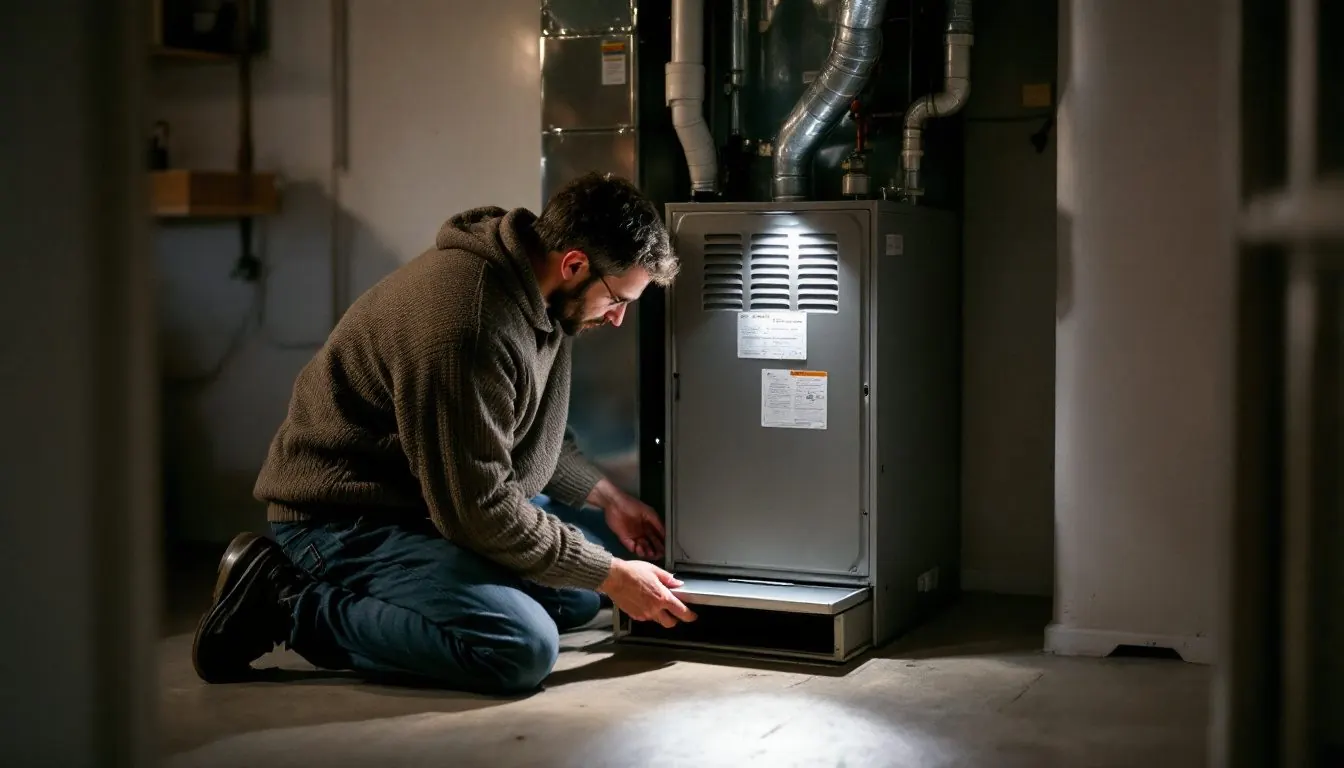
When the thermostat says heat on but there is no heat, the thermostat is calling and something downstream is not answering. Find where the chain stops: a silent furnace means no 24 volt power; an inducer hum means a pressure switch or vent fault; burners that light then die mean flame sensing; a heat pump blowing cool points to settings.
Stand at the furnace or air handler for two minutes after raising the setpoint and note the first thing that does not happen; that picks your branch below. Timings come from Goodman’s service instructions RS6610004 Rev. 9 and Resideo’s RTH6360 guide.
Does “Heat On” mean the furnace is actually getting the call?
No. It means the thermostat has decided the room is below setpoint; it says nothing about whether the furnace heard it. Resideo’s RTH6360 guide states that “C does not power the thermostat display or operations; batteries are always required,” so that screen keeps reading Heat On with the furnace switched off at the wall.
A flashing Heat On is a compressor protection delay of up to 5 minutes. For no response at all, Resideo’s checklist is physical: Heat mode with the setpoint above room temperature, the circuit breaker, the power switch at the equipment, and the furnace door closed securely. If the screen itself is blank or flashing a symbol, start with our thermostat troubleshooting by symptom instead.
How long after Heat On should warm air come out of a gas furnace?
Expect about a minute. On Goodman two-stage sequences the inducer runs a 15-second prepurge, the igniter warms up, the gas valve opens, then the blower waits a fixed 30 seconds and takes 30 more to reach full speed.
| Control (Goodman/Amana furnace line) | Steps the manual times | Result |
|---|---|---|
| White-Rodgers 50V51 or 50V61, two-stage 80% or 90% | 15 s prepurge + igniter warm up + 30 s blower delay + 30 s ramp | Blower starts 45 s plus warm up after the call; full airflow at 75 s plus warm up |
| White-Rodgers 50A55, single-stage 80% or 90% | Igniter 5 to 17 s + 30 s blower delay (prepurge length not printed) | Blower starts 35 to 47 s after the prepurge ends |
| White-Rodgers 50A65, single-stage 80% or 90% | 3 ignition tries; before each retry a 30 s purge and 20 s igniter preheat | 100 s of purge and preheat on top of the first try, then lockout that clears itself after one hour |
HVAC Brief calculation: sums of stage times printed in Goodman RS6610004 Rev. 9, for the named controls only.
Thermostat says heat on but the furnace is completely silent: where did the 24 volts go?
Silence with a dark status light means the control board has no power, so the call on the W wire has nowhere to land. Goodman’s troubleshooting chart lists four causes for “Furnace fails to operate” with no LED signal: the manual disconnect switch off, the door switch open, a loose 24 volt wire, and a blown fuse or breaker, with the instruction to check the control module fuse (3A).
Goodman notes that an interlock switch prevents furnace operation if the blower door is not in place, so after a filter change press that door fully home. Past the switch and breaker, the technician measures 120 volts into the furnace, 24 volts at R and C, and 24 volts on W while the thermostat calls. Goodman pairs the 3 A fuse with a check for shorts in the 115 and 24 volt circuits, so a second fuse without finding the short is not a repair. After an outage, see a furnace that will not start after a power outage.
Inducer motor runs but the burners never light: is it the pressure switch?
Usually the switch is reporting a real problem. Goodman’s 50V51 sequence starts igniter warm up only on “presence of closed low stage pressure switch contacts.”
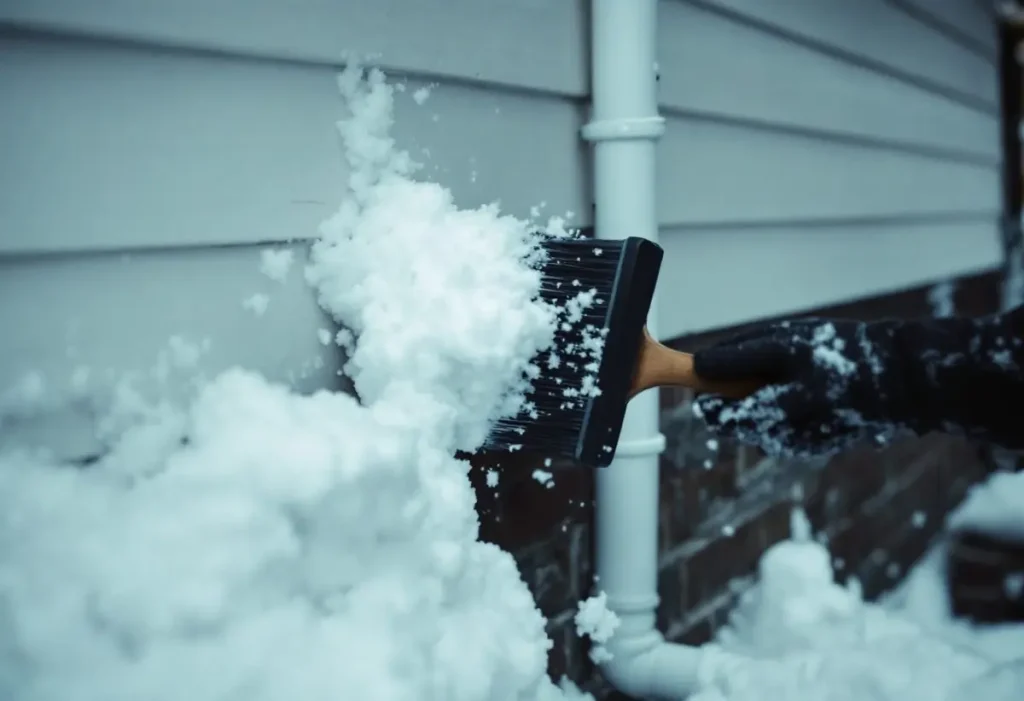
On the Amana 50A65 control, if the switch does not close within 5 minutes of the inducer starting, the board enters a 1-hour lockout with three short flashes; Goodman lists a disconnected hose, a faulty switch or wiring, and restricted intake or flue piping. On a 90% furnace, add the condensate drain: Goodman says a trap exposed to temperatures near or below freezing needs insulation or heat tape. Brush snow off the outdoor pipes yourself; for ice in the drain see a frozen furnace condensate line, and for the manometer test see our furnace pressure switch page.
Burners light, then shut off after a few seconds: why does it go quiet for an hour?
That is the flame proving step failing, then lockout. On the Goodman sequences the gas valve “will remain open only if flame is detected,” so a coated flame rod or poor ground shuts the gas within seconds even though the flame was real.
The Amana 50A65 control tries three (3) times, then locks out with one short flash and a longer pause. Goodman says it resets itself one hour after lockout, or when the thermostat is turned off for more than 5 and less than 20 seconds. So a furnace can sit silent under Heat On for an hour, then work. Note the flash count before cutting power; meanings by brand are on pages like Goodman furnace error codes. Repeated lockouts call for a technician to clean or replace the sensor and measure the flame signal in microamps (our flame sensor page covers it).
Blower comes on but no heat: fan setting, limit switch or no gas?
Check the fan setting first: Resideo notes the fan will still operate with the system off if the fan is set to On. On Auto, the blower should wait out the 30 second delay after the burners light.
If the fan is on Auto and the blower runs with no flame, the board is holding it on for a safety. On the Amana 50A65, an open primary or auxiliary limit runs the blower until the limit closes and shows four short flashes (dirty filter, duct restriction, faulty blower or low blower speed). An open rollout limit runs it all the time with six flashes (restricted flue or improper combustion air). Which one a homeowner may reset is on the furnace limit switch page; rollout is a technician call.
Heat pump says heat on but blows cool air: wrong O/B setting, delay or defrost?
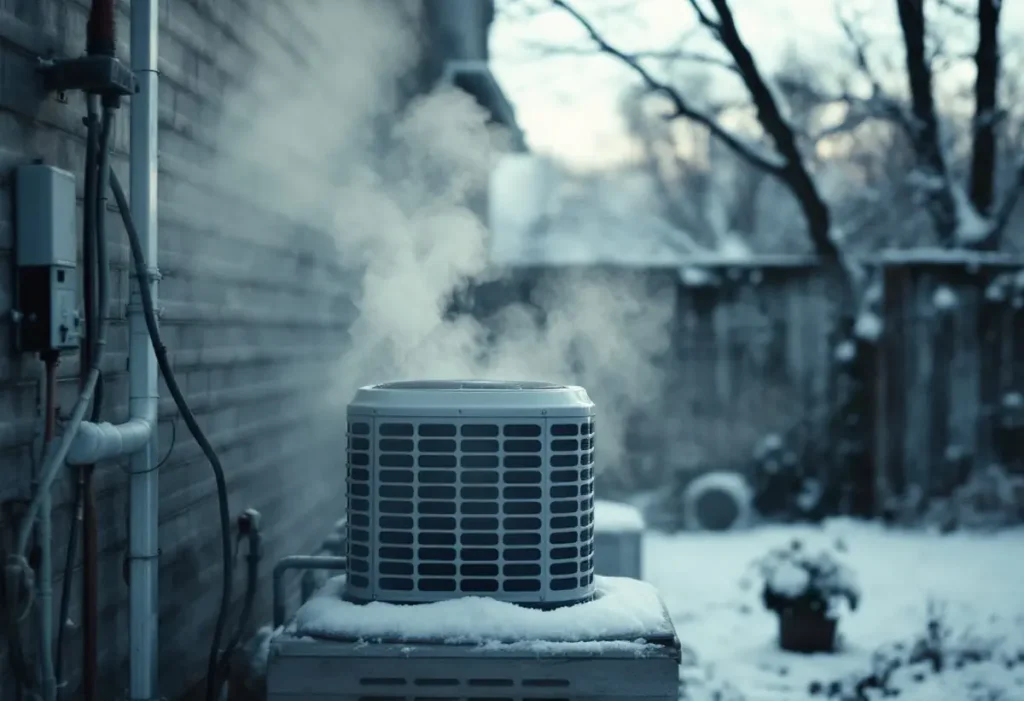
Three causes, one of them a fault. First, the compressor delay: Resideo says a flashing Heat On is compressor protection; wait 5 minutes. Second, a defrost cycle; intervals and sounds are on our heat pump defrost cycle page.
Third, often after a thermostat swap, the reversing valve setting. The RTH6360’s option 218 sets O/B: 0 energizes it in cool, 1 in heat, and Resideo’s fix for “Heat pump issues cool air in heat mode” is to check option 200 or 218 against the outdoor unit’s wiring diagram. The guide also says not to use W for heat pump applications. Em Heat runs auxiliary heat and the compressor is not used, so if Em Heat warms the house and Heat does not, suspect the outdoor unit; costs are on auxiliary heat vs emergency heat.
Boiler turns on but no heat, or a baseboard heater does not respond: what then?
With a hot-water boiler, a burner that fires while rooms stay cold points to water flow. Weil-McLain’s user manual for its CGa, CGi, EG, PEG and LGB boilers lists three causes when some radiators or baseboard units do not heat: air in the system, low system pressure and a high limit set too low. The same manual says a water boiler’s gauge should not exceed 24 psig.
Electric baseboard has no chain: the thermostat switches line voltage to the heater. QMark’s 2500 series has a factory-installed linear thermal cut-out that shuts the heater off on overheating and reactivates it when temperatures return to normal, so a heater blocked by drapes may cycle off on its own. Its 240 volt 1500 watt model draws 6.3 amps, so a dead heater under a clicking thermostat needs a line voltage check by an electrician.
| What you observe with Heat On | Where the chain stopped | Owner check | What the technician measures |
|---|---|---|---|
| Furnace silent, status LED dark | No 120 V or 24 V at the board | Service switch, breaker, blower door seated | 120 V supply, 24 V at R and C, 3 A board fuse, short on thermostat wire |
| LED lit, nothing runs | Call not reaching W | Thermostat mode and setpoint, batteries | 24 V on W at the board while calling |
| Inducer hums, no ignition | Pressure switch open | Snow on vent pipes, drain trap | Pressure across switch with manometer, hose, vent |
| Lights, dies, retries, then quiet | Flame not sensed; lockout | Count flashes; one thermostat reset | Flame signal in microamps, ground, gas pressure |
| Blower runs, air cool | Fan On, or limit open | Fan to Auto; filter | Temperature rise, limit and rollout continuity |
| Heat pump blows cool | Delay, defrost or O/B setting | Wait 5 min; check option 218 | Reversing valve voltage, refrigerant pressures |
| Boiler fires, rooms cold | Air, low pressure or limit | Gauge reading, bleed radiators | Circulator and zone valve operation |
Compiled by The HVAC Brief from Goodman RS6610004 Rev. 9, Resideo RTH6360, Weil-McLain 550-142-301/0224 and QMark 2500 documents. Stop line: smell gas, leave and call the utility from outside; never reset a rollout switch or work inside a powered furnace.
Frequently asked questions
Why is my thermostat off but my heat is still on?
Usually the blower is finishing its cool-down. On Goodman two-stage furnaces with the 50M56 control, the blower runs after the call ends for a heat off delay selectable at 100 or 150 seconds, factory set at 150 seconds. If it never stops, see a furnace that won’t turn off.
Does a baseboard heater have a reset button?
Many do not. QMark’s 2500 series uses a factory-installed linear thermal cut-out that shuts the heater off when it overheats and reactivates it by itself when temperatures return to normal, so there is nothing to press. A heater still cold after cooling down needs a voltage check.
What should boiler pressure be when the heating is on?
Weil-McLain’s manual for its CGa, CGi, EG, PEG and LGB boilers says a hot-water boiler’s gauge should not exceed 24 psig and a steam boiler’s should not exceed 15 psig. Low pressure is one listed cause of radiators or baseboard units that do not heat.
Why is the AC unit on when the heat is on?
With a heat pump that is normal, because the outdoor unit is the heat source. If the house still cools, check the reversing valve setting; on the Resideo RTH6360 that is option 218, where 0 energizes O/B in cool and 1 in heat. With a gas furnace and central AC, it should stay off.
How we researched this
On November 14, 2026 we read the heating sequences, abnormal-operation notes and troubleshooting chart in Goodman Service Instructions RS6610004 Rev. 9, the Resideo RTH6360 guide 33-00201EF, Weil-McLain user manual 550-142-301/0224 and the QMark 2500 series submittal, and the top three non-forum results (Trane, Lennox, The Furnace Outlet), none of which cites a document. Timings apply only to the controls named. One Goodman passage prints the flame-proving window as “seven (4) seconds”, so we left it out.
Sources
- Goodman. “Service Instructions, 80%, 90%, 95% Gas Furnaces, RS6610004 Rev. 9.” https://s3.amazonaws.com/s3.supplyhouse.com/product_files/Goodman-GMS951155DXA-Install-Instructions.pdf. Accessed November 2026.
- Resideo. “RTH6360 Series Programmable Thermostat, 33-00201EF.” https://digitalassets.resideo.com/damroot/Original/10015/33-00201EF.pdf. Accessed November 2026.
- Weil-McLain. “CGa, CGi, EG, PEG and LGB User Manual, 550-142-301/0224.” https://www.weil-mclain.com/wp-content/uploads/Users-Manual-CGa-S3-CGi-S4-EG-PEG-S6-LGB-S2-S3-0224.pdf. Accessed November 2026.
- QMark, Marley Engineered Products. “2500 Series Electric Baseboard Heater Submittal Sheet.” https://www.marleymep.com/wp-content/uploads/MEP_2500-Baseboard-Q_Submittal_2023-12-web.pdf. Accessed November 2026.
Leave a Reply