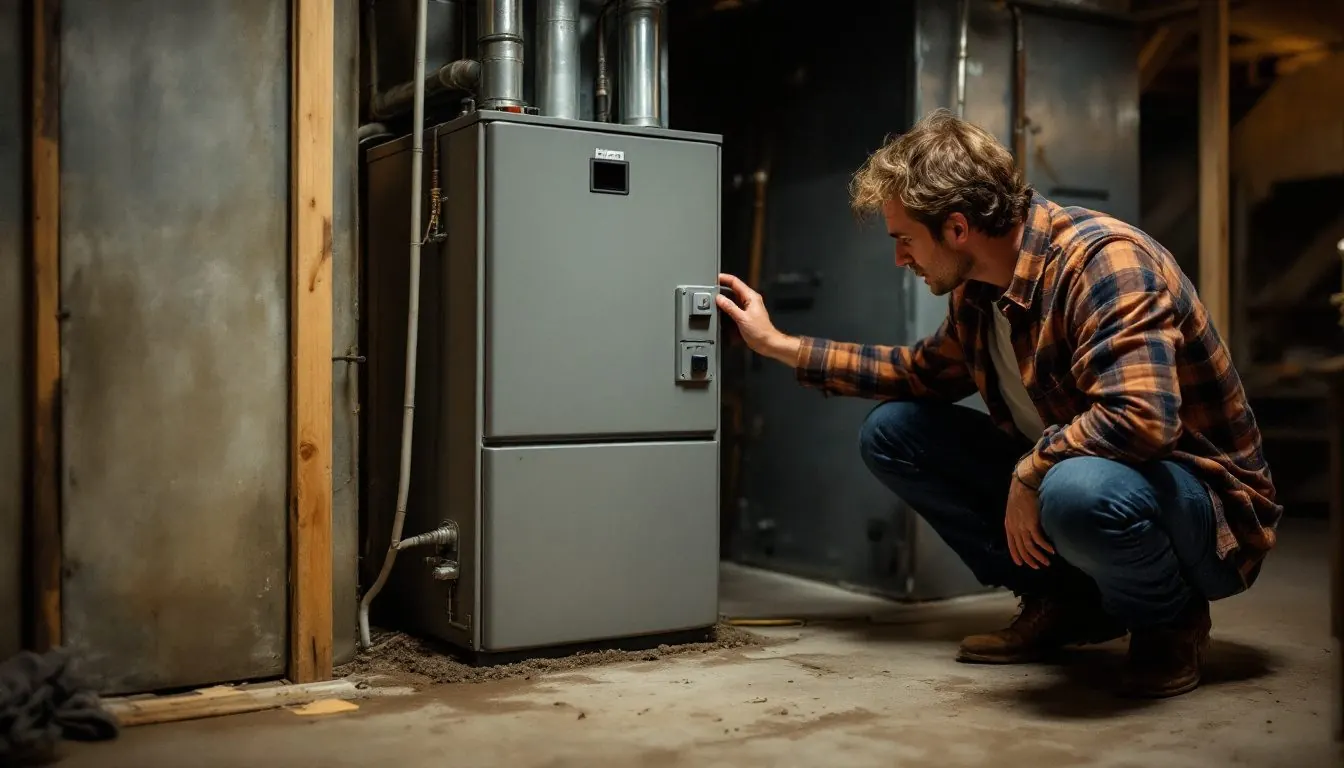
If your furnace won’t turn off, set the thermostat to OFF with the fan on AUTO and wait 3 minutes, because makers program a 90 to 180 second blower run after the burners stop. Blower still running: the fan setting, an open limit or rollout switch, or the board. Burners still lit: shut the gas and power.
Thermostat at OFF, fan at AUTO, 3 minutes later: is it the blower, the burners, or nothing?
That test splits every cause into three branches; only the burner branch is an emergency. After 3 minutes, listen for the blower (a steady rush of air), the inducer (a hum on the vent side) and look for blue flame through the sight window.
| Still running after 3 min at OFF | LED on the board | Most likely cause | What the maker says | Test that settles it |
|---|---|---|---|---|
| Nothing (it stopped) | Normal heartbeat | Thermostat was still calling; house never reached setpoint | Trane: a pro if “still running nonstop without frigid temperatures” | Back to HEAT; watch setpoint vs room reading |
| Blower only, steady | Normal | Fan switch on ON | Resideo RTH6360: at Off, “Fan will still operate if fan is set to On” | Fan to AUTO; blower stops within the off delay |
| Blower only | 4 flashes (Goodman, 50A55-843) | Open high limit: overheated heat exchanger | Goodman: blower “turned on until the limit closes” | Filter, closed registers; technician checks temperature rise |
| Blower only | Goodman 6 flashes; Carrier 33 | Open rollout switch | Goodman: blower “energized all the time”; Carrier: rollout “requires manual reset” | Technician: flue and combustion air before reset |
| Blower only | Steady LED or no code | G wire short, or a failed control | White-Rodgers: light on continuously means the failure is internal to the control | Power off, pull G at the board: stops means wiring or thermostat |
| Burners and inducer, often blower too | Goodman 5 flashes; Carrier 22 or 21; 50A55-843 continuous | Gas valve slow to close or stuck open; gas valve relay stuck | Carrier 22: “Flame is proved while gas valve is de-energized” | Stop: gas cock and power off |
Is a blower that runs 90 to 180 seconds after the flame goes out normal?
Yes. Goodman and Carrier sequences keep the blower going after the gas valve closes to pull leftover heat off the heat exchanger, and the inducer runs a short post-purge too.
| Furnace and document | Inducer after the call ends | Blower after the call ends | Other normal blower run |
|---|---|---|---|
| Goodman and Amana single stage 80% and 90%, White-Rodgers 50A55 board | 15 second post purge | Selectable 90, 120, 150 or 180 s; shipped at 150 seconds | Blower starts about 30 seconds after the gas valve opens |
| Carrier 59TP6B two stage | 15 second post purge | Selectable 90, 120, 150 or 180 s; factory set at 120 seconds | Code 12: blower runs 90 seconds if power returns during a heat call |
| Carrier 59TP6B, limit or rollout open (code 33) | Off | 4 min. or until the switch closes, whichever is longer | Over 3 minutes becomes lockout 13, auto reset after 3 hours |
A blower still going 2 or 3 minutes after the thermostat is satisfied is the factory delay; one still running at 5 minutes is a fault below. Goodman says the 150 second setting “may be changed to suit the installation requirements and/or homeowner preference” in service manual RS6610004.
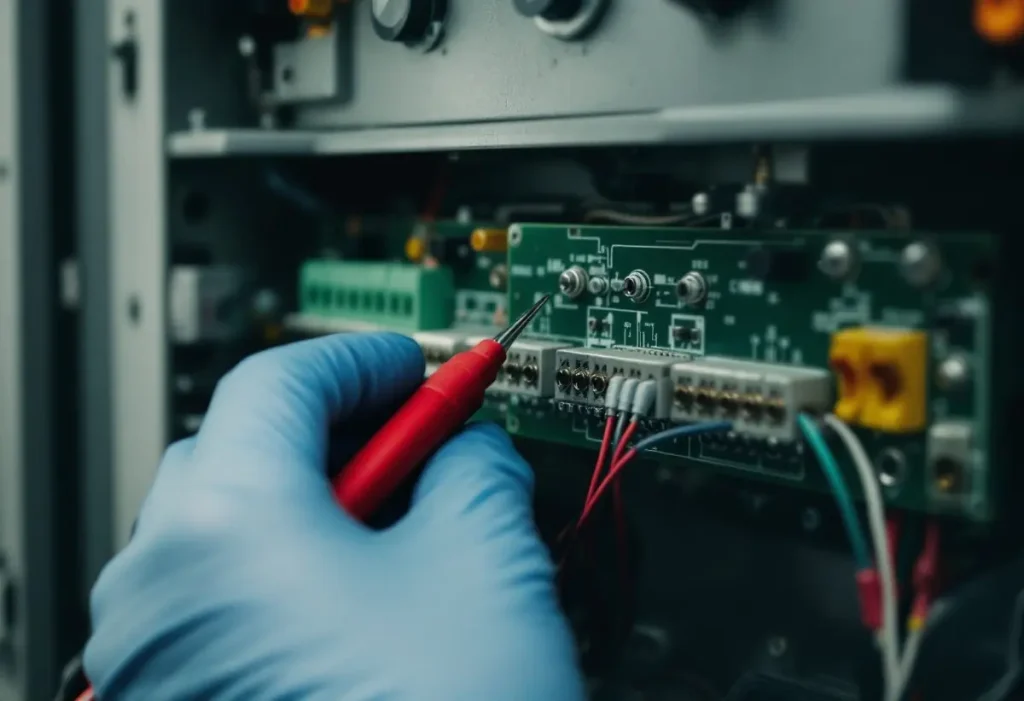
Blower motor keeps running on the furnace: is the fan switch, a limit, or the G wire holding it on?
Check the fan switch first. The Resideo RTH6360 guide states that in Off mode “Fan will still operate if fan is set to On,” so a thermostat at OFF does not stop a blower set to ON. The running cost of each setting is worked out in fan ON vs AUTO.
If the fan is on AUTO and the LED is flashing 4 times, the board is deliberately running the blower. Goodman’s RS6610004 says that when the limit opens “the air circulator blower will be turned on until the limit closes” and blames dirty filters, duct resistance, a faulty blower or low blower speed. Trane’s page says the limit tells the fan when to start and stop “based on signals from your thermostat,” which fits old fan and limit controls; on integrated boards an open limit shuts the gas and turns the blower on. Trips and resets are covered in our furnace limit switch guide.
Six flashes on a Goodman 50A55 board means the rollout switch opened, and the blower “will be energized all the time,” per RS6610004. Goodman blames restricted flue piping or improper combustion air, so this is not a homeowner reset. Check your board’s exact pattern: Goodman furnace codes and Carrier status codes are listed by series.
No code at all points at the G circuit. On a standard 24 V system the thermostat runs the blower by connecting R to G, as our thermostat wiring chart shows, so a pinched or wet thermostat cable can hold the fan on with the thermostat off. Following the logic of Goodman’s S-3A test, pull the G wire at the board with power off, then restore power: if the blower stops, blame the cable or thermostat. If it runs on with a steady LED, the 50A55-843 guide says the failure “is internal to the control” and the control should be replaced. Replacement options are in our furnace control board guide.
Furnace keeps running even when the thermostat is off: could the thermostat itself be calling?
Sometimes, and two thermostats do it on purpose. Google’s Nest help says Off mode keeps Safety Temperatures active, so the thermostat “will start heating or cooling automatically” in extreme cold, and Off mode “doesn’t turn off the power to your Nest thermostat or your system.” Trane suggests disconnecting the thermostat wiring or batteries: if the furnace stops, the thermostat is faulty.
A short between R and W in the cable does the same with no thermostat at all. Carrier’s code 24, an open 24 V fuse, lists “Short circuit in secondary voltage (24V) wiring including thermostat leads” as the cause: a cable shorted to ground blows the fuse, one shorted R to W keeps the heat call alive. Pulling W at the board, power off first, separates them.
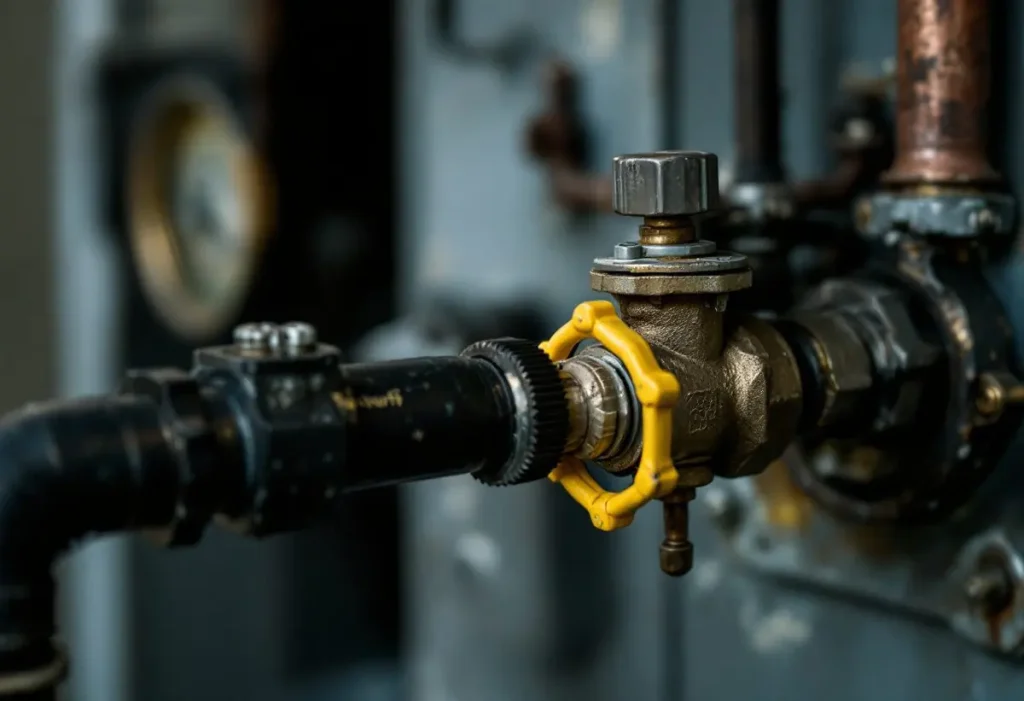
Gas furnace keeps running with the burners lit and no heat call: is the gas valve stuck open?
This is the dangerous branch. Goodman’s troubleshooting chart describes “Induced draft blower and circulator blower run continuously. No furnace operation” with 5 flashes, caused by a short to ground in the flame sense circuit, lingering burner flame, or a “Slow closing gas valve.” Carrier’s code 22 reads “Flame is proved while gas valve is de-energized” and lists a “Stuck open or leaky gas valve”; code 21 adds a “Stuck closed gas valve relay on control.”
The stop line: if flame is visible with the thermostat at OFF, turn the manual gas cock at the furnace to off, switch off the furnace power, and leave it off. Do not restart it. If you smell gas, leave first and call the utility from outside, per our furnace smells like gas sequence. The technician checks for 24 V across the valve while the flame burns: voltage means the board or wiring is holding it open, no voltage means the valve itself. Valve failures are covered in our furnace gas valve explainer.
Flash patterns differ even within one board family. The universal White-Rodgers 50A55-843 flags this fault with continuous flashing and uses 5 flashes for an open rollout switch; Goodman’s RS6610004 chart uses 5 flashes for flame sensed with no call for heat and continuous flashing for reversed 115 volt polarity. A Goodman fitted with a universal board will not match its door label.
Furnace keeps running after the temperature is reached in winter, or never reaches it?
Running a few minutes past setpoint is the delay table above. Running nonstop below setpoint means the thermostat is still calling, which can be normal in a cold snap. A furnace sized exactly to the house’s heat loss at the design temperature runs 100% of the time on that day. We calculated the share of each hour it should run, ignoring sun and internal gains, as (70 minus outdoor °F) divided by (70 minus design °F): with a 0°F design day, that is 50% at 35°F, 86% at 10°F, and more than the furnace can supply below 0°F. Run time by cycle is worked out in how long a furnace should run.
Nonstop with cool air means the burners are off and the blower is running: the limit and rollout branch above, or failed ignition, traced in furnace blowing cold air. Trane’s threshold: replace a dirty filter, wait a couple of hours, and call a professional if it is “still running nonstop without frigid temperatures.”
What readings should the technician give you before replacing a part?
Ask for four: the flash code plus the board model, since the universal 50A55-843 and Goodman’s chart disagree; voltage at W and G with the thermostat cable removed; temperature rise against the rating plate range if the limit tripped; and voltage at the gas valve with burners lit and no call, the split Carrier draws between codes 21 and 22.
Frequently asked questions
How do I turn off a furnace that won’t shut off?
Use the power switch that Trane says looks like a light switch on or near the furnace, or the breaker marked Furnace. If flame is visible, also close the manual gas cock. Count the LED flashes first: Goodman’s RS6610004 says cutting power for a minimum of 5 seconds resets a lockout.
Why does my furnace keep running even when turned off?
The Resideo RTH6360 guide says the fan still runs at OFF if set to ON, and a Nest at OFF still heats to its Safety Temperatures. Otherwise, an open limit makes Goodman boards run the blower until it closes, and a shorted R to W or R to G cable keeps the call alive.
Is it dangerous if a gas furnace keeps running?
A blower that will not stop is a nuisance; burners that stay lit with no heat call are a hazard. Carrier’s code 22 means flame is proved while the gas valve is de-energized, and Goodman’s 5 flash fault includes a slow closing gas valve. Close the gas cock, switch the power off, and keep it off until a technician tests the valve.
How we researched this
On 14 November 2026 we read Goodman RS6610004 Rev. 9 (sequences, abnormal operation, troubleshooting chart, S-3A test), Carrier 59TP6B-01SI (sequence and status codes), the White-Rodgers 50A55-843 guide, the Resideo RTH6360 guide, Google’s Nest Off mode page and Trane’s troubleshooting page. We excluded a blocked JustAnswer thread, an RV forum and contractor blogs as sources for numbers. Flash codes apply only to the boards named.
Sources
- Goodman. “Service Instructions: 80%, 90%, 95% Gas Furnaces, RS6610004 Rev. 9.” https://s3.amazonaws.com/s3.supplyhouse.com/product_files/Goodman-GMS951155DXA-Install-Instructions.pdf. Accessed November 2026.
- Carrier. “59TP6B Installation, Start-up, Operating, Service and Maintenance Instructions, 59TP6B-01SI.” https://www.shareddocs.com/hvac/docs/1009/public/0d/59tp6b-01si.pdf. Accessed November 2026.
- Copeland (White-Rodgers). “Single Stage Integrated Furnace Controls 50A55-843 and 50A65-843.” https://copeland.com/documents/50a55-843-50a65-843-single-stage-ifc-en-8185344.pdf. Accessed November 2026.
- Resideo. “RTH6360 Series User Guide, 33-00201EF.” https://digitalassets.resideo.com/damroot/Original/10015/33-00201EF.pdf. Accessed November 2026.
- Google. “Nest thermostat Off mode.” https://support.google.com/googlenest/answer/9251570?hl=en. Accessed November 2026.
- Trane. “Furnace Won’t Shut Off: Troubleshooting Tips.” https://www.trane.com/residential/en/resources/troubleshooting/gas-furnaces/furnace-wont-shut-off/. Accessed November 2026.
Leave a Reply