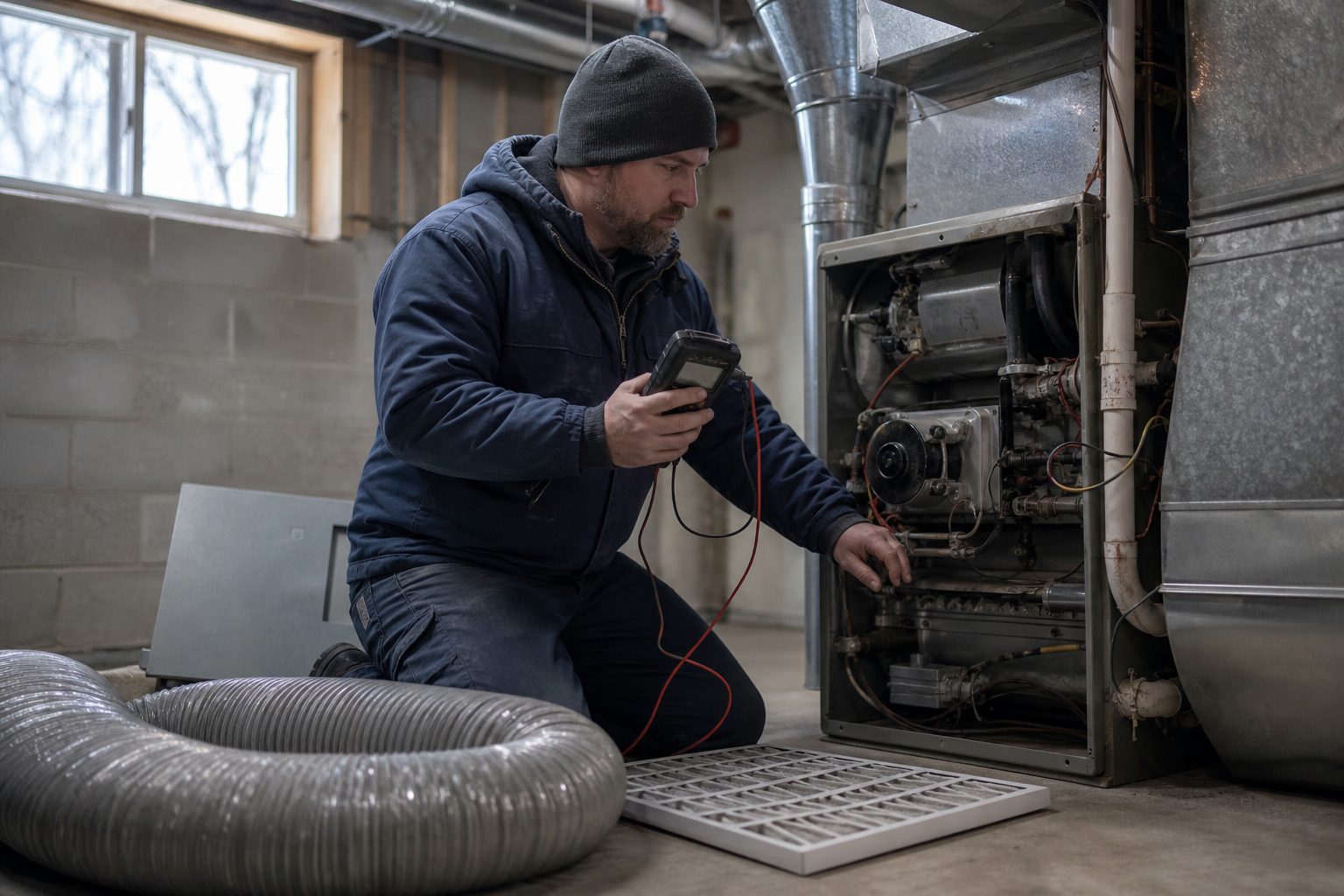
Why is my furnace blowing cold air? A furnace blowing cold air is usually one of three things: the thermostat fan is set to ON, the blower is in its normal purge run, or a safety switch has cut the burners while the blower keeps going.
Key Takeaways
- The federal furnace test procedure holds the blower on 3.0 minutes after burner shutdown on a non-condensing furnace, 1.5 on a condensing one. Cool air at the end of a cycle is designed behavior.
- Restricted airflow is the commonest real fault. DOE’s Building America Solution Center warns that excessive filter pressure drop “can damage furnaces due to overheating”.
- CPSC estimated 76 non-fire CO deaths tied to heating systems in 2022, 28 percent of that year’s 274 consumer-product CO deaths.
- CPSC and York recalled 223,600 US furnaces in 2012 after 402 overheating incidents that cracked heat exchangers.
- A gas smell, a burning smell or a CO alarm ends the troubleshooting: leave and call from outside.
Why is my furnace blowing cold air?
Because cold air at the registers is one symptom shared by at least eight conditions, three of them normal. The sequence below separates them in the order a technician works: settings, timing, then the safety chain.
Is the thermostat fan set to ON instead of AUTO?
Check this first. On ON, the blower runs continuously whether or not the burners fire, so between heat calls it pushes room temperature air through the ducts. That reads as cold. On AUTO it runs only on a call.
The setting is a feature, not a fault, but not free. DOE regulates furnace fans under a fan energy rating applying to units manufactured on and after July 3, 2019, covering a constant-circulation setting. Our explainer on what a thermostat can and cannot sense covers why the fan switch sits outside the heating call.
How long should the blower run before the burners light?
Roughly 30 to 60 seconds on a modern furnace, with a similar cool-down afterwards. The pre-ignition period proves the vent is clear before gas is released. The cool-down pulls residual heat out of the exchanger.
DOE measures the cool-down. With adjustable fan control, the delay between burner shutdown and blower shutdown is 3.0 minutes on a non-condensing furnace or 1.5 minutes on a condensing one, or until supply air falls to 40 degrees F above inlet air, whichever keeps the fan on longest. The same appendix records post-purge as burner OFF to combustion blower OFF, treats 30 seconds or less as zero, and caps it at 180 seconds.
The myth worth correcting
A furnace that blows cool air for the first minute of every cycle is not broken and needs no “delay adjustment.” What is abnormal is cool air all cycle, or heat that vanishes within a minute or two.
What causes a furnace blowing cold air after it starts hot?
Heat that arrives then stops while the blower carries on means the board cut the burners and left the fan running. That is the designed response to an open safety switch. Airflow is the usual culprit; the flame sensor is the runner-up.
A loaded filter or blocked return starves the heat exchanger of air, metal temperature climbs, and the high limit switch opens. DOE’s Building America Solution Center is direct: excessive pressure drop “can damage furnaces due to overheating, can freeze condensing coils in air conditioning units, and can burn out blower motors.” Most residential systems are held to no more than 0.4 or 0.5 in. WC total static, which a dirty filter alone can eat.
Filter choice is a heating problem, not only an air quality one. See why the highest MERV rating is the wrong target and the intervals in filter types and sizes. Blocked returns do the same in reverse, which is why closing vents backfires.
The six faults a technician checks, in order
With settings and timing ruled out, the list is short and worked cheapest first. Each gives the same symptom: burners off, blower on.
- Dirty filter or blocked return. The high limit opens on overheat, so heat alternates with cold.
- Dirty flame sensor. The board cannot prove flame, so gas drops seconds after ignition, then locks out.
- Failed igniter. No flame at all, so no heat at any point.
- Tripped pressure switch. A blocked intake or exhaust, or a failing inducer, stops draft proving.
- Tripped flame rollout switch. Flame has left the burner area. A shutdown, not a reset.
- Gas supply. A closed valve, an empty propane tank or a tripped excess flow device.
A condensing furnace adds a seventh: a blocked condensate drain backs water into the collector box, a safety switch opens, and firing stops. Standing water plus a furnace that will not stay lit is one symptom. See how condensate is removed for what clogs it.
| Fault | At the register | Safety device | Owner or technician |
|---|---|---|---|
| Fan switch on ON | Room temperature air between calls | None | Owner |
| Dirty filter or blocked return | Heat, then cold, looping | High limit switch | Owner, then technician |
| Dirty flame sensor | Brief heat, cold in seconds, three tries | Flame proving circuit | Technician |
| Blocked intake or exhaust | Blower only, no heat | Pressure switch | Owner outdoors |
| Flame outside the burner box | Blower only, scorched smell | Flame rollout switch | Technician only |
| Blocked condensate drain | Blower only, water at the base | Condensate float switch | Technician |
What can a homeowner check when the furnace is blowing cold air?
Four things, in this order, all free. Anything past step four involves the gas train, the flue or the safety chain: technician work under most warranties.
Never reset a tripped rollout or limit switch to buy another cycle. CPSC calls a flame rollout switch “a back-up device that shuts down the heater in the event of a heater failure”, and recalled about 400 unit heaters in April 2011 for shipping without one. If yours opened, the reason is still there. If the burners are visible, what blue, yellow and orange flames indicate shows whether combustion is the problem, and which furnace parts actually fail puts odds on each. If the burners never light, the ignition sequence and where it stops is the right page.
Does a heat pump blowing cold air mean the same thing?
No. On a heat pump the same complaint usually points at defrost or the reversing valve, not at anything a furnace has. Defrost deliberately runs in cooling for several minutes to clear frost off the outdoor coil, and if backup heat does not engage the registers go cold.
A reversing valve stuck in cooling produces the symptom continuously instead of in bursts. Neither has a burner or rollout switch, so none of the sequence above applies. Start with what the AUX and EM HEAT indicators mean in auxiliary versus emergency heat, and with cold climate heat pump ratings.
When is furnace blowing cold air an emergency?
When you smell gas, smell burning, or a CO alarm sounds. Troubleshooting stops there. CPSC’s instruction for a CO alarm is unambiguous: “Immediately move outside to fresh air. Call your emergency services, fire department, or 911.”
The failure chain is why that is not overcaution. CPSC estimated 76 non-fire CO deaths associated with heating systems in 2022, 28 percent of the 274 tied to all fuel-burning consumer products. Of the 15 tied to natural gas heating, 11 involved installed furnaces.
Overheating is how a sound heat exchanger becomes a compromised one. In February 2012 CPSC and York reannounced a recall of 223,600 US furnaces after 402 incidents in which the furnace could “overheat and cause the heat-exchanger to crack and create openings that allow flames to be exposed.” DOE adds that on a Category I furnace with an open return in the same room, “the blower fan can easily overcome the small induced-draft fan and backdraft the furnace, pulling carbon monoxide into the open return.” Check your alarms against carbon monoxide detector placement, and match the smell against which HVAC smells are emergencies.
How we researched this
Research date: September 29, 2026. Cited: 10 CFR 430 Appendix N, sections 8.5 and 8.6, and 10 CFR 430.32(y), read through the eCFR API at the September 2026 edition; three DOE Building America Solution Center guides; and four CPSC documents, being the CO fact sheet, the 2022 Annual Estimates on non-fire CO deaths, the February 2012 York recall and the April 2011 ADP recall.
Excluded: Reddit and every other user-generated forum, at every stage. This is a combustion and carbon monoxide safety topic, and anonymous anecdotes are the wrong evidence for one. Contractor blogs and lead-generation sites were excluded as sources. No repair prices appear, because no federal series publishes them. The burner-on to fan-on delay lives in ASHRAE 103, which is not free, so only the fan-off delays DOE restates in the CFR are quoted. The high limit switch, flame sensor, pressure switch and condensate switch are described by function, since appliance standards define them, not federal rules.
Frequently asked questions
Why does my furnace blow cold air for the first minute?
That is the pre-ignition period, typically 30 to 60 seconds, in which the blower or draft inducer proves the vent is clear before gas is released. DOE’s test procedure treats a purge of 30 seconds or less as negligible and caps post-purge at 180 seconds, so a short cool run at either end is expected.
Should the thermostat fan be on ON or AUTO in winter?
AUTO, unless you want continuous filtration and accept the electricity. On ON the blower delivers room temperature air between heat calls. Furnace fans made on and after July 3, 2019 must meet a federal fan energy rating under 10 CFR 430.32(y), which covers a constant-circulation setting.
Can a dirty filter really stop a furnace from heating?
Yes. Restricted airflow raises heat exchanger temperature until the high limit switch opens and cuts gas while the blower runs on. DOE’s Building America Solution Center states that excessive pressure drop “can damage furnaces due to overheating,” against a budget of 0.4 or 0.5 in. WC total static. The same program says to replace filters every three months.
Why does my furnace blow hot then cold on a loop?
That pattern is the signature of a high limit trip. Burners fire, the exchanger overheats because air is not moving through it, the limit opens, gas stops, and the blower stays on to cool the metal. Then it repeats. Check the filter and returns first.
Is it safe to reset a furnace safety switch myself?
No. CPSC describes a flame rollout switch as “a back-up device that shuts down the heater in the event of a heater failure,” and recalled about 400 unit heaters in April 2011 for shipping without one. Resetting it leaves the fault there.
Does a blocked condensate drain stop a condensing furnace?
It can. When the drain or trap clogs, water backs into the collector box and a safety switch opens, so the furnace will not fire. DOE notes the condensate is acidic enough that some local codes require neutralizing it.
Sources
- eCFR. “10 CFR Part 430, Subpart B, Appendix N.” https://www.ecfr.gov/current/title-10/chapter-II/subchapter-D/part-430/subpart-B/appendix-Appendix%20N%20to%20Subpart%20B%20of%20Part%20430. Accessed September 2026.
- eCFR. “10 CFR 430.32.” https://www.ecfr.gov/current/title-10/chapter-II/subchapter-D/part-430/subpart-C/section-430.32. Accessed September 2026.
- DOE Building America Solution Center. “High-MERV Filters.” https://basc.pnnl.gov/resource-guides/high-merv-filters. Accessed September 2026.
- DOE Building America Solution Center. “Proper Installation of Furnace and Air-Handler Filters.” https://basc.pnnl.gov/resource-guides/proper-installation-furnace-and-air-handler-filters. Accessed September 2026.
- DOE Building America Solution Center. “Combustion Furnaces.” https://basc.pnnl.gov/resource-guides/combustion-furnaces. Accessed September 2026.
- CPSC. “Carbon Monoxide Fact Sheet.” https://www.cpsc.gov/safety-education/safety-guides/carbon-monoxide/carbon-monoxide-fact-sheet. Accessed September 2026.
- CPSC. “Non-Fire Carbon Monoxide Deaths Associated with Consumer Products, 2022 Annual Estimates.” https://www.cpsc.gov/s3fs-public/Non-Fire-Carbon-Monoxide-Deaths-Associated-with-the-Use-of-Consumer-Products-2022-Annual-Estimates.pdf. Accessed September 2026.
- CPSC. “Fire Concerns Prompt York International to Reannounce Recall of Gas Furnaces for Manufactured Homes.” https://www.cpsc.gov/Recalls/2012/Fire-Concerns-Prompt-York-International-to-Reannounce-Recall-of-Gas-Furnaces-for-Manufactured-Homes. Accessed September 2026.
- CPSC. “ADP Recalls to Repair Unit Heaters Due to Fire Hazard.” https://www.cpsc.gov/Recalls/2011/adp-recalls-to-repair-unit-heaters-due-to-fire-hazard1. Accessed September 2026.
Leave a Reply