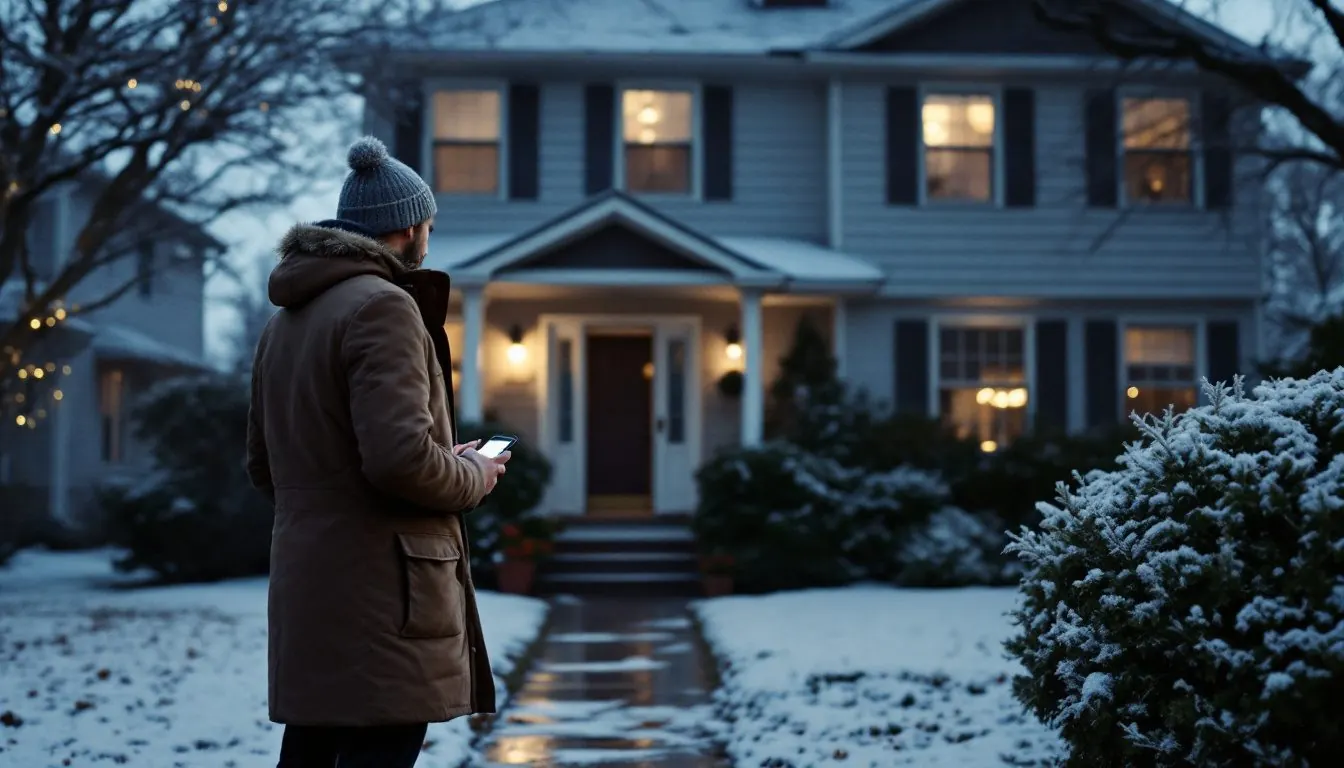
If your furnace smells like gas, as in rotten eggs or sulfur, treat it as a leak even when the smell is faint or brief: do not touch switches or the thermostat, get everyone out, and call the gas utility or 911 from outside. A toasty dust smell on the first heat of the season is the normal exception.
The rotten egg note is put there on purpose. Federal pipeline rule 49 CFR 192.625(a) requires gas in a distribution line to be odorized so it is “readily detectable by a person with a normal sense of smell” at one-fifth of the lower explosive limit. The odor is the alarm; the table below sorts it from the two smells people confuse with it.
Is it rotten egg gas, burning dust or furnace exhaust?
Rotten egg or sulfur means unburned gas until a utility worker proves otherwise; burning dust on the first cold night is normal for about 30 minutes to a few hours, per Carrier; a sharp exhaust smell points at venting, and carbon monoxide itself has no smell. The first firing of the season is where most owners meet that dust smell, and how to turn on a furnace lists what to set and what to hear in order, from the gas knob and blower door to the igniter glow and the flame. Musty and electrical odors are in our guide to every HVAC smell.
| What you smell | When and where | Most likely source | Danger | First action |
|---|---|---|---|---|
| Rotten eggs or sulfur, strong | At the furnace or through the room | Unburned gas with its odorant | Fire and explosion | Leave, no switches, call from outside |
| Rotten eggs, faint or only for a moment | At start-up, or now and then | Small fitting or valve leak, or late ignition | Same: IURC says to leave for “even a faint” odor | Leave and call; do not retest it |
| Rotten eggs near the floor, propane home | Basement, crawl space, low corners | Propane, which is 1.55 times as heavy as air | Fire and explosion; odor can fade | Leave; call the supplier from outside |
| Toasty, burning dust | From the registers, first heat of the season | Summer dust burning off | Low | Keep heating; Carrier: 30 minutes to a few hours |
| Sharp, acrid exhaust | Near the vent pipe or draft hood | Flue gas spilling from the vent | Carbon monoxide, which you cannot smell | Shut it off; CO alarm sounding means get out |
What should you do first when the furnace smells like rotten eggs?
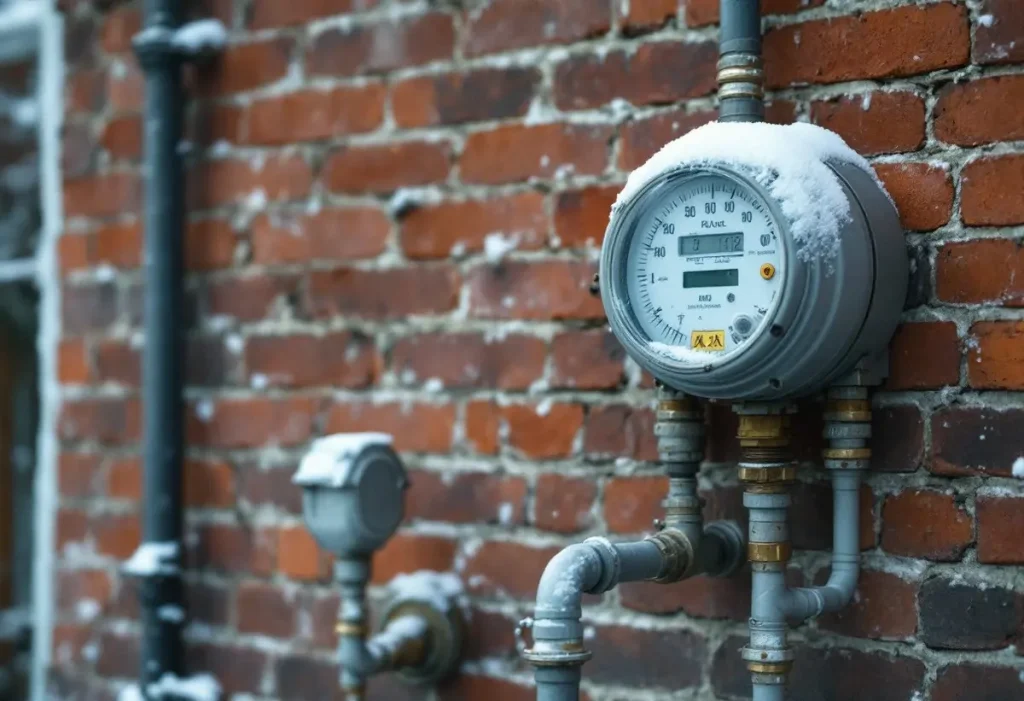
Stop, do not change anything electrical, and leave. Goodman prints the same four lines on its GM9S80 installation manual: “Do not try to light any appliance. Do not touch any electrical switch; do not use any phone in your building.” Then call the gas supplier from a neighbor’s phone, and the fire department if the supplier cannot be reached.
Utilities add detail. Peoples Gas says not to switch “any electrical or battery-operated devices” on or off, not to use garage door openers, and not to try to find or stop the leak. The Indiana Utility Regulatory Commission says not to open windows to air the house out. Gas South differs, allowing you to shut a single appliance valve and ventilate for a faint odor at that appliance. A furnace valve sits inside the cabinet beside the igniter, so follow the stricter rule there, and your own utility’s printed instructions.
Is a little gas smell when the furnace starts normal?
No maker document we read calls it normal, and the Indiana regulator says to leave for “even a faint natural gas odor.” The mechanical explanation: in the Lennox EL196UHE sequence the inducer runs a 15-second prepurge, the igniter heats for 20 seconds, and then the gas valve opens for a 4-second trial for ignition. If flame is late, gas reaches the burner area unburned for part of those seconds. The same late light causes a loud bang at start-up; a whiff plus a bang means stop using the furnace.
A start-up whiff cannot fill a room. We calculated the gas each event puts into a closed 10 by 12 by 8 foot furnace room from an 80,000 Btu/h furnace.
| Event | Gas released | Share of the 9.6 ft³ odor level |
|---|---|---|
| One failed 4-second ignition trial | 0.086 ft³ | 0.9% |
| Five failed trials, then Lennox’s 60-minute Watchguard lockout | 0.43 ft³ | 4.5% |
| Valve open with no flame for 7.5 minutes | 9.6 ft³ | 100%: the whole room smells |
| Valve open with no flame for 37 minutes | 48 ft³ | 500%: the lower explosive limit |
A smell that fills the room or lingers after the burner lights is more gas than ignition releases, so it points at piping, a fitting, or the furnace gas valve body itself.
Why does the furnace smell like gas when no leak is found?
Four things produce a “gas smell, but no leak” result: a leak too small or brief to find on the visit, odor fade, a sulfur smell that is not fuel, and nose fatigue. Peoples Gas says continued exposure can desensitize your sense of smell and that “odor fade” can follow absorption into new piping and soils.
Rotten egg hot water at the taps usually traces to the water heater anode rod, and a floor drain trap that dried out over summer can let sewer gas into the same basement. A new furnace has its own short list, sorted by how long each lasts, in our page on the smell after a new furnace is installed. Log when the smell appears (burner on, burner off, hot water running) for the utility and the technician.
Does a propane furnace smell different, and why sniff near the floor?
Propane carries an odorant too, but it sinks and its odor can weaken. OSHA’s 29 CFR 1910.110(b)(1) requires LP gas to be odorized so it signals gas “down to concentration in air of not over one-fifth the lower limit of flammability,” and deems 1.0 pound of ethyl mercaptan per 10,000 gallons enough. With the OSHA propane data sheet listing a 2.1% lower explosive limit, that works out to 0.42% propane in air.
The same OSHA sheet gives propane a vapor density of 1.55, heavier than air. Lennox’s EL196UHE manual warns that LP gas “will settle close to the floor and may be difficult to smell” and says an LP leak detector should be installed in all LP applications. Goodman goes further: “Rust can reduce the level of odorant in propane gas. Do not rely on your sense of smell.” Tanks and delivery are covered in our propane heating explainer.
Can a gas smell mean carbon monoxide?
No: carbon monoxide has no smell at all. EPA calls it “an odorless, colorless and toxic gas,” and CPSC names malfunctioning furnaces among the sources. What you smell at a bad vent is the rest of the flue gas, so an exhaust odor deserves a shutdown even with a silent CO alarm.
A CO alarm is built to sense carbon monoxide, which is why Gas South recommends a separate natural gas detector alongside it. CPSC lists early CO symptoms as headache, fatigue, shortness of breath, nausea and dizziness. If the alarm chirps rather than sounds, our carbon monoxide detector beeping guide decodes it by maker; a furnace that keeps spilling exhaust needs a vent test and sometimes a cracked heat exchanger inspection.
Why would the AC, boiler or baseboard heater smell like gas?
An air conditioner burns no fuel, so with a gas furnace a “gas” smell at the AC registers in November is furnace air through the same blower and ducts; the rules above apply. A chemical smell from an outdoor unit in summer is a refrigerant question, covered with room-by-room numbers in what happens if Freon leaks in your house.
A gas boiler burns the same odorized fuel through the same kind of valve and ignition trial, so a rotten egg smell there gets the same 4 steps; only the 4-second trial timing differs by maker. Electric baseboard heaters have no gas; their first-use smell is dust on the element.
What will the gas company and the technician test?
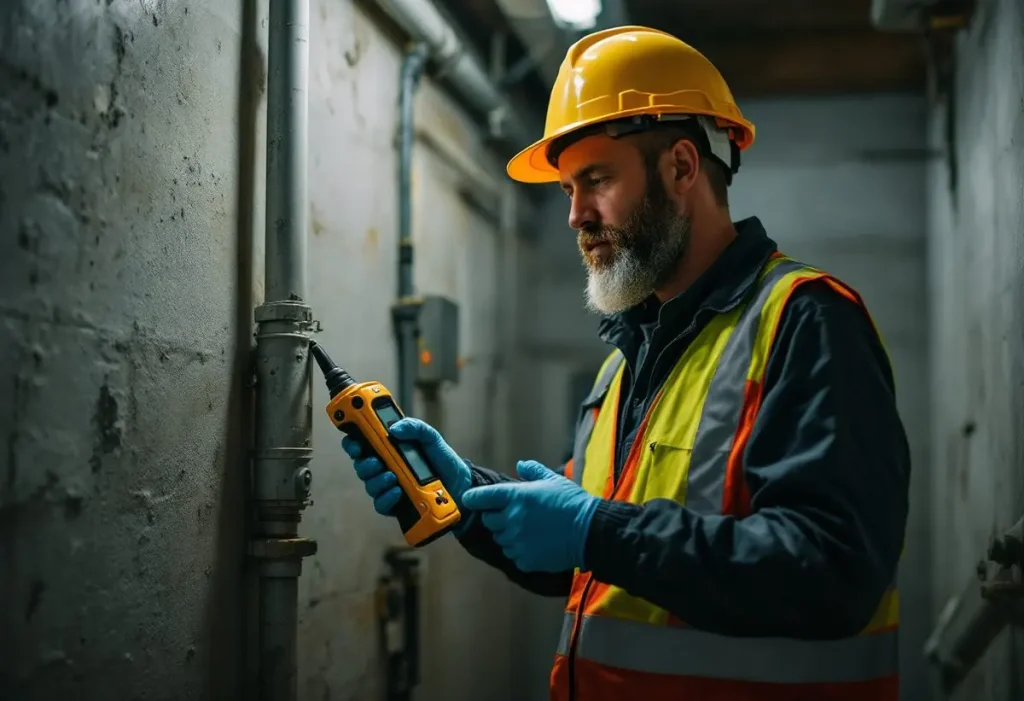
The utility makes the house safe; the technician then proves the furnace. Goodman specifies a leak test with “an approved chloride-free soap” solution, never a flame, and a manifold pressure check: 3.5 inches water column on high fire and 1.9 inches on low for natural gas on the GM9S80, and 10.0 and 6.0 inches on propane.
Ask for three results in writing: which joint bubbled, the manifold pressure on each stage, and whether the burners lit on the first trial. A Lennox EL196UHE that hits its 60-minute Watchguard lockout and smells at start-up has a measurable ignition fault, not a mystery odor.
Frequently asked questions
Is it okay to smell a little gas from a furnace?
Treat it as a leak. The Indiana Utility Regulatory Commission says that if you detect even a faint natural gas odor, make the safe choice, leave the area and call 911. The odorant is set by 49 CFR 192.625 to be readily detectable at one-fifth of the lower explosive limit, so a smell you notice is the warning working, not background noise.
Is it safe to run a furnace if it smells?
Only for a toasty dust smell on the first heat, which Carrier puts at about 30 minutes to a few hours. For a rotten egg smell, Goodman’s manual says do not try to light any appliance and do not touch any electrical switch, the thermostat included. An exhaust smell means shut it off and have the vent tested.
How can you tell if your furnace is leaking gas?
A rotten egg or sulfur smell and a hissing sound are the common signs, says the Indiana Utility Regulatory Commission, and soapy water on a connection may show bubbles. Leave the soap test to the utility or a technician: Goodman specifies a commercial leak detection solution and never an open flame. In a propane home, a detector near the floor is the backup Lennox recommends.
Does refrigerant smell like gas?
Refrigerant is not fuel and does not pass through the furnace burner. The rotten egg odor is a fuel gas requirement, set by 49 CFR 192.625 for natural gas lines and 29 CFR 1910.110 for LP gas. If a rotten egg smell comes from AC registers in winter, it is furnace air through shared ducts and calls for the full gas leak response.
How we researched this
On 14 November 2026 we read 49 CFR 192.625 and 29 CFR 1910.110 on eCFR, the Goodman GM9S80 manual (IOG-2030A) and Lennox EL196UHE manual (507764-06G), OSHA’s propane data sheet, EPA and CPSC carbon monoxide pages, EIA’s conversion factors, Carrier’s odor guidance, and the gas leak pages of Peoples Gas, Gas South and the IURC. Contractor blogs ranking for this query were excluded as sources, including one calling a gas release at every ignition “totally normal” with no maker document behind it. The room calculation is ours; real rooms exchange air, so it is a ceiling.
Sources
- eCFR. “49 CFR 192.625 Odorization of gas.” https://www.ecfr.gov/current/title-49/section-192.625. Accessed November 2026.
- eCFR. “29 CFR 1910.110 Storage and handling of liquefied petroleum gases.” https://www.ecfr.gov/current/title-29/subtitle-B/chapter-XVII/part-1910/subpart-H/section-1910.110. Accessed November 2026.
- Goodman Manufacturing. “Installation Instructions for *M9S80 and *C9S80* (IOG-2030A).” https://documents.alpinehomeair.com/product/goodmangm9s8gc9s8installationmanual.pdf. Accessed November 2026.
- Lennox Industries. “EL196UHE Elite Series Gas Furnace Installation Instructions (507764-06G).” https://www.lennox.com/dA/77ba4690a5/507764-06g.pdf. Accessed November 2026.
- OSHA. “Propane, Occupational Chemical Database.” https://www.osha.gov/chemicaldata/563. Accessed November 2026.
- Indiana Utility Regulatory Commission. “Learn to recognize the signs of a gas leak.” https://www.in.gov/iurc/pipeline-safety-division/safegas/. Accessed November 2026.
- Peoples Gas. “If You Smell Gas or Suspect a Gas Leak.” https://peoplesgas.com/safety/if-you-smell-gas. Accessed November 2026.
- Gas South. “Natural Gas Leak Detection and Safety Tips.” https://gassouth.com/customer-service/natural-gas-safety. Accessed November 2026.
- U.S. EPA. “Carbon Monoxide’s Impact on Indoor Air Quality.” https://www.epa.gov/indoor-air-quality-iaq/carbon-monoxides-impact-indoor-air-quality. Accessed November 2026.
- U.S. CPSC. “Carbon Monoxide Questions and Answers.” https://www.cpsc.gov/Safety-Education/Safety-Education-Centers/Carbon-Monoxide-Information-Center/Carbon-Monoxide-Questions-and-Answers. Accessed November 2026.
- U.S. EIA. “Energy Explained: Units and calculators.” https://www.eia.gov/energyexplained/units-and-calculators/. Accessed November 2026.
- Carrier. “Burning Smell in House: Causes and How to Get Rid of It.” https://www.carrier.com/residential/en/us/products/furnaces/burning-smell-in-house/. Accessed November 2026.
Leave a Reply