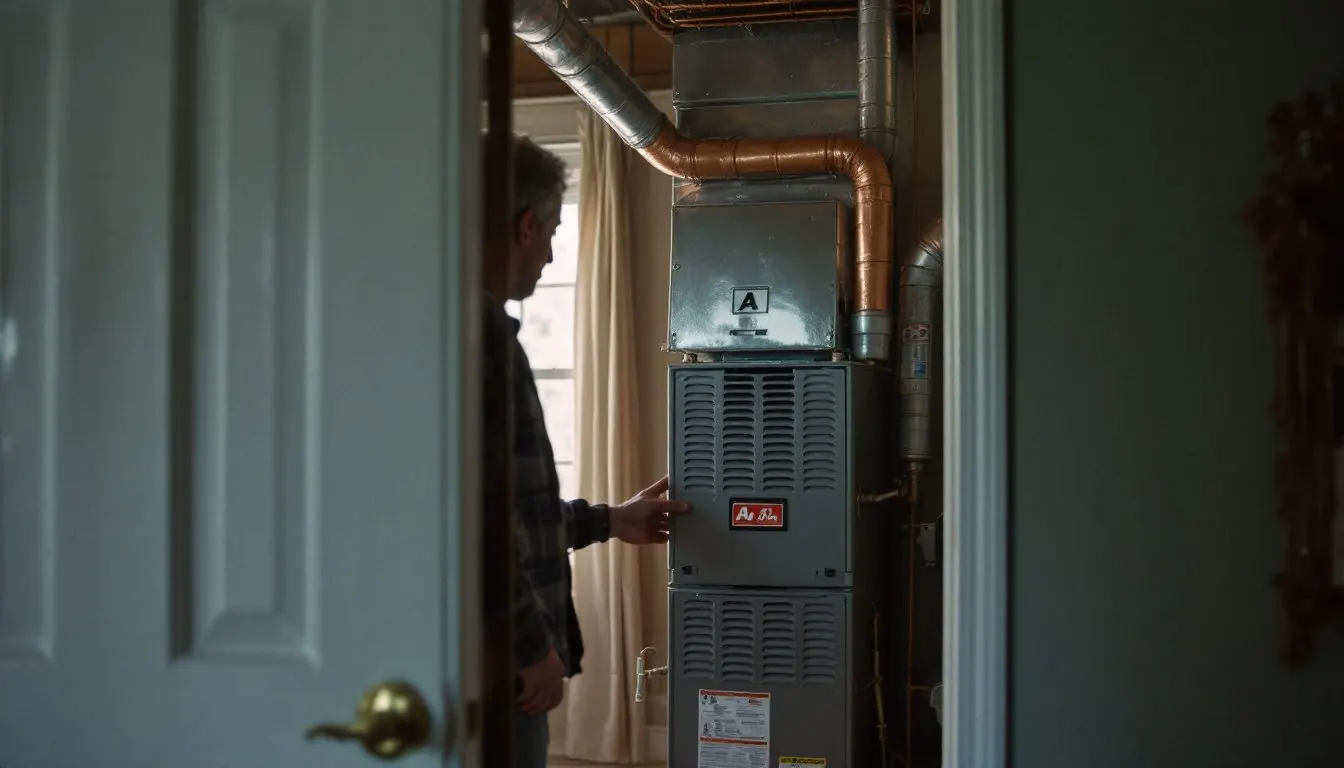
What happens if Freon leaks in your house? Usually nothing you can feel: a 3-ton central AC holds about 8.9 lb of refrigerant, which spreads to 0.40% of a 1,500 sq ft home’s air. The danger is a full release into a small closed room, where oxygen drops and new A2L refrigerants can reach their flammability limit.
“Freon” is a Chemours brand used on several blends, such as Freon 409A, so the R-number on your outdoor unit matters more than the word; our page on what refrigerant is covers the chemistry.
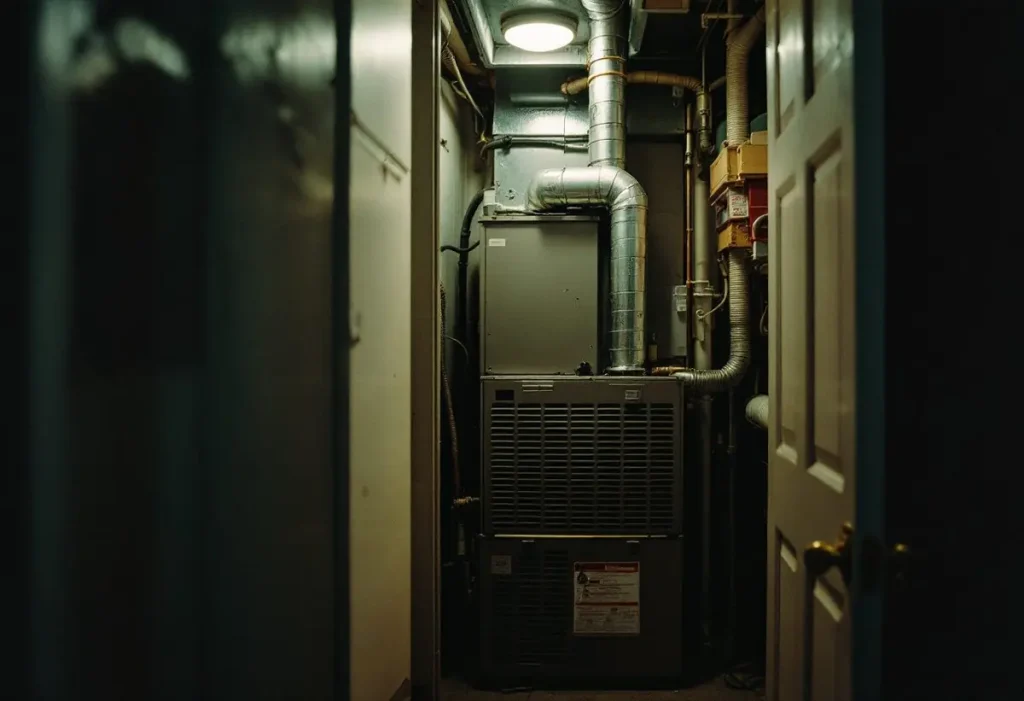
How much refrigerant could reach the air in a house, a bedroom or a furnace closet?
Far below the code’s limit in a whole house, about a third of it in a closed bedroom, and over it in a closed 5 x 6 ft closet. We took the factory charge Tempstar lists for its 3-ton NH4A4 air conditioner, 8.90 lb of R-410A, assumed all of it escaped and mixed evenly, and compared the result with the per-space refrigerant amounts in Table 1103.1 of the 2021 Seattle Mechanical Code, an International Mechanical Code reprint.
| Where 8.9 lb ends up | Refrigerant | Share of room air | Against the limit | Oxygen left |
|---|---|---|---|---|
| Whole house, 1,500 sq ft x 8 ft (12,000 cu ft) | R-410A | 0.40% | 3% of the 26 lb per 1,000 cu ft code amount | 20.8% |
| Bedroom, 12 x 10 x 8 ft (960 cu ft) | R-410A | 5.0% | 36% of the code amount | 19.9% |
| Furnace closet, 5 x 6 x 8 ft (240 cu ft) | R-410A | 20.0% | 143% of the code amount | 16.7% |
| Bedroom, same weight of older R-22 | R-22 | 4.2% | 71% of the 13 lb per 1,000 cu ft code amount | 20.0% |
| Bedroom, same weight of R-454B | R-454B | 5.8% | 51% of the 11.3% flammability limit; above the 2.83% evacuation line | 19.7% |
| Furnace closet, same weight of R-454B | R-454B | 23.2% | Inside the 11.3% to 23.6% flammable band | 16.1% |
HVAC Brief calculation: ideal gas at 77 F (24.45 L per mole), molar masses from the formulas (R-410A 72.58, R-22 86.47, R-454B 62.61 g per mole), charge mixed evenly. Oxygen left = 20.9% x (1 minus refrigerant share). R-22 and R-454B rows reuse 8.9 lb for comparison only.
Two things fall out of the math. In a bedroom, the code’s R-410A amount of 26 lb per 1,000 cu ft would take about 25 lb, nearly three times the whole 3-ton charge. And pushing that bedroom below the 19.5% oxygen line that 29 CFR 1910.134 calls oxygen deficient would take 11.9 lb, more than the charge itself. The furnace closet is the exception, and a closet beside the furnace is where many indoor coils sit.
Slow leaks are the common case, and they are milder still. A system that loses its whole 8.9 lb over 90 days averages 1.58 oz a day; one day’s loss mixed into 12,000 cu ft is about 44 ppm, against an occupational exposure limit of 1,000 ppm listed for R-410A in the same code table.
At what concentration does leaked refrigerant hurt someone: oxygen, heart rhythm or frostbite?
Harm starts at percent levels, not trace levels, through three routes that maker safety data sheets (SDS) describe.
Oxygen displacement. An R-410A SDS from Ability Refrigerants says that when oxygen is reduced to 12-14% by displacement, symptoms of asphyxiation, loss of coordination and faster pulse follow. By our math that takes 33% to 43% refrigerant in the air, more than even the closet row above. Both SDSs warn the vapor is heavier than air, so it collects low.
Heart rhythm. The Chemours Opteon XL41 (R-454B) SDS lists cardiac arrhythmia as its most important symptom and warns that misuse or intentional inhalation abuse may cause death without warning symptoms. The dog studies it reports put the no observed effect level for cardiac sensitization at 350000 ppm for the R-32 component and 120000 ppm for the R-1234yf component; the R-410A sheet gives a threshold above 100,000 ppm for pentafluoroethane. Chemours tells physicians to use epinephrine with special caution.
Cold and heat. Liquid refrigerant spraying from a fitting causes frostbite, per both sheets. The R-410A SDS adds that above 250 C, decomposition products may include hydrofluoric acid (HF) and carbonyl halides, which is why a leak near a burner or hot heat exchanger is more than an odor problem.
What does a Freon leak smell like, and can your nose or a CO alarm catch it?
Not reliably. The R-410A SDS describes a faint ethereal and faintly sweet odor, and the Chemours R-454B sheet says slight, ether-like; both list the odor threshold as not established or no data. The “chloroform” smell repeated on contractor blogs does not appear in either maker document. A carbon monoxide alarm is no help either: it is built to sense CO, and the CO alarm placement rules exist for combustion gas, not halocarbons.
What homeowners notice is the system: frost on the suction line, an iced coil or long run times with warm air. Our page on why an AC freezes up separates that from airflow causes such as a clogged filter.
Is a leak from a new R-454B or R-32 system a fire risk?
It can be, which is why those systems carry sensors and minimum room sizes. R-454B is classed A2L in Table 1103.1, and Chemours lists its lower flammability limit (LFL) at 11.3 %(V), with an upper limit of 23.6 %(V). Our table shows a full release into a closed closet landing inside that band; a release that circulates through the whole house lands at 0.46%, about 4% of the LFL.
EPA’s listing for R-454B in new home AC, Appendix W to 40 CFR part 82 subpart G, requires equipment to meet UL 60335-2-40, caps the charge by room size, and requires a “Minimum room area” marking near the indoor unit’s nameplate. It also says that above one-fourth of the LFL the space should be evacuated, and that room occupants should evacuate the space immediately following an accidental release. Per UL Solutions, the detection system responds at 25% of the LFL by running the evaporator fan to dilute the gas.
Lennox’s CK40CT R-454B coil instructions show the scale: a 10 lb charge needs 150.9 sq ft of minimum conditioned area, and the unit “must be powered except for service” so the sensor can run the blower. Shutting the breaker off on an A2L system disables the very fan meant to dilute a leak. Our R-454B explainer covers the rest of the A2L change.
What should you do in the first 15 minutes after you suspect a refrigerant leak?
Get people out of the small space, ventilate, and read the outdoor unit’s nameplate before deciding about power. The flow follows the Chemours first aid section, Appendix W and the Lennox powering rule.
Do not touch frost or liquid at a fitting; Chemours says to thaw frosted skin with lukewarm water and not rub it. In a utility room shared with a gas furnace or water heater, the HF note above 250 C is the reason to keep that door open.
What will the technician measure to find and fix the leak?
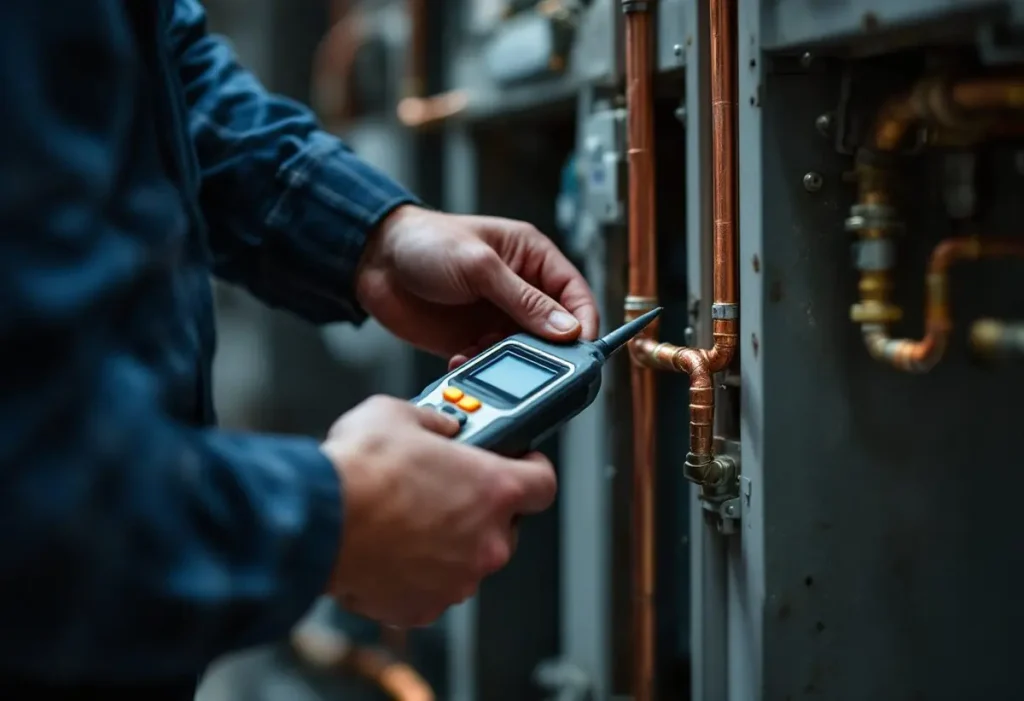
A competent visit proves the charge is low, finds the hole and closes it before refrigerant goes back in, as our refrigerant leak detection page details:
- Charge check by measurement. Superheat and subcooling readings against the maker’s chart, not a guess from pressure alone. Tempstar’s sheet notes its factory charge already covers 15 ft of 3/8 in. liquid line.
- Location. An electronic detector suited to the refrigerant, then bubble solution on the suspect joint; on A2L coils Lennox bans halide torches and other ignition sources during the search.
- Repair and proof. Recovery with certified equipment, as 40 CFR 82.154(b) requires, then repair, a nitrogen pressure hold, evacuation and a weighed charge.
If a quote offers refrigerant with no leak search, our page on whether an AC ever needs a recharge lists the questions to ask first.
Can you add Freon to your home AC unit yourself, or let a small leak go?
No on both counts under federal rules. 40 CFR 82.154(a) bars anyone maintaining, servicing or repairing an appliance from knowingly venting refrigerant, and 82.154(c) has barred sales of non-exempt substitute refrigerants such as R-410A since January 1, 2018 unless the buyer is a Section 608 certified technician or employs one. The EPA 608 certification guide explains the technician types.
No federal rule forces a homeowner to repair a slow leak: 40 CFR 84.106, in force from January 1, 2026, starts at a 15 lb full charge and excludes residential and light commercial AC, as our leak repair rules explainer shows. But every recharge without a repair sends the new refrigerant out through the same hole.
Frequently asked questions
How do I know if my AC unit is leaking Freon?
Look for frost on the larger insulated copper line, an iced indoor coil, oily stains at brazed joints or flare nuts, and long run times with warm air. Proof needs gauges: a technician compares superheat or subcooling with the maker’s chart, then sweeps with a detector. Tempstar’s NH4A4 sheet shows the factory charge already assumes 15 ft of 3/8 in. liquid line, so guessing by pressure misleads.
Can I buy Freon for my car and put it in myself?
Yes, in small cans. 40 CFR 82.154(c)(1)(ix) lets anyone buy car AC refrigerant in containers of two pounds or less with a unique fitting and, if made after January 1, 2018, a self-sealing valve that leaks no more than 3.00 grams per year. Refrigerant for home AC goes only to certified buyers, and a car that keeps losing charge still has a leak.
Can I add Freon to a portable air conditioner?
Not legally as an uncertified owner, since 40 CFR 82.154(c) limits refrigerant sales to certified technicians. Read the unit’s label first: 82.154(a)(1)(viii) lists propane (R-290) for self-contained room air conditioners, and Table 1103.1 rates propane-family refrigerants A3, the most flammable class. A portable unit that stops cooling usually needs a repair or replacement, not a top-up.
When should aircon Freon be refilled?
Never on a schedule. Refrigerant circulates in a sealed loop, so a system that needs more has a leak. Our math shows a 3-ton system losing its 8.9 lb charge over 90 days leaks about 1.58 oz a day, slow enough to go unnoticed until cooling fades. Find and fix the leak, then have a certified technician weigh in the charge.
How we researched this
Researched November 7 to 8, 2026, from the ten documents listed below, read in full where cited; UL 60335-2-40 itself is paywalled, so we cite the UL Solutions summary. Concentrations are our own ideal-gas calculations. Excluded: contractor blogs (no primary sources), the R-454B ppm figure in Table 1103.1 (it conflicts with the same row’s 22 lb per 1,000 cu ft), and Reddit (refrigerant safety topic).
Sources
- City of Seattle SDCI. “2021 Seattle Mechanical Code, Chapter 11 Refrigeration, Table 1103.1.” https://www.seattle.gov/documents/Departments/SDCI/Codes/MechanicalCode/2021SMCChapter11.pdf. Accessed November 2026.
- The Chemours Company (copy hosted by Hudson Technologies). “Opteon XL41 (R-454B) Refrigerant Safety Data Sheet, version 6.0, revised 03/05/2025.” https://www.hudsontech.com/pdfs/SDS/R-454B/R-454B_Chemours.pdf. Accessed November 2026.
- Ability Refrigerants. “R-410A Safety Data Sheet.” https://abilityrefrigerants.com/wp-content/uploads/2025/11/410ADSAR.pdf. Accessed November 2026.
- The Chemours Company (copy hosted by Sid Harvey). “Freon 409A (R-409A) Refrigerant Safety Data Sheet.” https://www.sidharvey.com/documents/Z1160.pdf. Accessed November 2026.
- Tempstar. “NH4A4 Horizontal Air Conditioner Product Specifications, 421 21 9703 03.” https://www.shareddocs.com/hvac/docs/1011/Public/06/42121970303.pdf. Accessed November 2026.
- Lennox Industries. “CK40CT Series Coils, R454B, Installation Instructions 508448-01.” https://www.lennox.com/dA/adcf7af85d/508448-01.pdf. Accessed November 2026.
- eCFR. “40 CFR 82.154, Prohibitions.” https://www.ecfr.gov/current/title-40/chapter-I/subchapter-C/part-82/subpart-F/section-82.154. Accessed November 2026.
- eCFR. “Appendix W to Subpart G of Part 82.” https://www.ecfr.gov/current/title-40/chapter-I/subchapter-C/part-82/subpart-G/appendix-Appendix%20W%20to%20Subpart%20G%20of%20Part%2082. Accessed November 2026.
- eCFR. “29 CFR 1910.134, Respiratory protection (definitions).” https://www.ecfr.gov/current/title-29/subtitle-B/chapter-XVII/part-1910/subpart-I/section-1910.134. Accessed November 2026.
- eCFR. “40 CFR 84.106, Leak repair.” https://www.ecfr.gov/current/title-40/chapter-I/subchapter-C/part-84/subpart-C/section-84.106. Accessed November 2026.
- UL Solutions. “Understanding UL 60335-2-40 Refrigerant Detector Requirements.” https://www.ul.com/news/understanding-ul-60335-2-40-refrigerant-detector-requirements. Accessed November 2026.
Leave a Reply