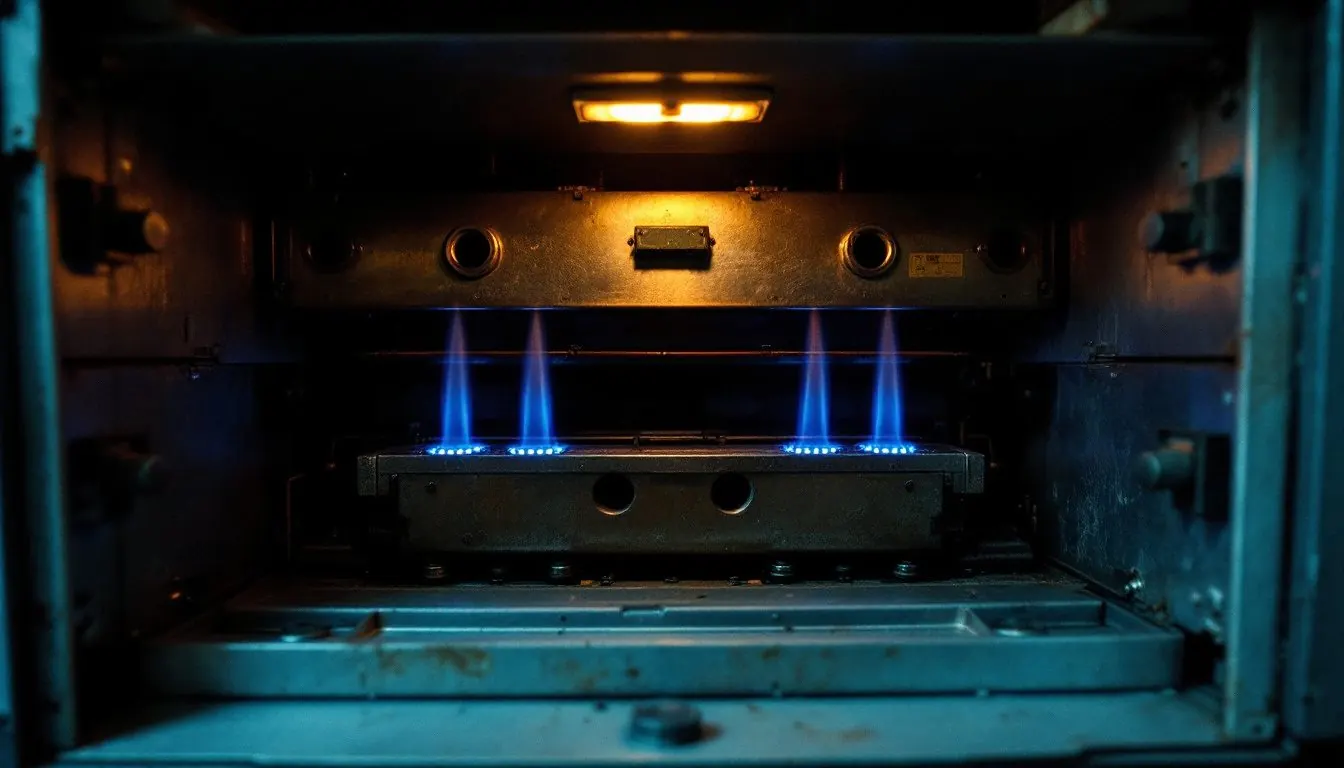
A furnace that makes a loud bang when turning on is usually lighting late: gas collects in the burner box for a second or more, then ignites at once. Carrier calls this delayed ignition and tells owners to shut the furnace down. A softer pop 30 seconds later, when the blower starts, is the ductwork.
When exactly does your furnace bang: at the flame, at the blower, or at shutdown?
Time the noise against the start sequence. In Goodman’s RS6612022R1 service manual for the GM9S96 family, a call for heat starts the inducer, then pre-purge, then the igniter warm-up, then the gas valve opens for a trial for ignition that “is 4 seconds.” The indoor blower comes on only “After 30 seconds” of flame. A boom at the flame and a pop half a minute later are different faults.
| When you hear it | What made it | Risk | What to do now | What the technician checks |
|---|---|---|---|---|
| Loud boom or whoomp as the burners light, before the blower runs | Delayed ignition: gas and air pile up, then light at once | High: Goodman warns it may explode or roll out | Furnace switch off; no more resets | Gas pressure, burner seating, carryover, orifices |
| Bang plus the furnace quits and the blower keeps running | Flame rollout control opened after the bang | High: flame left the burner area | Leave it off; note the flash code | Rollout switch, then the cause of the rollout |
| Pop about 30 s after the flame, as the blower starts | A flat duct panel snapping under supply pressure | Low: noise, not combustion | Check filter and registers | Static pressure, duct stiffening |
| Pop the moment the burners shut off | Extinction pop: flame burning back into the burner as gas cuts off | Moderate: same checklist as flashback | Book service | Gas pressure, burner alignment, orifices |
| Pop when the blower stops, 30 to 180 s after the flame | Duct panel springing back flat | Low | Same as the start pop | Static pressure, duct stiffening |
Compiled by The HVAC Brief from Goodman RS6612022R1 (sequence, 4 s trial, 30 s blower delay, 15 s post-purge, 30 to 180 s blower off delay, flashback and delayed ignition checklists, rollout flash code) and Carrier OM58-131. Other boards use other delays.
Why does gas light late and go off with a bang?
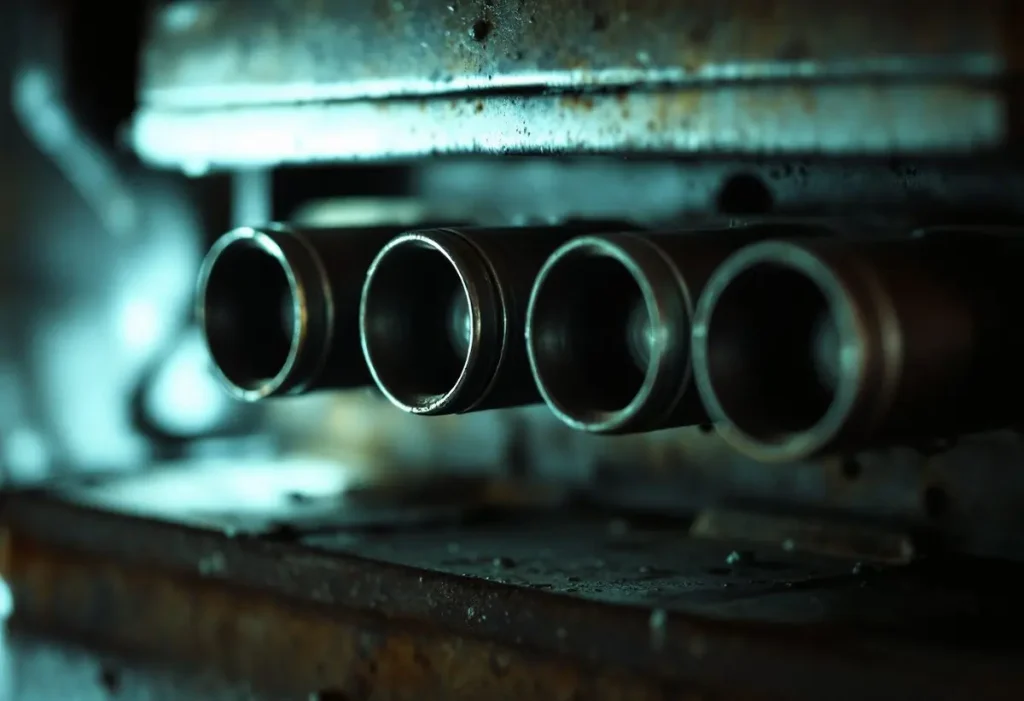
Because gas flows before flame reaches every burner. Goodman defines delayed ignition as “a delay in lighting a combustible mixture of gas and air which has accumulated in the combustion chamber,” and Goodman’s older RS6610004 service instructions for its 80, 90 and 95% furnaces add that “When the mixture does ignite, it may explode and/or rollout causing burning in the burner venturi.” Carrier’s OM58-131 owner’s manual says “Buildups on the main burners can cause faulty firing” and that this delayed ignition “is characterized by an alarmingly loud sound.”
Goodman’s service checklist names four causes, in this order:
- Improper gas pressure, adjusted to the specified setting.
- Improper burner positioning: burners “should be in locating slots, level front to rear and left to right.”
- “Carry over (lighter tube or cross lighter) obstructed”, which is cleaned.
- “Main burner orifice(s) deformed, or out of alignment to burner”, which are replaced.
The carryover is the slotted path that passes flame from the burner next to the igniter to the far burners. Goodman tells servicers to look for “signs of rust, oversized and undersized carry over ports restricted with foreign material”; when those slots are blocked, the first burner lights on time and the far ones keep flowing gas until the flame finally jumps across. Goodman also notes the design “makes this extremely unlikely unless safety controls have been by-passed or tampered with,” so a repeat bang on a Goodman unit is a reason to ask what was changed. A weak hot surface igniter is worth testing on the same visit.
How much gas is in the burner box when ignition runs 4 seconds late?
Between about 1 and 3 liters of natural gas on a typical home furnace, by our arithmetic. We took rated input, divided by the heating values Goodman uses (1,025 Btu per cubic foot natural gas, 2,500 for propane) and by 3,600 seconds, then converted with NIST SP 811 (1 cubic foot = 28.31685 L).
| Furnace input | Natural gas per second | Natural gas over a 4 s trial | Propane per second | Propane over a 4 s trial |
|---|---|---|---|---|
| 40,000 Btu/h | 0.31 L | 1.2 L | 0.13 L | 0.5 L |
| 60,000 Btu/h | 0.46 L | 1.8 L | 0.19 L | 0.8 L |
| 80,000 Btu/h | 0.61 L | 2.5 L | 0.25 L | 1.0 L |
| 100,000 Btu/h | 0.77 L | 3.1 L | 0.31 L | 1.3 L |
HVAC Brief calculation: input (Btu/h) / heating value (Btu per cu ft) / 3,600 s x 28.31685 L per cu ft. Upper bounds: it assumes full rated flow from the instant the valve opens. Script: flb-calc.py.
An 80,000 Btu/h furnace’s 2.5 L is more than a 2 liter soda bottle of gas, lit all at once inside a closed burner box. The Consumer Product Safety Commission has recalled other gas appliances for exactly this: Valor fireplaces in 2020 where gas could “accumulate prior to burner ignition” and the glass “shatter,” and Burnham Commercial boilers in 2023 because “Delayed ignition and/or flame rollout can occur with the boilers, posing a burn hazard.” Neither recall covers a furnace.
Is a furnace that bangs on startup safe to keep running?
No. Carrier’s instruction is plain: “If your furnace makes a loud noise when the main burners are ignited, shut down the furnace and call your servicing dealer.” Each late light can push flame out of the burner area, which is what the rollout switch is there to catch; Goodman’s rollout control “is designed to open should a flame roll out occur,” and when it opens “the air circulation blower will run continuously” while the board flashes six times.
Turn the furnace off, leave the rollout button alone, and do not cycle the thermostat to hear it again. If you smell gas, Carrier’s manual says to leave the building and call the gas supplier from a nearby phone. Carrier recommends a CO alarm in the living area even without a gas appliance; our guide to CO alarm placement gives the code rules.
What will the technician measure on a furnace that bangs?
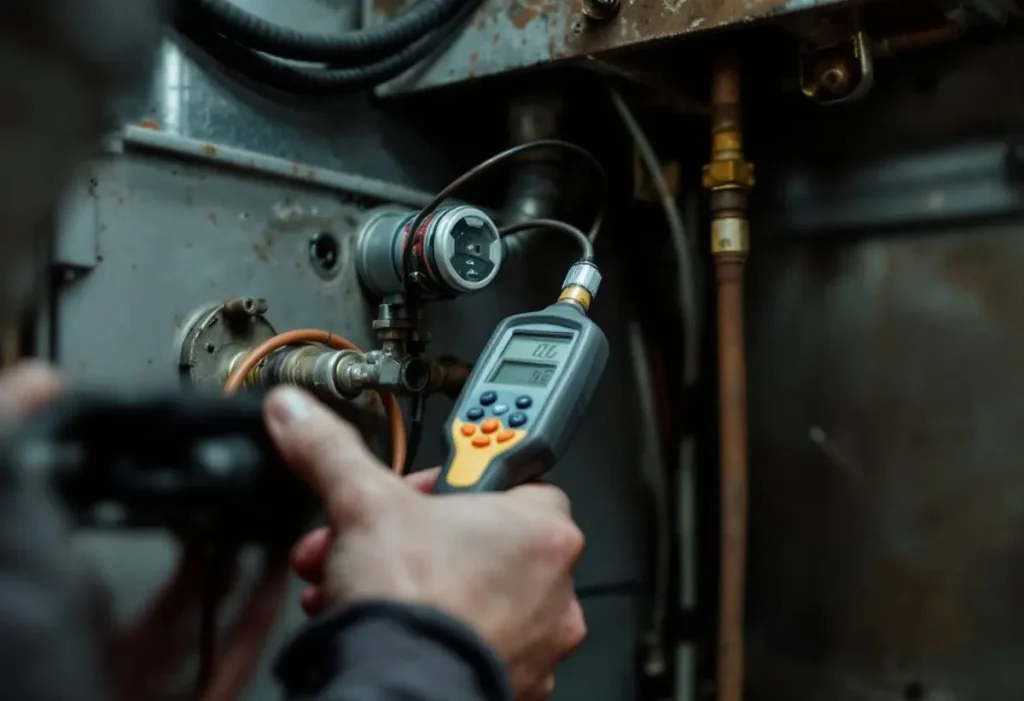
Gas pressure first, by manometer at the gas valve inlet and outlet taps, because both of Goodman’s checklists start there. Goodman’s numbers for the GM9S96 family:
| Reading | Natural gas | Propane | Why it matters for a bang |
|---|---|---|---|
| Inlet (supply) pressure | 4.5 to 10.0 in. w.c. | 11.0 to 13.0 in. w.c. | Goodman: the minimum must be held “to prevent unreliable ignition” |
| Manifold pressure, burners firing | 3.5 in. w.c. | 10.0 in. w.c. | Must not vary more than plus or minus 0.3 in. w.c. |
| Factory orifices | #45 on single stage models | Propane kit orifices | Goodman: never peened over and redrilled |
Compiled by The HVAC Brief from Goodman RS6612022R1. The rating plate wins over any table; the same manual prints an older caution of 3 in. w.c. plus or minus 0.2 for natural gas next to the 3.5 setting.
Then the burners: seated in their slots, carryover slots clean (Goodman says cross-over slots “should not be altered in size”), orifices checked with sizing drills. Ask the technician to watch several ignitions and time how long the flame takes to cross every burner. Repeated rollout is also a reason to inspect the heat exchanger.
Why does the furnace make a loud bang when shutting off?
If it pops the instant the flame goes out, it is the burners. Goodman: “Flashback may occur at the moment of ignition, after a burner heats up or when the burner turns off. The latter is known as extinction pop.” Its fix list is gas pressure, burner alignment and orifice size.
A bang a minute or more later, when the air stops, is sheet metal. Goodman’s blower runs on for 90 seconds by default after the burners shut off. That pop and the one 30 seconds after the flame belong to ductwork popping, which covers the fixes.
Why would an electric furnace make a loud bang when it turns on?
Not from ignition: there is no gas. In the Nordyne E2 series service manual (hosted by InspectApedia), a thermostat call heats a bimetal in the sequencer, which “completes the circuit to the no.1 element and the blower motor,”. The blower starts with the first element, so a bang right at startup on an electric furnace is almost always a duct panel loading up, with no 30 second wait.
Sequencers click rather than bang, and a slow one is normal: Nordyne allows “a maximum time (110 seconds)” for the sequencer heater to close its contacts.
Is an oil furnace bang the same as a gas furnace bang?
It is the oil burner’s version, called a puffback. Causes and cleanup differ from gas, so we cover them in oil furnace puffback. The owner rule is the same as Carrier’s for gas: shut it off and do not keep pressing reset.
Frequently asked questions
Why does my gas furnace make a loud bang?
Most often because the burners light late. Goodman defines delayed ignition as a delay in lighting a combustible mixture of gas and air that has accumulated in the combustion chamber, and warns it may explode or roll out. Carrier’s OM58-131 owner’s manual says the sound is alarmingly loud and tells owners to shut the furnace down and call the dealer.
When your furnace makes a loud bang, should you press the reset button?
No. Goodman’s flame rollout control is a manual reset switch at the burners, and its manual says never to bypass or alter furnace controls. On Goodman single stage boards the light flashes six times for a rollout trip. Carrier tells owners that if a manual reset limit trips a second time, turn the furnace off and call for service.
Does ductwork bang when the furnace shuts off too?
It can, but not when the flame goes out. On the Goodman GM9S96 family the blower keeps running for an off delay of 90 seconds by default, adjustable from 30 to 180 seconds. A pop at the end of that delay is a duct panel springing back; a pop the instant the burners shut off points to the burners.
How we researched this
We read the Goodman RS6612022R1 service and troubleshooting manual (GM9S92, GM9S96, GC9S96 and Amana equivalents), Goodman service instructions RS6610004, Carrier owner’s manual OM58-131 (induced combustion furnaces, 2010), the Nordyne E2 electric furnace service manual, two CPSC recall notices and NIST SP 811. Contractor blogs, forums and video in the current results cite no maker document and were excluded. Research date: November 14, 2026.
Sources
- Goodman Manufacturing. “Service and Troubleshooting: GM9S92 / GM9S96 / GC9S96 Single Stage Gas Furnaces (RS6612022R1).” https://mobile.goodmanmfg.com/mobileapp/stellent/pdf/infoPdf/Lit/RS6612022R1.pdf. Accessed November 2026.
- Goodman Manufacturing. “Service Instructions: 80%, 90%, 95% Gas Furnaces and Accessories (RS6610004 Rev. 9).” https://s3.amazonaws.com/s3.supplyhouse.com/product_files/Goodman-GMS951155DXA-Install-Instructions.pdf. Accessed November 2026.
- Carrier Corporation. “Induced Combustion Gas Furnace Owner’s Manual (OM58-131).” https://www.shareddocs.com/hvac/docs/1009/Public/01/OM58-131.pdf. Accessed November 2026.
- Nordyne (hosted by InspectApedia). “E2 Series Electric Furnaces Service Manual.” https://inspectapedia.com/heat/Nordyne-Electric-Furnace-Manual-E2.pdf. Accessed November 2026.
- U.S. Consumer Product Safety Commission. “Burnham Commercial Recalls Natural Gas Boilers Due to Burn Hazard.” https://www.cpsc.gov/Recalls/2023/Burnham-Commercial-Recalls-Natural-Gas-Boilers-Due-to-Burn-Hazard-Recall-Alert. Accessed November 2026.
- U.S. Consumer Product Safety Commission. “Miles Industries Recalls Gas Fireplaces Due to Burn and Laceration Hazards.” https://www.cpsc.gov/Recalls/2020/Miles-Industries-Recalls-Gas-Fireplaces-Due-to-Burn-and-Laceration-Hazards-Recall-Alert. Accessed November 2026.
- National Institute of Standards and Technology. “NIST Guide to the SI, Appendix B.8: Factors for Units Listed Alphabetically.” https://www.nist.gov/pml/special-publication-811/nist-guide-si-appendix-b-conversion-factors/nist-guide-si-appendix-b8. Accessed November 2026.
Leave a Reply