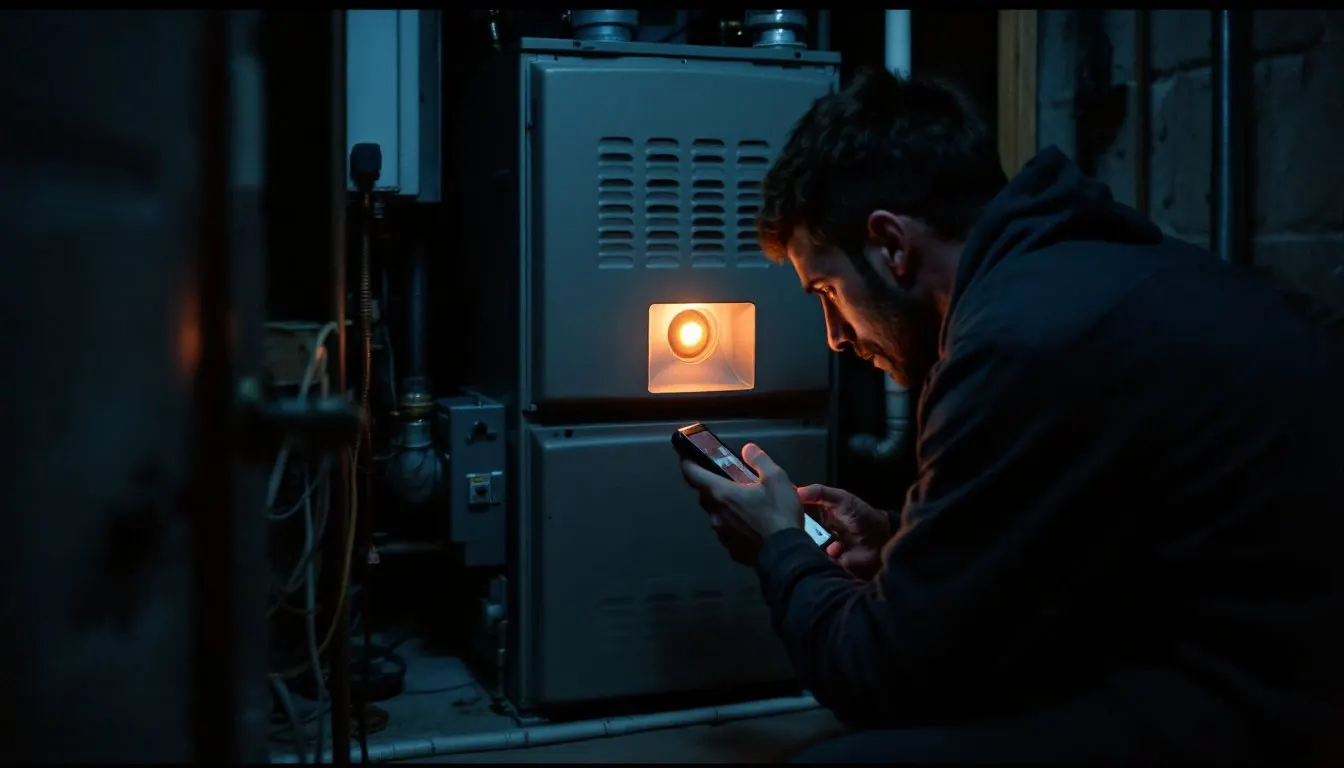
Carrier furnace error codes are two-digit status codes flashed by the control board LED: short flashes give the first digit, long flashes the second. So 3 short 1 long is code 31, a pressure switch fault, and 1 short 4 long is code 14, ignition lockout. Some meanings change by model series.
What does each Carrier flash pattern mean?
Find your pattern, then check the series table: a 1999 58MVP or 2023 59SC6A reads differently. Wording is from the Carrier 59TP6B troubleshooting guide.
| Flash pattern | Code | Carrier’s wording | Likely part | Safe owner check | Technician job |
|---|---|---|---|---|---|
| Steady on | none | Control has 24VAC power | None | Thermostat calling for heat | 24V at W/W1 |
| Rapid, no pause | none | Line voltage polarity reversed | House wiring | None: 115V work | Correct polarity; 24V phasing if twinned |
| Off | none | Check for 115VAC at L1 and L2, 24VAC at SEC-1 and SEC-2 | Breaker, door switch, transformer | Breaker on, door seated | Meter both voltages |
| 1 short, 1 long | 11 | No previous code | None | Run a heating cycle | Run all cycles |
| 1 short, 2 long | 12 | Blower on after power up | None: normal operation | Stops after 90 seconds | None |
| 1 short, 3 long | 13 | Limit circuit lockout | Limit or rollout switch | Filter | Work code 33 |
| 1 short, 4 long | 14 | Ignition lockout | Igniter, flame sensor, gas valve | Gas shut-off open | Work code 34 |
| 1 short, 5 long | 15 | Blower motor lockout | Blower motor, wiring | None | Under 250 RPM, or no signal in 30 seconds |
| 2 short, 1 long | 21 | Gas heating lockout | Gas valve relay or wire | Power off 5 minutes, retry once | Stuck relay, miswire, short |
| 2 short, 2 long | 22 | Abnormal flame-proving signal | Gas valve | Stop: no reset | Stuck open or leaky valve |
| 2 short, 3 long | 23 | Pressure switch did not open | Tube or switch | None | Obstructed tube, stuck switch |
| 2 short, 4 long | 24 | Secondary voltage fuse is open | 24V wiring, fuse | Pinched thermostat wire | Disconnect thermostat leads to isolate |
| 2 short, 5 long | 25 | Invalid model selection or setup error | Model plug PL4, setup switches | None | 4 flashes at power-up: PL4 missing |
| 3 short, 1 long | 31 | High-heat pressure switch or relay did not close or reopened | Relay, then the code 32 list | As code 32 | Relay, valve wiring, then code 32 |
| 3 short, 2 long | 32 | Low-heat pressure switch did not close or reopened | Vent, inducer, tubing, drain, switch | Outdoor vent clear, drain hose unkinked | Vent sizing, inducer voltage, inlet pressure |
| 3 short, 3 long | 33 | Limit circuit fault | Limit or rollout switch, blower wheel | Filter, closed registers | Gas input, loose wheel, limit gasket |
| 3 short, 4 long | 34 | Ignition proving failure | Flame sensor, igniter, gas valve | Gas shut-off open | Component test, sensor microamps |
| 3 short, 5 long | 35 (59MN7B) | Gas valve fault | Modulating valve wiring | None | Wires at valve and PL8 |
| 4 short, 1 long | 41 (58MVC, 59MN7B) | Blower motor fault | Blower wheel, motor | None | Rubbing or loose wheel, wiring |
| 4 short, 2 long | 42 (58MVC, 59MN7B) | Inducer motor fault | Inducer motor | Outdoor vent clear | No start in 20 seconds, vent sizing |
| 4 short, 3 long | 43 | Low-heat pressure switch open while high-heat pressure switch is closed | Low-heat switch, tubing | Drain hose unkinked | Stuck switch, miswiring |
| 4 short, 5 long | 45 | Control circuitry lockout | Control board | Reset power once | Replace control if it repeats |
How do you count short and long flashes on a Carrier LED?
Count the short flashes first, then the long ones. Carrier’s manual says: “The first digit is the number of short flashes, the second digit is the number of long flashes.” So 3 short 2 long is 32, never 23. Older Heil boards also split short and long flashes, with a plus sign between them, but their numbers do not match the Carrier list, as the Heil furnace error codes show.
Read the LED through the door indicator before touching anything, because the 59TP6B door switch cuts 115V to the control. A Carrier Infinity thermostat also draws its power from the furnace or fan coil, which is why a Carrier thermostat blank screen on that line sends you to the indoor unit first. The 58MEC label warns against removing power or the door on RED LED controls before a recall.
The exception is the 58MVP guide, Form 58MVP-8SM, whose board counts the “yellow LED” for the first digit and the green LED for the second. A chart claiming every Carrier uses yellow and green is describing that older board. Lennox has a similar history, with older boards that flash a red and a green LED and current ones that show Lennox furnace error codes on a display.
Does Carrier code 31 (3 short 1 long) mean the pressure switch is bad?
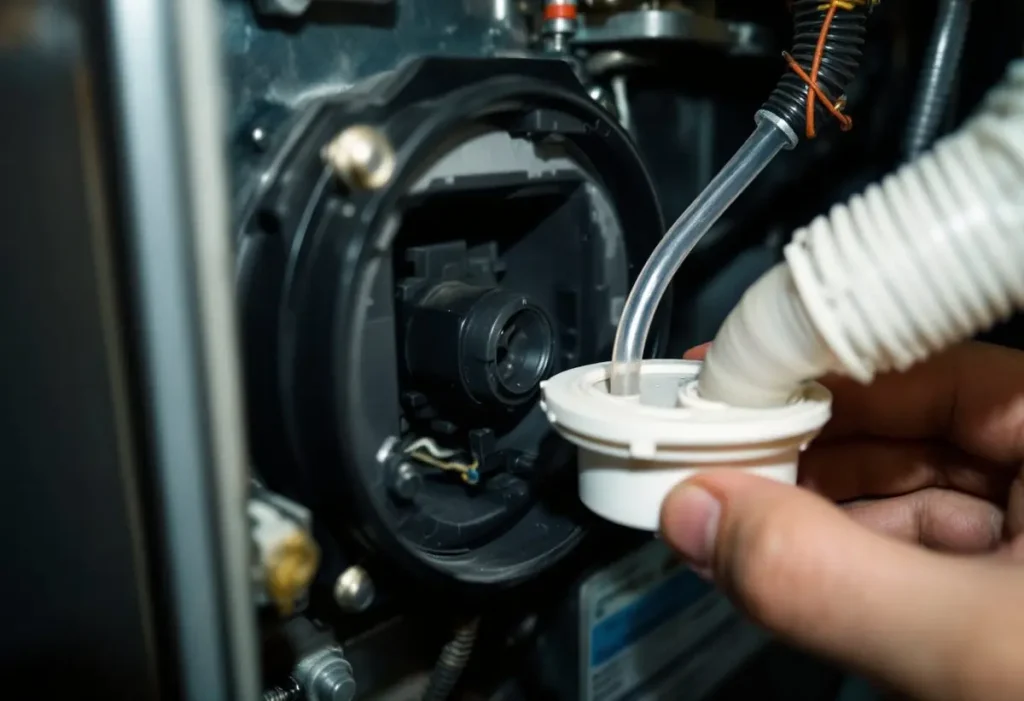
Not by itself. On the 59TP6B, code 31 lists a defective control relay and a miswired gas valve, then points to code 32, where a bad or miswired switch is one of 11 items. The rest include vent sizing, a restricted vent, tubing, wind, a plugged condensate drain, water in the vent and the inducer motor.
A technician clears those before buying a part: the pressure switch and hose checks and the inducer motor test cover both sides.
Why did my Carrier code change from 33 to 13, or from 34 to 14?
Because 33 and 34 are faults, and 13 and 14 are the lockouts that follow when the control quits retrying. Code 33 becomes 13 when a limit stays open past 3 minutes, or after 10 successive limit trips in high heat. Code 34 repeats ignition 3 more times, then becomes 14.
The 59TP6B auto-resets 13, 14 and 15 after 3 hours and 45 after 1 hour, so a furnace that fixed itself may have only timed out. Read about resetting a lockout, limit switch trips, the igniter glow test and the flame sensor microamp check.
Which Carrier furnace has which code set?
Read the model on the rating plate, then find its row.
| Series (manual date) | Display | What code 31 says | Beyond the common set | Stored-code recall |
|---|---|---|---|---|
| 58MVP (9-99) | Yellow and green LEDs | High pressure switch fault | 12, 21, 22, 23 differ; adds 41 to 44 | SW-1 on |
| 58MEC (09/09) | One LED | High-heat switch or relay | 43, 45 | Main limit wire: 5 codes |
| 58MVC (07/07) | One amber LED | Medium-heat switch or HPSR relay | 15, 25, 41, 42, 43, 45 | SW1-1 on |
| 59TP6B (04/19) | One amber LED | High-heat switch or relay | 15, 25, 43, 45 | SW1-1 on: 7 codes |
| 59MN7B (1/19) | One amber LED | Medium or high switch, or PSR relay | 15, 25, 35, 41, 42, 43, 45 | SW1-1 on: 7 codes |
| 59SC2D (03/19) | One LED | HPS pressure switch | 45 | Limit wire or TEST/TWIN jumper |
| 59SP6A (06/23) | One LED | HPS pressure switch | 25, 45 | SW1-1 on: 7 codes |
| 59SC6A (06/23) | Three-digit display plus LED | 31.2 open HPS; 31.3 HPS lockout | Minor digits; adds 10.1, 27, 46 | FLt menu: 7 faults |
On the 58MVP, code 22 is a setup error; on later boards it means flame with the valve off. The 59TP6B label says code 15 should “See code 41,” but its guide prints no 41 section. And the 59SC6A LED flashes only the major code, so 3 short 1 long could be 31.2 or 31.3.
How do you pull the last 7 fault codes from a Carrier board?
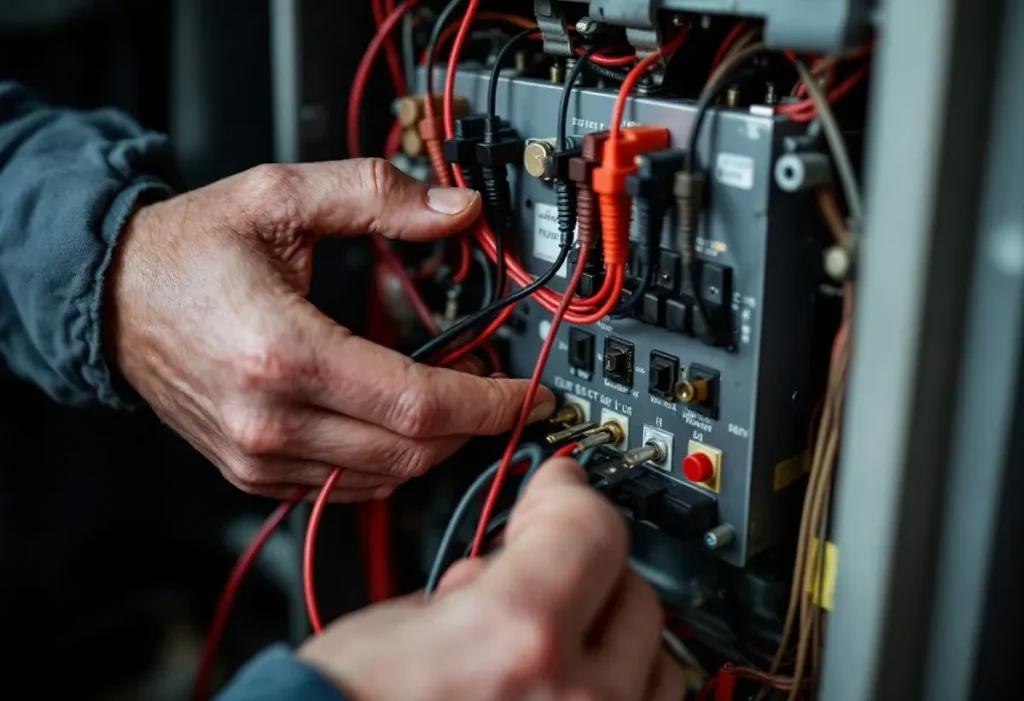
On the 59TP6B and 59SP6A, set SW1-1 on with no thermostat call and the door switch held closed: the control flashes up to 7 codes, ending on 11. With the door off, 115V is exposed and Carrier warns “Caution must be taken,” so this is technician work.
Methods conflict by board. The 59TP6B manual says codes “cannot be retrieved by disconnecting the limit switch,” yet that is how the 59SC2D and 58MEC recall them. Stored codes erase after 72 hours on the 59TP6B. The SW1-6 component test runs the igniter for 15 seconds, which splits igniter from gas valve on code 34; control board checks come after that.
Which Carrier codes mean stop instead of reset?
Code 22, code 33 with an open rollout switch, and any code with a gas smell. If you smell gas, leave the house and call the gas utility.
Code 22: Carrier says flame is proved while the gas valve is de-energized, and points at a “stuck open or leaky gas valve.” It is not a flame sensor cleaning job. Close the gas shut-off and book service.
Code 33, rollout: The 59SC6A manual says to correct combustion air, gas pressure, burner position or venting before resetting, and the 59TP6B manual says “DO NOT jumper this switch.” Leave the reset button to the technician.
Do Bryant, Payne and Day & Night furnaces use Carrier’s codes?
Partly confirmed, and only for what we opened. The Bryant 350MAV manual uses the same headings for 13, 14, 33, 34 and 45, though its 31 reads “pressure switch did not close or reopened.” The Payne PG9MAA page prints no code table. We read no Day & Night document, even though Carrier’s group holds all three names. Use your own door label, and do not read Goodman’s codes with this table.
Frequently asked questions
What does 3 short 2 long mean on a Carrier furnace?
That is code 32, low-heat pressure switch did not close or reopened. If the switch stays open longer than 5 minutes, the 59TP6B inducer shuts off for 15 minutes before retrying. Check the outdoor vent and condensate drain hose before suspecting the switch.
What does 3 short 4 long mean on a Carrier furnace?
That is code 34, ignition proving failure: no flame was sensed during the trial for ignition. The control repeats the sequence 3 more times before lockout 14. Carrier’s 59TP6B guide gives nominal flame sensor current as 4.0 to 6.0 microamps and flags readings below 0.5.
Where is the Carrier furnace error codes list PDF?
Your furnace carries the list as the service label on the blower door, and the installation manual prints it in its troubleshooting guide. On the 59TP6B PDF, those are pages 88 and 89. Match the model and series on your rating plate before trusting any list.
How we researched this
On 5 November 2026 we read status labels and troubleshooting guides in eight Carrier manuals dated 1999 to 2023 and one Bryant and one Payne page. We could not open a 58TP manual, so it has no row. We excluded error code sites, contractor blogs and forums: several contradict Carrier’s labels. No furnace was tested.
Sources
- Carrier. “59TP6B Instructions, 59TP6B-01SI, 04/19.” https://www.shareddocs.com/hvac/docs/1009/public/0d/59tp6b-01si.pdf. Accessed November 2026.
- Carrier. “58MVP Troubleshooting Guide, Form 58MVP-8SM, 9-99.” https://www.shareddocs.com/hvac/docs/1009/public/0b/58mvp-8sm.pdf. Accessed November 2026.
- Carrier. “58MEC Service and Maintenance Instructions, 09/09.” https://www.shareddocs.com/hvac/docs/1009/public/0a/58mec-01sm.pdf. Accessed November 2026.
- Carrier. “58MVC Service and Maintenance Procedures, 07/07.” https://www.shareddocs.com/hvac/docs/1009/public/0f/58mvc-01sm.pdf. Accessed November 2026.
- Carrier. “59MN7B Instructions, 1/19.” https://www.shareddocs.com/hvac/docs/1009/public/0a/59mn7b-01si.pdf. Accessed November 2026.
- Carrier. “59SC2D Instructions, 03/19.” https://www.shareddocs.com/hvac/docs/1009/public/05/59sc2d-01si.pdf. Accessed November 2026.
- Carrier. “59SP6A Instructions, Rev D, 06/23.” https://www.shareddocs.com/hvac/docs/1009/public/0c/59sp6a-01si.pdf. Accessed November 2026.
- Carrier. “59SC6A Instructions, Rev D, 06/23.” https://www.shareddocs.com/hvac/docs/1009/public/0a/59sc6a-01si.pdf. Accessed November 2026.
- Bryant via ManualsLib. “350MAV Service Procedures, page 15.” https://www.manualslib.com/manual/457870/Bryant-350mav.html?page=15. Accessed November 2026.
- Payne via ManualsLib. “PG9MAA User’s Manual, page 12.” https://www.manualslib.com/manual/760258/Payne-Pg9maa.html?page=12. Accessed November 2026.
Leave a Reply