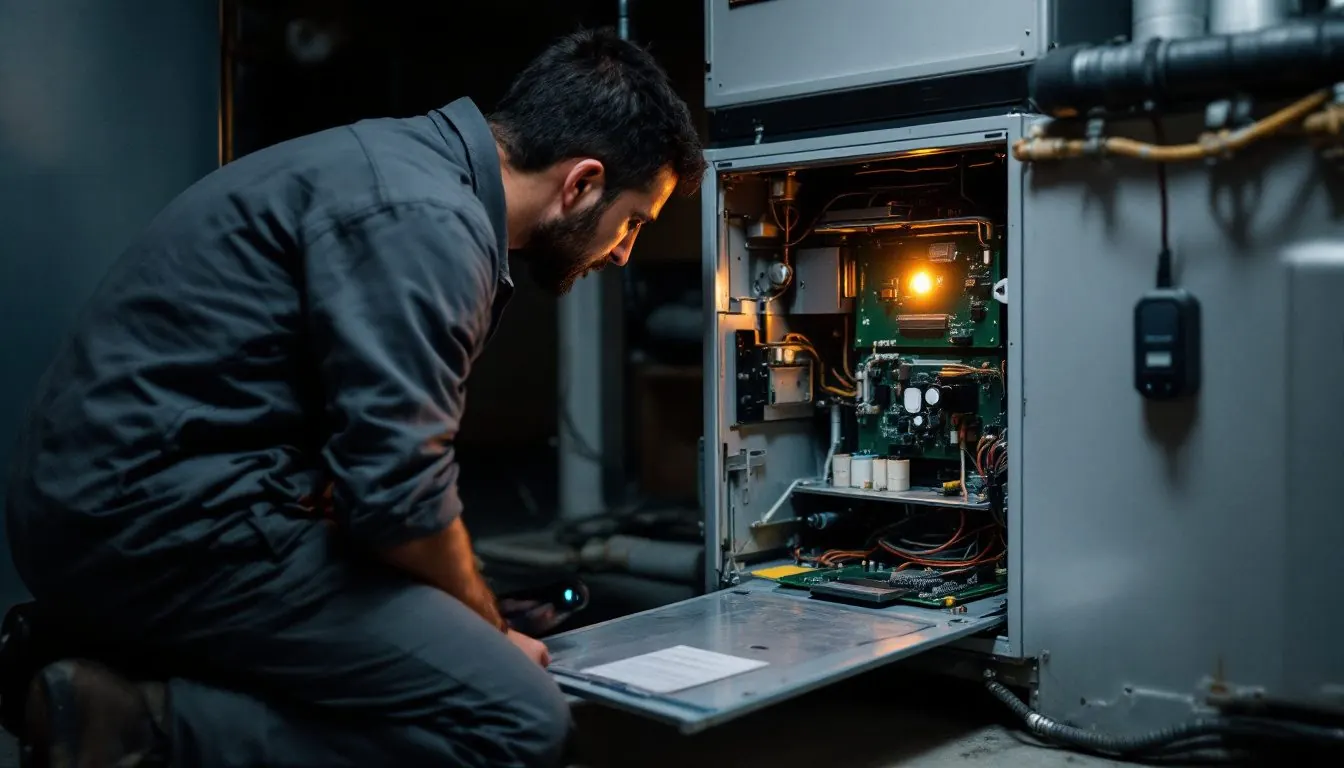
Heil furnace error codes come in two formats. N9MSE, N80ESN, N95ESN and G96VTN boards flash a 1 or 2 digit code, short flashes first and long flashes after a plus sign: 3 means the pressure switch did not close, 4 an open limit, 6 an ignition failure. The newer N96MSN displays major.minor codes such as 33.1 and 13.1.
Which Heil code system is on your furnace: flash codes with a plus sign, or a 3 digit display?
If the control board has a small screen showing idL, Ht or a number with a decimal point, it is the 3 digit board in the N96MSN manual (archived copy); if there is only a light behind the sight glass, use the plus code table. The digits differ: 3 on older boards is a pressure switch fault, 33.1 on the N96MSN an open limit.
What does each Heil flash code mean on N9MSE, N80ESN, N95ESN and G96VTN boards?
Each code is a count of short flashes, plus long flashes after a plus sign, in ICP’s label wording. Rows marked with a series appear only on that label; the rest are on all four: the N9MSE service manual (Figure 14), the N95ESN (Fig. 62), the N80ESN (Fig. 44) and the G96VTN (Fig. 67).
| Code (flashes) | ICP wording | Likely part | Owner check | Technician job |
|---|---|---|---|---|
| 2 | Pressure switch did not open | Switch, tubing | None | Tubing blocked, switch stuck closed |
| 3 | Pressure switch did not close or reopened | Vent, inducer, drain, switch | Vent and intake clear; drain flowing | Vent sizing, inducer voltage, gas pressure |
| 4 | Limit circuit fault: a limit or flame rollout is open | Filter, ducts, blower, rollout | Filter, registers open. Never reset a rollout | Gas input, blower wheel, rollout cause |
| 5 | Abnormal flame proving signal | Gas valve leaking or stuck open | None: call | Replace valve |
| 6 | Ignition proving failure | Flame sensor, igniter, gas | Furnace gas shut off open | Sensor current, igniter, ground |
| 7 | Limit circuit lockout | As code 4 | As code 4 | As code 4 |
| 8 | Gas heating lockout | Valve wiring, valve relay | None | Miswire, control |
| 9 (N95ESN, G96VTN) | HPS pressure switch did not close or reopened | High heat switch, HPSR relay (G96VTN) | As code 3 | As code 3 |
| 10 | Polarity: line voltage (115VAC) polarity reversed | House wiring | None | Correct polarity |
| 1+2 | Blower on after power up | Normal: blower runs for 90 seconds | None | None |
| 6+1 | Ignition lockout | As code 6 | As code 6 | As code 6 |
| 2+5 (G96VTN) | Model selection or setup error | Model plug PL4, SW1-1, SW1-6 | None | Correct plug |
| 4+3 (G96VTN) | Low heat pressure switch open while high heat pressure switch is closed | Drain, switches | Drain flowing | Stuck switch, wiring |
Three steady states carry no number. A heartbeat (bright, dim) means the control has 24VAC power. A dark LED means the secondary voltage fuse is open or power is missing; the label lists the door switch and a 3A fuse. ON SOLID is a control circuitry lockout that resets after one hour, and ICP says to replace the control board if the code repeats.
What do Heil codes 13.1, 33.1 and the other N96MSN display codes mean?
On the N96MSN, 33.1 means “A switch has opened in the Main Limit circuit” and 13.1 means the limit lockout that follows when that switch stays open longer than 3 minutes. The manual says the major code fills the first 2 digits and the minor code the third, and the LED through the door flashes only the major code as short then long flashes.
N96MSN major.minor codes (tap to close)
| Display | LED | ICP wording |
|---|---|---|
| 10.1 | Rapid flash | L1 polarity fault |
| 12.1 | 1 short, 2 long | W on at power up |
| 13.1 | 1 short, 3 long | Limit Lockout: switch open longer than 3 minutes in Main Limit circuit |
| 14.1 | 1 short, 4 long | Ignition Lockout after 4 consecutive ignition tries |
| 14.2, 14.3 | 1 short, 4 long | Flame lost 3 times after 70s of heating; 7 loss of flame events |
| 21.1 | 2 short, 1 long | 24VAC sensed on gas valve when shouldn’t be |
| 22.1 | 2 short, 2 long | False flame |
| 23.1, 23.2 | 2 short, 3 long | Stuck closed Main pressure switch; stuck closed secondary pressure switch |
| 24.1 | 2 short, 4 long | Fuse fault |
| 25.x, 27.x | 2 short, 5 or 7 long | Program, installer setting or super plug faults |
| 31.2, 31.3 | 3 short, 1 long | Open secondary pressure switch (HPS); lockout after three trials |
| 32.1 | 3 short, 2 long | Open Main pressure switch (LPS) |
| 33.1 | 3 short, 3 long | A switch has opened in the Main Limit circuit |
| 34.1 | 3 short, 4 long | Ignition fault during four consecutive ignition trials |
| 34.2 and 34.3 | 3 short, 4 long | Flame loss after flame proven |
| 45.1 to 45.3 | 4 short, 5 long | Control failure; if 45 repeats after a power cycle, replace control |
| 46.1 | 4 short, 6 long | Momentary loss of power |
If you count 1 short then 3 long on an older Heil, recount: no 1+3 or 3+3 row exists on the N9MSE, N80ESN, N95ESN or G96VTN labels.
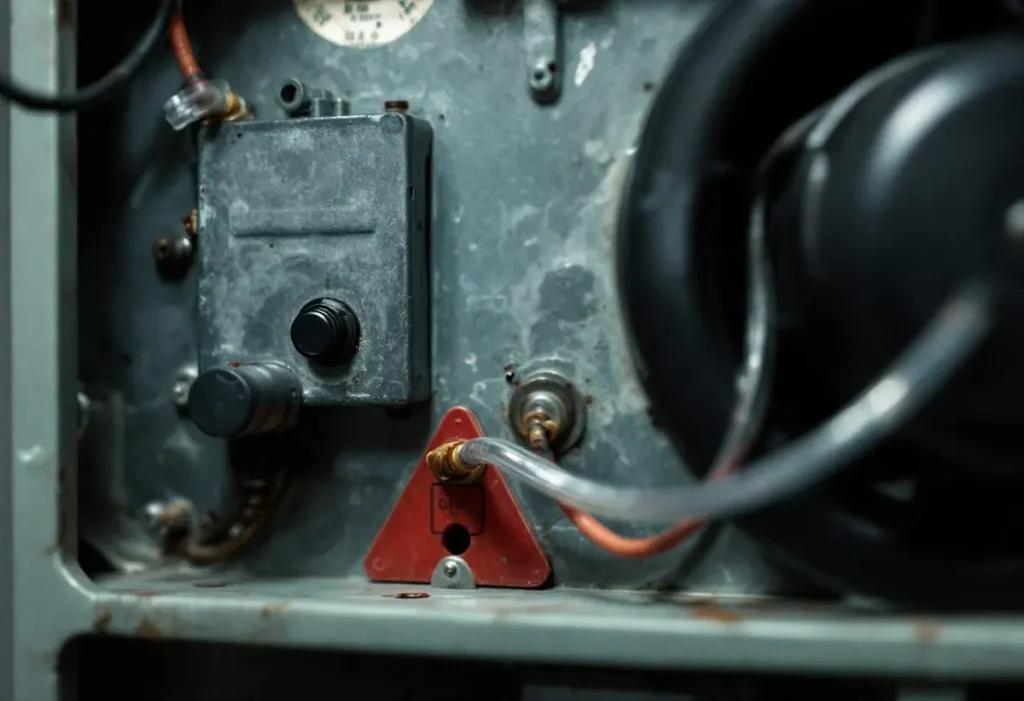
Heil furnace blinking 3 times or 4 times: pressure switch or overheating?
Three short flashes mean the pressure switch did not close or reopened; four mean a limit or the flame rollout switch is open. Of the ten checks the N9MSE label prints for code 3, only one is a defective pressure switch; the rest include excessive wind, a restricted vent, condensate drainage restricted or blocked and low inducer voltage (115VAC).
On code 4 the N95ESN runs the blower for 4 minutes, and if the switch stays open longer than 3 minutes the code becomes lockout 7. The owner check is the dirty filter or restricted duct system the label names; testing the limit switch is service work. The label adds: “Flame rollout switch requires manual reset”.
Stop line. Do not press a rollout reset, jumper any switch, or keep resetting codes 4, 5, 7 or 8. Code 5 means flame was seen with the gas valve off; code 10 is 115 volt polarity. If you smell gas, leave and call the gas utility from outside.
Heil furnace blinking 6 or 7 times: when does the lockout clear on its own?
Six flashes is an ignition proving failure: the control tries three more times, then locks out as 6+1, which auto resets after three hours, as does limit lockout 7. Code 8 differs: ICP prints “Control will NOT auto reset”, and its causes, a miswired gas valve or valve relay, are technician work.
For code 6 the label lists the manual gas shut off, oxide on the flame sensor (“clean with fine steel wool”) and sensor current: at least 0.5 microamps DC, 4.0 to 6.0 nominal. A bad igniter and low gas pressure are on the same list.
Write the code down before you cut power. A recall by briefly pulling a limit wire loses the stored code if the wire stays off more than 4 to 5 seconds, and stored codes erase after 72 hours. Our furnace reset guide covers the safe power cycle.
Green, amber, orange or yellow: what is the color of the Heil status light telling you?
The color identifies the board, not the fault. The N9MSE and N95ESN manuals describe “The green furnace control LED”; the variable speed G96VTN manual describes “The Amber furnace control LED”, which explains orange and yellow searches. The N80ESN and N96MSN manuals give no color. A slow bright and dim pulse is the heartbeat: power, no active code.
The G96VTN stores up to 7 codes; with setup switch SW1-1 on it flashes them in order and ends with code 11. The N96MSN FLt menu shows the last 7 faults, but reaching it means holding the live blower door switch.
Do Tempstar, Comfortmaker and Carrier codes read the same as a Heil’s?
The sister brands sell the same model numbers: Tempstar, Comfortmaker and Arcoaire each list the Performance 96 N96MSN just as Heil’s furnace page does, and International Comfort Products names Heil, Tempstar, Comfortmaker, Arcoaire, Day & Night, KeepRite and Airquest as its brands. So the tables apply to the same model under any of those badges.
ICP belongs to Carrier, as our brand ownership map shows from Carrier’s annual report. The newest Heil display codes borrow Carrier’s numbers: Carrier’s 59TP6B manual uses 13 for limit circuit lockout, 14 for ignition lockout and 33 for limit circuit fault, as the N96MSN does. The plus code boards do not: Carrier’s 34 is Heil’s 6, and Carrier’s 13 is Heil’s 7. Reading an older Heil with the Carrier furnace error codes table misdiagnoses it.
Frequently asked questions
What does Heil furnace code 3 mean?
On N9MSE, N80ESN, N95ESN and G96VTN boards, 3 short flashes mean the pressure switch did not close or reopened. ICP’s label lists vent sizing, wind, a restricted vent, a blocked condensate drain and low inducer voltage alongside the switch. If the low pressure switch is open longer than five minutes, the inducer shuts off for 15 minutes before retry.
Why is my Heil furnace blinking 9 times?
Code 9 appears on the N95ESN and G96VTN labels, not on the N9MSE label. It means the high pressure switch did not close or reopened; the G96VTN adds that its HPSR relay may be defective. ICP refers technicians to the code 3 checks: vent, condensate drain, tubing, inducer and the switch.
Will turning off the power clear a Heil furnace code?
Not from memory: the N95ESN manual says stored codes are not erased when 115 or 24 volt power is interrupted, and they erase on their own after 72 hours. An ON SOLID lockout does clear with a power reset, and ICP says to replace the control if that code repeats.
How we researched this
On 9 November 2026 we read the service labels and troubleshooting text in five ICP documents: the N9MSE service manual (440 04 4402 03) and the N95ESN (440 01 4501 01), N80ESN (441 01 3400 02), G96VTN (440 01 4800 02) and N96MSN manuals, four of them as archived copies because the dealer host blocks scripted requests. We confirmed model and brand links on the Heil, Tempstar and ICP sites and compared numbers with Carrier’s 59TP6B manual. We excluded an ICP modulating furnace guide naming no Heil model, and contractor and parts site code lists, which cite no maker document and contradict ICP’s labels. We found no document for Heil boards older than the N9MSE.
Sources
- International Comfort Products. “Service and Technical Support Manual, N9MSE (A Series), 440 04 4402 03.” https://www.shareddocs.com/hvac/docs/1011/Public/02/ICP_44004440203_28020.pdf. Accessed November 2026.
- International Comfort Products. “Installation Instructions, N95ESN (Series A), 440 01 4501 01” (archived copy). https://web.archive.org/web/2025id_/https://hvacdirect.com/media/hvac/pdf/N95ESN-Installation-Manual.pdf. Accessed November 2026.
- International Comfort Products. “Installation Instructions, N80ESN and N80ESL (Series A), 441 01 3400 02” (archived copy). https://web.archive.org/web/2025id_/https://hvacdirect.com/media/hvac/pdf/N80ESN-Install-Instructions.pdf. Accessed November 2026.
- International Comfort Products. “Installation Instructions, F96VTN and G96VTN (Series A), 440 01 4800 02” (archived copy). https://web.archive.org/web/20210826040202id_/https://hvacdirect.com/hvac/pdf/G96VTN-Install-Instructions.pdf. Accessed November 2026.
- International Comfort Products. “N96MSN: Installation, Start-up, Operating and Service and Maintenance Instructions” (archived copy). https://web.archive.org/web/20250109111304id_/https://hvacdirect.com/media/pdf/ACiQ%20N96MSN%20Installation%20Manual.pdf. Accessed November 2026.
- Heil. “Gas Furnaces.” https://www.heil-hvac.com/en/us/products/gas-furnaces. Accessed November 2026.
- Tempstar. “N96MSN Performance 96 Gas Furnace.” https://www.tempstar.com/en/us/products/gas-furnaces/performance-96-gas-furnace-n96msn. Accessed November 2026.
- International Comfort Products. “Our Brands.” https://www.icpusa.com/en/us/our-brands. Accessed November 2026.
- Carrier. “59TP6B Installation, Start-up, Operating and Service and Maintenance Instructions.” https://www.shareddocs.com/hvac/docs/1009/public/0d/59tp6b-01si.pdf. Accessed November 2026.
Leave a Reply