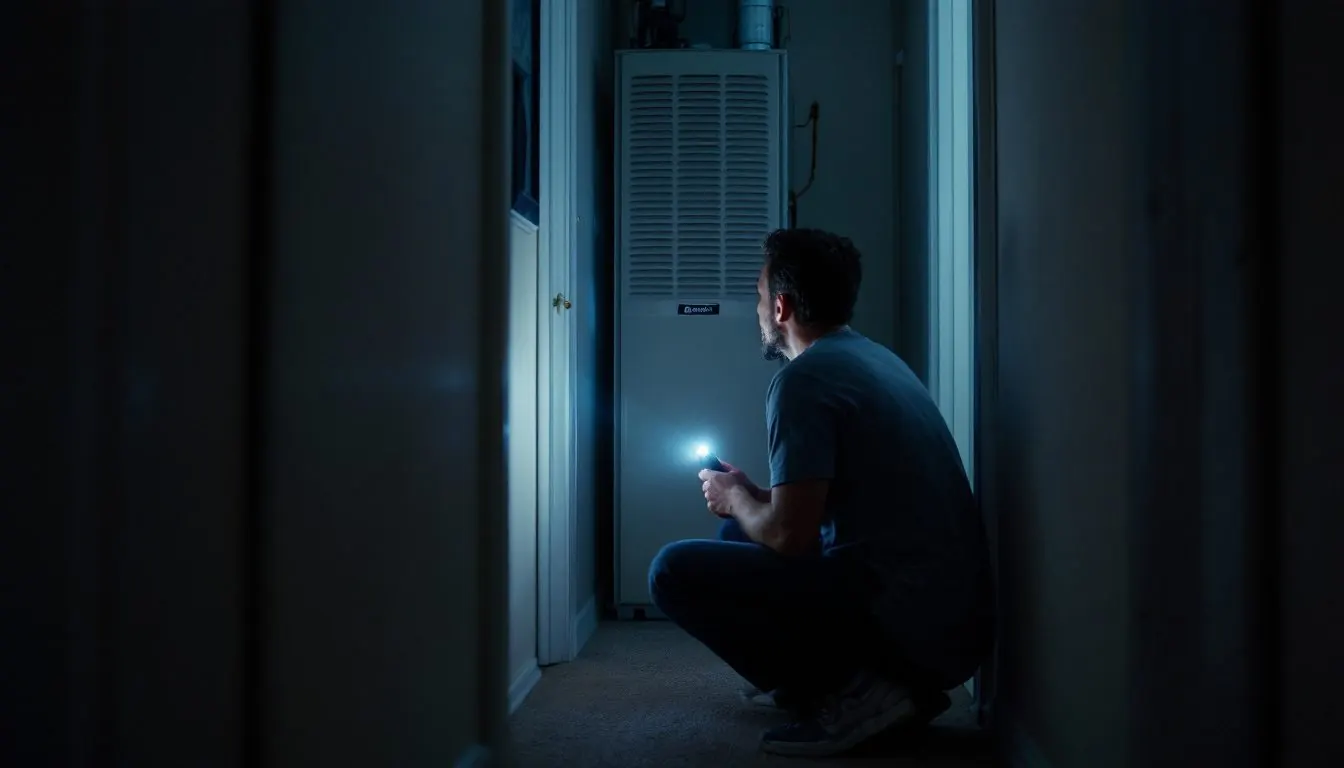
Coleman furnace error codes are blink counts on the board LED, and the same count means different things by furnace line. On TM9E, TM9V and CP9C house furnaces, red flashes are faults: 7 red means no flame after three tries. On DGAA, DGAH and Evcon DGAT mobile home furnaces, the green light blinks the fault: 1 flash means ignition failure.
What does each Coleman blink count mean on each furnace line?
The rating plate model number picks your column. Coleman’s archived furnace listing names CP9C, TM9V, TM9Y, TM9E, TM8V, TM8Y and TM8E, all with Johnson Controls manuals shared with York.
| Blinks | TM9E, TG9S (red) | TM9V (red) | CP9C (red) | DGAA, DGAH (green) | Evcon DGAT, DGAM (green) |
|---|---|---|---|---|---|
| 1 | Flame sensed, no call for heat | Same | Flame present with no power to the gas valve | Ignition failure | Ignition failure |
| 2 | Pressure switch closed when it should be open | Same | Pressure switch closed, inducer pressure below setpoint | Combustion air pressure switch stuck closed | Centrifugal switch stuck closed |
| 3 | Pressure switch open when it should be closed | Same | Pressure switch open, inducer pressure above setpoint | Pressure switch failed to close | Centrifugal switch stuck open |
| 4 | Main limit open | Main limit open | High limit, temperature sensor or 24 volt fuse open | Primary or auxiliary limit open | Limit cycling; clean filter |
| 5 | Rollout switch open; hard lockout | Limit circuit open over 15 minutes | Rollout or condensate pressure switch open | Gas flow with no call for heat | Gas valve energized, no call for heat |
| 6 | Pressure switch opened 4 times in one call | Same | Gas valve communication error | Not defined | Wrong polarity to furnace power |
| 7 | No flame in three trials for ignition | Same | No ignition in three tries | Not defined | Not defined |
| 8 | Flame lost five times (four recycles) | Same | Too many flame recycles | Not defined | Not defined |
| 9 | Reversed polarity or grounding | Same | Reversed polarity or grounding | Not defined | Not defined |
| 10 | Gas valve energized with no call for heat | Same | Gas valve circuit shorted | Not defined | Not defined |
| 11 | Limit open over five minutes; hard lockout | Limit open 5 to 15 minutes | Main blower failure | Not defined | Not defined |
| 12 | Not defined | Loose or missing model ID plug | ID plug missing or loose | Not defined | Not defined |
| 13 | Not defined | High-fire pressure switch open | Not defined | Not defined | Not defined |
| Rapid | TG9S: continuous green is a twinning error | Continuous amber: low flame current | Rapid amber: low flame current | Rapid flashes: reversed polarity | Not defined |
| Steady | Any color: control failure | Same | Red: control fault or no 24 volts | Normal (see below) | Green: normal |
Code 1 sits at opposite ends of the risk scale: gas with no call for heat on a TM9E, a furnace that never lit on a DGAA. The DGAA/DGAH manual also contradicts itself, listing “STEADY ON: Normal Operation” yet calling a continuously lit LED an internal control failure; steady light plus no heat means the latter.
Is your Coleman a house furnace or a manufactured-home furnace?
DGAA, DGAH, DGAT, DGAM and DGAX are downflow furnaces for manufactured homes; TM, TG and CP prefixes are house furnaces. The DGAT manual came from Evcon Industries of Wichita, Kansas, hence “Coleman Evcon”. Our mobile home furnace guide explains why the types cannot be swapped.
The slowest case, a 5 flash DGAA code, takes 12 seconds per cycle. Coleman’s user manual says removing the blower door cuts power through a safety switch, so count through the view port first.
Why is my Coleman furnace blinking green?
On a TM or TG house furnace, slow green (two seconds on, two seconds off) is normal standby. On a DGAA or DGAH, a counted green blink is a fault. The Evcon DGAT manual reads “NO Flashes (steady green): Normal Operation”, with the light behind the upper front door.
After pressing LAST ERROR on a TM9E, TM9V or CP9C, 2 green flashes mean no stored codes and 3 mean the memory was cleared.
What does a Coleman furnace blinking orange or yellow light mean?
The manuals call it amber, and slow amber on a TM or TG board means normal operation with a call for heat. Double amber is normal heating on modulating models only, per Coleman’s user manual 1010352-UUM-N-0121.
Counted amber splits by board. On the TM9E and TM9V, 4 amber means the thermostat sends “Y” without “G”, a wiring fault that still lets the furnace run. On the CP9C, 4 amber means “Heating capacity is reduced due to restriction in the circulating air system”; 5 amber flags a vent or drain restriction. Fast or continuous amber on the TM9V and CP9C is low flame current, covered in our flame sensor cleaning steps.
Coleman furnace blinking red 4 times: limit, filter or blower?
Four red flashes on a TM9E or TM9V mean the main limit switch opened its normally closed contacts. The manuals list a dirty filter first, then duct sizing, blower speed, firing rate, limit wiring and the blower motor.
Five limit trips in one call keep 4 red showing with a one-hour soft lockout. A limit open past five minutes becomes 11 red, a hard lockout only a power cycle clears; on the TM9V, past fifteen minutes it becomes 5 red, a likely tripped rollout switch. Our limit switch explainer covers both switch types.
On an Evcon DGAT, four green flashes read “Limit Cycling, may indicate that return air filter needs to be cleaned”. For its manual-reset upper limit, Evcon says to turn the system switch OFF, push the button, and call if it trips again soon.
Coleman furnace blinking 7 times: why the burners never stay lit
Seven red flashes on a TM9E, TM9V or CP9C mean no flame in three trials for ignition, followed by a one-hour lockout and an automatic retry. The TM9E manual’s checks: gas valve switch ON, gas pressure, gas valve, flame sensor, hot surface ignitor, loose wires, burner.
Beyond the valve switch, a technician reads gas pressure with a manometer, watches the hot surface ignitor glow, and measures flame current at the board test pad: about 3.7 microamps is normal, with a warning at 1.5 and lockout at 0.1.
Coleman Evcon furnace not heating: which step of the sequence stopped?
The DGAT/DGAM user manual gives timings a stopwatch can check. After the combustion blower starts, the ignitor heats for 40 to 50 seconds. If burners do not light within 6 to 8 seconds of the gas valve opening, the board retries; three failures mean a one-hour lockout. The blower follows 90 to 120 seconds after ignition.
The DGAA/DGAH board’s 60 minute “watchdog” clears faults 1, 3 and 4 itself, and cutting power erases its code, so count flashes before trying our furnace reset steps.
Where is the filter on a Coleman Evcon furnace, and what size is it?
Inside the furnace: on the DGAA, DGAH and DGAX in a rack attached to the door, holding two 16 x 20 x 1 filters. Early DGAT, DGAM and DLAS units used one permanent filter.
| Coleman line | Filter | Maker’s rule |
|---|---|---|
| DGAT, DGAM, DLAS, serial 960623003 and below | One permanent, 19 3/8 x 35 3/4 x 1/4 inches | Check every two or three weeks; wash in mild detergent and water |
| DGAT, DGAM, DLAS, serial 960623004 and above | Two 16 x 20 x 1 inch, disposable | Parts list item 36 |
| DGAA, DGAH and DGAX | Two 16 x 20 x 1 inch, rack on door | Check every 3 months; no pleated filter |
| TM, TG and CP house furnaces | Return duct or rack on the casing | Never install filters inside the cabinet |
The DGAX user guide adds weekly checks for the first four weeks in new construction.
Which Coleman codes mean shut off the gas and call?
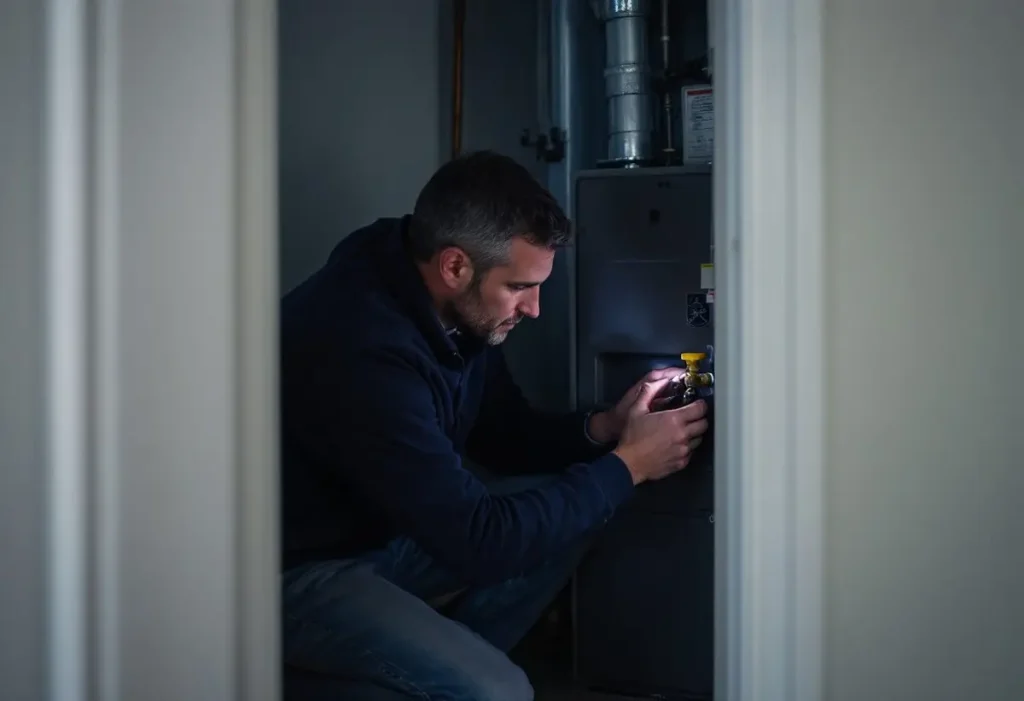
Stop at codes for gas without a call for heat, rollout or polarity: 1 and 10 red on the TM9E, 5 flashes on a DGAA or DGAT, 5 red on any board, 9 red, and the DGAT 6 flash code. If the gas valve fails to shut off, Coleman’s user manual says to turn the external manual gas valve off.
For 5 red, the TM9E manual sends the technician to combustion air, the inducer and the primary heat exchanger; for polarity, to the branch circuit, the ground and a flame probe shorted to chassis; codes 2, 3 and 6 are pressure switch tests. The York furnace error codes page covers TM9Y and TM8Y boards, and our control board guide covers the board fuse.
Frequently asked questions
What is Coleman furnace code 1?
It depends on the board. On TM9E, TM9V and TG9S house furnaces, 1 red flash means flame was sensed with no call for heat, usually a leaking or slow-closing gas valve, so close the gas valve and call. On DGAA, DGAH and Evcon DGAT manufactured-home furnaces, 1 green flash means ignition failure: the burners did not light.
Why is my Coleman furnace blinking a red light with no pause?
Coleman’s user manual 1010352-UUM-N-0121 says rapid red flashes mean “a problem with the operation of this furnace” and to contact a dealer. Some boards define it: continuous red is a twinning error on the TM8Y, and a steady red on the CP9C means a control fault or 115 volts without 24 volts.
How do you read old error codes on a Coleman furnace?
On TM9E, TM9V and CP9C boards, end every thermostat call and press the LAST ERROR button; the LED flashes up to five stored codes, newest first, and keeps them through a power loss. Holding the button more than five seconds clears them. The DGAA/DGAH board has no memory button, and cutting power erases its code.
Are Coleman furnace codes the same as York codes?
For house furnaces, often yes, because they share Johnson Controls manuals: the installation manual 5402901-UIM-A-0917 covers YP9C, CP9C, LP9C and TP9C under one flash table. Match the full model number to its manual, because even the TM9E and TM9V boards differ at 5, 11, 12 and 13 red flashes.
How we researched this
On 9 November 2026 we read the diagnostics sections of the eleven documents listed below; the lineup comes from an archived colemanac.com page because the live site blocks automated reading. We excluded code sites citing no maker document and borrowed no codes across brands.
Sources
- Johnson Controls Unitary Products. “Installation Manual, TM9E Series, 1083163-UIM-H-0817.” https://www.yorknow.com/pub/media/documentation/TM9E_Install.pdf. Accessed November 2026.
- Johnson Controls Unitary Products. “Installation Manual, TM9V*C Series, 5402851-UIM-A-0917.” https://www.yorknow.com/pub/media/documentation/TM9V_Install.pdf. Accessed November 2026.
- Johnson Controls Unitary Products. “Installation Manual, TG9S Series, 1083287-UIM-H-0817.” https://www.yorknow.com/pub/media/documentation/TG9S_Install.pdf. Accessed November 2026.
- Johnson Controls Unitary Products. “Installation Manual, TM8Y, 5052632-UIM-D-0217.” https://www.yorknow.com/pub/media/documentation/TM8Y_Install.pdf. Accessed November 2026.
- Johnson Controls Unitary Products. “Installation Manual, YP9C/CP9C/LP9C/TP9C Series, 5402901-UIM-A-0917.” https://www.yorknow.com/pub/media/documentation/YP9C_Install.pdf. Accessed November 2026.
- Johnson Controls Ducted Systems. “User’s Information Manual, All Residential Multi-position Gas Furnaces, 1010352-UUM-N-0121.” https://files.hvacnavigator.com/p/1010352-uum-n-0121.pdf. Accessed November 2026.
- Unitary Products Group. “User’s Information, Maintenance and Service Manual, DGAA and DGAH, 129099-UUM-F-0507” (archived copy). https://archive.org/download/manualzilla-id-7391458/7391458.pdf. Accessed November 2026.
- Evcon Industries. “Installation Instructions, User’s Information Manual and Parts List, DGAM, DGAT and DLAS Series” (InspectApedia copy). https://inspectapedia.com/heat/Coleman-DGAM-DGAT-DLAS-Manual-Wiring-Parts.pdf. Accessed November 2026.
- Johnson Controls. “User Guide, DGAX Sealed Combustion Gas Furnace, 5483103-UUM-A-1118.” https://files.hvacnavigator.com/p/5483103-uum-a-1118.pdf. Accessed November 2026.
- Johnson Controls. “Technical Guide, DGAX Sealed Combustion Gas Furnace, 5555944-BTG-A-1118.” https://files.hvacnavigator.com/p/5555944-btg-a-1118.pdf. Accessed November 2026.
- Coleman Heating and Air Conditioning. “Gas Furnaces” (archived copy, 1 August 2021). https://web.archive.org/web/20210801142530/https://www.colemanac.com/residential-equipment/heating-and-cooling/gas-furnaces. Accessed November 2026.
Leave a Reply