
A Nest “no power to Rh wire” alert (help code E4, E24 or E74) means no 24 volt power is reaching the Rh connector. The fault is almost always upstream at the furnace: power or door switch off, a blown 3 amp board fuse, a tripped float switch, a loose red wire or a dead transformer.
Which Nest help codes say “no power” to Rh, Rc, R or C?
Google files E4, E24 and E74 together as “No power to Rh wire detected” and sends all three to its Troubleshoot power steps, not to its C wire steps, in its help code table.
| Help codes | Google’s wording | What it points at |
|---|---|---|
| E4, E24, E74 | No power to Rh wire detected. | No 24 V on the heating (or only) power wire |
| E3, E23, E73 | No power to Rc wire detected. | No 24 V on the cooling (or only) power wire |
| E195 | No power to R wire detected. | Same fault on a single R connector |
| E2, E22, E72, E402 | No power wires detected. Rc or Rh wire required. | No live R wire at all |
| E9, E29, E79, E159 | No power to C wire detected. | Common wire open; also a power fault |
| N2, N22, N72, N402 | Power wire Rh detected. Not connected to equipment. | Rh is live but weak: a “low power” code, not an outage |
The general “No power” alert, codes E298 and E448, means the whole system is dark; our page on the Nest thermostat blinking light covers that one.
Where does the Rh wire get its 24 volts, and where can that path break?
From the furnace transformer, through the board fuse and R terminal, then up the red thermostat wire. Google’s wire label guide says that with no Rc wire, “the Rh wire is the power wire for both your heating and cooling systems,” so one break anywhere on this path silences everything.
The Nest keeps running on its internal battery for a while after power is lost, Google says on its won’t turn on page, then shuts off Wi‑Fi and finally the screen. So the alert can appear long after the furnace actually lost power.
Is the furnace powered: service switch, breaker and blower door?
Each of these kills the transformer and therefore Rh. Google notes the furnace switch “will seem like a light switch near the heating or cooling equipment,” and that some homes have 2 switches, one for heating and one for cooling.
The blower door is easy to miss after a filter change. Goodman’s GM9S80 installation manual says its blower door interlock switch “interrupts unit voltage when the blower door is opened for servicing. Do not defeat this switch.” A panel that is not fully home on its tabs leaves the switch open; our sibling page on the furnace door safety switch shows how to seat it.
What should a multimeter read at the furnace board, and what does each reading mean?
With the door switch closed, R to C on the board should read about 24 volts AC. Goodman’s service manual RS6612022R1 states “Must read 24 VAC,” and the Resideo S9200U1000 universal control accepts 19 to 30 Vac. Keep the probes on the low-voltage screw terminals and clear of the 120 V harness.
| What you find | What it means | Next step |
|---|---|---|
| Board LED dark, no transformer hum | No 120 V: breaker, service switch or door switch open | Reset breaker, switch on, seat the blower door |
| 24 V off the transformer, about 13 V R to C at the board | Goodman: “check for blown fuse” | Find the short before replacing the fuse |
| Carrier code 24 or Resideo 3+2 flashing | Low-voltage fuse open | Carrier: “a short in low-voltage wiring” |
| 120 V on the transformer primary, 0 V on the secondary | Goodman: “the transformer is inoperative. Replace.” | Technician job: line voltage testing |
| 24 VAC at board R to C, 0 V at the Nest Rh to C | Open float switch, broken splice or loose red wire | Check drain pan switch, then the cable |
| 24 VAC at the Nest wires, alert persists | Wire seating, base connector or thermostat | Reseat wires; old thermostat test |
With a C wire at the wall, Rh to C there should match the board. Our guide to the HVAC transformer walks through the primary side check that belongs to a technician.
Why did the board fuse blow, and will a new one blow again?
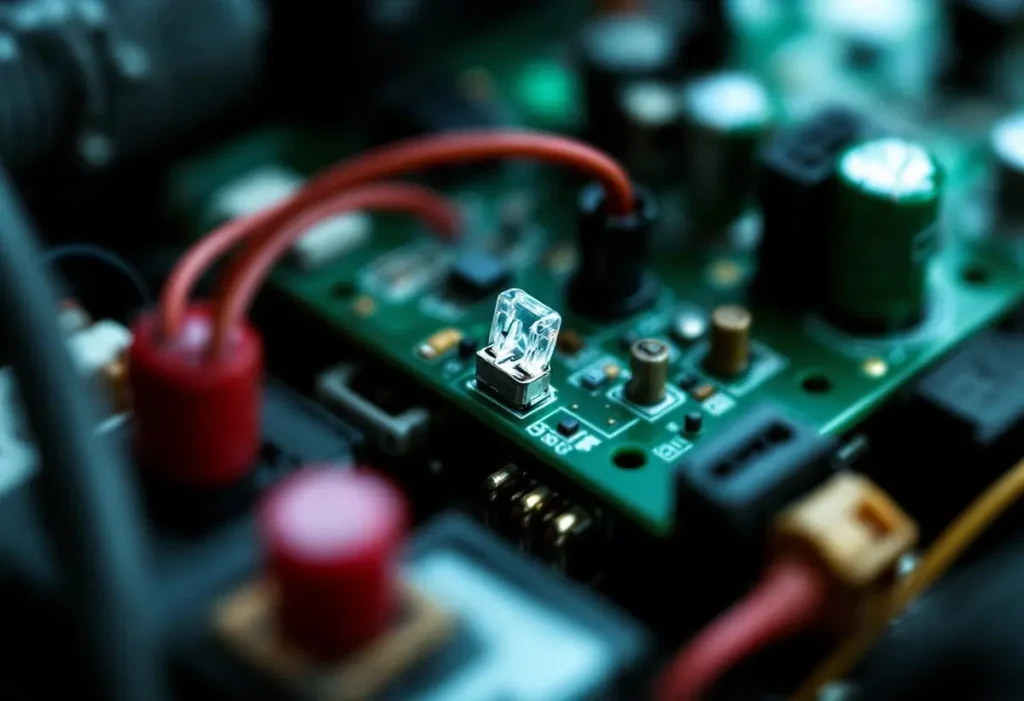
A blown low-voltage fuse means something shorted, so a new fuse alone often fails again. Carrier’s 58MVP fault code 24 chart says the open fuse “indicates fuse is open and there is a short in low-voltage wiring,” and its step 5 has you disconnect all thermostat leads, including HUM, before fitting the new fuse.
Carrier’s chart then isolates the limit, R to W and pressure switch circuits one at a time; Resideo’s code 3+2 lists limit, rollout and pressure switch wiring “shorted to chassis” and a possibly shorted gas valve. A nicked thermostat cable that touches sheet metal does the same, and Resideo’s low 24 V code 3+1 also names “the outdoor unit 24 Vac contactor” as a load to check. Resideo’s S9200U1000 specification lists a “Replaceable Fuse: 3.0 Amp, Automotive type” and says to replace it “with a fuse of the same type.” Google describes a small U-shaped fuse labeled “3,” pink or purple. The furnace control board page covers fuse locations by brand.
Can a condensate float switch cause “no power to Rh” in winter?
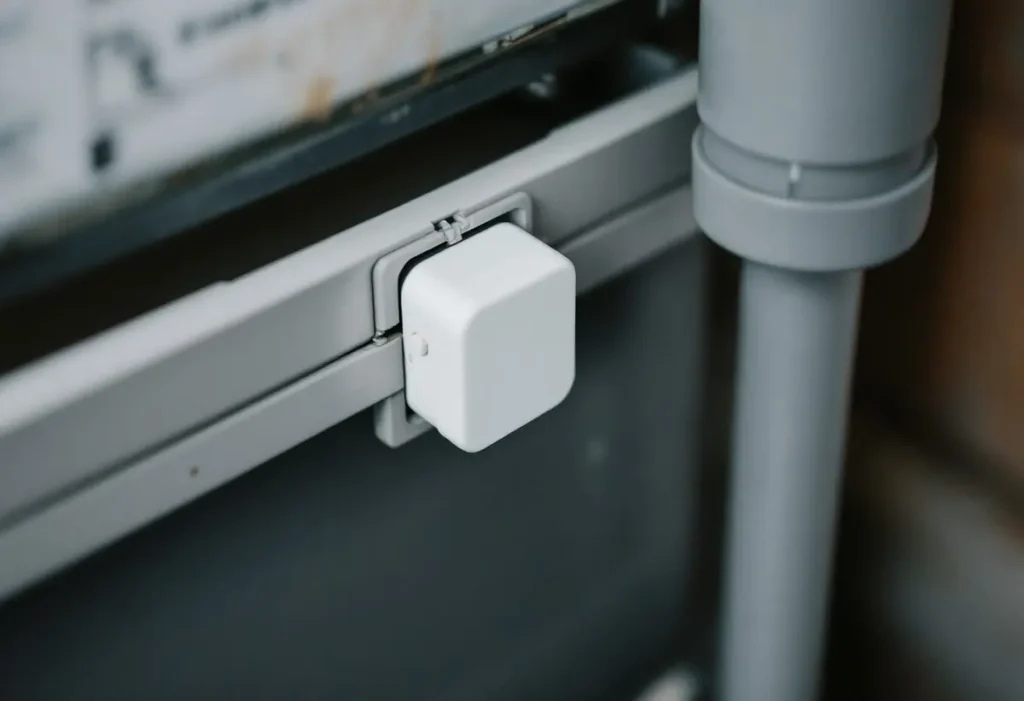
Yes, if the installer wired it into the red wire, because an open float switch then cuts R to the thermostat. RectorSeal’s Safe-T-Switch SS2 sheet tells installers to break the “red or yellow wire” and rates the switch “for use in Class 2 circuits only.” On the yellow wire it only stops cooling; on the red wire it stops the Nest’s power too.
Google’s own E74 steps send you to the drip pan: “If your drip pan or drain tube clogs and water backs up, your AC or heat pump may shut off,” and then “your system stops sending power to your Nest thermostat.” In November an AC coil makes no water, but a high-efficiency furnace drains condensate all winter,. RectorSeal’s test: lift the float with the unit on and confirm it stops. Clearing it is in our clogged AC drain line guide.
Rh and Rc: do you need a jumper, and what if only Rh is dead?
No jumper wire goes on a Nest. Google’s jumper wire article says “Nest Learning Thermostats use an internal jumper between the Rh and Rc connectors” and applies it automatically; a single R wire can go into either Rc or Rh. The Nest Thermostat E has only an R connector.
If you have two separate R wires from the wall, Google calls that a dual transformer system: Rh powers heating, Rc powers cooling. An E74 with no E73 then says the heating transformer side is dead while the cooling side still has power, so test the furnace or boiler transformer, not the AC. Swapping Rh and Rc at the base, as one top-ranking blog post tried, did nothing there: the cause was a clogged drain and a float switch.
What if the meter shows 24 volts and the Nest still says no power?
Then the fault is at the base: reseat each clean, straight wire until the connector button stays down. Google’s pages disagree on bare copper: ⅜ inch (6mm) in one step, ⅓ to ½ inch in another, at least one cm in a third. Note that ⅜ inch is about 9.5 mm, so aim for roughly ⅜ to ½ inch.
Google’s heating and cooling issues page gives the deciding test: reinstall the old thermostat. If the system runs with it, the Nest has a wire or power problem; if it does not, “your system might need maintenance.” An N2, N22, N72 or N402 low power code is different: Google says that if the system runs normally you can dismiss it. When the heat is also off, the companion check is our heat on but no heat diagnosis.
Frequently asked questions
Why does my Nest say no power to Rh wire after a power outage?
The Nest rides out a blackout on its battery, so the alert appears when the furnace fails to come back. Google says to switch the system breaker off and on and make sure it is “pushed all the way to the On position,” then check for a blown fuse. Our page on a furnace not working after a power outage covers restart timing.
Is Nest no power to Rc wire the same problem?
It is the same fault on the other power wire. Google lists E3, E23 and E73 as “No power to Rc wire detected” and sends them to the same power steps. On a dual transformer system Rc powers cooling, so check the AC side. Google warns that these codes in summer usually mean the HVAC system needs a professional.
Will a C wire or Nest Power Connector fix no power to Rh wire?
No. A C wire adds a return path; it cannot replace missing 24 V on Rh. Google’s table sends E4, E24 and E74 to Troubleshoot power, while its C wire and Power Connector steps cover different codes: E1, E297, N260, N261, N410 and N411. Restore R power first, then judge whether a C wire is needed.
Why does my Nest say no power to Y1 wire in cold weather?
Google lists E10, E30, E66, E80, E116, E160, E196 and E296 as “No power to Y1 wire detected (cold weather shutoff).” It says you get them when the air conditioner “has tripped a safety cut-out switch that prevents your air conditioner from turning on in very cold weather.” That is a Y1 issue, unrelated to the Rh supply.
How we researched this
On November 20, 2026 we read Google’s Nest help code table with its power, low power and hot weather steps, four related Google help articles, Goodman manuals RS6612022R1 and GM9S80, the Carrier 58MVP code 24 chart, the Resideo S9200U1000 specification and the RectorSeal SS2 sheet. Excluded as fact sources: the top-ranking personal blog, Stack Exchange and Google community threads, which cite no maker document. Google’s three conflicting strip lengths are reported as published.
Sources
- Google. “Troubleshoot Nest thermostat help codes.” https://support.google.com/googlenest/answer/9240096?hl=en. Accessed November 2026.
- Google. “Identify a thermostat wire.” https://support.google.com/googlehome/answer/9452748?hl=en. Accessed November 2026.
- Google. “Learn about thermostat jumper wires.” https://support.google.com/googlehome/answer/9250973?hl=en. Accessed November 2026.
- Google. “Troubleshoot when your thermostat won’t turn on.” https://support.google.com/googlenest/answer/9233319?hl=en. Accessed November 2026.
- Google. “Learn to fix strange heating or cooling issues.” https://support.google.com/googlenest/answer/9235232?hl=en. Accessed November 2026.
- Goodman. “Service and Troubleshooting, GM9S92 / GM9S96 / GC9S96 Single Stage Gas Furnaces (RS6612022R1).” https://mobile.goodmanmfg.com/mobileapp/stellent/pdf/infoPdf/Lit/RS6612022R1.pdf. Accessed November 2026.
- Goodman. “GM9S80 / GC9S80 Installation Instructions.” https://documents.alpinehomeair.com/product/goodmangm9s8gc9s8installationmanual.pdf. Accessed November 2026.
- Carrier. “58MVP User Manual, Fault Code 24, page 19.” https://www.manualsdir.com/manuals/63165/carrier-58mvp.html?page=19. Accessed November 2026.
- Resideo (Honeywell). “S9200U1000 Universal Integrated Furnace Control.” https://www.cochranesupply.com/media/assets/product/documents/Honeywell/S9200U1000.pdf. Accessed November 2026.
- RectorSeal. “Safe-T-Switch Model SS2 Installation Instructions.” https://assets.kele.com/Catalog/11%20Level/PDFs/SS2%20Installation%20Sheet.pdf. Accessed November 2026.
Leave a Reply