
A tankless water heater cold water sandwich is the hot, then cold, then hot pattern you get when a hot tap is reopened soon after it was shut: water parked in the pipe arrives hot, then a few ounces that crossed the heater while it restarted, then freshly heated water.
The DOE Building America measure guideline on tankless water heaters defines it as “the undesired introduction of cold water into the hot water supply line on occasions of frequent on/off operations.” Navien quotes that definition on its NPE-A2 page.
What is in the pipe when the cold water sandwich hits the shower?
Three slugs of water, in order: hot water left in the pipe from the last draw, a short slug of unheated water that passed through the heat exchanger while the burner relit, then water heated on this draw. The DOE guideline puts the restart at 1 to 2 s if flow resumes within the first minute, and the flow detector delay at 1 to 3 s.
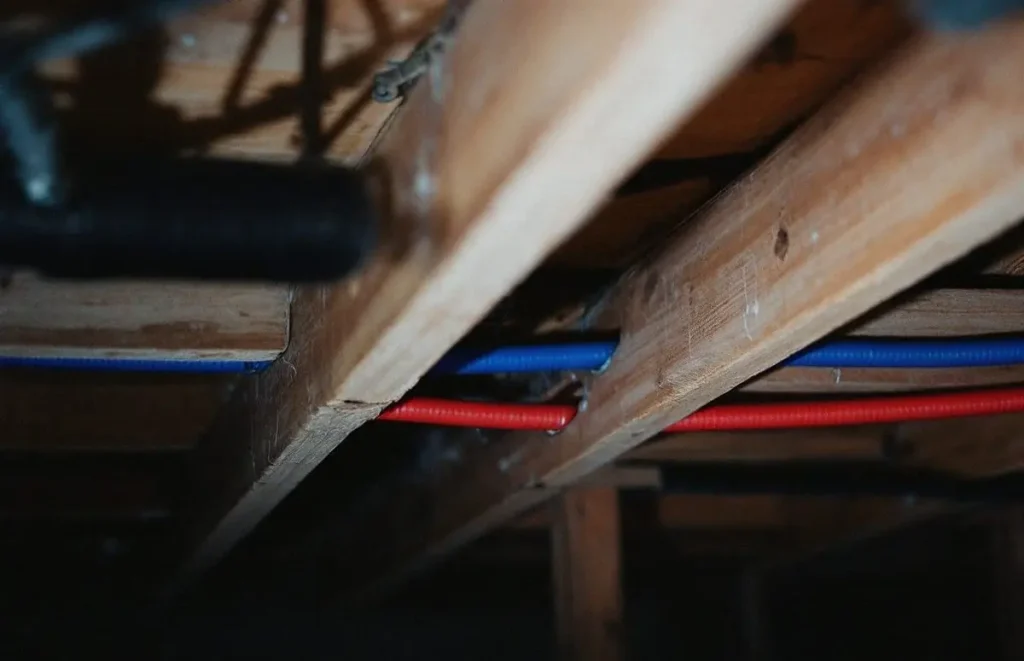
That order is why the cold does not come first: reopen a shower on a 30 ft run of 1/2 in PEX at 1.5 gpm hot side and you get 11 seconds of hot, then the slug. A longer pipe delays the slug; it does not shrink it.
How many seconds of cold is normal, and when does it reach the fixture?
About 1 to 3 seconds of cold, arriving after the pipe’s parked hot water has been pushed out. We calculated both from the DOE pipe volume and restart figures; slug volume is hot side flow times the restart delay.
| Run from heater to fixture | Hot water parked in the pipe | Hot first, at 1.0 gpm hot side | Hot first, at 1.5 gpm hot side | Cold slug at 1.0 / 1.5 gpm |
|---|---|---|---|---|
| 15 ft | 0.14 gal | 8.3 s | 5.5 s | 4.3 oz / 6.4 oz |
| 30 ft | 0.28 gal | 16.6 s | 11.0 s | 4.3 oz / 6.4 oz |
| 50 ft | 0.46 gal | 27.6 s | 18.4 s | 4.3 oz / 6.4 oz |
| Any length, if the restart takes 10 s | as above | as above | as above | 21.3 oz / 32.0 oz |
The last row tests a vendor claim. Eemax, which sells mini tanks as the cure, writes in its cold water sandwich white paper that the ignition sequence takes “about 10 seconds” to restart in most gas heaters. The DOE guideline says 1 to 2 s within the first minute. If you count closer to 10 seconds of cold, check the patterns in the next section.
Is it a cold water sandwich, or is the tankless heater too small?
A sandwich is one short cold burst after a pause, then steady heat. Other patterns point elsewhere.
- One cold burst, only after the tap was shut and reopened: a true sandwich, which DOE says “does not appear during steady uses of water.”
- Tankless water heater goes cold during the shower with no pause: look at total flow. Rinnai’s RE199i tops out at 9.8 GPM and the RE140i at 5.3 GPM, and Rinnai’s SENSEI RX sheet says its flow curves apply only to inlet water of 70 °F or less. Colder winter inlet water means a bigger temperature rise, so fewer gallons per minute at the same outlet temperature. Our tankless sizing guide does that math.
- Hot water flickers or quits at a trickle: the hot side flow fell below the activation rate (next section).
- No hot at all: not a sandwich; start with water heater not heating or, after a storm, no hot water after a power outage.
In winter the sandwich feels worse because the slug is unheated supply water at whatever the inlet temperature is that month; the DOE guideline ties delivery to “the cold water inlet temperature.”
Why does a low flow faucet make a Rinnai or Navien cycle cold?
Because the hot side flow at a mixing faucet is only part of the faucet’s rated flow, and it can fall under the heater’s activation rate. The DOE guideline gives 0.4 to 0.9 gpm across units; maker sheets give exact numbers.
| Item | Figure | Source |
|---|---|---|
| Rinnai RE199i, RE180i, RE160i, RE140i activation flow | 0.4 GPM (1.5 L/min) | Rinnai RE series spec sheet |
| Rinnai RE199i and RE180i at a set point of 140 °F or higher | 0.26 GPM activation | Rinnai RE series spec sheet, footnote 2 |
| Rinnai REP199i, REP160i (built in pump) activation flow | 0.4 GPM (1.5 L/min) | Rinnai REP series spec sheet |
| Rinnai SENSEI RX199i to RX130i | flow range starts at 0.13 GPM; no separate activation figure printed | Rinnai RX spec sheet |
| Navien NPE-2 minimum flow | 0.5 GPM (1.9 L/m) | Navien NPE-2 Quick Facts |
| Navien NPE-A2 in ComfortFlow recirculation mode | < 0.01 GPM | Navien NPE-2 Quick Facts |
| Hot side flow, 1.5 gpm WaterSense faucet, 100 °F mix, 50 °F inlet, 120 °F set | 1.07 gpm: fires | HVAC Brief calculation |
| Same mix through a 0.5 gpm public lavatory faucet | 0.36 gpm: below 0.4 and 0.5 | HVAC Brief calculation |
| 0.5 gpm faucet with the heater set at 140 °F | 0.28 gpm: above Rinnai’s 0.26, below Navien’s 0.5 | HVAC Brief calculation |
The mixing math is hot share = (mix minus inlet) / (set point minus inlet), the same formula our thermostatic mixing valve explainer uses. EPA’s WaterSense faucet page caps labeled bathroom faucets at 1.5 gallons per minute and describes 0.5 gpm or less for public lavatories, a flow it calls “not appropriate for use in private lavatories.” The federal ceiling in 10 CFR 430.32 is 2.2 gpm for lavatory faucets and 2.5 gpm for showerheads; WaterSense showerheads use no more than 2.0 gpm.
Which fix removes the cold water sandwich, and what does each cost in energy?
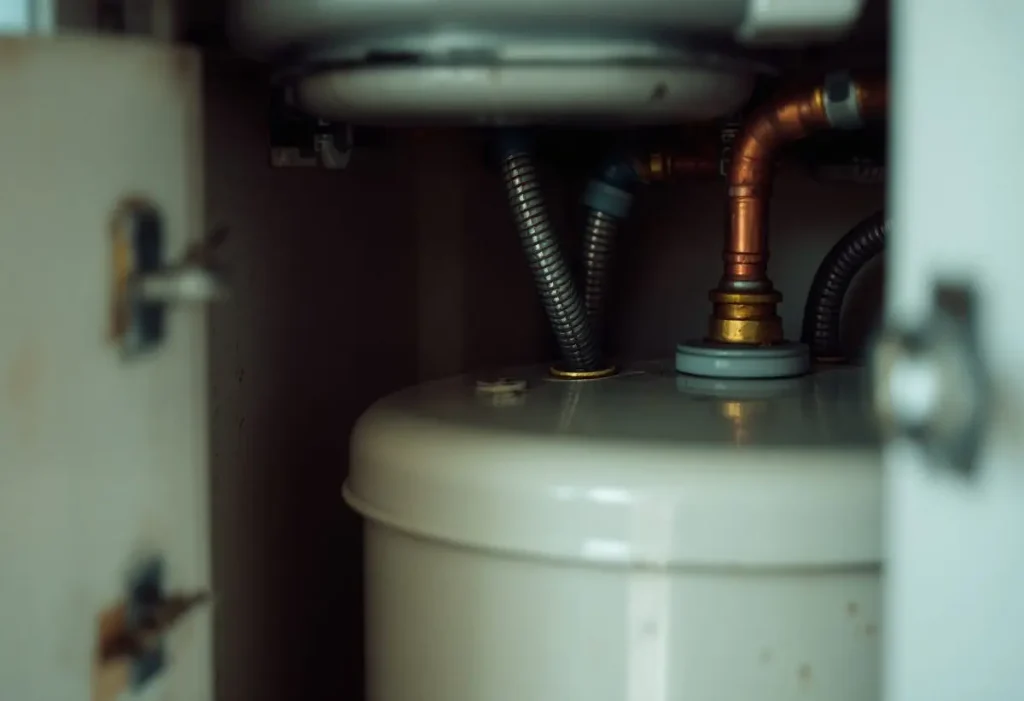
Only a buffer tank or recirculation removes it; everything else shortens it. The DOE guideline says the issue “cannot be completely removed from tankless water heaters because safety standards require a delay in their ignition sequence.”
| Fix | What it does to the slug | Energy or other penalty, per the source |
|---|---|---|
| 1. Heater with built in buffer tank and pump (Navien NPE-A2 ComfortFlow) | Navien says it resolves “the cold-water sandwich effect”; slug blends into stored hot water | Navien: “Energy consumption will increase when the system is configured for recirculation” |
| 2. Small storage tank on the hot outlet (Eemax EMT2.5, EMT4, EMT6 or similar) | Slug mixes into 2.5 to 6 gallons of hot water; DOE says several makers recommend this | DOE: “The added storage tank will experience standby losses” |
| 3. Demand recirculation (button or sensor, Navien’s HotButton accessory, Rinnai Circ-Logic on REP models) | Fires the heater and fills the pipe before the tap opens | Pump power; Rinnai lists 162 W normal with pump on the REP199i |
| 4. Timer or continuous recirculation | Same as 3, whenever the pump runs | Navien warranty terms differ for uncontrolled pumps |
| 5. Habits: keep the tap open, reopen within one minute | DOE: refires within 1 to 2 s inside the first minute | Water down the drain; no hardware |
On Navien’s own Quick Facts, controlled recirculation and “uncontrolled recirculation” from external pumps carry different warranty terms, and an aquastat is the minimum pump control Navien accepts for the full controlled warranty. Read that before adding a pump to an NPE-S2.
Two fixes that top search results suggest fail against the documents. Swapping electric tankless for gas: the DOE 1 to 3 s delay applies before the unit “activates the heating elements or gas burner,” and Eemax names gas units as the susceptible ones. Raising the set point: it lowers the hot share at every mixing fixture, cutting a 0.5 gpm faucet from 0.36 to 0.28 gpm in our calculation, below Navien’s 0.5 GPM floor.
Can you stop the cold slug without buying anything?
Partly. Inside the DOE “ready to fire” window of one minute the heater refires within 1 to 2 s, a slug under 7 oz at 1.5 gpm hot side.
- Leave the shower running at low flow while lathering rather than shutting it, but keep the hot side above 0.4 GPM on a Rinnai RE or 0.5 GPM on a Navien NPE-2, or the burner drops out.
- Do not chase it by turning the heater up: the water heater temperature setting page shows how fast 140 °F water scalds, and the mixing table above shows the activation cost.
- Keep the heat exchanger clean. The DOE guideline warns that scale restricts flow, and that makers may require a softener above 8 to 14 grains per gallon; our page on how to flush a water heater covers tankless descaling.
Frequently asked questions
Does a Navien tankless water heater get the cold water sandwich?
Models without a buffer, such as the NPE-S2, can. The NPE-A2 adds ComfortFlow, a built in buffer tank, pump and controls that Navien says resolves the effect. Navien lists a 0.5 GPM minimum flow for the NPE-2 line, with under 0.01 GPM available only on A2 models in ComfortFlow recirculation mode.
How do you fix a Rinnai tankless water heater cold water sandwich?
Rinnai’s route is recirculation. Its REP199i and REP160i have an integrated pump with Circ-Logic recirculation, which Rinnai says can learn hot water patterns to schedule recirculation. The DOE Building America guideline also cites Rinnai (2008) among makers recommending a small storage tank on the hot outlet. RE series heaters activate at 0.4 GPM, so a trickle will not keep the burner lit.
Why do I get hot water when I turn on cold water?
Usually recirculation using the cold line as the return. The DOE guideline describes systems that circulate stagnant hot pipe water back to the heater “through a connection made to the cold water pipe,” so the cold tap nearest the crossover can run warm for a few seconds.
What is the most common problem with tankless water heaters?
Scale in the heat exchanger is the one DOE singles out. The Building America guideline says scale and lime build up inside the unit and restrict flow, that makers set flushing intervals from twice a year to once every three years, and that some require a water softener above 8 grains per gallon (136 ppm) to 14 grains per gallon (239 ppm).
How we researched this
We read the DOE Building America tankless measure guideline (IBACOS, September 2012) in full, the Rinnai RE, REP and SENSEI RX spec sheets, Navien’s NPE-2 Quick Facts and NPE-A2 page, the Eemax white paper, 10 CFR 430.32 and two EPA WaterSense pages. Timing and mixing figures are our calculations. We excluded forums and contractor blogs as number sources, a Navien commercial guide claim of “no minimal flow rate requirements” that conflicts with Navien’s 0.5 GPM figure, and a retailer copy of a Rinnai RX sheet. Research date: November 20, 2026.
Sources
- U.S. Department of Energy, Building America (IBACOS). “Measure Guideline: Transitioning to a Tankless Water Heater.” https://www1.eere.energy.gov/buildings/publications/pdfs/building_america/measure_guide_tanklesswh.pdf. Accessed November 2026.
- Rinnai. “REi SP Non Condensing Residential Indoor Spec Sheet.” media.rinnai.us. Accessed November 2026.
- Rinnai. “REPi SP Non Condensing Residential with Pump Indoor Spec Sheet.” media.rinnai.us. Accessed November 2026.
- Rinnai. “SENSEI RX Residential Condensing Spec Sheet.” media.rinnai.us. Accessed November 2026.
- Navien. “NPE-2 Series Quick Facts.” navieninc.com. Accessed November 2026.
- Navien. “NPE-A2 series.” navieninc.com. Accessed November 2026.
- Eemax. “Cure for the Cold Water Sandwich.” https://media.eemax.com/blobazrheem/media/uploads/iat/sites/46/2013/06/ColdWaterSandwich_WhitePaper_FINAL.pdf. Accessed November 2026.
- eCFR. “10 CFR 430.32, Energy and water conservation standards and their compliance dates.” https://www.ecfr.gov/current/title-10/chapter-II/subchapter-D/part-430/subpart-C/section-430.32. Accessed November 2026.
- U.S. EPA WaterSense. “Bathroom Sink Faucets.” https://www.epa.gov/watersense/bathroom-faucets. Accessed November 2026.
- U.S. EPA WaterSense. “Showerheads.” epa.gov. Accessed November 2026.
Leave a Reply