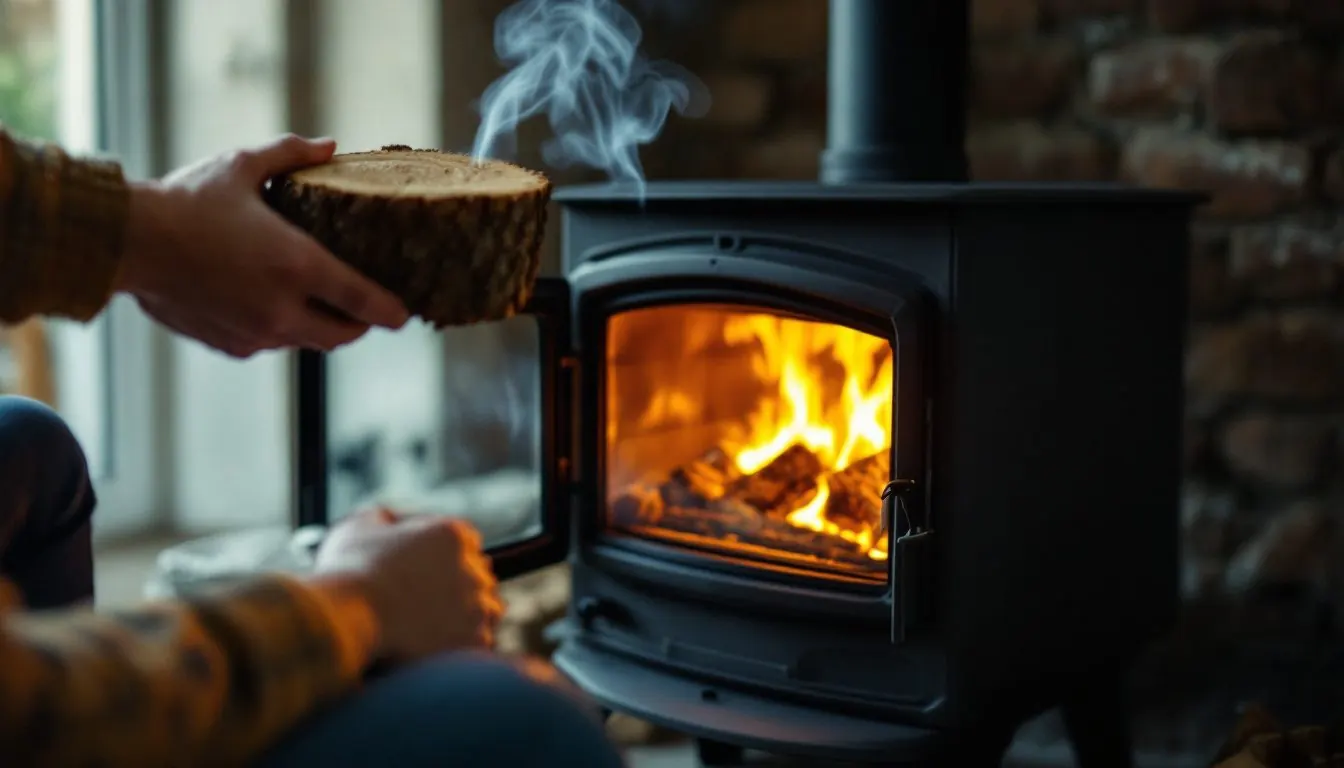
A wood stove smoking into the house means room pressure is beating chimney draft. The timing names the cause: only at lighting, a cold flue or a depressurized house; only when loading, low draft or a door opened too fast; with the door shut, a blocked cap, creosote or wet wood; only in wind, downdraft.
When does your wood stove smoke into the house: at lighting, when loading, with the door shut, or in wind?
Pin down the moment first: each one has its own cause. Natural Resources Canada’s Guide to Residential Wood Heating (2002, archived copy) sorts spillage into poor system design, negative pressure in the house and poor firing, and says a system that is “properly designed, installed and operated will not spill smoke into the house.”
| When the smoke comes in | Most likely cause | What the document says | First thing to try |
|---|---|---|---|
| Only while lighting a cold stove | Cold flue; house stack effect pulling down the chimney | NRCan: “cold-backdraft-at-standby” | Fans off; prime the flue with newspaper |
| When you open the door to reload | Smouldering load, weak draft | Drolet: air open about 15 seconds, door open 2″ to 4″ first | Use that sequence every reload |
| Every reload since a new EPA stove went in | Old venting too restrictive | Jotul: EPA stove on a “marginal venting system” | Count elbows; 45s in place of 90s |
| Door shut, smoke from pipe joints | House under negative pressure | England’s Stove Works: unit “is likely fighting negative pressure” | Range hood, bath fans, dryer off |
| Puffs on windy days | Wind pressure on the chimney top or house | Jotul: no cap, or open windows on the downwind side | Cap the chimney |
| Smell with no fire at all | Outside chimney, stove on a low floor | Jotul: “Cold backdraft at standby” | Insulated chase or inside chimney |
| First few fires in a new stove | Paint curing | Drolet: vapors “not poisonous, but they smell bad” | Small fires, then hotter, windows open |
Compiled by The HVAC Brief from NRCan (2002), two Drolet manuals, the England’s Stove Works 15‑W03 manual and Jotul’s chart.
Why does the wood stove smoke only when you first light it?
Because a cold chimney has no draft, and in winter the house is a taller, warmer chimney. With no fire, NRCan says, the air in an outside chimney “cools to the outside temperature,” and the basement’s slight negative pressure “is enough to pull the cold air down the chimney and out through any openings in the stove.” The Drolet wood stove manual (2023) says the same of any chimney “shorter than the warm space inside the house.”
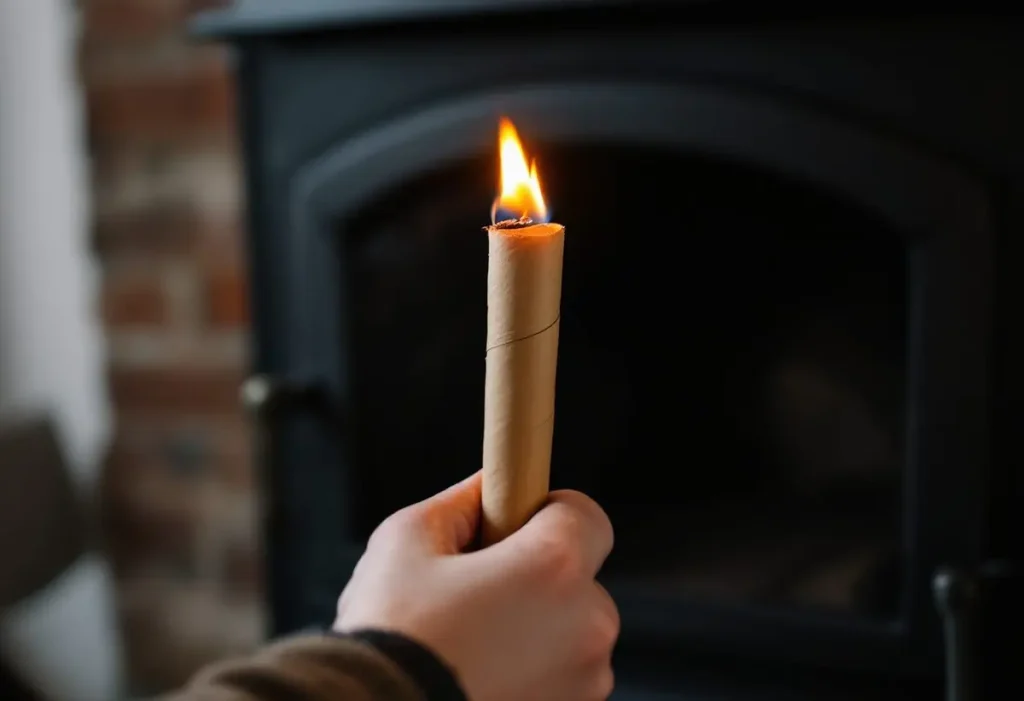
The England’s Stove Works 15‑W03 manual says to “Heat the flue first by burning crumbled newspaper in the stove.” NRCan adds cracking a window on the same level, windward side, and warns this only masks the problem. Its permanent fixes: an inside chimney exiting near the roof peak, or an insulated chase around an outside one.
Exhaust appliances make it worse. NRCan names “high-grade bathroom or kitchen fans, clothes dryers and central vacuum cleaners,” with a downdraft range hood the strongest. Shut them off while the fire catches; our make up air explainer covers the code trigger for big hoods, and the bathroom exhaust fan page covers how those fans are sized.
Why does smoke roll out when you open the door to add wood?
Because the load is smouldering and the flue has cooled. NRCan calls a smouldering fire “one of the most common reasons for smoke spillage.” The Drolet Classic EPA manual gives the reload routine: open the air control “to its maximum for approximately 15 seconds,” then open the door “by 2" to 4" (52 to 104 mm) for 10 to 15 seconds before opening it completely,” longer on a weak flue.
If smoke rolls out on every reload since a new stove went in, look at the pipe. Jotul’s troubleshooting chart blames runs “with too many elbows/changes in direction and horizontal runs,” and NRCan says an outside chimney with a long, multi-elbow pipe will “almost certainly” spill.
Why does it smoke into the room with the door closed?
With the door latched, smoke escapes through joints, gaskets or the air inlet, so the flue is not drawing: stop and inspect. The 15‑W03 manual says smoke “forced out the chimney connector joints” means the stove “is likely fighting negative pressure in the dwelling.” NRCan says severe smouldering can spill smoke with the door closed, “which can be hazardous when it happens during the night.”
Next, look at the top. Under IRC Sections R1003.9.2 and R1003.9.3 (Seattle’s 2021 reprint), a spark arrestor on a masonry chimney has openings between 3/8 inch and 1/2 inch and must be removable for cleaning, and a cap’s net free area must be at least four times the flue outlet. A stuck fireplace damper blocks the flue too; our fireplace damper guide shows how to check it.
Then check the fuel and the flue lining. EPA’s Burn Wise program says wood burns best below 20 percent moisture and tells owners to test it with a wood moisture meter. Drolet’s owner’s manual says soot or creosote “in excess of 1/8" (3 mm) thick” calls for immediate cleaning. If a masonry chimney is unlined or the liner is cracked, the chimney liner rules apply before the stove is used again.
Is the chimney too short or too cold to draw?
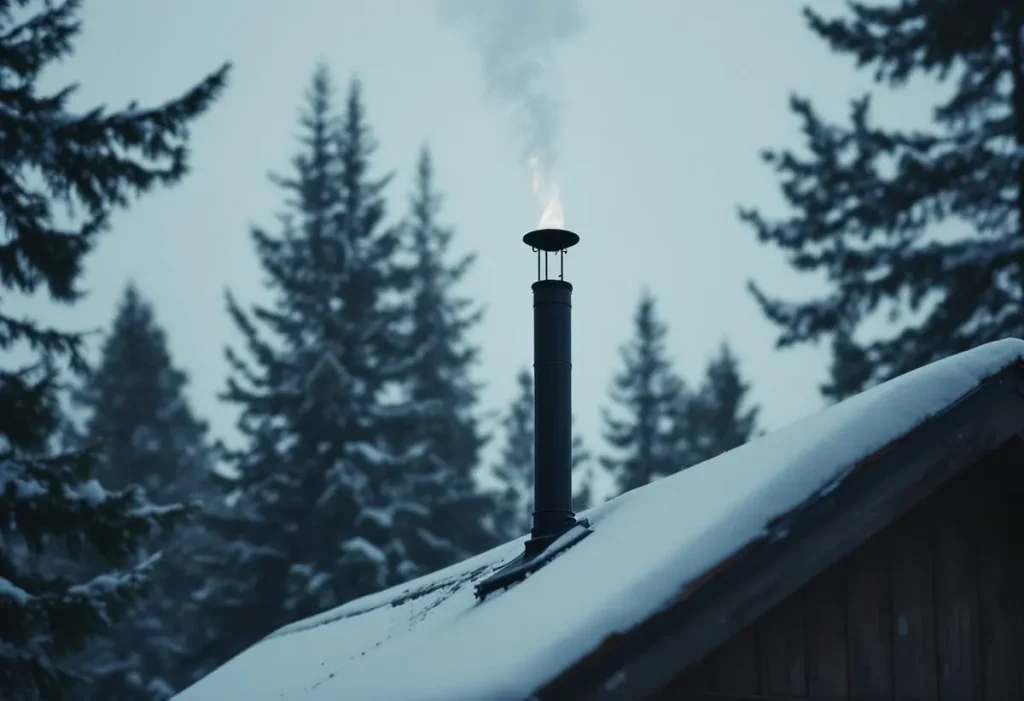
Check the height first. IRC Section R1003.9 says chimneys “shall extend not less than 2 feet (610 mm) higher than any portion of a building within 10 feet (3048 mm), but shall be not less than 3 feet (914 mm) above the highest point where the chimney passes through the roof.” England’s Stove Works lists missing this “10‑3‑2 rule” as the first cause of a stove that “smokes into room.” NRCan’s rule of thumb is at least 4.6 m (15 ft.) from the stove’s floor to the chimney top.
Height alone does not fix an outside chimney; NRCan says the extra heat loss “cancels out any benefit.” A technician settles it with a draft gauge read against the maker’s figure.
| Draft reading (Drolet Classic EPA) | Inches of water column | About (Pa) | What Drolet says it means |
|---|---|---|---|
| Too weak | less than .03 | 7 | “will cause operational difficulties” |
| Target, medium high fire | .05 to .07 | 12 to 17 | Normal operating range |
| Too strong | greater than .10 | 25 | Over-firing; a manual damper may be added |
HVAC Brief calculation: 1 in. of water column is about 249 Pa, so .03 in. = 7.5 Pa, .05 = 12.5, .07 = 17.4, .10 = 24.9 (rounded). Limits are Drolet’s for one model; use your own manual’s figure.
Why does the wood stove puff smoke into the house on windy days?
Wind pushes on the chimney top and on the house. NRCan says wind flowing down onto an open top “produces a positive pressure zone” that “forces the exhaust back down the chimney,” and every chimney “should have a cap.” Jotul pairs puffing in wind with a missing cap, or a leaky house with “open windows on downwind side.”
Outside air kits are a weak fix. Drolet says to disconnect the duct if smoke puffs in wind, because wind can reverse its flow, and NRCan reports smoke spillage “occurs at the same level of room depressurization, whether or not an outdoor air duct is installed.” England’s Stove Works does list outside air for negative pressure, so the makers disagree; the stove’s listing and the local inspector decide whether a kit is required. Our combustion air page covers the gas appliance rules in the same basement.
Is wood stove smoke in the house dangerous?
Yes: indoor smoke can carry carbon monoxide, and the same conditions build creosote. Drolet says that when unburned logs sit without flame, “the CO rate will increase,” and requires a CO detector in the stove room. Under model IRC Section R315.1.1, CO alarms must be listed to UL 2034; heights and distances are on our carbon monoxide detector placement page.
Creosote is the fire risk. NRCan says severe smouldering can build enough to “sustain a chimney fire” in “only a few days,” while a properly run low-emission stove usually needs cleaning once a year. Chimney and flue fires lead the federal counts on our home heating fire statistics page; for outage use, see keeping a house warm in a power outage.
The stop line: if a CO alarm sounds, the flue roars, or smoke keeps coming with the door shut and fans off, get everyone out and call 911. A sweep or hearth technician should then camera the flue, check the cap and spark screen, measure creosote against the 1/8 inch trigger and take a hot draft reading. Certification rules for the stove itself are on our wood stove rules and data page.
Frequently asked questions
Why is my new wood stove smoking on first use?
Usually the paint is curing. Drolet’s 2023 manual says the vapors from the first few fires “are not poisonous, but they smell bad” and can trip smoke alarms. It advises two or three small fires, then hotter ones, with windows open, until the smell stops. Smoke from the door or pipe joints is a draft problem instead.
Why is there a wood stove smoke smell in the house when no fire is burning?
Most often cold air is flowing down the chimney. NRCan’s 2002 guide calls it the cold-backdraft-at-standby syndrome: an idle outside chimney cools to outdoor temperature and the basement’s negative pressure pulls air and odor down through the stove. The permanent fix is an inside chimney or an insulated chase.
How do I tell if I have creosote buildup?
With the stove cold, look into the flue pipe and chimney with a light. Drolet’s manual treats soot or creosote over 1/8 inch (3 mm) thick as a call for immediate cleaning. NRCan says smouldering leaves black, tarry, flammable creosote, while proper firing leaves small amounts of soft, flaky, dark brown deposits.
Will an outside air kit stop a wood stove smoking into the house?
Not reliably. NRCan’s 2002 guide reports research showing spillage happens at the same room depressurization with or without an outdoor air duct, and wind can reverse the duct’s flow. England’s Stove Works still lists outside air as a fix. Turning off exhaust fans, or adding make up air, addresses the cause.
Why does my wood fireplace put smoke in the house?
Check the damper first, then the stove causes: a cold flue, exhaust fans, or a chimney short of IRC Section R1003.9, which requires 3 feet above the roof penetration and 2 feet above anything within 10 feet. NRCan also names a fireplace “competing with your range hood” as a cause of indoor smoke.
How we researched this
Documents read November 20, 2026: NRCan’s Guide to Residential Wood Heating (2002, archived copy), two Drolet owner’s manuals, the England’s Stove Works 15‑W03 manual, Jotul’s troubleshooting chart, EPA Burn Wise and IRC Chapters 3 and 10 in the 2021 Seattle reprint, plus the top results (a Regency article and two forums). Excluded: forum and video advice that cites no document, and NFPA 211, which we did not read. Draft limits are one maker’s, not universal.
Sources
- Natural Resources Canada. “A Guide to Residential Wood Heating” (2002), archived copy. https://web.archive.org/web/2020id_/http://dsp-psd.pwgsc.gc.ca/Collection/M92-23-2002E.pdf. Accessed November 2026.
- Drolet. “Owner’s Manual: Classic EPA Wood Stove.” https://www.drolet.ca/file/45145A.pdf. Accessed November 2026.
- Drolet. “Wood Stove Owner’s Manual, Part 1 of 2: Safety Notifications and General Information” (2023). https://www.drolet.ca/file/46231_UA_2023-04-28.pdf. Accessed November 2026.
- England’s Stove Works. “15‑W03 (ESW0016 Model) Installation and Operation Manual.” https://cdn.shopify.com/s/files/1/0782/2077/files/W03.pdf. Accessed November 2026.
- Jotul. “A Troubleshooting Chart For Your Wood Stove Or Insert.” https://jotul.com/how-tos/troubleshooting-chart-your-wood-stove-or-insert. Accessed November 2026.
- U.S. Environmental Protection Agency, Burn Wise. “Best Wood-Burning Practices.” https://www.epa.gov/burnwise/best-wood-burning-practices. Accessed November 2026.
- Seattle Department of Construction and Inspections. “2021 Seattle Residential Code, Chapter 10: Chimneys and Fireplaces” (IRC reprint). https://seattle.gov/documents/Departments/SDCI/Codes/SeattleResidentialCode/2021SRCChapter10.pdf. Accessed November 2026.
- Seattle Department of Construction and Inspections. “2021 Seattle Residential Code, Chapter 3: Building Planning” (IRC reprint, Section R315). https://seattle.gov/documents/Departments/SDCI/Codes/SeattleResidentialCode/2021SRCChapter3.pdf. Accessed November 2026.
Leave a Reply