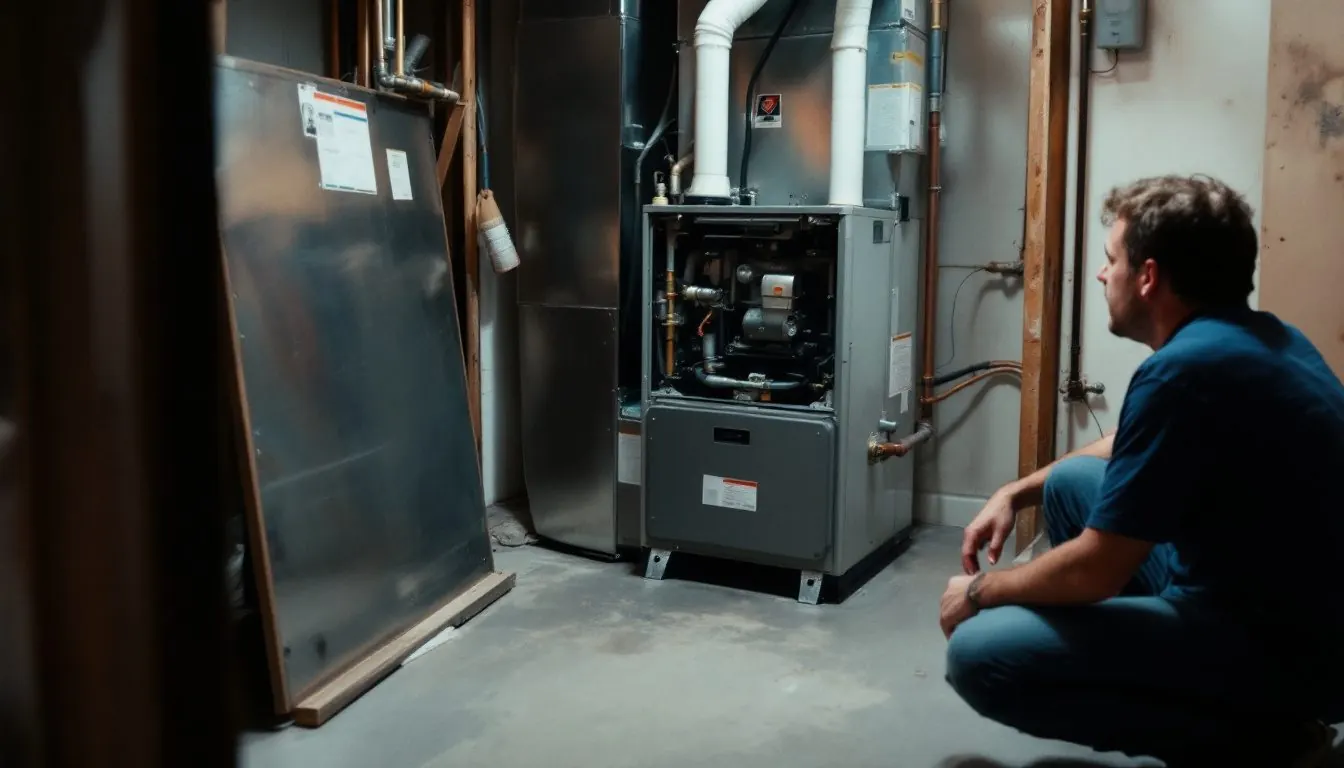
A furnace door safety switch is a spring-loaded push button that the seated blower door holds closed. Pull the door, or leave it crooked, and the switch opens: Goodman, Carrier and York manuals say it cuts line power to the furnace control, so the status light goes dark and nothing runs. Every maker forbids bypassing it.
Manuals also call it the blower door interlock or blower access panel door switch. In heating season it is the first suspect when a furnace that ran yesterday is silent after a filter change.
What does the door switch cut on a Goodman, Carrier, Rheem, York, Trane or Lennox furnace?
On most furnaces it cuts the 120 V feed to the control board, taking the 24 V transformer and thermostat down with it. Lennox describes its SL280DFNV interlock fault as a loss of 24 VAC instead.
| Maker and manual | What the switch interrupts (maker’s wording) | Panel that works it | Fault codes when the door comes off | Bypass and service warning |
|---|---|---|---|---|
| Goodman GM9S92, GM9S96 (RS6612022R1) | “interrupts unit voltage when the blower door is opened” | Blower compartment door | Stored code lost unless the switch is held closed | “Do not defeat this switch.” |
| Goodman and Amana 80% and 90% (RS6610004) | No 120 V at the ignition control: check the door switch and harness | Blower door | “LED Flash codes will cease” | Door in place except for inspection and maintenance |
| Carrier Infinity 58MVC | Opens 115 V power to the furnace control | Blower access panel only; main door can come off with power on | Stored for 72 hours regardless of power interruption | Tape closed only during service tests |
| Rheem (-)801T | Not stated | Blower door; switch clips in beside the junction box | Not stated | “DO NOT DISABLE THIS SWITCH” |
| York TM8Y | “interrupts all power at the unit” | Blower panel (switch sits in the burner compartment) | Up to five codes kept even if power is lost | “Do not rely upon the interlock switch as a main power disconnect” |
| Trane S9V2 (18-CE03D1) | Not described | Blower door | Wait 10 seconds after power off for the control to discharge | “Do not bypass the door switch or panel loop by any permanent means” |
| Lennox SL280DFNV (508150-02) | Code E370: control “sees the loss of 24VAC for 2 minutes” | Blower panel | E370 logged after 2 minutes open | All services stop until the switch closes |
Compiled by The HVAC Brief from the seven maker manuals listed under Sources, read November 2026. Wording in quotation marks is the maker’s own.
Two rows change how you troubleshoot. Carrier’s 58MVC code retrieval steps take the main door off with power on and read the LED through the blower access panel’s sight glass, so only the lower panel works that switch. York’s TM8Y switch is mounted in the burner compartment yet responds to the panel covering the blower compartment, so on that furnace it is the blower panel that has to be seated, even though the switch is not behind it.
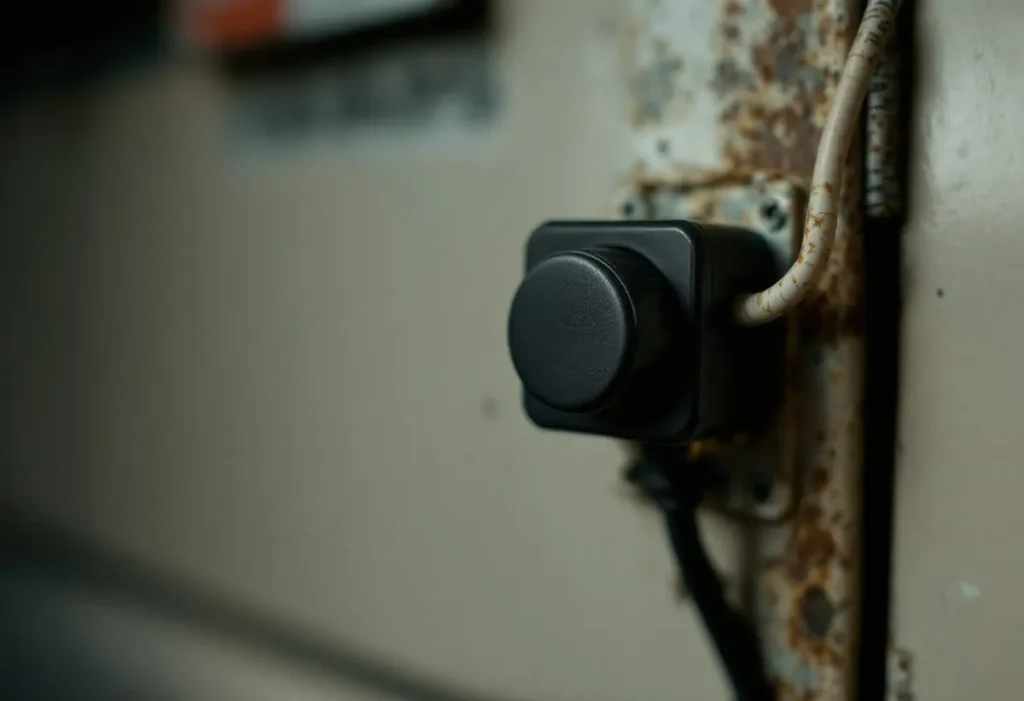
Where is the furnace door safety switch located?
Look on the cabinet frame at the edge of the blower compartment opening, usually near the junction box or control board, where the inside face of the blower door presses a small plunger. On Rheem’s (-)801T the switch is clipped into a hole in the cabinet wall next to the junction box, and the manual shows moving both to the opposite side when the line voltage enters from the right. On the Carrier 58MVC it is one assembly with the control box and transformer.
York’s TM8Y wiring diagram labels it DS, Door Switch; on an unfamiliar furnace, the diagram inside the door is the fastest way to find it.
Why is the furnace completely dead after you put the blower door back on?
Usually because the door is not pressing the plunger all the way in. A panel hung one tab low, a filter edge pushing it out or a switch bracket bent during an earlier repair leaves the contacts open while the door looks closed. The result matches the first row of Carrier’s 58MVC troubleshooting chart: the amber status LED is off.
Carrier’s chart then checks for 115 V at the control, whether the door switch is closed, and whether 115 V reaches the switch; power at the switch but not at the control means “Replace door switch.” Goodman’s RS6612022R1 flow chart sends the same no-power reading to “furnace breaker, switch, door switch.”
A thermostat powered by the furnace transformer goes blank at the same moment, which is why a door left ajar can trigger the Nest message about no power to the Rh wire. A furnace that clicks, hums or shows a lit LED is past this switch, and a furnace clicking but not turning on is the next place to look.
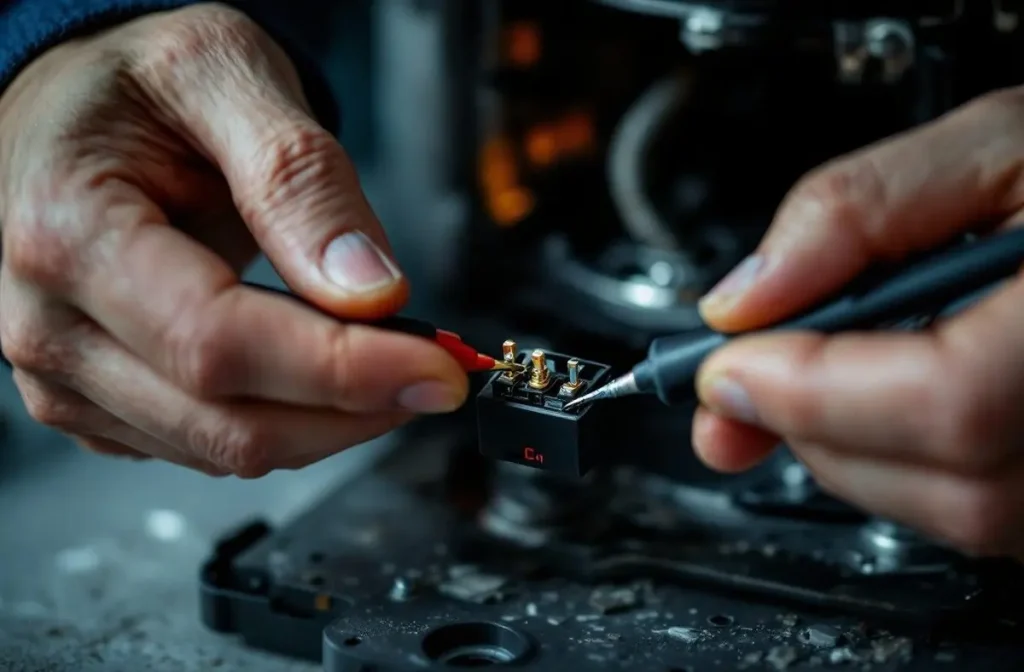
How do you test a furnace door safety switch with the power off?
With a multimeter on continuity or the lowest ohms range, the plunger pressed should read closed and the plunger released should read open. Anything else means the switch is bad. Do it this way:
- Turn the furnace off at the service switch and the breaker. York warns not to rely upon the interlock switch as a main power disconnect, because the wires feeding it stay live with the door off.
- On a Trane, wait at least 10 seconds after disconnecting power so the control supply discharges, as the S9V2 installer’s guide requires before the blower door comes off.
- Photograph the wires, then pull them off the switch terminals.
- Press the plunger fully: the meter should beep or read close to zero ohms. Release it: the meter should show open (OL).
- Open when pressed, or closed when released: replace the switch.
If the switch passes, the fault is upstream or downstream. Goodman’s RS6610004 tells the technician to check for 120 volts from Line 1 to neutral at the ignition control, and if it is missing, “check the door switch connections and wire harness for continuity.” The next Goodman step is 24 volts at the transformer; if R to C reads “approximately 13 volts” with 24 volts at the transformer, the manual points to a blown fuse. Those live readings are a technician’s job; our pages on the HVAC transformer and the furnace control board cover them.
Why does pulling the blower door erase the furnace’s blinking code?
On a Goodman furnace, opening the door switch cuts power to the board, and Goodman’s manuals say “LED Flash codes will cease” when power is interrupted through the disconnect or door switch. RS6612022R1 adds that failing to hold the switch closed while removing the door “will result in the loss of the stored failure code,” though recycling the control usually brings it back.
Other makers keep a history through the outage. The Carrier 58MVC control stores all status codes for 72 hours regardless of power interruption, and the York TM8Y board keeps up to five codes even if power is lost. Lennox works the other way: its SL280DFNV logs E370 after the interlock has been open for 2 minutes, so an E370 in the history may be the code you created by leaving the door off. Read the light through the sight glass first, then match it on the Goodman flash code table or the Carrier status codes.
How do you replace a furnace door safety switch?
Buy the part number on the furnace’s own parts list, because switch bodies and mounting clips differ between makers. With the power off, move the wires one at a time to the new switch.
Rheem’s (-)801T instructions show how its switch comes out: squeeze the retaining arms with a flat screwdriver and gently pry the switch from its opening. Push the new one in until the arms lock, refit the door, and confirm the LED lights with the door seated, goes dark when it is pulled, and that a heat call runs the start sequence in our guide to turning on a furnace. If the board was in lockout before the switch failed, the steps to reset a furnace apply once power is back.
Is it safe to tape down or jump the door switch to get heat back?
No. Rheem’s warning is the plainest: blower and burners “MUST NEVER BE OPERATED WITHOUT THE BLOWER DOOR IN PLACE” because doing so can draw gas fumes, which “COULD CONTAIN HAZARDOUS CARBON MONOXIDE,” into the home. With the panel off, the blower pulls return air from the furnace room itself.
York adds: never operate the furnace with the blower door removed. The only sanctioned exception is the temporary one in Carrier’s 58MVC procedures, where a technician tapes the switch closed with the panel off to watch the component test or read codes, then removes the tape and refits the panel. A failed switch is a part swap, not a reason for a jumper; if the blower still will not start once power is back, the furnace blower not turning on checks pick up from there.
Frequently asked questions
Where is the Goodman furnace door safety switch?
It is at the edge of the blower compartment, pressed by the lower door. Goodman’s RS6612022R1 calls it a blower door interlock switch that “interrupts unit voltage when the blower door is opened,” and tells technicians to read the fault light through the sight glass in that door first, because opening it without holding the switch closed loses the stored failure code.
Does the Rheem furnace door safety switch move with the junction box?
Yes. Rheem’s (-)801T instructions allow the junction box to move to the right side of the cabinet, and step 8 of that procedure installs the door switch in the same opening on the opposite side and reconnects its wires. Rheem notes that reversing the junction box is not possible in 14.0 inch cabinets.
Why is the York furnace door safety switch in the burner compartment?
That is where York’s TM8Y installation manual says the electrical interlock switch is mounted, even though it responds to the panel covering the blower compartment and “interrupts all power at the unit” when that panel is removed. York also states that blower and burner must never be operated without the blower panel in place.
How we researched this
On November 20, 2026 we read the seven maker documents under Sources in full text. Every quote and number here comes from one of them and is tied to the model it covers. The top-ranking pages for this query (parts stores, forums, videos and two how-to articles) cite no maker document, so we used none of them for a fact. Part prices are left out because supplier pages blocked automated reads, and Trane’s “panel loop” is not described beyond Trane’s wording because the guide does not define it.
Sources
- Goodman Manufacturing. “Service and Troubleshooting, GM9S92 / GM9S96 Single Stage Gas Furnaces (RS6612022R1).” https://mobile.goodmanmfg.com/mobileapp/stellent/pdf/infoPdf/Lit/RS6612022R1.pdf. Accessed November 2026.
- Goodman Manufacturing. “Service Instructions, 80%, 90%, 95% Gas Furnaces and Accessories (RS6610004 Rev. 9).” https://s3.amazonaws.com/s3.supplyhouse.com/product_files/Goodman-GMS951155DXA-Install-Instructions.pdf. Accessed November 2026.
- Carrier. “Infinity ICS Model 58MVC Condensing Gas Furnace, Service and Maintenance Procedures.” https://www.shareddocs.com/hvac/docs/1009/public/0f/58mvc-01sm.pdf. Accessed November 2026.
- Rheem. “Installation Instructions, (-)801T Upflow Series Gas Furnaces.” https://resource.gemaire.com/is/content/Watscocom/Gemaire/rheem_r801t_en_ii.pdf. Accessed November 2026.
- York. “Installation Manual, TM8Y Two Stage Standard ECM Residential Gas Furnace.” https://www.yorknow.com/pub/media/documentation/TM8Y_Install.pdf. Accessed November 2026.
- Trane. “Installer’s Guide, S9V2 Gas Fired Condensing Variable Speed Furnaces (18-CE03D1-1F).” https://elibrary.tranetechnologies.com/public/residential-hvac/Literature/Installation/18-CE03D1-1F-EN_05132020.pdf. Accessed November 2026.
- Lennox Industries. “SL280DFNV Gas Furnace Downflow Installation Instructions (508150-02).” https://www.lennox.com/dA/78477aadd3/508150-02a.pdf. Accessed November 2026.
Leave a Reply