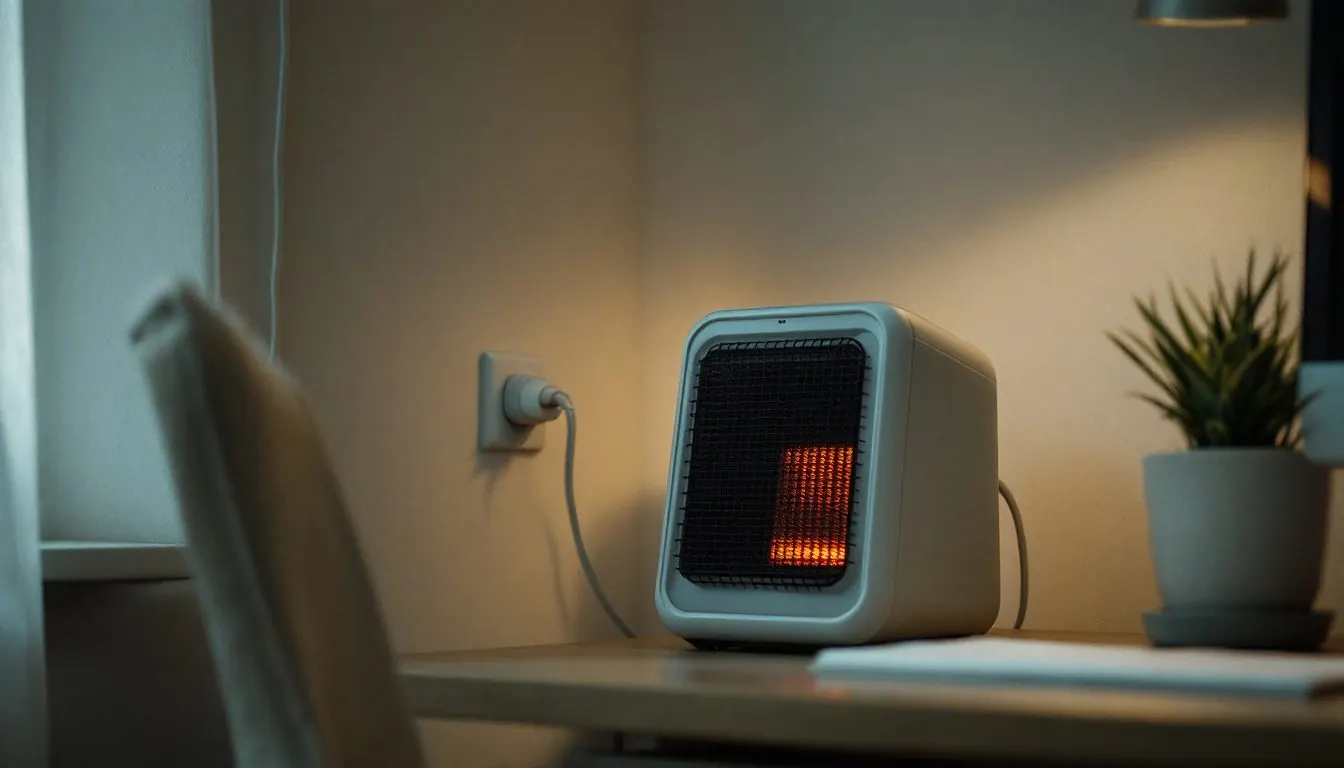
A space heater tripping the breaker is usually an overload: on high, a 1,500 watt heater draws 12.5 amps at 120 volts, over the 12 amps the code allows one plug-in appliance on a 15 amp circuit. Add a lamp and a TV and it trips. An instant trip, a GFCI trip or a hot plug means a fault.
How many amps does a 1500W space heater pull on a 15 amp circuit?
12.5 amps on high: watts divided by volts, 1,500 ÷ 120. That is 83% of a 15 amp breaker before anything else is switched on.
| What is running on the circuit | Watts | Amps at 120 V | Share of a 15 A breaker | Share of a 20 A breaker |
|---|---|---|---|---|
| Oil filled heater, one switch on (De’Longhi MG15T) | 600 | 5.0 | 33% | 25% |
| Oil filled heater, other switch on (De’Longhi MG15T) | 900 | 7.5 | 50% | 38% |
| Any heater on high, nothing else (Lasko, Dreo, De’Longhi both switches) | 1,500 | 12.5 | 83% | 62% |
| 1,500 W heater plus a 150 W floor lamp and a 200 W TV | 1,850 | 15.4 | 103% | 77% |
| CPSC example: 1,000 W heater plus 1,400 W hair dryer | 2,400 | 20.0 | 133% | 100% |
| Square D example: 1,300 W heater, hair dryer, coffee maker, lights, TV | 3,600 | 30.0 | 200% | 150% |
HVAC Brief calculation: amps = watts ÷ 120 V. Heater settings from the De’Longhi MG15T, Lasko 6462 and Dreo manuals; example loads from the CPSC Guide to Home Wiring Hazards and Square D Data Bulletin 0760DB0204. Red cells exceed the breaker rating.
The 80 percent figure is IRC section E3702.3, which mirrors NEC 210.23(A): “the rating of any one cord-and-plug-connected utilization equipment not fastened in place shall not exceed 80 percent of the branch-circuit ampere rating” (IRC 2021, Chapter 37). By our arithmetic that is 1,440 watts on a 15 amp circuit and 1,920 watts on a 20 amp circuit. The CPSC home wiring guide rounds the first to “1500 watts” (CPSC Guide to Home Wiring Hazards). Either way, a heater on high fills a 15 amp circuit alone.
The code also treats a load lasting “3 hours or more” as continuous and sizes conductors at 125 percent of it (E3701.2.1): for a heater on high all night, 15.6 amps, above a 15 amp rating. The running cost and fire record of space heaters follow from the same 1,500 watts.
Why does the space heater trip the breaker after a few minutes, not right away?
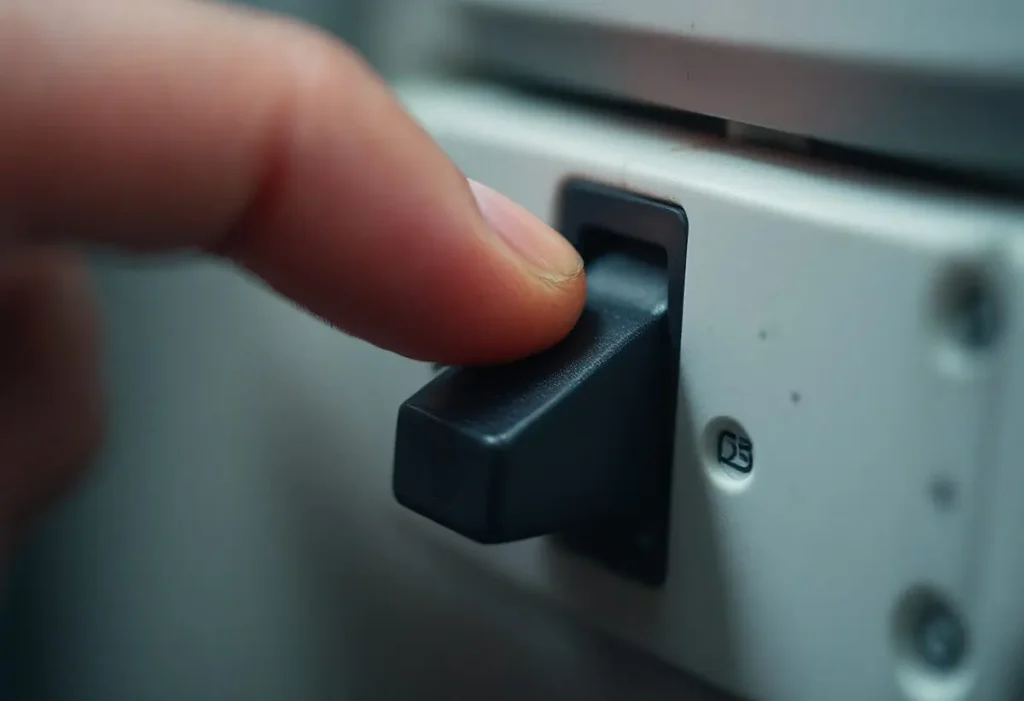
Because overload tripping is thermal and slow. A bimetal strip in the breaker heats with the current until it unlatches; Schneider Electric’s QO catalog says “the greater the overcurrent, the faster” it trips, and that above 135% of rating it will “open the circuit within limits specified by the band” (QO catalog 0730CT9801).
On a 15 amp breaker that point is 20.25 amps. A heater, lamp and TV at 15.4 amps sit below it, so the trip comes after minutes of warming, or when one more load joins. In Square D’s worked case, a 3,600 watt bedroom circuit with an electric space heater (1,300 watts) and a hair dryer, the curve shows a trip “in 30 seconds” at 1.5 times rating (Square D Data Bulletin 0760DB0204).
Bulletin 0760DB0204 also sorts every trip by speed: overloads take “seconds or tens of seconds,” while short circuit, ground fault and arc fault trips act in “less than one-tenth of a second.” Lights out the instant the heater clicks on is not an overload.
What else is on the circuit with the heater, and how do you find it?
Usually more than the room you are in: Square D’s 3,600 watt example included a coffee maker, and the bulletin warns “the circuit may serve loads outside the affected room.” The CPSC guide’s method is to note what went dark, read the watts on each rating label and add them.
Before resetting, list every dead outlet and lamp; that is the circuit. Compare its total with 1,440 watts (15 A) or 1,920 watts (20 A). Two 1,500 watt heaters total 25 amps, more than any 15 or 20 amp general purpose circuit carries.
Space heater tripping an AFCI or arc fault breaker: overload, short or arc?
An AFCI trips on everything a standard breaker does plus arcing, and Square D says its AFCIs also detect residual current of “50 mA and greater.” Check timing first: a trip 30 seconds after a hair dryer or second heater starts is an overload.
If it trips the moment the heater switches on, Square D says to unplug the heater: if the breaker then resets, “this would indicate a short in the heater.” An arc fault is what remains once overload, short and ground fault are ruled out. The CPSC says ordinary breakers “do not respond to early arcing and sparking” (CPSC Publication 5133), so repeat AFCI trips with a good heater are an electrician’s wiring job, never a reason to fit a standard breaker.
Why does a space heater trip a GFCI outlet when the breaker holds?
A GFCI trips on current leaking to ground, not on total load. Schneider Electric’s Class A GFCI breakers “must trip at 6 milliamperes” of ground fault current and hold below 4 milliamperes. A healthy heater drawing 12.5 amps will not trip one; a few milliamps leaking through moisture or a damaged element will.
GFCIs sit where heaters go in winter: IRC section E3902 requires them for bathroom, garage, outdoor, laundry, crawl space and unfinished basement receptacles (IRC 2021, Chapter 39). Lasko’s 6462 manual says its heater is “not intended for use in bathrooms” or laundry areas (Lasko 6462 manual). Trips on every GFCI you try mean the heater leaks; trips on one only mean that circuit needs an insulation test.
Why does a space heater trip a power strip or surge protector?
Because makers forbid it. Lasko’s manual says never to plug the heater into “a power strip, surge protector, multiple outlet adapter, cord reel,” Dreo’s says never use a “relocatable power tap (outlet/power strip),” and the CPSC says never power a heater “with an extension cord or power strip” (CPSC heater safety).
De’Longhi alone allows a cord when unavoidable: grounded, “No. 14 AWG minimum size and rated not less than 1875 watts,” feeding only the heater (De’Longhi MG15T manual).
Warm plug or hot outlet: when is the trip no longer the problem?
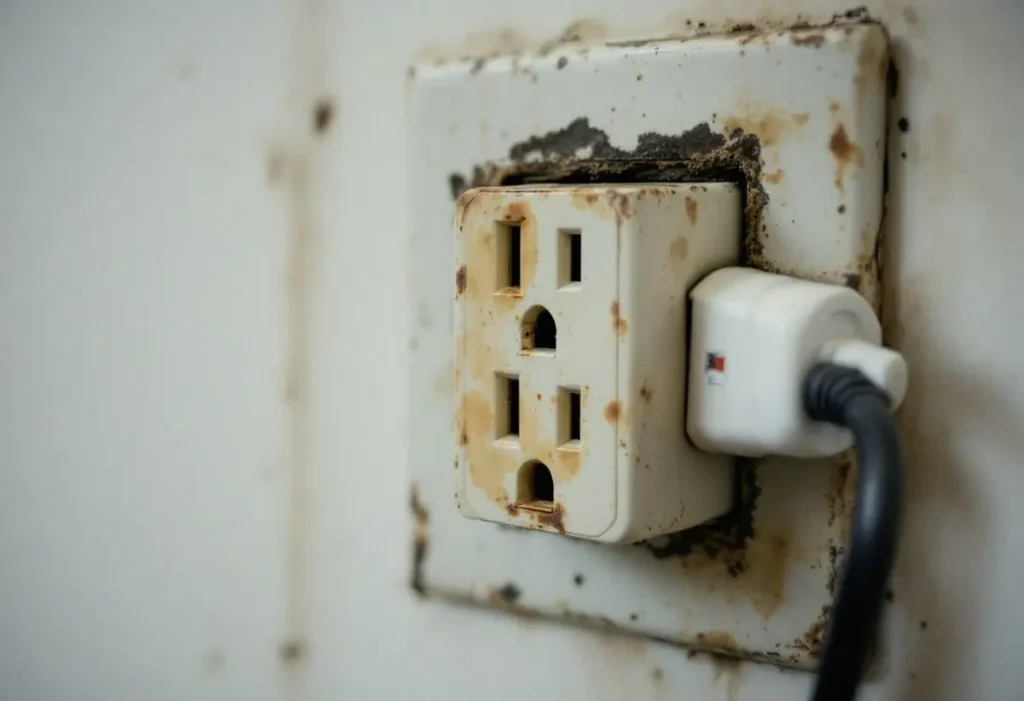
When the plug or wall plate is hot, not warm. Dreo’s manual says “it is normal for the plug and cord to feel warm to the touch,” and Dreo and De’Longhi both say a plug that turns hot or distorted “may be a result of a worn electrical outlet” to be replaced before further use. The CPSC guide agrees: plugs and outlet covers “may be warm but should never be hot.”
A loose contact can cook a receptacle without tripping anything, because 12.5 amps makes heat at the contact, not overcurrent at the panel. The CPSC flags backwired push-in outlet connections as ones that “may tend to loosen and overheat.” A burning smell belongs on our electric heater burning smell decoder; a discolored outlet means stop and call an electrician.
Can you swap in a 20 amp breaker, or does the heater need a dedicated circuit?
Never upsize the breaker. The CPSC guide says “do not put in a higher ampere fuse or circuit breaker”: the breaker protects the wire, which stays the same size. The AC version of a tripping breaker makes the same case at 240 volts.
Fixes in cost order: use the low setting (900 watts is 7.5 amps, 50% of 15 A); move to an outlet on an idle circuit; keep the hair dryer off that circuit. A new 20 amp circuit carries the heater at 62%. For nightly heat, 240 volt electric baseboard on its own circuit is the permanent answer.
Ask the electrician for three readings: clamp meter amps on the circuit with the heater on high, outlet voltage at 120 V nominal with and without the heater, and receptacle temperature under load.
Frequently asked questions
Is it normal for a space heater to trip a breaker?
It is common on a shared 15 amp circuit, because a 1,500 watt heater draws 12.5 amps, over the 12 amp limit IRC E3702.3 sets for one plug-in appliance there. It is not normal on an otherwise idle circuit: the CPSC wiring guide treats one appliance that repeatedly trips a breaker as a sign of a defect.
Why does my space heater keep tripping the breaker when nothing else is on?
Check that nothing else really is on: Square D’s bulletin found a coffee maker in another room on a bedroom circuit. If the heater alone still trips a 15 amp breaker, that is 83% of its rating, so suspect the heater, a loose or worn outlet, or the breaker. Try the heater on another circuit; if it trips there too, retire it.
Can two space heaters be on the same circuit?
Not two on high. Two 1,500 watt heaters draw 25 amps at 120 volts, above 135% of a 15 amp rating, where Schneider Electric says a QO breaker will open. Two De’Longhi MG15T heaters on their 600 watt switches total 10 amps, which fits a 15 amp circuit with little else on it.
Will running a space heater on low stop it tripping the breaker?
Often, yes. The De’Longhi MG15T manual shows 900 and 600 watt switches (700 and 800 on its dial version), which is 7.5 or 5.0 amps at 120 volts, against 12.5 amps on high for an oil filled radiator with both on. If it still trips on low, other loads or a fault are the cause.
How we researched this
On November 17, 2026 we read the 2021 IRC electrical chapters (Utah edition on UpCodes, with NEC sections in brackets), Schneider Electric’s QO catalog 0730CT9801, Square D Data Bulletin 0760DB0204, three CPSC publications, and the Lasko 6462, Dreo and De’Longhi MG15T manuals. Amps are our arithmetic at 120 volts. We excluded contractor blogs and forums as sources for figures, gave no breaker trip times beyond those printed by Square D, and do not list AFCI rooms because the Utah edition omits that rule; the local inspector decides which code edition applies.
Sources
- UpCodes. “2021 IRC (Utah), Chapter 37 Branch Circuit and Feeder Requirements.” https://up.codes/viewer/utah/irc-2021/chapter/37/branch-circuit-and-feeder-requirements. Accessed November 2026.
- UpCodes. “2021 IRC (Utah), Chapter 35 General Requirements (definitions).” https://up.codes/viewer/utah/irc-2021/chapter/35/general-requirements. Accessed November 2026.
- UpCodes. “2021 IRC (Utah), Chapter 39 Power and Lighting Distribution.” https://up.codes/viewer/utah/irc-2021/chapter/39/power-and-lighting-distribution. Accessed November 2026.
- Schneider Electric. “QO and QOB Miniature Circuit Breakers, Catalog 0730CT9801.” https://download.schneider-electric.com/files?p_Doc_Ref=0730CT9801&p_enDocType=Catalog. Accessed November 2026.
- Square D (Schneider Electric). “Determining the Cause of AFCI Tripping, Data Bulletin 0760DB0204.” https://media.distributordatasolutions.com/schneider/2018q1/3e01143b5f3cfdfe3d2fd6ffb5d7f7081b14dfa7. Accessed November 2026.
- CPSC. “CPSC Guide to Home Wiring Hazards (Publication 518).” https://www.cpsc.gov/s3fs-public/518.pdf. Accessed November 2026.
- CPSC. “Preventing Home Fires: Arc Fault Circuit Interrupters (Publication 5133).” https://www.cpsc.gov/s3fs-public/5133.pdf. Accessed November 2026.
- CPSC. “7 Highly Effective Portable Heater Safety Habits.” https://www.cpsc.gov/s3fs-public/PortableElectricHeaterSafetyNSN.pdf. Accessed November 2026.
- Lasko. “Model 6462 Ceramic Heater Important Instructions.” https://pdf.lowes.com/operatingguides/046013766236_oper.pdf. Accessed November 2026.
- Dreo. “Dreo Space Heater User Manual (1500W ceramic heater with ALCI plug).” https://m.media-amazon.com/images/I/D1gEx9OO8LL.pdf. Accessed November 2026.
- De’Longhi. “Electric Oil Filled Radiators, Type MG15T, Important Instructions.” https://dls.delonghigroup.com/files/docs/5/A1-5785004700.pdf. Accessed November 2026.
Leave a Reply