An AC freezing up at night is usually a coil that was already marginal in the afternoon. Cooler outdoor air and cooler, drier return air push coil temperature down: Goodman’s own data put one correctly charged piston system as little as 1.7°F above freezing on a 65°F night. A dirty filter or a small leak supplies the rest.
Why does the AC freeze overnight but run fine all afternoon?
Because the coil runs colder at night even when nothing is broken. Coil temperature follows refrigerant pressure, which falls when the air entering the coil is cooler and drier and the outdoor air is cooler. Goodman publishes those pressures for every GSX14 condensing unit pairing; we converted six of them to coil temperature with the Bonneville Power Administration R-410A chart.
| Condition | Outdoor air | Air into coil (dry/wet bulb) | Blower | Suction | Coil saturation | Margin above 32°F |
|---|---|---|---|---|---|---|
| Rated afternoon, piston | 95°F | 80°F / 67°F | 600 cfm | 148 psig | 51.8°F | 19.8°F |
| Warm evening, piston | 85°F | 75°F / 63°F | 600 cfm | 127 psig | 43.4°F | 11.4°F |
| Mild night, piston | 75°F | 75°F / 63°F | 600 cfm | 123 psig | 41.8°F | 9.8°F |
| Cool night, piston | 65°F | 70°F / 59°F | 600 cfm | 108 psig | 35.1°F | 3.1°F |
| Cool night, piston, lowest blower step | 65°F | 70°F / 59°F | 525 cfm | 105 psig | 33.7°F | 1.7°F |
| Cool night, TXV pairing | 65°F | 70°F / 59°F | 550 cfm | 125 psig | 42.6°F | 10.6°F |
Piston rows: GSX140181 with a CA*F3636*6D* coil and its included 0.051 inch piston. TXV row: GSX140191 with EEP and TXV, as Goodman labels it. From a 95°F afternoon to a 65°F night, the same clean, correctly charged piston system loses about 18°F of coil temperature. R-410A boils at 32°F at about 101.6 psig, our interpolation of the BPA chart’s 100 and 102 psig rows, so a 105 psig reading leaves almost nothing.
Goodman’s pressures “are measured at the liquid and suction service valves” at the outdoor unit; the indoor coil runs slightly warmer because the suction line costs some pressure, so a healthy system on this table stays ice free. Add a loaded filter or a short charge to the bottom rows and no margin is left.
That gives night freezing its signature: ice builds in the small hours, and the heavier afternoon load can lift the coil back above 32°F so the ice melts before anyone looks. The general two-cause explanation, airflow or charge, is on our page about why an AC freezes up; this page covers what changes after dark.
Which matters more at night: cooler outdoor air, drier indoor air or a lower setpoint?
Outdoor temperature and indoor humidity move the coil most; the dry bulb setpoint itself barely registers. On Goodman’s piston table at 70°F entering air, 59°F wet bulb and 600 cfm, dropping the outdoor air from 95°F to 65°F takes suction from 124 to 108 psig, about 7°F of coil temperature. At 65°F outdoors, drying the house from 67°F to 59°F wet bulb takes it from 125 to 108 psig, about 7.5°F.
Lowering the air entering the coil from 75°F to 70°F at the same 59°F wet bulb moves suction 1 psig, from 106 to 105. A low setpoint freezes a coil mostly by running longer, which dries the house to a lower wet bulb. Goodman’s GSX14 tables stop at 70°F entering dry bulb and 59°F wet bulb, so a bedroom held at 65°F runs the coil off the maker’s published chart. Overnight comfort and cost are covered in whether to run the AC all night.
The same data contradict the claim on two top-ranking pages that humid nights cause ice. Moister return air raises coil pressure, because condensing water hands the coil extra heat: 108 psig at 59°F wet bulb against 125 psig at 67°F. A house the AC has already dried out is what shrinks the margin.
Blower speed is the third lever. On the same piston table, dropping from 675 to 525 cfm lowers suction from 109 to 105 psig, about 2°F. A quiet or dehumidify setting that slows the blower overnight spends that margin; a loaded filter cuts airflow below the table’s lowest step. How often to change a filter, and what a neglected one does, is in our HVAC filter guide.
Why does one house freeze on cool nights when the neighbour’s AC does not?
Often the metering device. On the same 65°F night, Goodman’s data put the piston pairing at 105 to 109 psig across three blower steps and the TXV pairing at 125 to 128 psig. A TXV opens and closes to hold superheat as load falls; a piston is a fixed bore whose flow is set by the pressure difference across it, as our TXV valve explainer details.
Night takes that pressure difference away. At 70°F and 59°F wet bulb indoors, the piston table’s liquid pressure falls from 309 psig on a 95°F day to 212 psig at 65°F, so less refrigerant is pushed through the same hole into the coil. Carrier’s 24APA3 product data describes its MotorMaster low ambient controller as holding condensing temperature at 100°F ±10°F by slowing the outdoor fan, which is the maker’s fix for exactly this drop.
Charge sensitivity widens the gap. ORNL’s summary of ASHRAE project 1173 (ORNL/TM-2018/485) found fixed orifice systems “had noticeable performance degradations when reducing the system charge below 90%” of factory charge, while TXV systems held until below 80%. A slightly short piston system can cool at 95°F and still freeze at 65°F. On a piston, charge is checked by superheat and subcooling against the maker’s chart, and a system that has lost charge has a leak, as our page on AC recharges explains.
Is it too cold outside at night to run a central AC?
Below 55°F outdoors, yes, unless low ambient accessories are installed. Goodman’s installation and service reference IOG-4002A says outdoor units “are approved for operation above 55°F in cooling mode” and that operation below 55°F “requires the use of an approved low ambient kit.”
Carrier’s 24APA3 accessory usage guideline marks an Evaporator Freeze Thermostat “Yes” for low ambient cooling below 55°F and describes it as “an SPST temperature-actuated switch that stops unit operation when evaporator reaches freeze-up conditions.” Goodman’s GSX14 accessory list carries the same pair: the LAKT01A Low-Ambient Kit and the FSK01A Freeze Protection Kit, footnoted “installed on indoor coil.” Top-ranking pages that put the cutoff at 60°F to 65°F cite neither.
An AC running on a 52°F night can mean a thermostat left on Cool or a contactor stuck closed. Frost on the outdoor suction line that night is indoor coil ice travelling outward, which our page on ice on an outside AC unit separates from normal heat pump defrost frost.
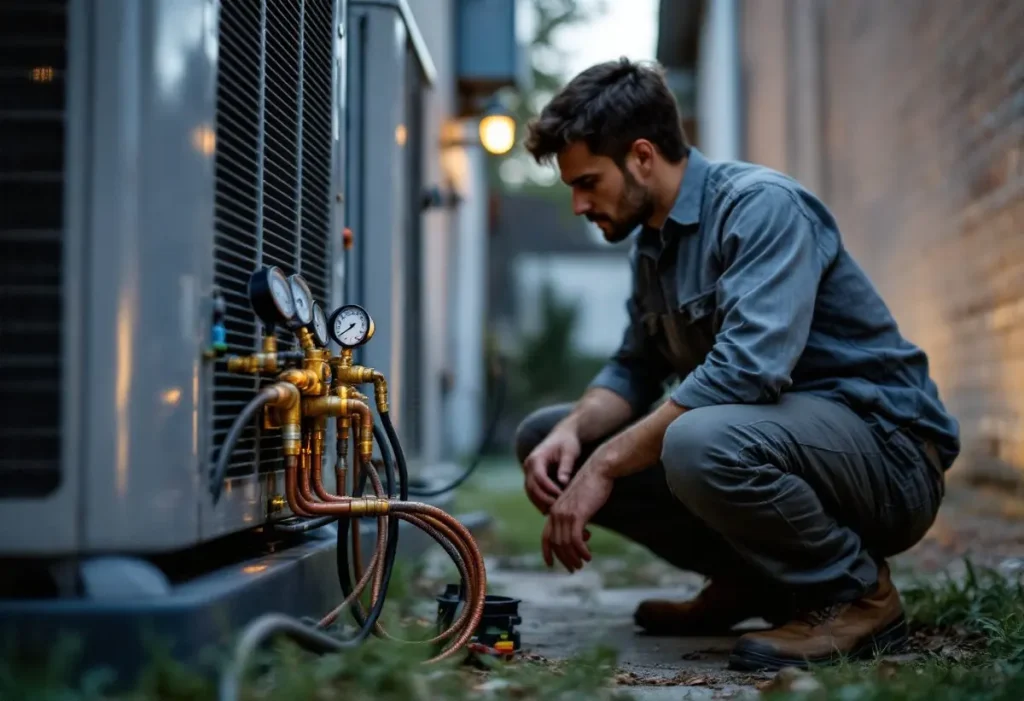
What should you check tonight, and what should the technician record?
Thaw first, then test under the conditions that caused the ice. Set the thermostat to Off with the fan on, as in fan on vs auto, until the coil and the larger copper line are clear. Technician readings mean something only if taken on a night like the one that froze.
| Check | Who | Reading that points to night freezing | What it means |
|---|---|---|---|
| Outdoor temperature when the ice formed | Owner (weather record) | Below 55°F | Outside Goodman and Carrier cooling limits without low ambient kit and freeze thermostat |
| Filter and return grilles | Owner | Loaded filter, blocked return | Airflow below the maker table’s lowest step |
| Night setpoint and blower mode | Owner | Setpoint below 70°F, quiet or dehumidify mode | Coil running off the GSX14 chart or at reduced airflow |
| Suction pressure on a cool night (R-410A) | Technician | At or below about 101.6 psig | Refrigerant boiling below 32°F |
| Superheat against the maker’s chart | Technician | High superheat with low suction | Short charge; leak search, not a top off |
| Blower airflow and static pressure | Technician | Below the airflow the maker lists for the pairing | Low superheat with low suction; duct, filter or blower setting |
| Metering device | Technician | Fixed piston on a system that freezes only on cool nights | Low head pressure starving the coil; TXV kit or low ambient control |
Stop at the refrigerant circuit and line voltage. Under 40 CFR 82.154, no person servicing an appliance “may knowingly vent or otherwise release into the environment any refrigerant.” Gauges, low ambient kits and freeze thermostats are technician work. If the house has more tonnage than it needs, read what happens when an AC unit is too big for the house.
Frequently asked questions
How do I stop my AC from freezing up at night?
Keep the night inside the maker’s range: a clean filter, open returns, a setpoint of 70°F or higher, and no cooling below 55°F outside without a low ambient kit. Goodman’s GSX14 data put a clean piston coil at 35.1°F on a 65°F night, so anything that cuts airflow or charge tips it below freezing.
Should I turn off my AC if it freezes overnight?
Yes. Switch cooling off and run the fan until the coil and the larger copper line are free of ice, then restart and watch the next cool night. Carrier’s 24APA3 product data treats freeze-up as a shutdown condition: its accessory freeze thermostat exists to stop the unit when the evaporator reaches freeze-up conditions.
What temperature should I set my AC at night so it doesn’t freeze?
No maker document we read gives a setpoint rule. Goodman’s GSX14 expanded cooling tables stop at 70°F entering air and 59°F wet bulb, so 70°F is the lowest return temperature that maker publishes performance for. The 72°F figure on one top-ranking page has no source, and setpoint alone moved suction just 1 psig in Goodman’s data.
Can low refrigerant make an AC freeze only at night?
Yes, especially with a piston. ORNL’s summary of ASHRAE project 1173 found fixed orifice systems degraded once charge fell below 90% of factory charge, versus 80% for TXV systems. A slightly short system can hold above freezing on a 95°F afternoon and drop below it on a 65°F night, when Goodman’s data already shows the coil near 35°F.
How we researched this
On 7 November 2026 we read the six documents listed under Sources, including Goodman’s SS-GSX14 (7/16). Coil temperatures are our linear interpolation of the BPA chart applied to Goodman’s published suction pressures; the calculation script is kept with this article. The BPA chart’s 110 psig row (35.5°F) breaks its slope and was not used. We excluded the top-ranking articles as sources because none cites a primary document, and could not open Goodman’s FSK01A instructions, so we give no cut-out temperature for that kit.
Sources
- Goodman Manufacturing. “GSX14 Split System Air Conditioner Specification Sheet (SS-GSX14).” https://cdn.shopify.com/s/files/1/0253/0852/8730/files/Goodman_GSX14_Spec_Sheet.pdf. Accessed November 2026.
- Goodman Manufacturing. “Installation and Service Reference (IOG-4002A).” https://cdn.shopify.com/s/files/1/0253/0852/8730/files/Goodman_GSZ16_Installation_Manual__1.pdf. Accessed November 2026.
- Carrier. “24APA3 Performance Series Air Conditioner Product Data.” https://www.shareddocs.com/hvac/docs/1009/Public/0C/24APA3-1PD.pdf. Accessed November 2026.
- Bonneville Power Administration. “R-410A Pressure-Temperature Chart.” https://www.bpa.gov/-/media/Aep/energy-efficiency/residential/residential-ptcs-essentials/r-410a-pressure-temperature-chart.pdf. Accessed November 2026.
- Oak Ridge National Laboratory. “Low-GWP Refrigerant Evaluation in AC Systems for High Ambient Temperature Applications: Literature Survey for Impact of Varying Refrigerant Charge on AC System Performance (ORNL/TM-2018/485).” https://info.ornl.gov/sites/publications/Files/Pub108381.pdf. Accessed November 2026.
- eCFR. “40 CFR 82.154, Prohibitions.” https://www.ecfr.gov/current/title-40/chapter-I/subchapter-C/part-82/subpart-F/section-82.154. Accessed November 2026.
Leave a Reply