
What happens if an AC unit is too big for the house? It reaches the thermostat setting in short bursts and shuts off before the coil has dried much air, so rooms can feel cool but clammy and peak power draw rises. Field studies measured an energy penalty from zero to about 9 percent, far less than most ranking pages imply.
How far over the load counts as too big: 115, 130 or 160 percent?
By compressor type, the ENERGY STAR National HVAC Design Report (Rev. 13) recommends a single-speed air conditioner at 90 to 115 percent of the calculated cooling load and allows up to 130 percent. Two-speed equipment is recommended at 90 to 120 percent (allowed 140), and variable-speed at 90 to 130 percent (allowed 160).
The form says the upper “allowed” ranges sit above ACCA Manual S limits and are “temporarily allowed”. Older guidance was tighter: Florida Solar Energy Center (FSEC) researchers, restating Manual J in a 1997 study of 368 Florida homes, wrote that cooling-only equipment should be sized “0% to 15% greater than the Manual J sensible heat gain value.”
Real houses rarely land there: in that sample installed systems averaged 23% above the Manual J load, and 194 of 368 homes (53%) were above 120 percent. The ratio that matters is installed capacity divided by a room-by-room load, which is why a proper load calculation beats any square-foot rule and the tonnage on the condenser says little by itself.
What did researchers measure when oversized units were swapped for smaller ones?
Less than the warnings suggest. Across 4 studies, oversizing cut run time by up to 48% and raised peak demand, while energy use and humidity moved a few percent, sometimes the “wrong” way.
| Study | Houses and climate | How oversized | Run time | Indoor humidity | Cooling energy |
|---|---|---|---|---|---|
| James et al., FSEC 1997 | 368 new Florida homes, submetered | Average 23% over Manual J | Right-sized homes: 30 to 50% more hours near full run | Not measured | +3.7% at 1.2 times the load, +9.3% at 1.5 times (regression) |
| Sonne, Parker, Shirey, FSEC 2006 | 4 Florida homes, units swapped, ducts kept | 47 to 65% over Manual J 8th edition | Smaller Lakeland unit ran 11% longer | Higher after downsizing: Lakeland 3.6%, Jacksonville about 1% | Lakeland 8 to 13% lower; Merritt Island 8 to 18% higher; Jacksonville 0% |
| Townsend and Ueno, BSC 2008 | 13 new homes, Redding, CA (hot, dry) | 155 to 184% vs resized 135 to 152% | Resized group ran longer on average and at maximum | No clear difference; medians 40 to 50% RH | 19.8 vs 19.9 kWh a day, no significant difference |
| NIST TN 1848, 2014 (simulation) | Houston slab house, ducts resized with the unit | 100% oversized | 1,981 to 1,022 hours a year (48% less) | Hours above 55% RH: 1,512 to 1,587 | +3.3% AC energy |
| NIST TN 1848, 2014 (simulation) | Same house, ducts left at original size, 5 cities | 100% oversized | Not reported | Not reported | +19.8 to +23.4% cooling energy |
Compiled by The HVAC Brief from FSEC-PF-328-97, FSEC-CR-1641-06, ACEEE 2008 and NIST TN 1848 Tables 5.4 and 5.5; row 4 percentages are our calculation.
Row 5 matters most at replacement. When NIST’s model put a unit twice the needed size on ductwork sized for the nominal unit, the blower fought higher static pressure, cooling COP fell about 10 to 12 percent and cooling energy rose about 20 percent in every city. With ducts resized in proportion, the same oversizing cost only 1.8 to 3.3 percent.
The 2006 FSEC swap study shows the mirror image. The smaller replacement units on the old, oversized ducts moved 13 to 85 cfm per ton more air than the originals, and the house with the biggest airflow jump, Lakeland at 341 to 426 cfm per ton, had the biggest humidity rise.
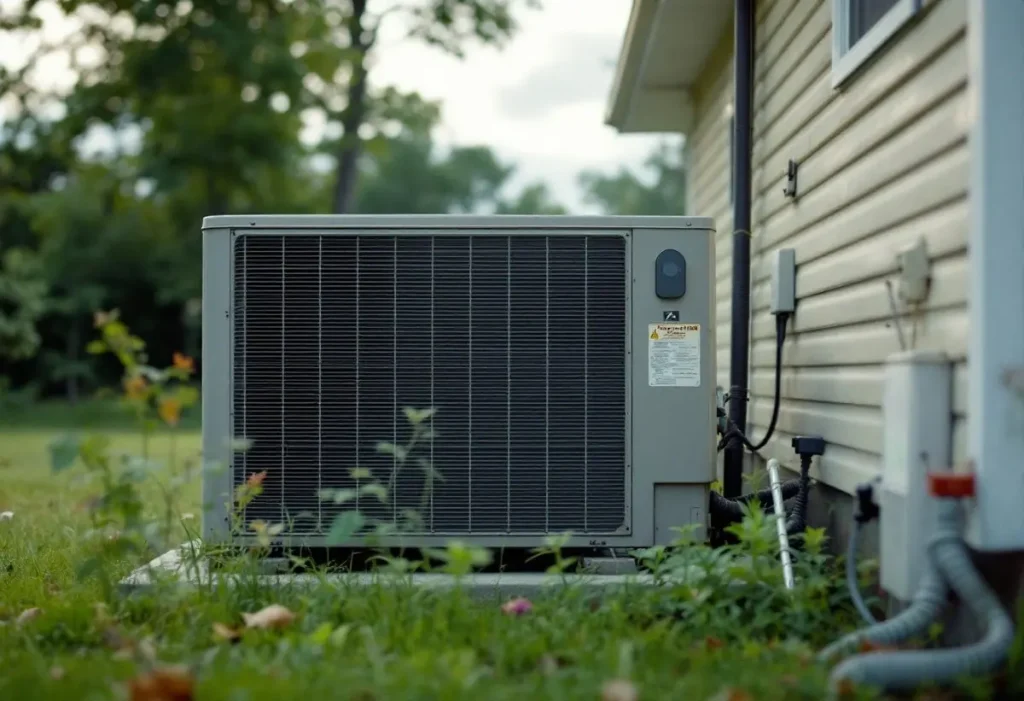
Why does an AC that is too big leave the house cold and clammy?
Because the coil removes little water in the first minutes of each cycle, and an oversized unit spends most of its life in those minutes. Lab tests by Katipamula and O’Neal on a 3 ton heat pump, summarized in FSEC report CR-1537-05 for DOE, found the unit added moisture to the supply air right after start, began drying it only after 60 to 150 seconds, and needed 3 to 15 minutes to reach steady moisture removal.
Moisture capacity fell faster than temperature capacity as on-time shortened, the clammy signature our page on a house that is cold but humid describes. For scale, the federal cyclic test in 10 CFR 430 Appendix M1 runs a single-speed compressor 6 minutes on and 24 off.
The fan setting can erase what little water a short cycle removes. In the FSEC lab work, a coil whose blower ran 10 minutes past compressor shutdown, at run fractions of 0.29 and 0.09, “provided no net dehumidification over the complete on/off cycle.” NIST modelled the AUTO setting, where the blower stops with the compressor, and found off-cycle evaporation minimal. An oversized system on fan ON is the worst combination.
Climate decides how much this matters: in dry Redding, CA, humidity was the same at both sizings. ENERGY STAR recommends, but does not require, latent capacity to hold 60% RH or less in “Warm-Humid” climates: IECC climate zone 1 and parts of zones 2 and 3A.
Does an AC that is too big raise the electric bill, and by how much?
A little, usually. The federal rating formula charges a single-speed unit 10 percent for cycling at half load when its cycling loss is not tested, and NIST cites measured coefficients on modern equipment of 0.05 to 0.10, a quarter to a half of the 0.20 default.
| Cyclic degradation coefficient (Cd) | Where the value comes from | Part-load factor at half load | Penalty vs steady running |
|---|---|---|---|
| 0.25 | Appendix M1 default for outdoor units with no match and variable-speed systems | 0.875 | 12.5% |
| 0.20 | Appendix M1 default for other single-speed systems (2024 edition) | 0.90 | 10% |
| 0.10 | Upper end of measured values, Dougherty 2003 as cited by NIST | 0.95 | 5% |
| 0.05 | Lower end of measured values, same source | 0.975 | 2.5% |
HVAC Brief calculation: SEER2 = PLF(0.5) × EER at the B test, with PLF(0.5) = 1 minus 0.5 × Cd, per 10 CFR 430 Appendix M1 section 4.1.1 (2024 edition).
The 1997 FSEC regression put the cost at 872 kWh per unit of sizing ratio: 174 kWh a summer for a system 20% too big and 435 kWh for one 50% too big. Shorter runs also mean less time pushing cold air through attic ducts, FSEC’s explanation for why its 2006 swaps saved little or nothing.
The utility sees more. In the 1997 sample, homes above 120% of Manual J drew about 13% (0.3 kWh) more cooling energy in the utility’s peak hour. In the 2006 swaps, units about 30% smaller cut average 4 to 7 PM demand by 377 W (29%) in Lakeland and 1,550 W (50%) in Jacksonville. No study we opened measured compressor life against sizing; the restart limits makers publish are covered in our AC short cycling guide.
What happens if the AC unit is too small for the house instead?
It runs longer, loses about 2 °F on the hottest afternoons and often uses slightly less energy. In NIST’s Houston case a unit 20% undersized ran 2,401 hours a year instead of 1,981, let the indoor maximum reach 27.7 °C (81.9 °F) instead of 26.6 °C (79.9 °F), and used 3.5% less AC energy.
The 1997 field data agree: homes at or below Manual J ran at 90 to 100% of the hour in 8.45%, 14.19% and 10.04% of June, July and August hours. In Redding, units resized to 135 to 152% met the loads; most of the longest runs, up to 342 minutes, followed setpoint changes rather than heat. DOE’s Energy Saver guidance (archived copy) puts the risk plainly: an undersized unit “won’t cool effectively on the hottest days.”
What can you do with an AC that is already too big for the house?
Fix fan mode and airflow first, add dehumidification second, and change capacity only at replacement. Set the thermostat fan to AUTO: FSEC’s tests show a blower running through the off cycle returns the coil’s water to the house, and NIST found the effect minimal when the fan cycles with the compressor.
Ask the technician for two numbers: measured airflow per ton and total external static pressure. Every as-built Redding unit ran above the maker’s 0.5 in. w.c. recommendation, partly from MERV 13 return filters, with a median of 0.66 in occupied homes, and FSEC wrote that the 341 versus 426 cfm per ton gap at Lakeland “can be expected to adversely impact coil temperatures and humidity removal.” Blower taps sit behind line-voltage panels: a technician job.
If summer RH stays above 60%, a whole-house or portable dehumidifier treats the moisture without lowering the setpoint. At replacement, insist on a Manual J and a unit inside the ENERGY STAR band; a two-stage or variable-speed system earns the wider 140 and 160 percent limits because it slows down instead of switching off.
Frequently asked questions
What happens if a window AC is too big for the room?
ENERGY STAR says an oversized room air conditioner “will cool the room, before it has a chance to remove the humidity,” leaving it damp and clammy. Its guidance sizes from square footage, then adds 10 percent for a very sunny room, subtracts 10 percent for heavy shade, and says to round down to the nearest thousand Btu.
What happens if a dehumidifier is too big?
Little harm. ENERGY STAR’s buying guidance says “it’s better to oversize than undersize” a dehumidifier, the reverse of air conditioner advice. Its chart suggests 20 to 30 pints a day for a slightly to moderately damp space under 2,000 square feet.
What happens if HVAC is too big for the house on the heating side?
Oversized heating is treated more loosely. ENERGY STAR recommends a furnace at 100 to 140 percent of the heat loss and allows up to 400 percent when the furnace is paired with cooling. NIST found a heat pump twice the needed size cut heating energy 3 to 4 percent in cooling climates and almost 9 percent in cold ones, by needing less backup resistance heat.
How we researched this
Research date: November 7, 2026. We read in full FSEC-PF-328-97, FSEC-CR-1641-06, FSEC-CR-1537-05, Townsend and Ueno (ACEEE 2008), NIST TN 1848, the ENERGY STAR National HVAC Design Report Rev. 13 and 10 CFR 430 Appendix M1 (2024 and current editions), plus ENERGY STAR and DOE consumer pages for the FAQ. Table percentages marked as our calculation come from a script kept with this article. ACCA Manual J and S are paywalled and appear only through ENERGY STAR and FSEC restatements. Excluded: ranking contractor pages, which cite no measurements, and square-foot-per-ton rules. No prices appear: no federal source publishes them for this question.
Sources
- U.S. EPA ENERGY STAR. “National HVAC Design Report, Version 3 / 3.1 / 3.2 (Rev. 13).” https://www.energystar.gov/sites/default/files/asset/document/National%20HVAC%20Design%20Report_Rev%2013.pdf. Accessed November 2026.
- Florida Solar Energy Center (James et al.). “The Effect of Residential Equipment Capacity on Energy Use, Demand, and Run-Time” (FSEC-PF-328-97). https://publications.energyresearch.ucf.edu/wp-content/uploads/2018/06/FSEC-PF-328-97.pdf. Accessed November 2026.
- Florida Solar Energy Center (Sonne et al.). “Measured Impacts of Proper Air Conditioning Sizing in Four Florida Case Study Homes” (FSEC-CR-1641-06). https://publications.energyresearch.ucf.edu/wp-content/uploads/2018/06/FSEC-CR-1641-06.pdf. Accessed November 2026.
- Florida Solar Energy Center (Shirey et al.). “Understanding the Dehumidification Performance of Air-Conditioning Equipment at Part-Load Conditions” (FSEC-CR-1537-05). https://publications.energyresearch.ucf.edu/wp-content/uploads/2018/06/FSEC-CR-1537-05.pdf. Accessed November 2026.
- Building Science Corporation (Townsend and Ueno). “Effects of Air Conditioner Sizing on Energy Consumption and Peak Demand in a Hot-Dry Climate.” ACEEE Summer Study 2008. https://www.aceee.org/files/proceedings/2008/data/papers/1_9.pdf. Accessed November 2026.
- NIST. “Sensitivity Analysis of Installation Faults on Heat Pump Performance” (Technical Note 1848, 2014). https://nvlpubs.nist.gov/nistpubs/TechnicalNotes/NIST.TN.1848.pdf. Accessed November 2026.
- eCFR. “10 CFR 430, Subpart B, Appendix M1” (version of January 1, 2024). https://www.ecfr.gov/on/2024-01-01/title-10/chapter-II/subchapter-D/part-430/subpart-B/appendix-Appendix%20M1%20to%20Subpart%20B%20of%20Part%20430. Accessed November 2026.
- U.S. EPA ENERGY STAR. “How to choose the right sized window AC.” https://www.energystar.gov/products/ask-the-experts/how-choose-right-sized-window-ac. Accessed November 2026.
- U.S. EPA ENERGY STAR. “Dehumidifiers.” https://www.energystar.gov/products/dehumidifiers. Accessed November 2026.
- U.S. DOE Energy Saver. “Central Air Conditioning” (archived copy). https://web.archive.org/web/2025id_/https://www.energy.gov/energysaver/central-air-conditioning. Accessed November 2026.
Leave a Reply