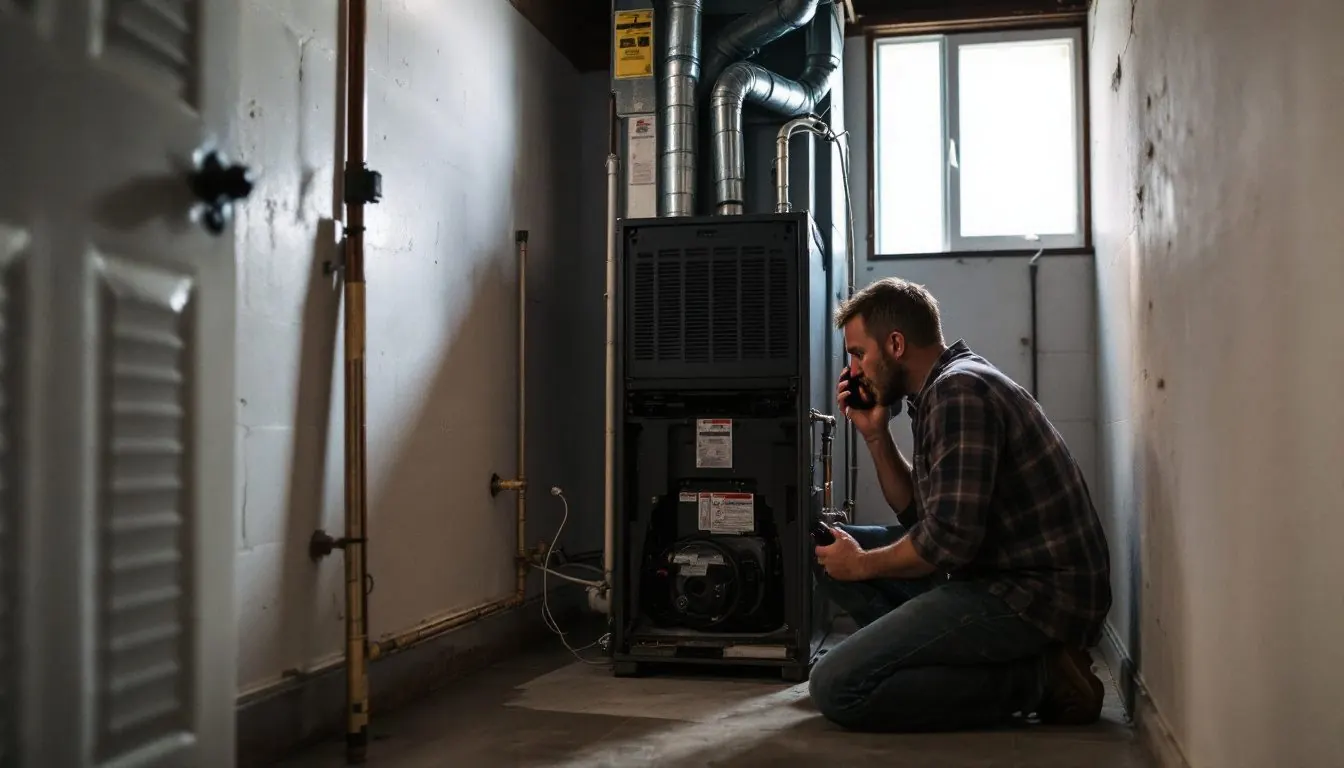
A furnace making loud humming noise is usually one of four parts, and when the hum starts tells you which: always on, even between cycles, is the 24 V transformer; starting with the heat call, the inducer motor; as the burners light, the gas valve or its piping; about 30 seconds later, the blower motor or its capacitor.
Which furnace part is humming? Time the hum against the heat cycle
Timing beats ear. Turn the thermostat up 3 degrees, start a stopwatch, and note when the hum begins and ends. The stopwatch works for a squeal too, and a furnace squealing noise that starts before the flame points to the inducer, while one that starts with the airflow points to the blower. On a Resideo S9200U1000 control, the inducer starts first, the igniter heats after a 30 second prepurge, the gas valve opens about 47 seconds in, and the blower follows 30 or 60 seconds later, per Resideo’s installation instructions. Squeals and bangs are sorted in our guide to what HVAC noises mean.
| Hum starts | Hum stops | Likely source | Normal when | Reading the technician takes |
|---|---|---|---|---|
| Always, even with no heat call | Only when furnace power is off | 24 V control transformer (Goodman: 120 V primary, 24 V secondary, 40 VA) | Soft, even drone at 120 Hz | 24 VAC across R and C (Goodman); Resideo accepts 19 to 30 Vac |
| At the heat call, before any glow | 15 s after the burners go out | Inducer (draft) motor | Steady pitch, wheel spinning | Continuity between motor leads (Goodman); wheel turns freely with power off (Fasco K674) |
| When the burners light, about 47 s in | The moment the thermostat is satisfied | Gas valve coil or ringing gas pipe | Click plus faint coil hum | Manifold pressure on a manometer with burners firing (Goodman); pipe supports per Table 415.1 |
| 30 s after the burners light (Goodman) | 90 s after the burners go out by default | Blower motor or its run capacitor | Motor hum under strong airflow | Capacitance within 5 to 10% of rating; amps no more than 10% over nameplate (NORA) |
| Never stops, no heat | Does not stop | Blower or inducer held on by a fault | Never | Primary limit circuit; flame sensed with no call for heat (Goodman troubleshooting chart) |
Is a steady hum with the heat off just the 24 V transformer?
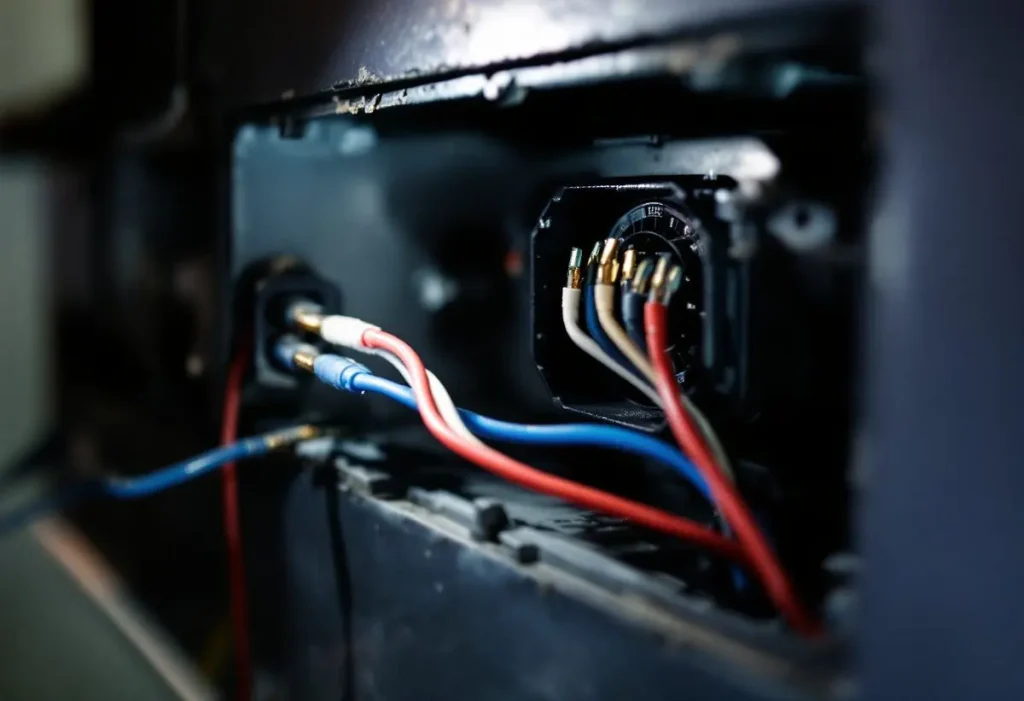
Usually, yes. It is the one part energized between cycles, because the control needs 24 volts on R to see the thermostat close: Goodman’s GM9S80 sequence begins when “the control board receives 24 VAC on the W terminal.”
Its sound is a 120 Hz drone, not a 60 Hz one. A 2023 paper in Sensors on transformer core magnetostriction puts “the fundamental frequency of magnetostriction” at “twice the frequency of the excitation signal.” The Resideo S9200U1000 runs on 120 V, 60 Hz power, so we calculated 2 × 60 Hz = 120 Hz.
Goodman’s RS6612022 service manual specifies a 120 volt primary, 24 volt secondary, 40 VA transformer and says R to C “must read 24 VAC”; Resideo lists 19 to 30 Vac as the low voltage range for its board. A drone turned rattle points to loose mounting screws. One that runs hot or keeps blowing the board fuse is overloaded, which our HVAC transformer explainer works through with VA math.
Why does the furnace hum for 30 seconds before the burners light?
That is the inducer motor purging the heat exchanger, and a steady hum from it is normal. Resideo’s S9200U1000 runs a 30 second prepurge, then heats the igniter for 17 seconds on the first trial; Goodman’s single stage GM9S92 and GM9S96 use a 17-second warm up.
The problem hum is one with no spin. The Fasco A136 replacement inducer, for example, is a permanent split capacitor motor rated 115 V, 0.75 A, 3450 rpm with ball bearings, per its Regal product information packet. If it hums without turning, the pressure switch stays open and the furnace never lights. Fasco’s K674 kit instructions tell installers to spin the cooling fan to confirm the assembly moves freely.
A technician follows Goodman’s service manual: power off, leads disconnected, continuity tested between each lead. A grind or squeal there points to the bearing or a rubbing wheel, and the inducer motor guide covers replacement.
Does a hum that starts when the burners light mean the gas valve is failing?
Not by itself. A hum that starts with the flame and stops when the thermostat is satisfied comes from the valve’s 24 volt coil or from gas pipe vibrating with it; no maker document we read lists hum as a valve failure symptom.
The White-Rodgers 36J series sheet rates its single stage valve at 24 VAC and 0.28 amps, a small electromagnet held on for the whole burn. Goodman’s check is manifold pressure on a manometer with burners firing, compared with the furnace’s table. Our furnace gas valve page lists the ranges by valve.
Pipe hum is a support question. The 2021 Seattle Fuel Gas Code, Chapter 4 (an IFGC reprint) requires metal hooks, straps, bands or brackets; Table 415.1 caps steel pipe support spacing at 6 feet for 1/2 inch pipe, 8 feet for 3/4 or 1 inch, and 10 feet for 1-1/4 inch or larger horizontal runs. Section 403.6 adds that “no appliance shall be supported by, or develop any strain or stress on, its supply piping.” In many jurisdictions that is a licensed gas fitter’s job. If you smell gas, leave and call the utility from outside.
Why does the blower motor hum but not spin, or spin slowly?
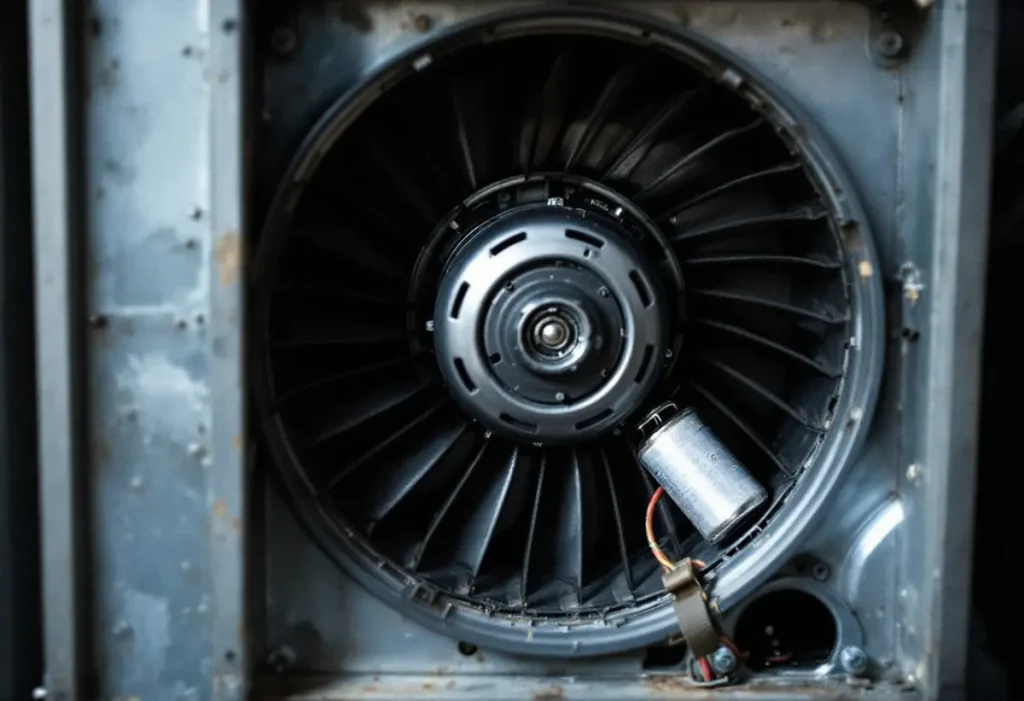
On a PSC blower, suspect the run capacitor first. The National Oilheat Research Alliance motor manual (NORA Chapter 11) says “a failed capacitor will cause a PSC motor to either stop or run more slowly than designed,” and that the thermal protector trips if a restart is attempted, which is why a stalled blower hums, goes quiet, then hums again.
NORA’s readings settle it: capacitance within 5 to 10% of the printed rating, and current no more than 10% over nameplate amps. Goodman adds a mechanical check for any obstruction keeping the wheel from turning. Its multi-speed ECM in RS6612022 takes line voltage plus a 24 VAC speed tap signal, and its wiring list has no run capacitor. Our furnace blower motor page compares PSC and ECM designs.
Stop line: NORA warns that failing to discharge a capacitor “can cause physical harm due to electrical shock,” and Goodman’s blower door interlock “interrupts unit voltage when the blower door is opened.” Leave this test to a technician; our HVAC capacitor explainer shows how ratings are printed.
Why does the furnace keep humming after the heat shuts off?
For up to 3 minutes, that is designed in. Goodman’s GM9S80 installation manual keeps the inducer on for a 15 second post purge and runs the blower for a 90 second off delay by default, adjustable from 30 to 180 seconds; the Resideo S9200U1000 offers 60, 90, 120 or 180 seconds by DIP switch.
A blower that never stops is the thermostat fan set to ON or a fault. Goodman’s troubleshooting chart ties a circulator that runs with no furnace operation to an open primary limit circuit, blocked filters or restrictive ductwork, the chain our furnace limit switch page follows. Inducer and blower both running continuously points to “flame sensed with no call for heat” or a slow closing gas valve: shut off power and gas, and have it serviced before relighting.
In cooling, Resideo starts the same blower after a 5 second cool fan on delay. A hum from the condenser outside is covered in our outside AC unit humming page.
When should you shut a humming furnace off instead of timing it?
Shut it off at the service switch when the hum comes with a burning smell, smoke, a tripped breaker, or both blowers running with no heat call; leave if you smell gas or a CO alarm sounds. Safe checks from the floor: the thermostat fan switch (AUTO, not ON), the filter, and where the sound is loudest with panels on. A working CO alarm belongs near sleeping areas, as our CO detector placement guide sets out.
Frequently asked questions
Is a humming furnace dangerous?
A soft, steady hum from the transformer or inducer is normal. The dangerous patterns are a hum with a burning smell, or inducer and blower both running with no heat call, which Goodman’s troubleshooting chart ties to “flame sensed with no call for heat” or a slow closing gas valve. Shut off power and gas and call for service.
Should I oil a humming furnace motor?
Usually not. Goodman’s GM9S80 manual says the bearings in the induced draft blower and circulator blower motors “are permanently lubricated by the manufacturer. No further lubrication is required.” Older motors with oil ports are the exception; follow that motor’s own label.
Why is my furnace making a loud noise when the AC is on?
The furnace blower moves the air for central cooling. The Resideo S9200U1000 starts it 5 seconds after a cooling call and can keep it on 60 seconds after, and Goodman boards set separate heating and cooling blower speeds, so the same motor can sound different in summer. A hum with no airflow is the stalled blower case above.
Why is my air filter making a humming noise?
A filter does not hum on its own; a clogged one makes the blower work against more resistance. Goodman’s service manual says too great an external static pressure gives insufficient air, which “can cause excessive temperature rise, resulting in limit tripping.” Blocked filters appear in its chart as a cause of a blower that runs continuously.
Can dust make a furnace motor hum or overheat?
Goodman tells servicers to check motor windings for “accumulation of dust which may cause overheating,” and NORA lists dirt in motor cooling vents among the causes of thermal overload. An overloaded PSC motor trips its thermal protector, so the hum stops and restarts.
How we researched this
On 7 November 2026 we read the Resideo S9200U1000 instructions, Goodman’s GM9S80 and RS6612022 manuals, NORA Chapter 11, the Fasco A136 and K674 documents, the White-Rodgers 36J and Resideo VR8205 valve sheets, 2021 Seattle Fuel Gas Code Chapter 4 and a 2023 Sensors paper. We excluded the top search results’ unsourced prices, their advice to oil sealed motors and a 4 to 6 foot pipe strap figure that does not match Table 415.1. Timings differ by board; check your furnace’s manual.
Sources
- Resideo. “S9200U1000 Universal Hot Surface Ignition Integrated Furnace Control: Installation Instructions.” https://www.cochranesupply.com/media/assets/product/documents/Honeywell/S9200U1000.pdf. Accessed November 2026.
- Goodman Manufacturing. “Installation Instructions for *M9S80 and *C9S80 Gas Furnace.” https://documents.alpinehomeair.com/product/goodmangm9s8gc9s8installationmanual.pdf. Accessed November 2026.
- Goodman Manufacturing. “Service and Troubleshooting: GM9S92, GM9S96, GC9S96 Single Stage Gas Furnaces (RS6612022R1).” https://mobile.goodmanmfg.com/mobileapp/stellent/pdf/infoPdf/Lit/RS6612022R1.pdf. Accessed November 2026.
- Wang Z. et al. “Measurement of Magnetic and Magnetostrictive Characteristics of Transformer Core Based on Triaxial Strain Gauge and B-H Vector Sensor.” Sensors, 2023. https://pmc.ncbi.nlm.nih.gov/articles/PMC10346938/. Accessed November 2026.
- National Oilheat Research Alliance. “Chapter 11: Motors.” https://learning.noraweb.org/wp-content/uploads/2022/09/Chapter-11.pdf. Accessed November 2026.
- Regal Beloit (Fasco). “Product Information Packet: Model No. A136 Draft Inducer Blower.” https://shop.dreisilker.com/content/fasco-data/A136/spec-sheet/A136-spec-sheet.pdf. Accessed November 2026.
- Fasco. “K674 Installation and Operation Guide.” https://www.electricmotorwarehouse.com/content/PDF/K674_instructions.pdf. Accessed November 2026.
- White-Rodgers. “36 Series Electronic Ignition Gas Valves.” https://resource.bakerdist.com/is/content/Watscocom/Gemaire/white-rodgers_36j54-214_article_1438071350237_en_ss.pdf. Accessed November 2026.
- City of Seattle. “2021 Seattle Fuel Gas Code, Chapter 4: Gas Piping Installations.” https://www.seattle.gov/documents/Departments/SDCI/Codes/FuelGasCode/2021SFGCChapter4.pdf. Accessed November 2026.
Leave a Reply