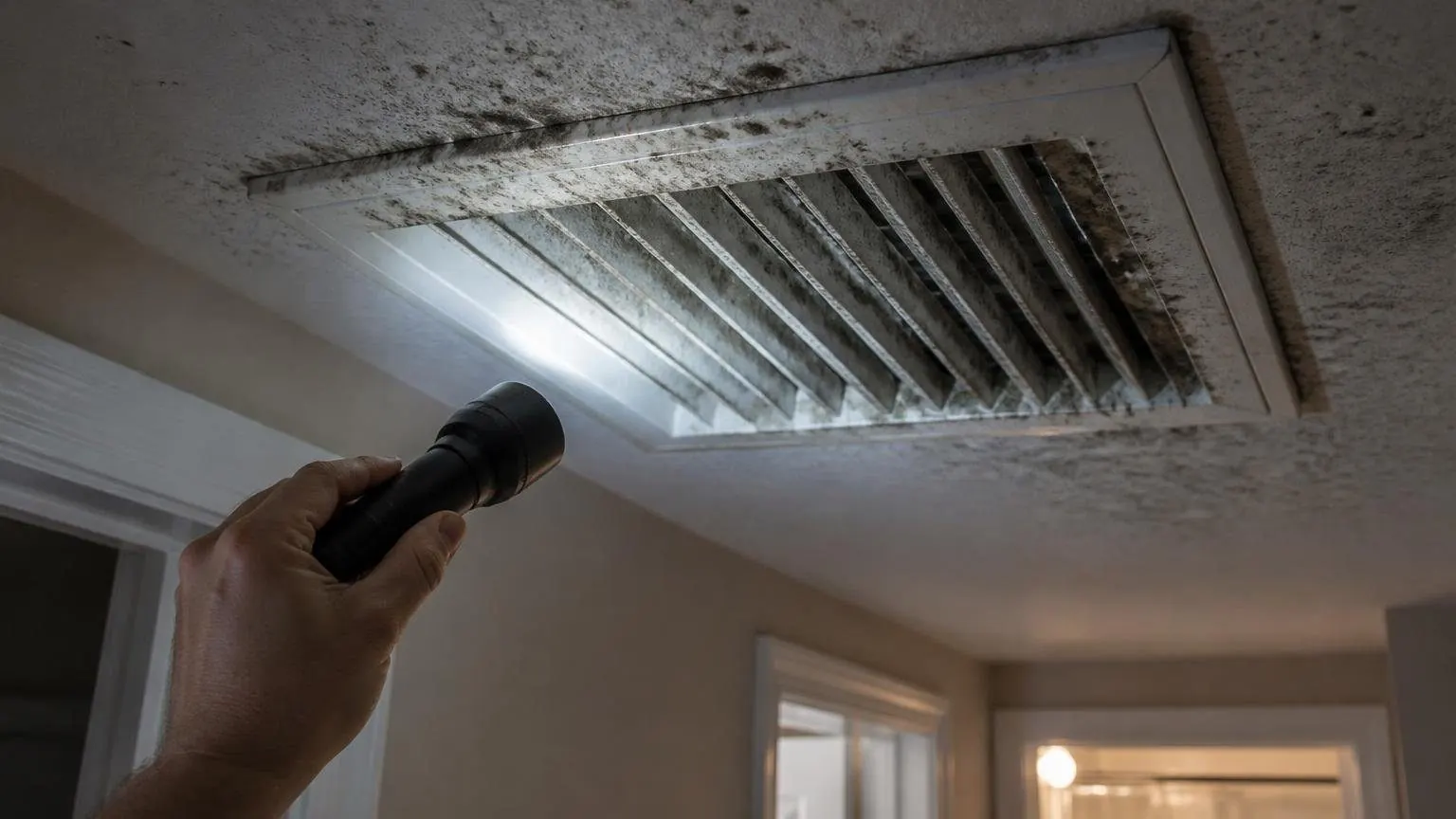
Do you have mold in air ducts? Only visible growth proves it. EPA says fix the moisture first, do not run a contaminated system, clean bare metal, and replace wet or moldy insulated duct, because no biocide is registered for fiberglass duct board or lined duct.
Key Takeaways
- EPA: dry wet materials within 24 to 48 hours and keep humidity below 60 percent, ideally 30 to 50 percent (EPA, A Brief Guide to Mold).
- No federal limits exist for mold or mold spores, so no test can show a home “passes” (EPA).
- No biocide is EPA registered for fiberglass duct board or lined duct; moldy insulated duct “should be removed and replaced” (EPA duct guide).
- CDC cites the 2004 Institute of Medicine finding linking indoor mold to cough, wheeze, upper respiratory symptoms and asthma symptoms (CDC).
- The IOM found the little evidence available does not support a link to fatigue or neuropsychiatric disorders (National Academies).
- About 3.6 million households, 3.0 percent, reported mold in the 2019 American Housing Survey (HUD).
How do you tell mold in air ducts from dust?
Usually not by eye. EPA’s duct guide says a positive determination “can be made only by an expert and may require laboratory analysis,” and that many sections cannot be inspected, so ask any contractor to show you the growth.
Smell is a better clue. EPA says to suspect hidden mold when a building smells moldy but you cannot see the source, listing “inside ductwork,” condensate drain pans and porous duct liners. A musty odor has other causes too; see what each HVAC smell means sorts out.
Color does not change the answer. CDC says “You do not need to know the type of mold” and “No matter what type of mold is present, you need to remove it.”
What causes mold in air ducts?
Water. EPA says no type of mold will “grow without water or moisture.” In ducts, the water comes from a short list of sources.
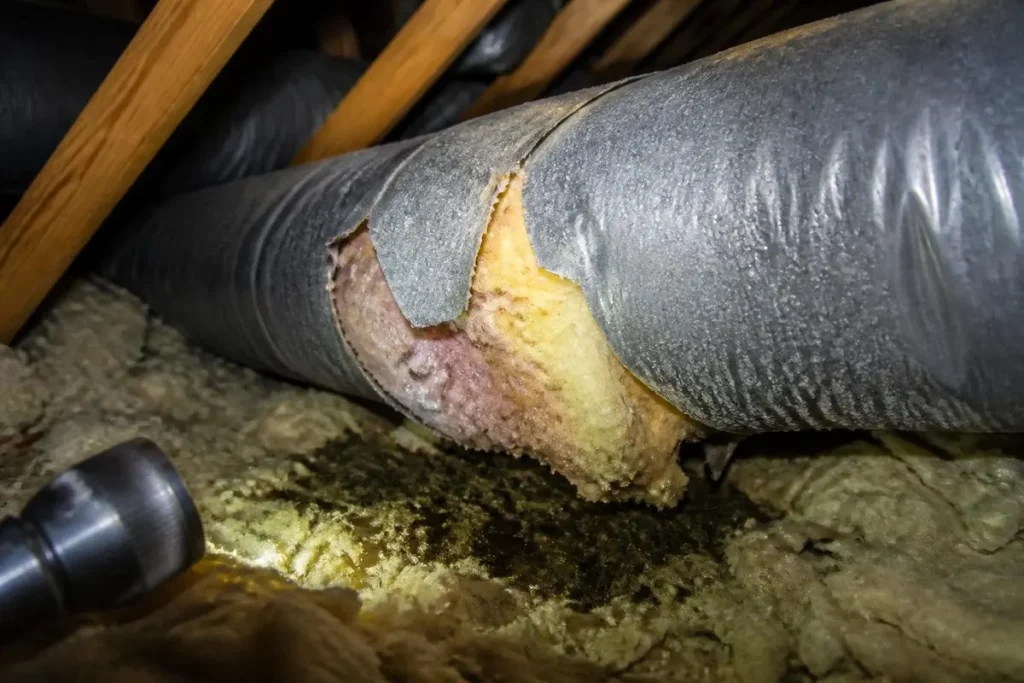
- The cooling coil. EPA calls condensation on or near cooling coils “a major factor in moisture contamination of the system,” and standing water in the drain pan needs “immediate attention.” See how to clear a clogged AC drain line.
- Sweating ducts in humid attics. NREL flags “dripping condensation on cold air-conditioning ductwork” in hot humid climates as “conducive to mold growth and rot” (NREL, 2024).
- Leaks and installation faults. EPA says moisture enters ducts “through leaks or if the system has been improperly installed or serviced.”
- An oversized air conditioner. DOE says “An oversized unit won’t adequately remove humidity” (DOE Energy Saver, archived copy). See why a house feels cold but humid.
- Neglected humidifiers. EPA says that if humidifiers are used, “they must be properly maintained.”
How common is mold in ducts?
No federal survey counts mold inside ducts. The closest figure covers whole homes: in the 2019 American Housing Survey, about 3.6 million households, or 3.0 percent, “reported signs of mold in their home in the last 12 months” (HUD release, archived copy). Renters: 4.4 percent; owners: 2.1 percent.
EPA also notes that “Many insulated duct systems have operated for years without supporting significant mold growth.” Dry ducts rarely grow mold; wet coils, full drain pans and sweating attic runs do.
Can mold in air vents make you sick?
It can, for some people. CDC says damp, moldy environments “may cause a variety of health effects, or none at all,” including for some people “a stuffy nose, sore throat, coughing or wheezing, burning eyes, or skin rash.” People with asthma or mold allergy “may have severe reactions,” and people who are immune compromised or have chronic lung disease “may get infections in their lungs from mold.”
The 2004 Institute of Medicine report Damp Indoor Spaces and Health found sufficient evidence linking mold and dampness to asthma symptoms in sensitized people with asthma and to “coughing, wheezing, and upper respiratory tract symptoms in otherwise healthy people,” but not “a clear, causal relationship” (National Academies, May 2004). It also linked mold to hypersensitivity pneumonitis, an uncommon condition, in susceptible people.
EPA notes molds can produce “potentially toxic substances (mycotoxins),” yet “Symptoms other than the allergic and irritant types are not commonly reported.” WHO’s 2009 guidelines name respiratory symptoms, allergies and asthma as the main effects and prevention of “persistent dampness and microbial growth” as the main protection (WHO, 2009).
Myth check: “10 warning signs of mold toxicity”
CDC, EPA, WHO and the IOM publish no such list. The IOM found “very few studies” on fatigue and neuropsychiatric complaints, and “The little evidence that is available does not support an association,” though it could not rule one out. See a clinician about symptoms. Complaints that fade soon after leaving one building fit a different pattern, sick building syndrome, which investigators most often trace to ventilation.
Should you test for mold in your ducts?
Usually not. EPA says “if visible mold growth is present, sampling is unnecessary,” and “no EPA or other federal limits have been set for mold or mold spores.” CDC says “CDC does not recommend mold testing”; there are “no set standards for what is and what is not an acceptable quantity” of mold in a home.
Two narrow uses remain. EPA’s 1997 duct guide says some labs can tell, for about $50, whether a tape sample is mold, and surface sampling can show whether an area “has been adequately cleaned.” EPA’s remediation guide calls air sampling a “snapshot.”
How is mold removed from air ducts?
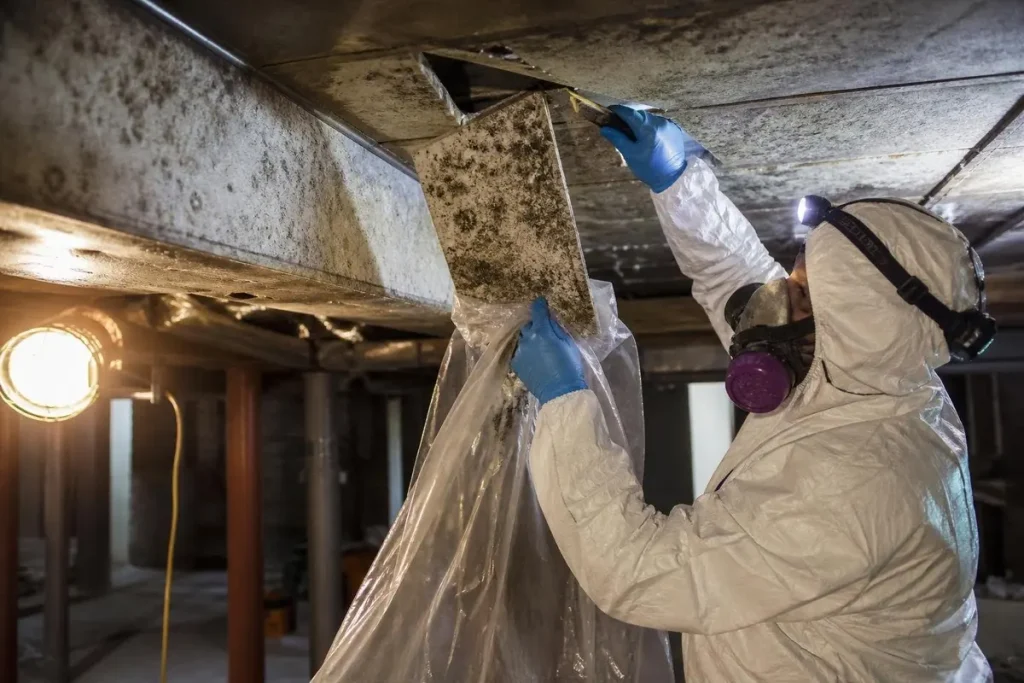
By removal, not spraying. First, EPA says: “Do not run the HVAC system if you know or suspect that it is contaminated with mold.” Then the duct material decides the method. Contractor and price questions are in our air duct cleaning guide.
| Duct component | Moldy: clean or replace? | Biocide status (EPA) |
|---|---|---|
| Bare sheet metal duct | Clean and dry; “much easier” to treat | A few products registered for bare metal interiors |
| Fiberglass duct board | Replace; cleaning “is not sufficient” | None registered |
| Sheet metal with fiberglass liner | Replace the wet or moldy liner | None registered |
| Flex duct | Brush, or replace; replacing can be “more economical” | Only where the label allows |
| Cooling coil and drain pan | Clean; slope the pan to the drain | Only where the label allows |
EPA, NADCA and NAIMA “all recommend the replacement of wet or moldy fiber glass duct material,” which covers fiberglass duct board and lined duct. For flexible duct,, replacement is often simpler.
EPA’s Table 2 scales the job by area, with “a more cautious or conservative approach” when hidden mold in the HVAC system is expected.
- Under 10 square feet: N-95 respirator, gloves and goggles; no containment. Usually a do it yourself job.
- 10 to 100 square feet: limited or full PPE, limited containment under negative pressure.
- Over 100 square feet: full PPE and full containment.
Skip the fogger. EPA says biocides such as bleach are “not recommended as a routine practice,” “Dead mold is still allergenic,” and spraying into an operating system can release the product “into other areas of your home.” For UV lamps, see our review of UV lights and air purifiers. EPA suggests a MERV 8 filter during cleanup; see how HVAC filter ratings work.
What stops mold in ducts from coming back?
Moisture control. EPA says if you clean up mold “but don’t fix the water problem,” it will most likely come back. Work in this order:
- Keep the drain pan clean and the line flowing (EPA).
- Hold humidity below 60 percent, ideally 30 to 50 percent; see ideal indoor humidity.
- Stop duct sweating. NREL’s conventional fix: “wrap ductwork in thicker duct-wrap insulation with an integrated exterior vapor barrier.” See duct insulation requirements.
- If the AC cannot pull humidity down, check sizing or add a properly sized dehumidifier.
- Dry any water leak within 24 to 48 hours.
EPA’s finish line: moisture fixed, no visible mold or moldy odor, no new damage on a revisit. Ozone is not part of that plan, and EPA notes that an ozone machine run at levels people can safely breathe does little against mold.
How we researched this
Researched October 28 to 29, 2026. We read more than 20 pages from EPA, CDC, the National Academies, WHO, NREL, DOE and HUD and cite ten. Health statements come only from CDC, EPA, the IOM and WHO. Excluded: contractor blogs, vendor “toxic mold” symptom lists and Reddit, as this is a health topic. We did no testing or sampling.
Frequently asked questions
What do I do if I have mold in my air ducts?
Turn the system off, since EPA says running a contaminated system could spread mold through the building. Find and fix the water source, usually the coil, drain pan or a sweating duct. Then clean bare metal and replace wet or moldy insulated duct. Over 10 square feet, EPA points you to its professional remediation guidance.
Can I run my AC if there is mold in the ducts?
EPA says no: “Do not run the HVAC system if you know or suspect that it is contaminated with mold.” Run it again only after the moisture source is fixed and the moldy material is cleaned or replaced. Plan for heating or cooling another way while the work is done.
Can I spray bleach or a fogger into my air ducts?
EPA says biocides like chlorine bleach are not recommended as a routine practice, and dead mold is still allergenic, so it must be removed. No biocide is registered by EPA for fiberglass duct board or lined duct. Spraying into an operating system can carry the product into other rooms.
What are the 10 warning signs of mold toxicity?
No such list appears in CDC, EPA, WHO or Institute of Medicine material. CDC lists stuffy nose, sore throat, coughing or wheezing, burning eyes and skin rash for some people. The IOM found that the little evidence available does not support a link between mold and fatigue or neuropsychiatric disorders. Ask a clinician about symptoms.
Is black mold in air vents more dangerous?
Color is not a safety test. CDC says “You do not need to know the type of mold” and that whatever type is present, you need to remove it. EPA says molds can produce irritants, allergens and in some cases potentially toxic substances, so every type gets the same treatment: fix the moisture and remove the growth.
Do home mold test kits tell me if my ducts are safe?
No. EPA says no federal limits exist for mold or mold spores, so no result proves a home is safe, and sampling is usually unnecessary when growth is visible. CDC does not recommend mold testing. A lab check of a tape sample can confirm whether a deposit is mold, which is its main use.
Will duct cleaning alone get rid of the mold?
Not for long. EPA’s duct guide says that if the conditions that caused the growth are not corrected, “mold growth will recur.” Cleaning also cannot rescue moldy fiberglass liner or duct board, which EPA, NADCA and NAIMA all recommend replacing. Fix drainage, humidity and duct sweating first, then clean.
Sources
- US EPA. “A Brief Guide to Mold, Moisture and Your Home.” https://www.epa.gov/mold/brief-guide-mold-moisture-and-your-home. Accessed October 2026.
- US EPA. “Should You Have the Air Ducts in Your Home Cleaned?” EPA 402-K-97-002. https://www.epa.gov/indoor-air-quality-iaq/should-you-have-air-ducts-your-home-cleaned. Accessed October 2026.
- US EPA. “Mold Remediation in Schools and Commercial Buildings Guide: Chapter 3.” https://www.epa.gov/mold/mold-remediation-schools-and-commercial-buildings-guide-chapter-3. Accessed October 2026.
- US EPA. “Mold Remediation in Schools and Commercial Buildings Guide: Chapter 5 (Table 2).” https://www.epa.gov/mold/mold-remediation-schools-and-commercial-buildings-guide-chapter-5. Accessed October 2026.
- CDC. “About Mold and Your Health.” https://www.cdc.gov/mold-health/about/index.html. Accessed October 2026.
- National Academies. “Indoor Mold, Building Dampness Linked to Respiratory Problems.” May 2004. https://www.nationalacademies.org/news/2004/05/indoor-mold-building-dampness-linked-to-respiratory-problems-and-require-better-prevention-evidence-does-not-support-links-to-wider-array-of-illnesses. Accessed October 2026.
- WHO. “WHO Guidelines for Indoor Air Quality: Dampness and Mould.” 2009. https://www.who.int/publications/i/item/9789289041683. Accessed October 2026.
- NREL (Kaufman et al.). “Moisture Performance of Unvented Attics With Vapor Diffusion Ports and Buried Ducts in Hot, Humid Climates.” 2024. https://www.osti.gov/biblio/2447466. Accessed October 2026.
- US DOE Energy Saver. “Central Air Conditioning.” Archived copy. https://web.archive.org/web/2025id_/https://www.energy.gov/energysaver/central-air-conditioning. Accessed October 2026.
- HUD. “HUD and Census Bureau Release New American Housing Survey.” HUD No. 20-147, September 16, 2020. Archived copy. https://web.archive.org/web/2021id_/https://www.hud.gov/press/press_releases_media_advisories/HUD_No_20_147. Accessed October 2026.
Leave a Reply