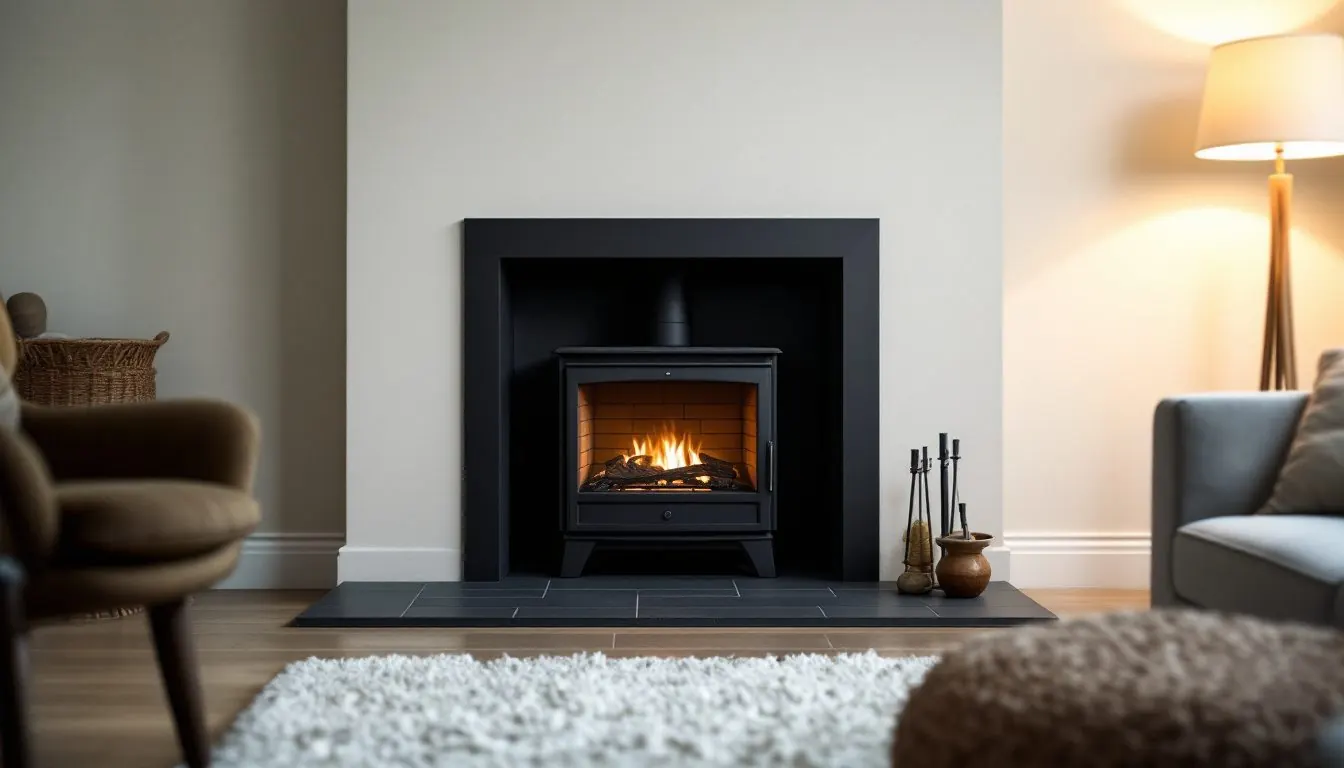
What is a fireplace insert? A fireplace insert is a closed, glass-fronted heater that slides into an existing fireplace and vents through a liner in the old chimney. It turns an open fireplace, which EPA says loses over 90 percent of its heat, into a room heater burning wood, pellets, gas or electricity.
Key Takeaways
- Most open fireplaces lose over 90 percent of the fire’s heat up the chimney; EPA calls inserts wood stoves converted to fit fireplace openings (EPA Burn Wise).
- Wood and pellet inserts sold since May 15, 2020 must meet 2.0 g/hr of particulate, or 2.5 g/hr on the cord wood option (40 CFR 60.532).
- DOE puts new catalytic stoves and inserts at up to 83% HHV and pellet units at 70% to 83% (DOE, archived copy).
- Gas inserts have no federal efficiency floor: “there is no test procedure or energy conservation standard for consumer hearth heaters” (DOE, 87 FR 36249).
- The 25C credit for biomass stoves of at least 75 percent efficiency ended for property placed in service after December 31, 2025 (26 U.S.C. 25C).
- Heating appliances were tied to an estimated 76 of 274 non-fire carbon monoxide deaths in 2022 (CPSC).
What is a fireplace insert, and how is it different from a fireplace?
A fireplace insert is a sealed heater built to sit inside an existing firebox and exhaust through the old chimney. Federal rules define “fireplace insert wood heaters” as heaters “intended to be installed in masonry fireplace cavities or in other enclosures,” generally listed under UL 1482, UL 737 or ULC S628 (40 CFR 60.531).
A fireplace, under the same rule, is “intended to be used primarily for aesthetic enjoyment and not as a space heater.” EPA puts it plainly: fireplaces “should not be confused with fireplace inserts, which are wood stoves converted to fit in existing fireplace openings.” Gas and electric inserts sit outside that rule; see our pages on gas fireplace venting and efficiency and what an electric fireplace costs to run.
How much more efficient is a fireplace insert than an open fireplace?
Much more. EPA says most open fireplaces lose over 90 percent of the fire’s heat out the chimney, while DOE says a well-fitted insert “can function nearly as efficiently as a wood stove.” DOE adds that an open fireplace can draw as much as 300 cubic feet per minute of heated room air.
EPA credits a certified stove with up to 50% more energy efficiency and 1/3 less wood for the same heat, and says fireplaces create “20 times the amount of air pollution” of certified heaters. An idle chimney still leaks, so a closed fireplace damper and its heat loss math still matter.
Wood, pellet, gas or electric: which fireplace insert type fits?
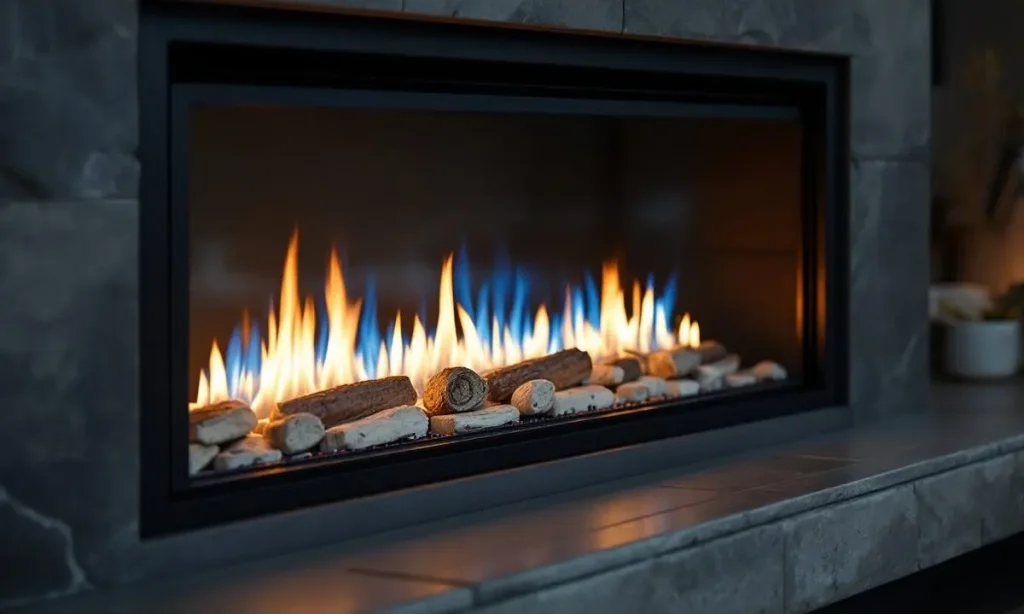
Fuel decides the venting, the rules and the running cost. In our math at EIA prices, pellet and natural gas inserts cost least per delivered million Btu, propane and electric resistance the most, and cord wood depends on what you pay per cord.
| Insert type | Efficiency evidence | Venting | Delivered cost per million Btu |
|---|---|---|---|
| Wood, catalytic | Up to 83% HHV (DOE) | Stainless liner, UL 1777 | $6.02 per $100 of cord price |
| Wood, non-catalytic | 65% to 75% HHV (DOE) | Stainless liner, UL 1777 | $6.67 to $7.69 per $100 of cord price |
| Pellet | 70% to 83% (DOE) | Small flue pipe or liner | $17.77 to $21.07 |
| Natural gas, direct vent | No US rule; Canada floor 50% | Two 3 inch liners | $21.15 to $29.61 |
| Propane, direct vent | No US rule; Canada floor 50% | Two 3 inch liners | $42.65 to $59.70 |
| Electric | Approaches 100 percent (DOE) | None | $50.50 |
HVAC Brief calculation. EIA prices: natural gas $15.34 per thousand cubic feet and electricity 17.23 cents per kWh (2025 residential averages); propane $2.730 per gallon (week of October 26, 2026); pellets $243.39 per ton (July 2026 manufacturer sales, below retail). EIA heat contents: 1,036 Btu per cubic foot, 91,452 per gallon, 3,412 per kWh, 20,000,000 per cord, 330,000 per 40 pound pellet bag. Gas uses 50% to 70% efficiency.
That gas band is not a US rating. Natural Resources Canada testing found some gas fireplaces “in the 30 percent range, while the better units ranged from 50 percent to 70 percent.” Our full fuel comparison is on the heating cost by fuel page, with state prices in our natural gas price table.
Read the efficiency label twice
An ad saying “85% efficient” is often quoting combustion efficiency, and EPA says overall efficiency “may be 10 % to 20% lower.” Ask for the overall figure under CSA B415.1. Check the heating value too: one Osburn 1100 insert manual lists the same test at 70.0% HHV and 75.0% LHV.
What federal rules apply to a fireplace insert?
Wood and pellet inserts fall under EPA’s wood heater standard, 40 CFR part 60 subpart AAA. Gas and electric inserts have no federal efficiency standard.
The wood heater rule set a 2015 limit of 4.5 g/hr of particulate, then 2.0 g/hr for units “manufactured or sold at retail” on or after May 15, 2020, or 2.5 g/hr under the cord wood option. It bans burning garbage, plastics, paints, plywood and particleboard, and pellet units must burn graded pellets from the Pellet Fuels Institute, ENplus or CANplus.
The older Osburn 1100 manual lists 2.9 g/h, above both 2020 limits, so match the metal EPA tag on the back to the limits before buying. Our guide to EPA wood stove certification covers the label.
For gas, DOE’s 2022 notice found no hearth heater standard, and the October 1, 2026 eCFR text of 10 CFR 430.32(i) still lists only wall, floor and room heater classes. DOE also withdrew coverage of decorative “miscellaneous gas products,” effective June 6, 2025. Canada, by contrast, requires heating gas fireplaces made since January 1, 2020 to reach at least 50%.
Does a fireplace insert need a chimney liner?
In practice, yes for wood, pellet and gas. DOE says a relined chimney’s liner “should be continuous from the appliance outlet to the chimney top,” and Natural Resources Canada says chimneys “must be relined with an approved vent when a gas insert is installed.” Electric inserts need no vent.
An Osburn manual calls a 6 inch stainless liner to the chimney top “the optimum system,” with a connector into the first flue tile as the US minimum. For inserts in factory-built fireplaces it demands “a full height listed chimney liner meeting type HT requirements (2100 degree F.) per UL 1777.” Gas inserts usually run two 3 inch flexible liners, exhaust and intake; a Hearth Technologies i30SE manual requires them to terminate vertically.
Our sibling piece explains the chimney liner rules and when code requires one. The Osburn 1100 manual also restates the hearth extension: 20 inches in front and 12 inches each side for openings of 6 square feet or more, 16 and 8 inches for smaller ones.
How do you size and install a fireplace insert safely?
Size to the room you use. DOE’s rule of thumb is that 60,000 Btu can heat a 2,000 square foot home and 42,000 Btu a 1,300 square foot space; oversized units get run at a smolder, wasting fuel.
- Have the chimney inspected and cleaned; Osburn requires masonry free of cracks, loose mortar and creosote.
- Confirm firebox size and mantel and trim clearances from the insert manual, not a generic chart.
- Check the EPA tag or gas rating plate; one gas unit, the Nordik 34i, lists 40,000 Btu/h maximum input on natural gas.
- Install the listed liner, sealed at the collar and capped at the top.
- Plan for power: DOE estimates pellet units use about 100 kWh a month, roughly $17.23 at 17.23 cents per kWh.
- Install carbon monoxide alarms and book an annual sweep; DOE says catalytic combustors need inspection after every two cords.
Direct-vent gas inserts draw outside air, but wood inserts pull room air, so check how much combustion air the house can supply. Then place alarms using our carbon monoxide detector placement rules.
Is there still a tax credit for a fireplace insert?
No, not for 2026 installs. Section 25C paid 30% up to $2,000 a year for biomass stoves with “a thermal efficiency rating of at least 75 percent,” but it “shall not apply with respect to any property placed in service after December 31, 2025.”
Gas and electric inserts never qualified under that biomass line. What still pays for other heating upgrades is on our 2026 heat pump rebate page; ask your state energy office or air district about any wood stove changeout program.
How we researched this
Research date: October 31, 2026. We opened 26 sources, including 3 ranking competitor pages, 4 insert manuals and current eCFR text of 40 CFR 60.530 to 60.532 and 10 CFR 430.32, and list those we relied on below. Costs are our arithmetic from EIA prices.
Excluded: unsourced retailer efficiency and price claims, installed insert prices (no federal series), and Reddit, because combustion and carbon monoxide are safety topics. EPA’s Burn Wise site is a historic record that EPA stopped updating on October 30, 2025.
Frequently asked questions
Do fireplace inserts need electricity?
Pellet inserts do, because fans, controls and the feeder run on power; DOE estimates about 100 kWh a month. The Nordik 34i gas insert manual specifies a 120 VAC, 6 amp junction box that must stay live at all times.
Is a fireplace insert worth it?
For heating, usually yes. EPA says most open fireplaces lose over 90 percent of the fire’s heat, while DOE says a well-fitted insert can run nearly as efficiently as a wood stove. DOE adds that an open fireplace can pull up to 300 cubic feet per minute of heated room air.
Can a fireplace insert go in a prefab fireplace?
Only if both manuals allow it. The Osburn 1800-i manual requires the factory-built fireplace to be listed to UL 127, the insert tested to UL 1482, and a full height UL 1777 liner rated to 2100 degrees F. Ask your local building official before buying.
Does a gas fireplace insert need to be vented?
Yes. Vented gas inserts exhaust outdoors, and direct-vent models use two flexible liners, one for outside combustion air and one for exhaust. Natural Resources Canada says existing chimneys must be relined with an approved vent when a gas insert goes in.
Do fireplace inserts qualify for a tax credit in 2026?
No. The federal 25C credit covered biomass stoves rated at least 75 percent efficient, at 30% up to $2,000 a year, but it does not apply to property placed in service after December 31, 2025. State and local programs may still exist.
How often should a fireplace insert be cleaned?
Fire officials recommend a yearly inspection of the insert, liner and chimney, per EPA. DOE adds that catalytic combustors need checking after every two cords of wood. Burn wood dried to 20% moisture or less, per EPA, to cut smoke and wasted heat.
Sources
- U.S. EPA. “Choosing the Right Fireplace or Fireplace Retrofit Device.” https://www.epa.gov/burnwise/choosing-right-fireplace-or-fireplace-retrofit-device. Accessed October 2026.
- U.S. EPA. “Energy Efficiency and Your Wood-Burning Appliance.” https://www.epa.gov/burnwise/energy-efficiency-and-your-wood-burning-appliance. Accessed October 2026.
- U.S. EPA. “Wood-Burning Installation and Maintenance.” https://www.epa.gov/burnwise/wood-burning-installation-and-maintenance. Accessed October 2026.
- eCFR. “40 CFR Part 60 Subpart AAA.” https://www.ecfr.gov/current/title-40/chapter-I/subchapter-C/part-60/subpart-AAA. Accessed October 2026.
- eCFR. “10 CFR 430.32.” https://www.ecfr.gov/current/title-10/chapter-II/subchapter-D/part-430/subpart-C/section-430.32. Accessed October 2026.
- U.S. DOE, Energy Saver. “Wood and Pellet Heating.” Archived copy. https://web.archive.org/web/2025id_/https://www.energy.gov/energysaver/wood-and-pellet-heating. Accessed October 2026.
- U.S. DOE. “Energy Conservation Standards for Direct Heating Equipment,” 87 FR 36249. https://www.federalregister.gov/d/2022-12787. Accessed October 2026.
- U.S. DOE. “Final Withdrawal of Determination of Miscellaneous Gas Products.” https://www.federalregister.gov/d/2025-07950. Accessed October 2026.
- Natural Resources Canada. “Gas fireplaces” and “All About Gas Fireplaces.” https://natural-resources.canada.ca/energy-efficiency/energy-efficiency-regulations/gas-fireplaces. Accessed October 2026.
- Legal Information Institute. “26 U.S. Code 25C.” https://www.law.cornell.edu/uscode/text/26/25C. Also IRS, “Energy efficient home improvement credit.” Accessed October 2026.
- U.S. CPSC. “Non-Fire Carbon Monoxide Deaths, 2022 Annual Estimates.” https://www.cpsc.gov/s3fs-public/Non-Fire-Carbon-Monoxide-Deaths-Associated-with-the-Use-of-Consumer-Products-2022-Annual-Estimates.pdf. Accessed October 2026.
- U.S. EIA. “Units and calculators explained”; natural gas, propane and Electric Power Monthly Table 5.3 prices; Densified Biomass Fuel Report; 2020 RECS documentation. https://www.eia.gov/energyexplained/units-and-calculators/. Accessed October 2026.
- Stove Builder International. “Osburn 1100 Insert” and “Osburn 1800-i” owner’s manuals. https://manuals.stove-parts-unlimited.com/wood/osburn/osburn-1100-insert-owners-manual.pdf. Accessed October 2026.
- Hussong Mfg. “Nordik 34i Manual, Rev. 6”; Hearth Technologies “i30SE Owner’s Manual.” https://www.kozyheat.com/wp-content/uploads/2022/09/Nordik-34i-Manual-English-Rev.-6.pdf. Accessed October 2026.
Leave a Reply