
What is the best office temperature? OSHA recommends an office temperature of 68 to 76°F with 20% to 60% humidity, but no US rule requires it. A Lawrence Berkeley National Laboratory review found office work output peaks near 71 to 72°F.
Key Takeaways
- OSHA’s 2003 interpretation letter recommends 68 to 76°F and 20% to 60% humidity, and says OSHA has no office temperature regulation.
- An LBNL review by Seppänen, Fisk and Lei put peak office performance at 21.75°C (about 71°F), with an 8.9% loss at 30°C (86°F).
- In a Berlin lab test of 543 students, women solved 1.76% more math problems per 1°C of warming (PLOS ONE, 2019).
- Kingma and van Marken Lichtenbelt (2015) say the 1960s comfort model may overestimate female metabolic rate by up to 35%.
- Across 351 office buildings, only 2% reached the 80% thermal satisfaction target in a UC Berkeley survey analysis.
- Raising a 72°F cooling setpoint to 77°F saved an average 29% of cooling energy in UC Berkeley simulations.
What is the recommended office temperature?
The most quoted US office temperature range is OSHA’s: 68 to 76°F, with humidity held between 20% and 60%. It comes from a February 24, 2003 interpretation letter, not a regulation, and the same letter points to ASHRAE Standard 55 for ranges “intended to satisfy the majority of building occupants.”
ASHRAE 55 works through the predicted mean vote (PMV) model rather than one number. UC Berkeley’s Center for the Built Environment (CBE) notes that a PMV band of -0.5 to +0.5 is defined as comfortable under Standard 55, which allows a thermostat band of about 3K (5.4°F). Most comfort standards aim to satisfy at least 80% of occupants. The humidity half of OSHA’s advice is covered in our guide to indoor humidity targets.
| Source | Office temperature figure | Basis |
|---|---|---|
| OSHA letter (2003) | 68 to 76°F; 20% to 60% humidity | Recommendation, not a standard |
| ASHRAE Standard 55 | PMV -0.5 to +0.5, about 5.4°F wide | Comfort model, 80% satisfied goal |
| LBNL review (2006) | Peak at 21.75°C (about 71°F) | Weighted regression of office task studies |
| Cornell field study (2004) | 77°F beat 68°F | Nine workstations, one month |
| Chang and Kajackaite (2019) | Warmer rooms helped women | 543 students, 16.19 to 32.57°C |
| UK HSE guidance | Minimum 16°C (about 61°F); 13°C for strenuous work | UK workplace law guidance |
| OSHA heat proposal (2024) | Exempts indoor areas kept below 80°F | Proposed rule, not final |
Is there a legal limit on office temperature in the US?
No federal rule sets an office temperature limit. OSHA’s letter states plainly that “OSHA has no regulations specifically addressing temperature and humidity in an office setting,” and notes that the agency withdrew its indoor air quality proposal on December 17, 2001.
The nearest thing is a proposal. OSHA published its heat injury and illness rule on August 30, 2024, with an initial trigger at a heat index of 80°F and a high heat trigger at 90°F. It would exclude indoor work areas “where air-conditioning consistently keeps the ambient temperature below 80 °F.” The latest Federal Register action we found extended post-hearing comments to October 30, 2025; no final rule appears.
Federal buildings lost their own rule. Until December 16, 2025, 41 CFR 102-74.185 told agencies to match “local commercial equivalent temperature levels” and to heat to no higher than 55°F during non-working hours. The eCFR version history shows the section removed on that date. For contrast, the UK’s Health and Safety Executive sets a normal minimum of 16°C, or 13°C for strenuous work, and says there is no legal maximum.
Myth check
“OSHA requires offices to stay between 68 and 76°F” is wrong. That range is a recommendation in a 2003 letter. Depending on your state, lease or union contract, other terms may apply, but no federal office temperature standard exists.
What office temperature is best for productivity?
The best pooled estimate is about 71 to 72°F. Seppänen, Fisk and Lei at LBNL combined studies that used objective measures such as text processing, simple math and call center handling time, and found performance “increases with temperature up to 21-22 oC, and decreases with temperature above 23-24 oC,” peaking at 21.75°C.
Their sample sizes ranged from 9 to 500, and the authors warn the relationship “has a high level of uncertainty.” We ran their published equation to show the curve in Fahrenheit; the 30°C value is the paper’s own figure.
| Room temperature | Fahrenheit | Performance vs. peak |
|---|---|---|
| 20°C | 68°F | 99.4% |
| 22.2°C | 72°F | 99.9% |
| 25°C | 77°F | 98.2% |
| 26°C | 78.8°F | 97.1% |
| 28°C | 82.4°F | 94.4% |
| 30°C | 86°F | 91.1% |
A smaller field study points warmer. Cornell’s Alan Hedge reported that when an office went from 68 to 77°F for a month, typing errors fell 44% and output rose 150%, according to a 2004 Cornell release. That test covered nine workstations, so treat it as one data point next to the pooled review.

Why do women and men disagree about office temperature?
Part of the answer is the comfort math. Kingma and van Marken Lichtenbelt write that indoor climate rules rest on a model developed in the 1960s whose metabolic rate values “are based on an average male, and may overestimate female metabolic rate by up to 35%.” A lower metabolic rate means a person needs a warmer room to feel neutral.
Performance data point the same way. Chang and Kajackaite tested 543 students in Berlin at 16.19 to 32.57°C. Each 1°C of warming raised women’s math score 1.76% and verbal score 1.03%, while men’s math score fell 0.63%, a change that was not statistically significant. Their conclusion: mixed workplaces “may be able to increase productivity by setting the thermostat higher than current standards.”
How many offices actually keep workers comfortable?
Very few. Karmann, Schiavon and Arens analyzed 52,980 occupant votes from 351 office buildings, mostly in North America. They found 43% thermally dissatisfied, 19% neutral and 38% satisfied, and only 2% of buildings met the 80% satisfied mark on a strict reading. Temperature also shapes perceived air quality and sick building symptoms, the LBNL authors note.
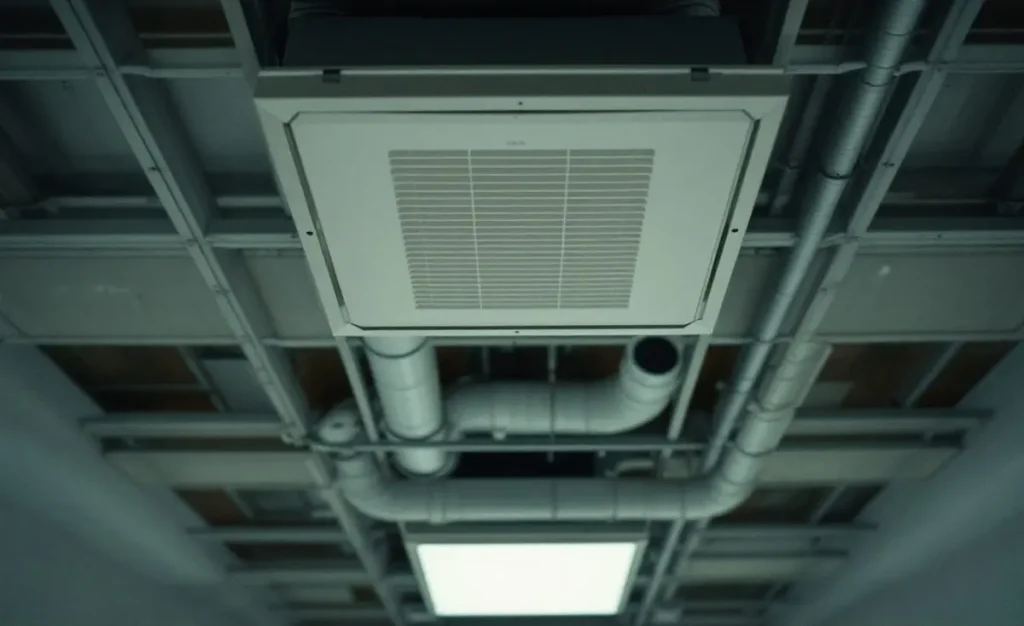
The authors blame the “inability of the large majority of HVAC systems to provide adequately personalized conditioning or control.” In large offices that usually means one thermostat serving many desks through a variable air volume terminal, a problem that splitting a floor into zones only partly fixes.
How much energy does a wider office temperature setpoint save?
A lot. In Hoyt, Arens and Zhang’s simulations of six medium office buildings across seven ASHRAE climate zones, raising the cooling setpoint from 72°F to 77°F saved an average 29% of cooling energy and 27% of total HVAC energy, “without reducing satisfaction levels.”
Dropping the heating setpoint from 70°F to 68°F saved 34% of terminal heating energy. Wider bands with fans or personal controls reached 32% to 73% HVAC savings depending on climate. Low-wattage options such as ceiling fans set for cooling fit that model, but the authors note that 1500 W heaters at every desk “could not save heating energy,” which is also why under-desk space heaters are a poor fix.
How should a facility manager set the office temperature?
Start inside OSHA’s band, then widen the deadband and add personal control rather than fighting over one number. A building automation system makes most of these steps a scheduling change.
- Hold occupied hours within 68 to 76°F and 20% to 60% humidity, per OSHA’s letter.
- In cooling season, test setpoints toward 77°F instead of 72°F, the change Hoyt’s team modeled.
- Widen the heating to cooling deadband beyond the typical 4°F; CBE found narrow ranges did not raise satisfaction.
- Offer fans or other low-wattage personal controls so warmer setpoints stay comfortable.
- Survey occupants and track the share satisfied against the 80% goal.
- Check ventilation too, using CO2 readings as an airflow gauge.
Homes follow different math; see our data on what Americans set the thermostat to, and the separate evidence on bedroom temperature for sleep.
How we researched this
Research date: October 31, 2026. We reviewed the top-ranking pages for “office temperature” (an Indeed employer guide, a Planon vendor blog and a UK consultancy guide); none linked a primary study. We then read 10 primary sources in full or in abstract: OSHA’s 2003 letter, the LBNL 60946 paper, PLOS ONE, Nature Climate Change, two CBE papers, the Cornell release, the UK HSE page, the Federal Register heat proposal and eCFR version data for 41 CFR 102-74. The performance table is our calculation from the LBNL equation. Excluded: vendor and thermostat-maker blogs, press coverage of studies we could not open, and the GSA P100 setpoints, which we could not verify. Reddit was not used.
Frequently asked questions
What temperature should an office be kept at?
OSHA recommends 68 to 76°F with humidity between 20% and 60%, from its February 24, 2003 interpretation letter. Within that band, an LBNL review of office task studies found performance peaks at 21.75°C, about 71°F, and stays within about 2% of peak up to 77°F.
Is 68 degrees too cold for an office?
It sits at the bottom of OSHA’s recommended 68 to 76°F range. The LBNL curve puts 68°F at 99.4% of peak performance, but a Cornell field study found typing errors fell 44% when an office warmed from 68 to 77°F, and women in a Berlin experiment did better in warmer rooms.
What is the maximum legal office temperature in the US?
There is none. OSHA states it has no regulations addressing office temperature and humidity. Its 2024 heat proposal would set triggers at a heat index of 80°F and 90°F but would exclude indoor areas that air-conditioning keeps below 80°F, and it was still a proposal at our last check.
Why are offices so cold for women?
Comfort standards use a model from the 1960s whose metabolic rate values are based on an average male. Kingma and van Marken Lichtenbelt write that this may overestimate female metabolic rate by up to 35%, so a setpoint tuned to that model can feel cold to many women.
Does a warmer office save energy?
Yes. In UC Berkeley simulations, moving a cooling setpoint from 72°F to 77°F saved an average 29% of cooling energy and 27% of total HVAC energy across seven climate zones. Lowering the heating setpoint from 70°F to 68°F saved 34% of terminal heating energy.
What is the minimum office temperature in the UK?
The UK Health and Safety Executive says indoor workplaces should normally be at least 16°C, or 13°C where much of the work involves rigorous physical effort. It also states there is no law for a maximum working temperature because every workplace is different.
How common are office temperature complaints?
Very common. A CBE analysis of 52,980 occupant votes in 351 office buildings found 43% thermally dissatisfied and only 38% satisfied. Just 2% of the buildings reached the 80% satisfied goal when only positive votes counted as satisfaction.
Sources
- OSHA. “Reiteration of Existing OSHA Policy on Indoor Air Quality: Office Temperature/Humidity and Environmental Tobacco Smoke.” https://www.osha.gov/laws-regs/standardinterpretations/2003-02-24. Accessed October 2026.
- Seppänen, Fisk and Lei, Lawrence Berkeley National Laboratory. “Effect of Temperature on Task Performance in Office Environment” (LBNL 60946). https://eta-publications.lbl.gov/sites/default/files/lbnl-60946.pdf. Accessed October 2026.
- Chang and Kajackaite, PLOS ONE. “Battle for the thermostat: Gender and the effect of temperature on cognitive performance.” https://journals.plos.org/plosone/article?id=10.1371/journal.pone.0216362. Accessed October 2026.
- Kingma and van Marken Lichtenbelt, Nature Climate Change. “Energy consumption in buildings and female thermal demand.” https://www.nature.com/articles/nclimate2741. Accessed October 2026.
- Karmann, Schiavon and Arens, UC Berkeley CBE. “Percentage of commercial buildings showing at least 80% occupant satisfied with their thermal comfort.” https://escholarship.org/uc/item/89m0z34x. Accessed October 2026.
- Hoyt, Arens and Zhang, UC Berkeley CBE. “Extending air temperature setpoints: Simulated energy savings and design considerations for new and retrofit buildings.” https://escholarship.org/uc/item/13s1q2xc. Accessed October 2026.
- Cornell Chronicle. “Study links warm offices to fewer typing errors and higher productivity.” https://news.cornell.edu/index%2Ephp/node/281845. Accessed October 2026.
- Federal Register. “Heat Injury and Illness Prevention in Outdoor and Indoor Work Settings.” https://www.federalregister.gov/documents/2024/08/30/2024-14824/heat-injury-and-illness-prevention-in-outdoor-and-indoor-work-settings. Accessed October 2026.
- eCFR. “41 CFR Part 102-74, Facility Management” (version history for 102-74.185). https://www.ecfr.gov/current/title-41/subtitle-C/chapter-102/subchapter-C/part-102-74. Accessed October 2026.
- UK Health and Safety Executive. “Temperature in the workplace: Is it too hot or cold to work?” https://www.hse.gov.uk/temperature/employer/index.htm. Accessed October 2026.
Leave a Reply