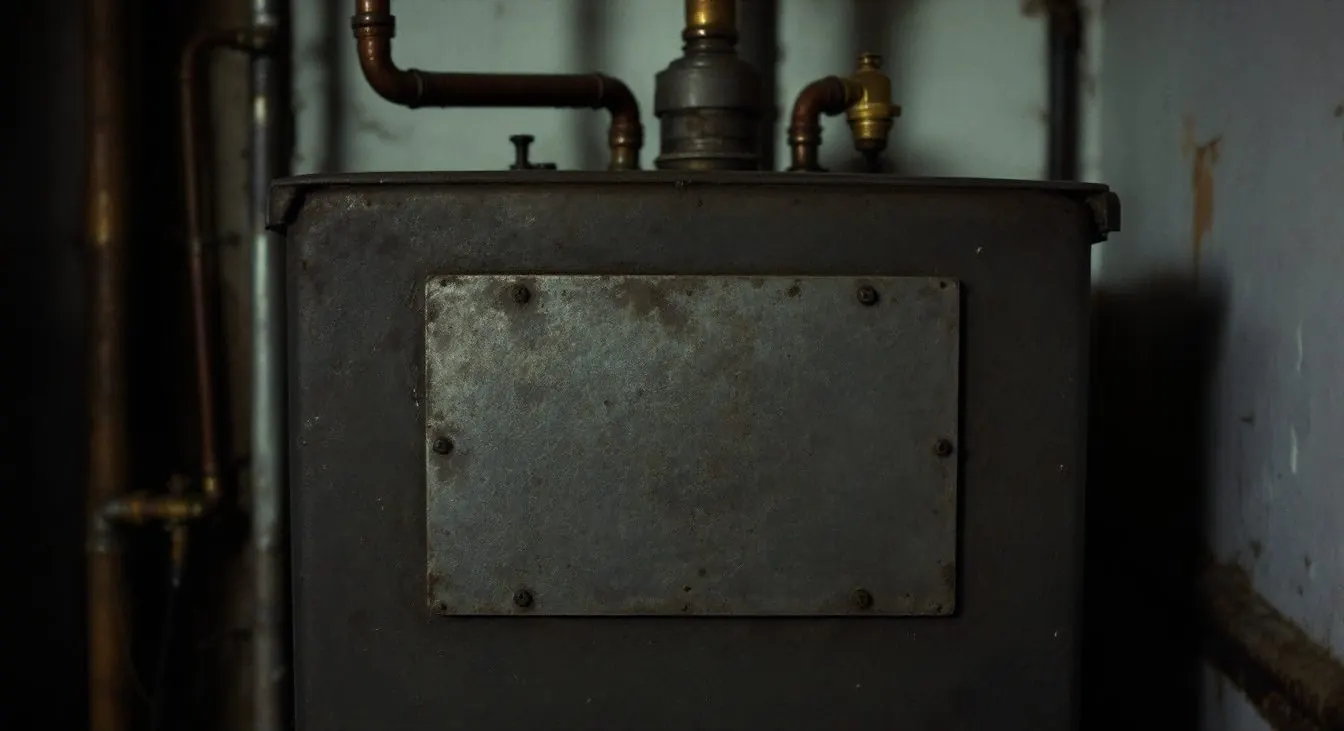
A tankless coil is a copper coil submerged in a boiler’s hot water that heats tap water as it flows through, with no storage tank. Maker ratings run 3.00 to 4.50 gallons per minute at a 100°F rise, and the boiler must stay hot all summer, which Brookhaven tests found roughly halves water heating efficiency.
How does a tankless coil heat water inside a boiler?
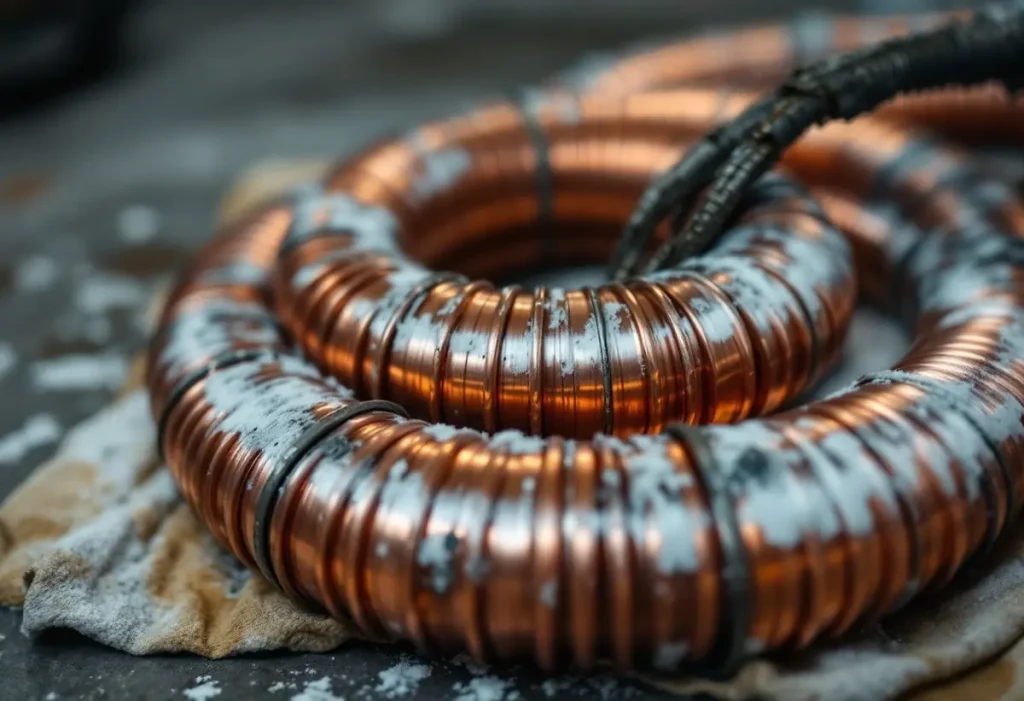
Cold tap water enters a finned copper coil bolted into the boiler, picks up heat from the boiler water, and leaves hot enough that a mixing valve must cool it. In DOE’s words, water “is heated as it flows through a heating coil or heat exchanger installed in a main furnace or boiler” (DOE Energy Saver, archived copy).
The boiler water is the storage. The boiler aquastat holds a low limit so it is hot before anyone opens a tap, which is why a coil boiler fires in July. Burnham’s V8H oil boiler ships its Warm Start control with a 180°F high limit and a 110°F low limit, adjustable from 110°F to 220°F (Burnham V8H manual 110218-06). U.S. Boiler Company’s Heating Helper says coil boilers must hold “at least 140°F or more depending on the desired flow.”
How many gallons per minute will a tankless coil deliver?
About 3 to 4.5 gpm of 140°F water for a short draw, and less for a long one. Weil-McLain rates its coils as “gallons of water per minute heated from 40°F to 140°F with 200°F boiler water,” and lists a separate, lower continuous figure (Weil-McLain EG manual 550-142-303, Table 10). The last column converts each rating into 2.5 gpm showers, the federal showerhead maximum in 10 CFR 430.32(p).
| Boiler and coil | Intermittent rating, gpm | Continuous rating, gpm | 2.5 gpm showers at once |
|---|---|---|---|
| Weil-McLain EG-35 water, coil E-624 | 3.00 | 1.60 | 1.85 |
| Weil-McLain EG-50 water, coil E-626 | 4.00 | 2.80 | 2.46 |
| Weil-McLain EG-75 water, coil E-632 | 4.50 | 4.80 | 2.77 |
| Weil-McLain EGH-125 steam, coil 35-S-29 | 4.00 | 5.00 | 2.46 |
| Burnham V8H3 oil, coil 222B | 3.00 (18.7 psi drop) | Not listed | 1.85 |
| Burnham V8H7 oil, coil 222B | 4.25 (41.3 psi drop) | Not listed | 2.62 |
| U.S. Boiler V13A RO/FO oil | 3.25 | Not listed | 2.00 |
| HUD/FHA minimum, 2 to 2.5 baths, 3 or 4 bedrooms | 3.25 | Not listed | 2.00 |
Compiled by The HVAC Brief from Weil-McLain 550-142-303 Table 10, Burnham V8H manual Table 6-2 and the U.S. Boiler Company Heating Helper 2024-2025 (V13A product table; HUD/FHA minimums at 200°F boiler water). HVAC Brief calculation for the last column: a 105°F shower blended from 140°F coil water and 40°F inlet water is 65% coil water, so one 2.5 gpm shower takes 1.625 gpm of coil output.
Burnham’s pressure drop column matters on well systems: a V8H7 coil eats 41.3 psi at its rated 4.25 gpm, so a 40 psi well will not push that flow. And the HUD/FHA table reprinted in the Heating Helper sets 3.75 gpm as the minimum coil for a 3 to 3.5 bath, 4 bedroom house: just over two showers at once.
Why does the hot water run out after a few minutes on a coil boiler?
Because a long draw asks the coil for nearly the boiler’s entire output. We multiplied each Weil-McLain continuous rating by 8.33 lb per gallon, 60 minutes and the 100°F rise, then divided by the boiler’s DOE heating capacity from Table 16 of the same manual.
| Weil-McLain water boiler | DOE heating capacity | Continuous gpm | Heat the coil needs | Share of boiler output |
|---|---|---|---|---|
| EG-35 | 85 MBH | 1.60 | 79,968 Btu/h | 94% |
| EG-55 | 169 MBH | 3.20 | 159,936 Btu/h | 95% |
| EG-75 | 237 MBH | 4.80 | 239,904 Btu/h | 101% |
HVAC Brief calculation from Weil-McLain 550-142-303 Tables 10 and 16.
The intermittent rating exceeds what the burner can sustain: 3.00 gpm on an EG-35 needs 149,940 Btu/h, 176% of its 85 MBH output. The difference comes out of the hot boiler water; once that cools toward the low limit, the shower cools too, and the radiators get almost nothing. Weil-McLain’s fix is a flow regulating valve “according to intermittent draw of heater”; Burnham asks for a regulator “matching the heater rating,” at least 3 ft from the coil inlet.
What does a tankless coil boiler waste in summer?
Most of the fuel. Brookhaven National Laboratory tested one oil boiler both ways: as a tankless coil it delivered summer hot water at 24.7% efficiency, and the same boiler feeding an indirect tank reached 51.4% (BNL, “Performance of Integrated Hydronic Systems,” 2007). Its idle loss was 4.87% of maximum input in coil mode against 1.16% with the tank.
BNL’s average summer load is 1,720 Btu/h, or 41,280 Btu a day. At 24.7% that takes about 167,000 Btu of fuel; at 51.4%, about 80,300. At 138,500 Btu per gallon of heating oil (EIA), we calculated 1.21 gallons a day against 0.58.
The coil is not always the loser. In the same BNL table, a separate cast iron oil boiler with a tankless coil (1.2% idle loss) scored 40.6% in summer, ahead of an older boiler with an indirect tank at 38.3%. Idle loss, not the coil, decides the result. Federal rules allow for the coil: boilers with “tankless domestic water heating coils” are exempt from the automatic water temperature adjustment required on other hot water boilers under 10 CFR 430.32(e)(2).
Is the coil limed up, or is something else starving the shower?
Scale is the usual suspect, not the only one. Burnham warns that hard water “will, over a short period of time, reduce the output of the coil, reduce flow due to increased pressure drop and reduce the useful life of the coil.” A 2016 National Oilheat Research Alliance briefing by BNL’s Thomas Butcher adds that “the heat transfer performance of coils decreases” over time, pushing owners to raise setpoints (NORA, 2016).
| What you notice | Likely cause | What to check first |
|---|---|---|
| Hot for 3 to 5 minutes, then lukewarm | Draw above the continuous rating, or no flow regulator | Boiler gauge temperature during the draw; regulator gpm against the coil rating |
| Weak hot water at every flow, hot side pressure low, worse over years | Lime inside the coil | Hardness test; flow at a hose bib before and after the coil |
| Temperature swings from scalding to cool | Limed or worn mixing valve | Whether the valve is trapped below the cold inlet, as Burnham specifies |
| Hot water fine in winter, poor in summer | Low limit set too low or turned off | Aquastat low limit against the 140°F floor in the Heating Helper |
| Relief valve weeping, boiler pressure climbing | Leaking coil letting tap water into the boiler | Pressure with the coil valved off; Weil-McLain limits boiler water to 30 psig and rates coils at 60 psig domestic |
Compiled by The HVAC Brief from Burnham V8H section 6, Weil-McLain 550-142-303 Table 10 notes and the Heating Helper. The leak row is our reading of the two pressures: water moves from the 60 psig side to the 30 psig side.
Rising pressure also comes from a failed fill valve, and noise from a kettling boiler, so valve the coil off before blaming it. Burnham’s manual says “DO NOT operate tankless heater without mixing valve”; the thermostatic mixing valve page covers ASSE ratings.
Clean the coil, replace it, or switch to an indirect tank?
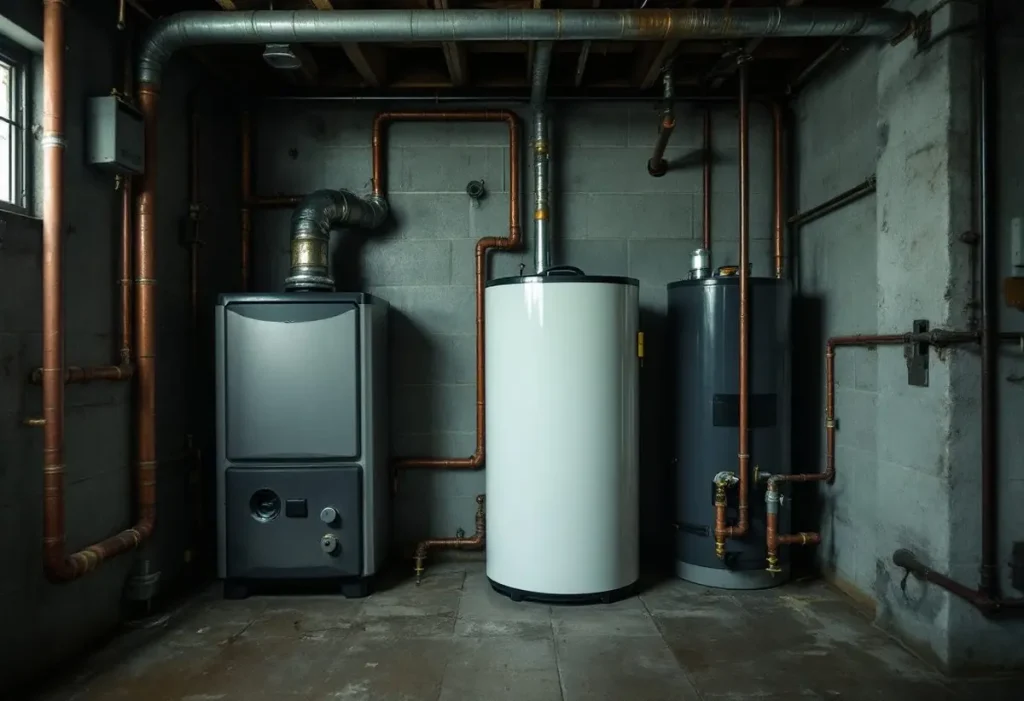
Clean it if output fell slowly and the boiler has years left; replace it if it leaks; move to a tank if the household outgrew 3 gpm or the boiler is due anyway.
Burnham’s cleaning method is a backwash: hose bibs on both sides of the coil, city pressure run backward “until the discharge is clear,” with the tees the same size as the coil connections. Weil-McLain suggests brass plugs in the tees and crosses “to facilitate cleaning in hard water areas,” and both makers recommend softening hard supply water. For more than two showers at once, an indirect water heater is the step up; DOE calls indirect tanks “a more efficient choice for most homes.” A combi boiler is the other route when the old boiler goes.
What does a tankless coil replacement involve: gasket, clearance and fit?
A replacement coil unbolts from the boiler’s heater opening, and the gasket goes with it. Weil-McLain sells separate cover plate gaskets for its rectangular (590-317-579) and round (590-317-495) heater openings and warns installers that over tightening the studs and nuts can damage the gasket.
Check three things first. The opening: Weil-McLain says a coil “cannot be added to standard block assembly,” so a boiler built without one cannot take a coil. The model: match the coil number in the manual (222B on every Burnham V8H, 35-S-29 on Weil-McLain EG steam). The room: Burnham asks for 24 in. of clearance to pull a front coil, or on the right side for a rear one. Old steam boilers often carry coils too, and an aging boiler due for replacement is usually a better place for the money than a new coil.
Frequently asked questions
Is a tankless coil better than an indirect water heater?
Usually not on efficiency. In Brookhaven’s 2007 tests the same oil boiler made summer hot water at 24.7% efficiency with its tankless coil and 51.4% feeding an indirect tank. The coil wins on simplicity: no tank, no extra circulator, no floor space.
How long do tankless coils last?
No maker manual we read gives a service life in years. Water quality sets it: Burnham’s V8H manual warns that hard water will cut the coil’s output, its flow and “the useful life of the coil,” and recommends a water analysis and a softener where needed.
What is a tankless coil cleaner?
The term covers descaling products pumped through a coil to remove lime; none of the maker manuals we read names one. Burnham’s V8H manual describes plain backwashing instead: city water run backward through the coil between two hose bibs until the discharge is clear. With any chemical, follow its label and flush the coil fully before the taps go back in service.
Does a tankless coil need a mixing valve?
Yes. Burnham’s V8H manual says “DO NOT operate tankless heater without mixing valve,” and Weil-McLain’s EG manual says an automatic mixing valve “must be installed.” Coil water can leave near 140°F or hotter; Weil-McLain prints the CPSC recommendation of 130°F or less at the tap.
Can a steam boiler have a tankless coil?
Yes, if it was built with a heater opening. Weil-McLain’s EG and EGH steam boilers take a 35-S-29 coil rated 3.00 to 4.00 gpm intermittent, heating 40°F water to 140°F. The boiler then stays hot all year, burning fuel through the summer.
How we researched this
On November 14, 2026 we read Weil-McLain manual 550-142-303, Burnham V8H manual 110218-06, the Heating Helper 2024-2025, BNL’s 2007 report, a 2016 NORA briefing, DOE Energy Saver (archived), 10 CFR 430.32 and EIA’s Btu table. Calculations are shown on the page. We excluded retailer listings, forums and contractor blogs as number sources, and list no installed prices because no federal source publishes them for coils.
Sources
- U.S. Department of Energy. “Tankless Coil and Indirect Water Heaters.” Archived copy. https://web.archive.org/web/2025id_/https://www.energy.gov/energysaver/tankless-coil-and-indirect-water-heaters. Accessed November 2026.
- Weil-McLain. “EG/PEG Series 6, EGH Series 5 Gas-Fired Boilers, Boiler Manual 550-142-303.” https://www.weil-mclain.com/wp-content/uploads/EG-PEG-Series-6-Boiler-Manual-Web-Version.pdf. Accessed November 2026.
- Burnham (U.S. Boiler Company). “V8H Installation, Operating and Service Instructions 110218-06.” https://s3.amazonaws.com/s3.supplyhouse.com/product_files/Burnham-V8HSeries-Installation.pdf. Accessed November 2026.
- U.S. Boiler Company. “Heating Helper, 2024-2025 Edition.” https://s3-us-west-2.amazonaws.com/catsy.782/Heating+Helper.pdf. Accessed November 2026.
- Butcher, T. A., Brookhaven National Laboratory. “Performance of Integrated Hydronic Systems.” May 1, 2007. https://www.greenbuildingadvisor.com/sites/default/files/brookhavenReport.pdf. Accessed November 2026.
- Butcher, T., National Oilheat Research Alliance. “High Efficiency Tankless Coil Boilers and Mini-Split Integration.” 2016. https://noraweb.org/wp-content/uploads/2016/09/High-Efficiency-Tankless-Coil-Boilers-and-Minisplits.pdf. Accessed November 2026.
- eCFR. “10 CFR 430.32, Energy and water conservation standards and their compliance dates.” https://www.ecfr.gov/current/title-10/chapter-II/subchapter-D/part-430/subpart-C/section-430.32. Accessed November 2026.
- U.S. Energy Information Administration. “British thermal units (Btu).” https://www.eia.gov/energyexplained/units-and-calculators/british-thermal-units.php. Accessed November 2026.
Leave a Reply