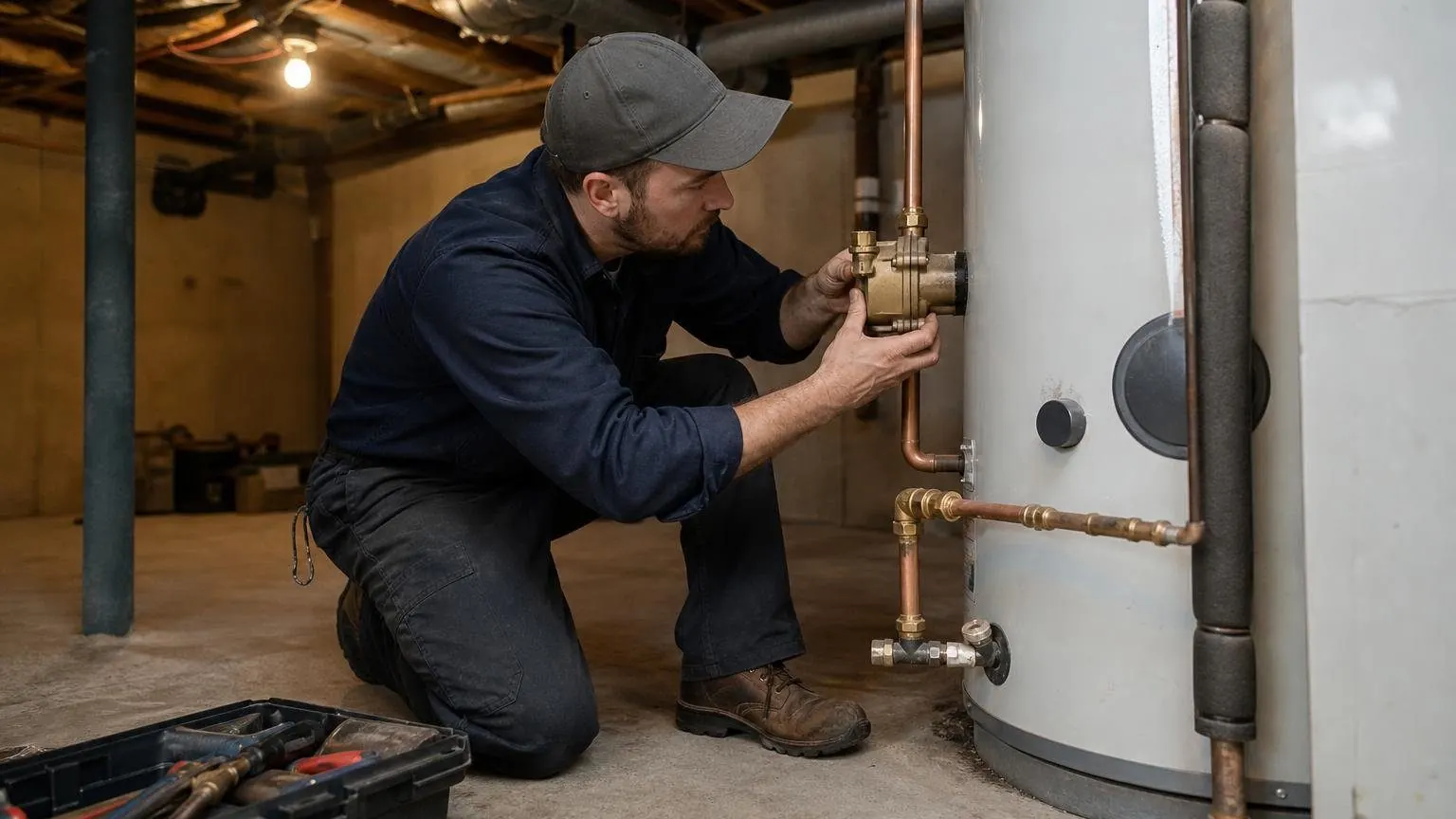
What is a water heater recirculation pump? A water heater recirculation pump pushes the cooled water sitting in your hot pipes back to the heater, so hot water reaches a distant tap in seconds instead of down the drain. Whether it saves energy depends on the control: on demand pumps can, always on pumps waste it.
Key Takeaways
- EPA WaterSense says the average home wastes more than 3,650 gallons of water a year waiting for hot water (EPA WaterSense, 2014, archived copy).
- A Lawrence Berkeley National Laboratory pilot study of 36 shower events found 30 percent of the water and 41 percent of the hot water energy wasted (LBNL, 2011).
- Virginia Tech measured 20 percent more energy for recirculation in the best case, and more than double with the pump always on (Virginia Tech release, 2013).
- A federal rule adapted from the 2021 IECC requires circulation pumps that start on a demand for hot water and stop when there is none (10 CFR 460.203).
- EPA WaterSense requires new home recirculation to be demand-initiated; timer or temperature only systems do not qualify (WaterSense spec v1.1).
- Rinnai and Navien tankless models have built-in pumps that run through a return line or a crossover valve (Rinnai spec sheet, maker claim).
What is a water heater recirculation pump?
A water heater recirculation pump is a small pump that keeps the hot water line close to tap temperature by looping water back to the heater. The loop returns either through a dedicated return pipe or through the cold water line, using a valve under a sink.
It is a cousin of the boiler circulator pump that moves heating water through radiators, but it pumps drinking water rather than a sealed heating loop. Grundfos marks its Comfort System kit ANSI/NSF61 and IAPMO listed.
| System type | How water returns | Maker example | Trade off |
|---|---|---|---|
| Dedicated return line | Third pipe from the last fixture back to the heater | Rinnai Dedicated Mode | Needs open walls or new construction |
| Crossover (comfort) valve | Thermal bypass valve under the farthest sink sends water into the cold line | Grundfos Comfort System, Navien NaviCirc, Rinnai ThermaCirc360 | Warm water at the cold tap |
| Tankless with built-in pump | Either path above, pump inside the heater | Navien NPE-A2, Rinnai RUR series | Burner and pump both run during each loop cycle, per Navien |
How much water and energy does waiting for hot water waste?
Waiting for hot water wastes thousands of gallons a year per home, plus the energy used to heat it. EPA WaterSense put it at more than 3,650 gallons a year in 2014, about 10 gallons a day.
The best measured data come from Jim Lutz at Lawrence Berkeley National Laboratory, whose 2011 pilot study in three California homes found 30 percent of shower water and 41 percent of shower hot water energy wasted. Three homes is a small sample: an illustration, not a national average.
Pipe losses come on top of the tank’s own; our guide to setting the water heater thermostat covers that side of the bill.

Do hot water recirculation pumps waste energy?
Yes, a hot water recirculation pump can waste more energy than it saves when it runs all the time. A loop kept hot around the clock loses heat through every foot of pipe, and the heater makes it up.
ENERGY STAR states it directly: systems that “operate continuously” can use more energy, from pumping and pipe heat loss, “than the energy saved by reducing hot water waste.” The Virginia Tech team of Randi Brazeau and Marc Edwards reported 20 percent more energy than a standard system even in the best case, and more than double with the pump always on.
The water saved at the tap is real; the energy saving is conditional. The loop loss is reheated by whatever heater you own, gas tank, tankless or a heat pump water heater, so it lands on the bill either way.
Myth check: “A recirculation pump is always the green choice.” ENERGY STAR and Virginia Tech both say otherwise for continuous pumping. Any energy saving depends on a demand control.
Which recirculation pump controls save the most: timer, thermostat or on demand?
On demand recirculation saves the most, because the pump runs only after someone signals they want hot water. Timers and thermostats cut run time compared with an always on pump, but EPA does not count either as efficient on its own.
From most energy use to least:
- Always on. Never stops; Virginia Tech’s worst case.
- Recirculation pump timer. Runs in set hours. Grundfos ships a plug-in timer; Navien’s NPE-A2 lists Weekly beside its Always On, Intelligent and HotButton modes.
- Thermostatic. Starts when the loop cools and stops when it is hot, even with nobody home.
- On demand. A push button, motion sensor or flow sensor starts the pump just before a draw. Navien says its HotButton kit runs recirculation “exactly when the actual demands arise.”
The federal sources disagree. ENERGY STAR lists a push button, a timer or a motion sensor as demand controls, while the WaterSense New Home Specification says systems activated “based solely on a timer and/or temperature sensor” do not qualify. We follow the stricter WaterSense reading.
What does code require for hot water circulation systems?
Energy codes based on IECC section R403.5.1.1 require a circulation pump, ban gravity loops, and require controls that start the pump on a demand for hot water and stop it when the loop is hot. Whether that binds your house depends on your state’s adopted code.
The cleanest federal restatement is 10 CFR 460.203, DOE’s rule for manufactured homes, which says it is “adapted from section R403 of the 2021 IECC.” It allows the return to be “a dedicated return pipe or a cold water supply pipe,” so crossover valve systems fit the model language, and it requires R-3 insulation on hot pipes outside conditioned space.
States amend the model. Washington’s residential energy code requires a dedicated return pipe under R403.5.1.1, and R403.5.1.1.1 says demand systems must start the pump on a user’s action, a presence sensor or a sensed flow of hot water. Its R403.5.3 sets R-3 pipe insulation inside and outside conditioned space.
Whether these rules reach a homeowner adding a plug-in pump to an existing house varies by jurisdiction. Check with your building department, and see our note on when a permit is required.
Can you add a recirculation pump to an existing water heater or a tankless unit?
Yes. A crossover kit retrofits an existing tank heater without new pipe runs, and several tankless models have the pump built in. The usual water heater installation checks still apply.
A crossover retrofit, per the Grundfos Comfort System manual:
- Close the cold supply valve to the heater and drain the hot line through an open faucet.
- Mount the pump on the heater’s hot discharge, pumping away from the heater and clear of any flue pipe; the UP15 is rated for water up to 150°F.
- Reopen the supply, purge air, and plug into a grounded 115V outlet.
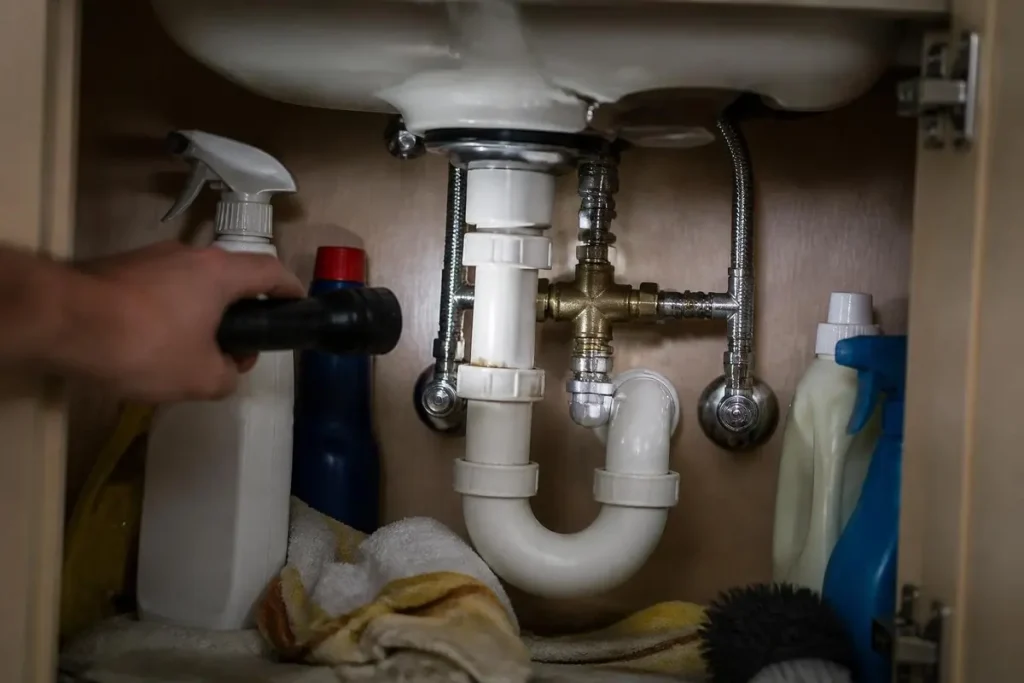
- At the sink farthest from the heater, close both angle stops and fit the bypass valve between the stops and the faucet with flex hoses. A branched hot line may need more than one valve.
- Set the timer around peak use; Grundfos suggests 30 minutes before the first shower until 15 minutes after the last.
The catch is warm water at the cold tap. Grundfos warns its kit “is not an anti-scald device” and that the cold line under the sink may run warm. Navien’s NaviCirc valve closes at about 95°F to limit how much hot water enters the cold line (maker claim).
A recirculation pump with a tankless water heater has one extra hurdle: the burner fires only above a minimum flow. Rinnai’s RUR series lists a 0.4 GPM minimum activation flow and caps the loop at 400 equivalent feet of 3/4 inch pipe or 100 equivalent feet of 1/2 inch. Navien says an add-on pump must move 2 to 4 GPM against 15 to 23 feet of head through the heater (maker claims).
Navien’s NaviCirc also works with its combi boilers. Our tankless water heater guide covers minimum flow and sizing.
Is a hot water recirculation pump worth it?
A hot water recirculation pump is worth it when the farthest fixture is a long pipe run from the heater and the pump runs on demand. As an always on pump, the evidence says it mostly trades wasted water for wasted energy.
If you are replacing the water heater anyway, compact piping that keeps under 0.5 gallons between heater and fixture, the WaterSense target, cuts the wait without a pump.
Frequently asked questions
Do you need a recirculating pump for a water heater?
No. A water heater works without one; the pump only shortens the wait at distant taps. If you do install a loop, energy codes based on IECC R403.5.1.1 expect a demand control, and 10 CFR 460.203 restates that rule for manufactured homes.
How long should a hot water recirculating pump last?
No federal or lab source publishes a service life for these pumps. The best documented number is the maker warranty: Grundfos covers its Comfort System for 24 months from installation, and no more than 30 months from manufacture. A warranty is not a measured lifespan.
Why does my cold water run warm after installing a recirculation pump?
Crossover systems use the cold line as the return, so hot water reaches the cold tap at the farthest sink. Grundfos warns this and says its kit is not an anti-scald device. Navien’s NaviCirc valve closes at about 95°F to limit the effect (maker claim). A dedicated return line avoids it.
What is an under sink recirculation valve?
It is the thermal bypass valve in a crossover system, fitted between the hot and cold stops under the sink farthest from the heater. It passes cooled water into the cold line until hot water arrives, then closes. Grundfos notes a branched hot line may need more than one valve.
Why is the water still not hot with a recirculation pump?
First test the valve. Grundfos says to close the cold angle stop and open the cold faucet: flow should taper to a trickle as hot water reaches the valve. If the valve checks out and nothing is hot anywhere, the problem is the heater itself, covered in our water heater not heating guide.
Should hot water recirculation lines be insulated?
Yes. Insulation slows loop heat loss. 10 CFR 460.203 requires R-3 on hot pipes outside conditioned space, and Washington’s code section R403.5.3 requires R-3 on service hot water pipe both inside and outside conditioned space. Local codes vary, so check yours.
How we researched this
Research date: October 14, 2026. We consulted 13 sources and cite 10: EPA, ENERGY STAR, LBNL, the eCFR, Washington’s adopted code and three maker documents, labelled as maker claims. Excluded: vendor price surveys (no federal installed cost series exists), contractor blogs and Reddit. ICC pages block fetches, so we cite federal and state restatements of the code.
Sources
- Lawrence Berkeley National Laboratory. “Water and Energy Wasted During Residential Shower Events” (LBNL-5115E, 2011). https://escholarship.org/uc/item/5209d7pf. Accessed October 2026.
- US EPA WaterSense. “Our Water newsletter, Winter 2014” (archived copy). https://19january2017snapshot.epa.gov/www3/watersense/our_water/winter2014.html. Accessed October 2026.
- US EPA. “WaterSense New Home Specification, Version 1.1.” https://www.epa.gov/sites/production/files/2017-02/documents/ws-specification-home-spec-v1.1.pdf. Accessed October 2026.
- ENERGY STAR. “Demand Hot Water Recirculating System.” https://www.energystar.gov/products/demand-hot-water-recirculating-system. Accessed October 2026.
- Virginia Tech, via Newswise. “Some green hot water systems fail to deliver on promises” (2013). https://www.newswise.com/doescience/virginia-tech-researchers-find-that-some-green-hot-water-systems-fail-to-deliver-on-promises. Accessed October 2026.
- eCFR. “10 CFR 460.203, Service hot water.” https://www.ecfr.gov/current/title-10/chapter-II/subchapter-D/part-460/subpart-C/section-460.203. Accessed October 2026.
- Washington State Legislature. “WAC 51-11R-40340, Section R403.5.” https://app.leg.wa.gov/wac/default.aspx?cite=51-11R-40340. Accessed October 2026.
- Grundfos. “Comfort System installation and operating instructions.” https://wizard.youngsupply.com/files/70-b110111.pdf. Accessed October 2026.
- Navien. “NaviCirc Installation and Operation Manual.” https://www.navieninc.com/downloads/navicirc-installation-and-operation-manual-en/download. Accessed October 2026.
- Rinnai. “RURi SP N Series Indoor Spec Sheet.” https://media.rinnai.us/salsify_asset/s-1dad732b-6408-4ea7-8fa5-72339c9d7c69/RURi-SP-N%20Series%20Condensing%20Residential%20with%20Pump%20Indoor%20Spec%20Sheet.pdf. Accessed October 2026.
Leave a Reply