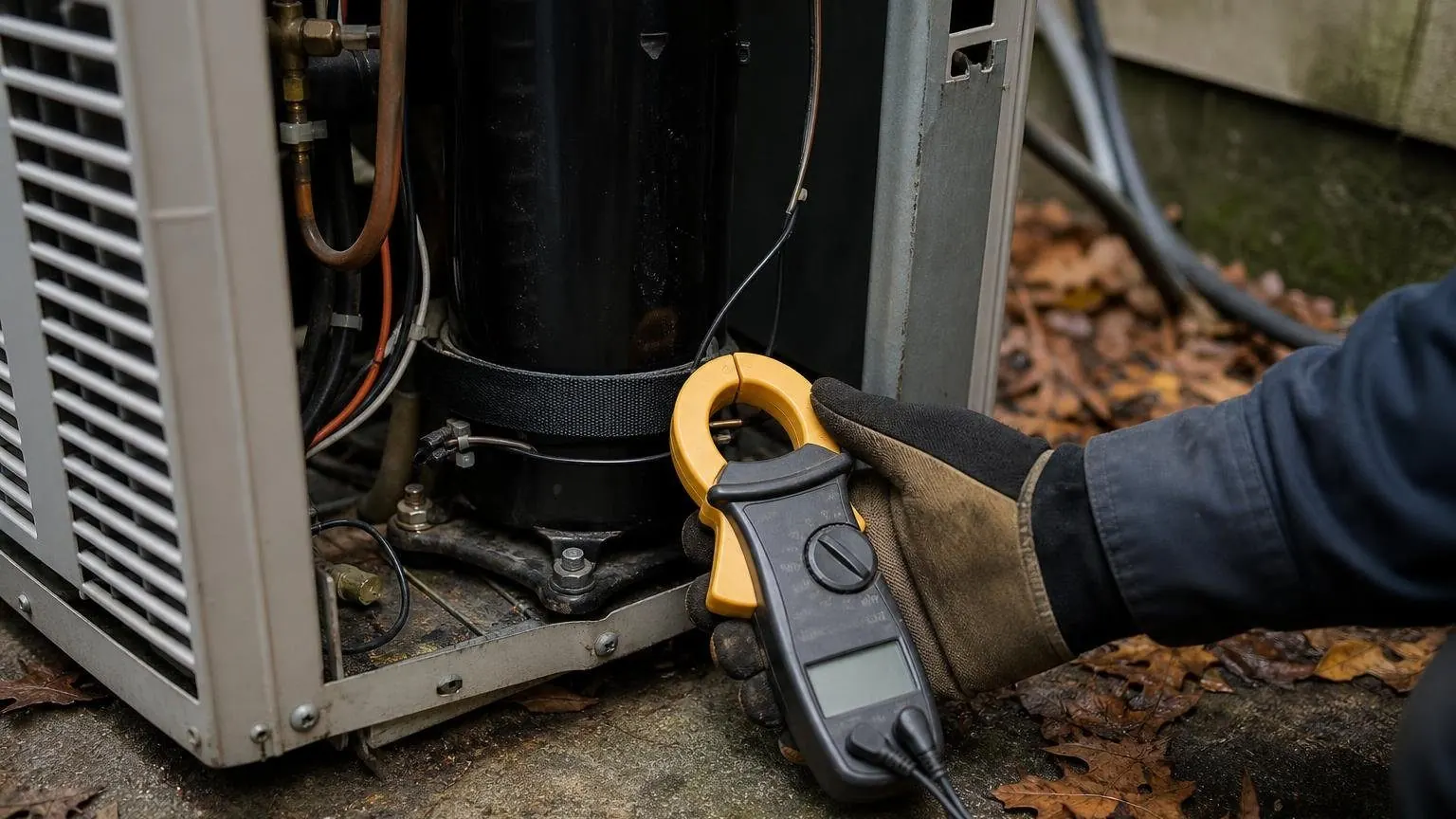
What does a crankcase heater do? A crankcase heater keeps the compressor’s oil sump warm while the unit sits idle, so refrigerant cannot migrate in and condense in the oil. That prevents flooded, noisy starts. Copeland requires one on its 1.5 to 5 ton scrolls once the system charge tops 120% of the compressor’s limit.
Key Takeaways
- Copeland AE4-1331 R9 (September 2024): a heater is recommended above the charge limit (8 pounds or 10 pounds, by model) and required above 120% of it. Copeland
- Goodman’s GPC15/GPH16 manual says to energize the unit 24 hours before start-up; Copeland’s European note says at least 12 hours. Goodman manual
- Copeland lists 40 W heaters; Trane sells 40 W and 60 W bellyband kits. Trane
- Not always on: Goodman’s heater thermostat closes at 67°F and opens at 85°F. Goodman manual
- Federal off mode caps: 30 W for split air conditioners, 33 W for split heat pumps made since January 1, 2015. 10 CFR 430.32
- A 40 W heater energized nonstop uses 28.8 kWh in 30 days, about $5.27 at the July 2026 US average of 18.31 cents per kWh. EIA
What does a crankcase heater do?
A crankcase heater is a small electric heater clamped around, or inserted into, the bottom of a compressor shell. It keeps the oil sump from becoming the system’s cold spot while the compressor is off, so refrigerant does not collect there as liquid.
Copeland’s application bulletin for its R-410A residential scrolls says compressors “may fill with liquid refrigerant” after long off cycles when the compressor has cooled, and that a cold sump can mean high refrigerant migration after shutdown. The next start brings loud clearing noise, repeated internal overload trips, and dimming lights.
Copeland’s European technical note names the mechanical risk behind those symptoms: oil dilution and bearing stress on start-up. That matters most on a heat pump running through winter or an air conditioner idle for months, and it is one of the quieter ways a unit ends up needing an AC compressor replacement.
Which AC and heat pump compressors need a crankcase heater?
The compressor maker decides, based on system charge. Copeland’s AE4-1331 R9 bulletin (September 2024) recommends a heater on single-phase scrolls above the charge limit and requires one above 120% of that limit.
Copeland adds that this “includes long line length systems,” since a longer refrigerant line set holds more charge. Three-phase compressors need one above the limit unless an accumulator drains freely in the off cycle.
| Copeland scroll family | Frame | Charge limit | Heater required above (120%) |
|---|---|---|---|
| ZP14 to ZP31K5 | 53 | 8 pounds | 9.6 pounds |
| ZP34 to ZP61K5 | 63 | 10 pounds | 12.0 pounds |
| ZP16 to ZP44K3 | 63 | 8 pounds | 9.6 pounds |
Source: Copeland AE4-1331 R9, Table 4. Frame number approximates shell diameter (63 is about 6.5 inches, per Copeland).
Worked example: a ZP34 to ZP61K5 system holds 11 pounds after a long line set. That tops the 10-pound limit, so a heater is recommended; past 12.0 pounds it is required. Copeland’s European note says no heater is required within the limit, a rule independent of system type.
What types of crankcase heater are there?
Maker documents describe four ways to heat the sump: a belly band, an insert element, a self-regulating cable, and, on inverter compressors, current through the motor windings. All run at roughly 32 W to 60 W.
| Type | How it heats | Maker example |
|---|---|---|
| Belly band (wrap-around) | Fixed-wattage band clamped low on the shell | Copeland 40 W, 120 to 575 V; Trane BAYCCHT301RES 60 W for 6.5 to 7.5 inch shells, BAYCCHT302RES 40 W for 5.5-inch shells |
| Insert | Element inserted into the compressor | Goodman GPC15/GPH16: insert type, self-regulating, wired to contactor L1 and L2 |
| Self-regulating cable | Output falls as the shell warms | Raychem FreezGard: 32 watts minimum at 50°F, 60 watts minimum at 0°F; compressors up to 5 HP and 40 inches around |
| Motor winding heat | Inverter drive warms the stator | Copeland variable-speed drives: up to 50 watts DC, no external heater needed |
Copeland says to mount a band as low on the shell as possible, torque the clamp to 20 to 25 in-lb for full contact, ground it, and never power it in free air, where it burns out. Raychem’s FreezGard data sheet requires ground-fault equipment protection on each heating cable branch circuit.
Is a crankcase heater always on?
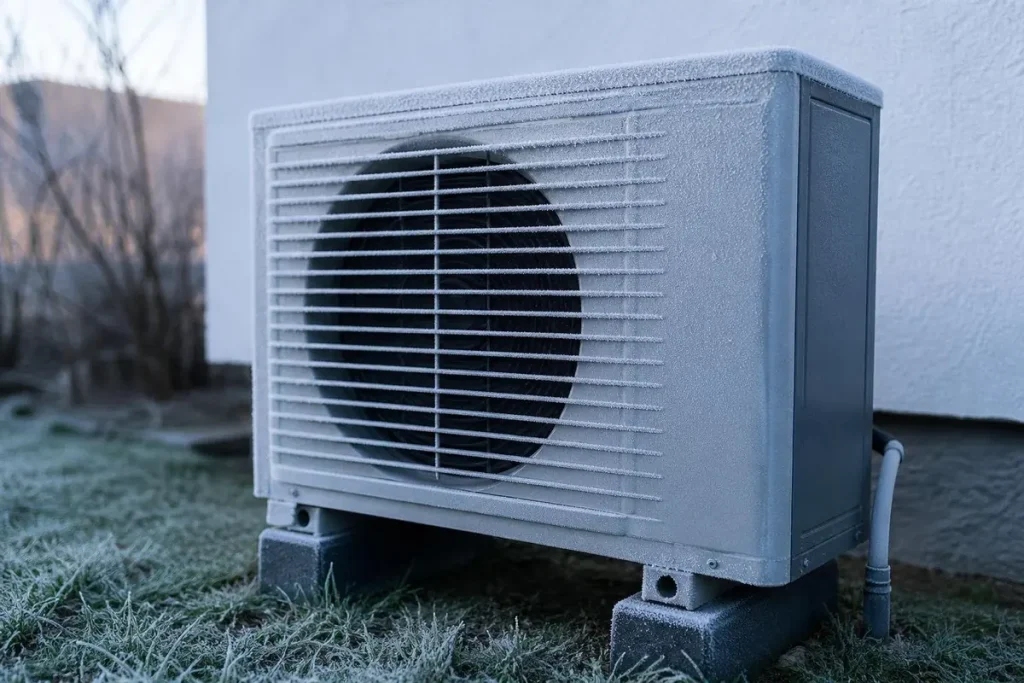
Not always. A heater without controls runs whenever the compressor is off, but many units switch it on temperature. The DOE test procedure for central air conditioners defines a crankcase heater and notes that control “may be achieved using a timer” or a temperature, while one without controls “operates continuously when the compressor is not operating.”
Two examples from maker documents show the range. In the Goodman GPC15/GPH16 manual, the heater is on whenever the unit has power and its thermostat is closed; that thermostat closes at 67°F and opens at 85°F. Trane’s bellyband kit heats when the discharge line is below 75°F and stops above 105°F.
Where the heater is wired matters too. Goodman connects it to the line side of the compressor contactor, terminals L1 and L2, so it has power whenever the outdoor AC disconnect is on, even with the thermostat at OFF.
On a heat pump it works alongside other cold-weather controls such as the defrost cycle, and the federal test procedure treats its winter draw as a separate measurement, covered below.
Why power the unit 24 hours before startup?
Because warming a cold sump takes hours. Goodman’s GPC15/GPH16 installation instructions say that if a crankcase heater is used, the unit “should be energized 24 hours prior to compressor start up,” or the compressor may be damaged.
Copeland’s European technical note on scroll crankcase heaters recommends at least 12 hours to prevent oil dilution and bearing stress. The numbers differ, so the unit’s own manual wins.
Correction
The 24-hour rule is a manufacturer instruction, not a code requirement. The same logic applies after any long power-off period, not only at installation, because with the breaker off the heater is off too.
A restart after a seasonal shutdown:
- Set the thermostat to OFF.
- Turn the breaker and outdoor disconnect back on.
- Wait the period in the unit’s installation manual: 24 hours for Goodman GPC15/GPH16.
- Set the thermostat to cool or heat.
- If the compressor is loud at start, trips, or dims the lights, call a technician before anyone fits a hard start kit.
How much energy does a crankcase heater use?
A fixed 40 W heater left energized around the clock uses 0.96 kWh a day, or 28.8 kWh over 30 days. At the July 2026 US residential average of 18.31 cents per kWh (EIA), that is about $5.27 for the month; controlled heaters use less.
Federal rules count this load. Under the DOE test procedure in force through mid-2025, Appendix M1, labs energized the heater and recorded P2, the heating season per-compressor off mode power. If the certified turn-on temperature was above 71°F, shoulder-season P1 equaled P2; cycling heaters were averaged over three cycles or 18 hours.
Since July 7, 2025, the current Appendix M1 sends labs to section 11.3 and appendix G of AHRI 210/240-2024 for off mode power. The ceiling in 10 CFR 430.32(c)(4) sits beside the SEER2 minimums: 30 W for split air conditioners and 33 W for split heat pumps. For a local estimate, use our electricity prices by state table.
How do technicians test a crankcase heater?
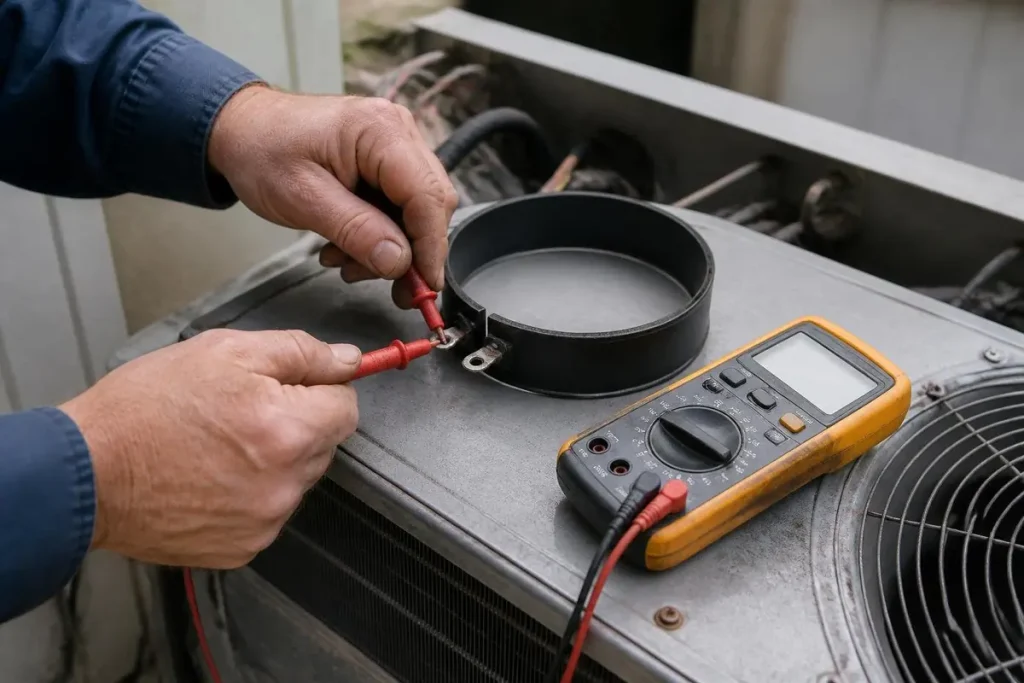
With power off, a technician reads resistance and compares it with voltage squared divided by watts. A fixed 40 W, 240 V heater should read about 1,440 ohms; the same wattage at 120 V reads 360 ohms. An open reading means a failed element.
This is technician work: the heater sits beside line-voltage terminals. A typical sequence:
- Open the breaker and disconnect, then prove the circuit dead with a meter.
- Lift the heater leads and measure resistance; check the nameplate wattage and voltage first.
- Restore power with the compressor off and clamp the heater lead: a 40 W, 240 V heater draws about 0.17 A. A heater whose thermostat is open, such as Goodman’s above 85°F, correctly reads zero.
- Confirm the band sits low and tight on the shell, with the clamp at 20 to 25 in-lb per Copeland.
Self-regulating heaters have no single fixed resistance, so compare readings with maker data. Our guide to HVAC watts and amps walks through the same arithmetic for other components, and a heat pump that struggles at low temperatures may have other causes covered in how heat pumps handle cold weather.
How we researched this
Research date: October 14, 2026. We read the Google results for “crankcase heater,” then primary documents: Copeland AE4-1331 R9 and its European heater note, Goodman and Amana manuals, Trane’s heater guide, Raychem’s data sheet, two versions of DOE Appendix M1, 10 CFR 430.32 and EIA Table 5.6.A. About 14 sources were consulted; 9 are cited.
Excluded: uncited figures on ranking explainers, retailer listings, and a Trane support page and Carrier manual we could not retrieve. Reddit was skipped because testing involves line voltage. No installed prices: no federal series exists. The cost figure is our arithmetic.
Frequently asked questions
Are crankcase heaters always on?
Not always. DOE says a heater without controls runs continuously while the compressor is off, but makers often add a thermostat. Goodman’s GPC15/GPH16 heater thermostat closes at 67°F and opens at 85°F, and Trane’s bellyband kit stops heating once the discharge line passes 105°F. With the breaker off, it gets no power.
What happens if a crankcase heater fails?
Usually nothing shows until a cold start after a long off cycle. Copeland says compressors may then fill with liquid refrigerant, causing loud start-up clearing noise, repeated trips of the internal overload, and dimming lights. Its European note links missing crankcase heat to oil dilution and bearing stress.
How hot should a crankcase heater get?
None of the maker documents we read publish a target shell temperature. They publish control points instead: Trane’s kit heats below a 75°F discharge line and stops above 105°F, and Goodman’s thermostat opens at 85°F. Raychem rates its FreezGard cable for intermittent exposure up to 185°F. Technicians judge a heater by resistance and current.
Can I turn off my AC breaker for the winter?
You can, but the crankcase heater goes off with it. Before the first cooling start, restore power and wait the warm-up period in the unit’s manual: Goodman specifies 24 hours, and Copeland’s European note asks for at least 12 hours. Skipping the wait risks a flooded start.
Does a heat pump need a crankcase heater?
It depends on charge, not on the label. Copeland’s charge-limit rule is independent of system type, so a single-phase heat pump scroll over 120% of its limit needs one. Variable-speed Copeland compressors can skip an external heater because the drive can send up to 50 watts DC through the motor windings.
How many watts is a crankcase heater?
Copeland lists 40 W heaters for its 1.5 to 5 ton R-410A scrolls in 120, 240, 480 and 575 V versions. Trane sells a 40 W kit for 5.5-inch shells and a 60 W kit for 6.5 to 7.5 inch shells, and Raychem’s self-regulating cable puts out at least 32 watts at 50°F.
Sources
- Copeland. “AE4-1331 R9: R-410A 1.5 to 5 Ton Scroll Compressors.” September 2024. https://apps.copeland.com/Publications/AEB/AE4_1331_R9.pdf. Accessed October 2026.
- Copeland. “TI_Scroll_Heater_EN_Rev01: Crankcase heaters.” https://media.copeland.com/c0147352-d009-4344-84b2-b16b010a7662/TI_Scroll_Heater_E_Rev00.pdf. Accessed October 2026.
- Goodman. “GPC15/GPH16 Installation Instructions.” https://images.homedepot-static.com/catalog/pdfImages/f7/f740f193-dd36-483c-9007-d7e1ea7dbb0a.pdf. Accessed October 2026.
- Trane. “18-HE48D1-5A-EN: Crankcase Heater (Bellyband Style).” July 2020. https://elibrary.tranetechnologies.com/public/trane-history/Literature/Installation/18-HE48D1-5A-EN_07082020. Accessed October 2026.
- Chemelex (Raychem). “FreezGard Crankcase Heater data sheet.” https://cdn.chemelex.com/Product%20Documents/Data%20Sheets/Raychem-DS-H50833-FreezGardCrankcase-EN.pdf. Accessed October 2026.
- DOE via eCFR. “10 CFR 430 Appendix M1 (June 1, 2024 version).” https://www.ecfr.gov/on/2024-06-01/title-10/chapter-II/subchapter-D/part-430/subpart-B/appendix-Appendix%20M1%20to%20Subpart%20B%20of%20Part%20430. Accessed October 2026.
- DOE via eCFR. “10 CFR 430 Appendix M1 (current).” https://www.ecfr.gov/current/title-10/chapter-II/subchapter-D/part-430/subpart-B/appendix-Appendix%20M1%20to%20Subpart%20B%20of%20Part%20430. Accessed October 2026.
- DOE via eCFR. “10 CFR 430.32.” https://www.ecfr.gov/current/title-10/chapter-II/subchapter-D/part-430/subpart-C/section-430.32. Accessed October 2026.
- EIA. “Electric Power Monthly Table 5.6.A, July 2026.” https://www.eia.gov/electricity/monthly/epm_table_grapher.php?t=epmt_5_6_a. Accessed October 2026.
Leave a Reply