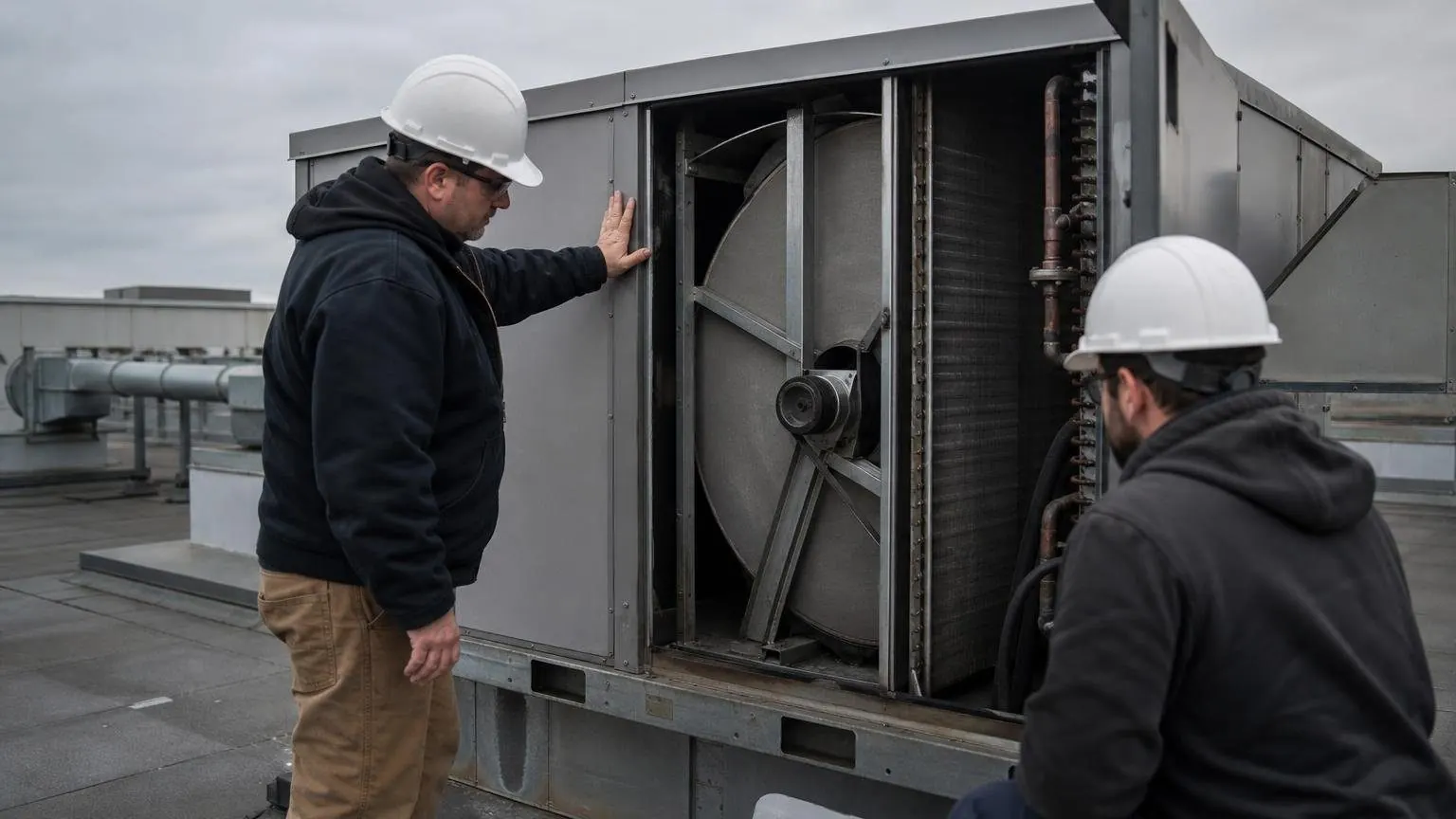
What is a dedicated outdoor air system? A dedicated outdoor air system (DOAS) is a unit that brings in, dries and tempers 100% outdoor air for ventilation, separately from the equipment that heats and cools each room. Federal rules regulate the smaller DX units, and some codes now require one.
Key Takeaways
- Federal law defines a DX-DOAS as a unitary unit that can dry air to a 55°F dew point with under 324 lb/h of moisture removal, per 10 CFR 431.92.
- Units built from May 1, 2024 must meet ISMRE2 minimums of 3.8 to 5.1 lb of moisture per kWh, per 10 CFR 431.97(h).
- Washington’s energy code requires a DOAS for offices, schools and retail, with 68 percent sensible recovery, per WAC 51-11C-40335.
- Eight retrofitted buildings in WA, OR, MT and NY averaged 48 percent whole-site energy savings, per PNNL-34419 (2023).
- NREL modeled VRF with DOAS at 16% site energy savings across the US commercial stock, per NREL/TP-5500-86103 (archived copy).
- The same NREL model shows heating electricity rising 24%, the trade for cutting gas heat.
What is a dedicated outdoor air system?
A dedicated outdoor air system is the ventilation half of a split HVAC design. One unit treats all the outdoor air the building must breathe; separate terminal equipment handles each room’s heating and cooling. Federal regulations call the packaged version a unitary DOAS: equipment “capable of providing ventilation and conditioning of 100-percent outdoor air.”
The main job is moisture. Desert Aire, a dehumidification maker, says a DOAS is “primarily selected” to remove moisture from outdoor air and only secondarily to heat and cool it (maker claim). A conventional central air handler instead mixes outdoor and return air and conditions the blend.
How does a dedicated outdoor air system work?
A dedicated outdoor air system works by treating the outdoor airstream in a fixed order, then delivering it to rooms where separate terminal units handle the remaining heating and cooling. The sequence below is the common packaged arrangement; built-up units vary.
- Intake and filter. All supply air is outdoor air; nothing is recirculated.
- Energy recovery. A wheel or fixed plate swaps heat, and with an enthalpy core moisture, between incoming air and building exhaust. Federal rules call this a ventilation energy recovery system (VERS).
- Cooling coil. A DX or chilled water coil pulls moisture out. DOE’s DX-DOAS class is built around reaching a 55°F dew point.
- Reheat or heat. The dried air is warmed so it does not overcool rooms; in winter the unit heats.
- Supply. A fan sends the air to each room or to the terminal units.
Which systems does a DOAS pair with?
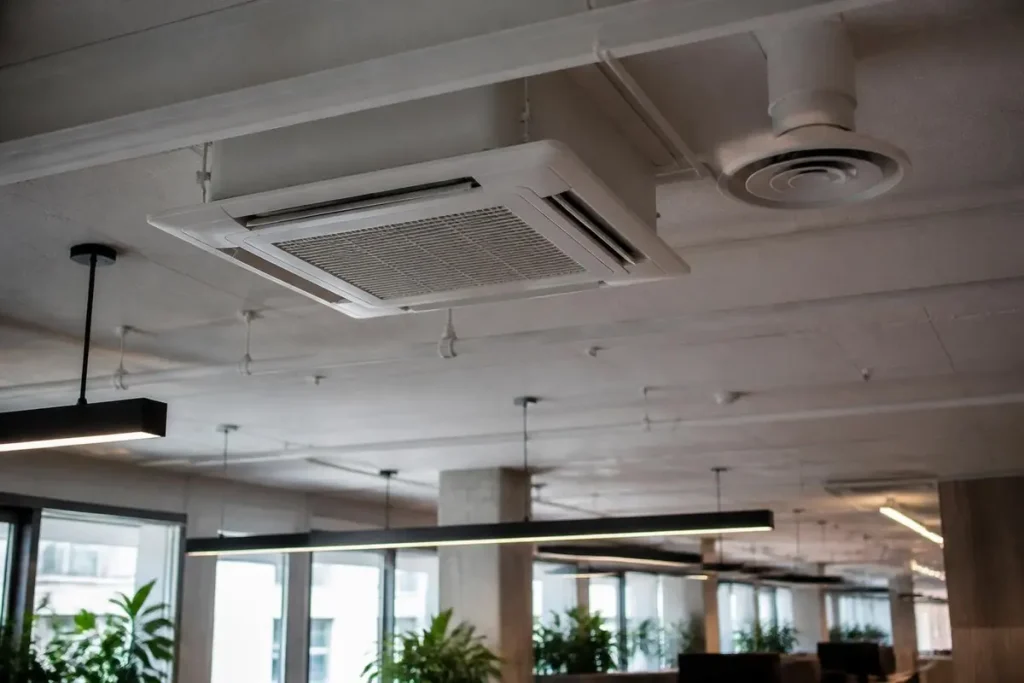
A DOAS pairs with any terminal system that conditions rooms but does not bring in enough outdoor air on its own. PNNL says the most common high-efficiency pairing is heat pumps or VRF for conditioning plus an HRV or ERV for ventilation. VRF systems need the help because, as NREL notes, ventilation air “is generally not supplied” by them.
Hydronic fan coil units and water-loop heat pumps follow the same logic. The table shows what the federal and code record says about each pairing.
| Terminal system | Handles | What the record shows |
|---|---|---|
| VRF with heat recovery | Room sensible load | NREL modeled 16% site savings for VRF plus DOAS versus existing RTU and VAV systems |
| Heat pumps | Room heating and cooling | All eight PNNL field sites used heat pumps or VRF; seven added an HRV, one an ERV |
| Fan coil units | Room sensible load | Washington code requires terminal fans to cycle off when the zone needs no heating or cooling |
| Active chilled beams | Room sensible load | Named as an exception to Washington’s rule that DOAS air bypass terminal coils |
DOAS vs AHU, RTU, ERV and MAU: what is the difference?
The difference is what air each unit moves and whether it actively dries it. A DOAS supplies only outdoor air and dehumidifies it; an AHU or packaged rooftop unit mixes outdoor and return air; an ERV only exchanges energy; a make-up air unit replaces exhausted air.
| Unit | Air it supplies | Actively dehumidifies? | Main job |
|---|---|---|---|
| DOAS | 100% outdoor air | Yes, cooling coil plus reheat | Ventilation and latent load |
| Air handling unit (AHU) | Mixed outdoor and return air | Only as a side effect of cooling | Central heating and cooling of many zones |
| Rooftop unit (RTU) | Mixed outdoor and return air | Only as a side effect of cooling | Packaged heating and cooling, own compressor |
| ERV or HRV | Outdoor air, exchanged with exhaust | No coil; an ERV only transfers moisture | Recover energy from exhaust |
| Make-up air unit (MAU) | Outdoor air replacing exhaust | Varies by design | Balance kitchen hood and process exhaust |
Correction: is an ERV a DOAS?
Sometimes, by name. PNNL calls ERVs and HRVs “a type of packaged DOAS” for small buildings. But an ERV has no cooling coil, so it cannot pull outdoor air down to the 55°F dew point that defines the federal DX-DOAS class. Add a cooling coil and it becomes the recovery stage of one; our ERV and HRV explainer covers the core types.
What does the federal standard for dedicated outdoor air systems require?
The federal standard for dedicated outdoor air systems sets minimum ISMRE2 dehumidification efficiency, plus ISCOP2 heating efficiency for heat pumps, on every DX-DOAS manufactured from May 1, 2024. The levels sit in 10 CFR 431.97(h), Table 17.
ISMRE2 is a seasonal average measured in pounds of moisture removed per kWh; ISCOP2 is a seasonal heating ratio in W/W. DOE adopted the levels in a final rule at 87 FR 65651 on November 1, 2022, and ratings have used the Appendix B test since July 24, 2023, per DOE’s program page.
| DX-DOAS class | Without energy recovery | With energy recovery (VERS) |
|---|---|---|
| Air-cooled air conditioner | ISMRE2 3.8 | ISMRE2 5.0 |
| Air-source heat pump | ISMRE2 3.8, ISCOP2 2.05 | ISMRE2 5.0, ISCOP2 3.20 |
| Water-cooled air conditioner | ISMRE2 4.7 | ISMRE2 5.1 |
| Water-source heat pump | ISMRE2 3.8, ISCOP2 2.13 | ISMRE2 4.6, ISCOP2 4.04 |
The standard covers only DX units under 324 lb/h of moisture removal. Units fed by a chiller plant are not DX, so they fall outside it, as do units of 324 lb/h and up; those answer to local energy codes.

When do energy codes require a DOAS or energy recovery?
ASHRAE 90.1 requires energy recovery on many outdoor air streams; Washington goes further and requires the DOAS itself. Under Washington Energy Code Section C403.3.5, offices, schools and retail must get outdoor air from a DOAS “which delivers 100 percent outdoor air.”
The Washington rules, effective March 15, 2024 and amended September 7, 2024, add four conditions:
- Energy recovery of at least 68 percent sensible effectiveness, or a 60 percent enthalpy recovery ratio.
- Total DOAS fan power of no more than 1 watt per cfm of outdoor air when no single fan reaches 1 kW.
- Cooling “for dehumidification only,” with the coil sized to peak dehumidification “and no larger.”
- Supply air delivered directly to rooms or downstream of the terminal coils.
A high-efficiency variable air volume system meeting Section C403.6.10 is the main alternative. Elsewhere, ASHRAE 90.1-2019 requires an enthalpy recovery ratio of at least 50% where its tables apply, as NREL’s 2023 report summarizes.
Airflow comes from ventilation tables, not the DOAS maker. Washington’s adopted mechanical code sets office spaces at 5 cfm per person plus 0.06 cfm per square foot (IMC Table 403.3.1.1). A 10,000 square foot office with 50 people needs 250 plus 600, or 850 cfm. Recirculating multiple-zone systems must divide by a system ventilation efficiency, set at 0.75 in the simplified procedure once the occupant diversity ratio reaches 0.60; a DOAS does not recirculate.
Does a dedicated outdoor air system save energy, and what are the drawbacks?
A dedicated outdoor air system has saved energy in measured federal field work, though how much depends on what it replaces. PNNL re-checked eight retrofits in Washington, Oregon, Montana and New York in 2021 and 2022 and found 48 percent average whole-site savings against the old systems (PNNL-34419).
The fairer benchmark is a new code-minimum system. Against that, PNNL reports modeled savings of 36 percent for the whole building. At the Seattle airport site, measured savings topped 75 percent against the old equipment but only 35 percent against code minimum, because the old system heated and cooled at once.
NREL’s national model is more modest: 16% site savings for VRF with DOAS, applicable to 53% of commercial floor area. It cut gas heating 53% and fan electricity 30%.
The drawbacks are real. In NREL’s model, heating electricity rose 24% as heat pumps replaced gas. NREL excluded kitchens, restaurants and hospitals because heavy exhaust or ventilation erodes the benefit, and skipped buildings over 200,000 square feet as cost-prohibitive. A DOAS also adds a second system whose sequences a building automation system must coordinate.
How we researched this
Research date: October 14, 2026. We read the top three ranking pages (Trane, Wikipedia, Greenheck) and Google autocomplete, consulted 14 documents and cited 8. Federal values come from eCFR text; code values from Washington’s adopted text, since ASHRAE 90.1 and 62.1 are paywalled. Maker statements are labelled as claims. Excluded: vendor price ranges (no federal series) and 2002 to 2005 simulations repeated on Wikipedia. No Reddit content was used.
Frequently asked questions
What does DOAS stand for in HVAC?
DOAS stands for dedicated outdoor air system. Federal rules define a unitary DOAS as commercial package equipment capable of ventilating and conditioning 100-percent outdoor air. The DX-DOAS subset must be able to dry air to a 55°F dew point and remove under 324 lb/h of moisture.
What is the difference between a DOAS and an RTU?
A rooftop unit mixes outdoor and return air and conditions the blend with its own compressor. A DOAS supplies only outdoor air and is built to dehumidify it, leaving room loads to terminal units. DOE rates DX-DOAS units on ISMRE2 dehumidification efficiency, not the cooling metrics used for rooftop units.
Can a DOAS be used in a house?
Rarely as a commercial unit, but the concept scales down. PNNL describes ERVs and HRVs as a type of packaged DOAS generally designed for small commercial or residential buildings. A home ERV does not dehumidify on its own, so humid-climate homes still rely on the air conditioner or a dehumidifier to hold indoor humidity targets.
Does a DOAS need energy recovery?
Federal law does not require it, but units with a VERS face a higher bar: ISMRE2 5.0 versus 3.8 for air-cooled units. Washington’s code requires 68 percent sensible effectiveness or a 60 percent enthalpy recovery ratio on every required DOAS. ASHRAE 90.1-2019 requires at least 50% enthalpy recovery where its thresholds apply.
What dew point does a DOAS deliver?
The federal DX-DOAS class is defined by the ability to reach a 55°F dew point at AHRI 920 rating conditions. Desert Aire, a maker, says the most efficient approach lowers supply dew point below 55°F. Dry supply air also absorbs moisture from people and infiltration, the maker says.
How much does a dedicated outdoor air system cost?
We found no federal or national-lab source that publishes installed DOAS prices, so we do not quote a range. NREL’s 2023 model did treat buildings over 200,000 square feet as cost-prohibitive for VRF plus DOAS, noting boilers and chillers are cheaper to retrofit there. Get engineered bids with a load calculation.
Sources
- eCFR. “10 CFR 431.92, Definitions.” https://www.ecfr.gov/current/title-10/chapter-II/subchapter-D/part-431/subpart-F/subject-group-ECFR6d42c9e3b3cc8e2/section-431.92. Accessed October 2026.
- eCFR. “10 CFR 431.97(h), Table 17.” https://www.ecfr.gov/current/title-10/chapter-II/subchapter-D/part-431/subpart-F/subject-group-ECFR6d42c9e3b3cc8e2/section-431.97. Accessed October 2026.
- U.S. DOE. “Direct Expansion-Dedicated Outdoor Air Systems.” https://www.energy.gov/cmei/buildings/direct-expansion-dedicated-outdoor-air-systems. Accessed October 2026.
- Washington State Legislature. “WAC 51-11C-40335, Section C403.3.5.” https://app.leg.wa.gov/WAC/default.aspx?cite=51-11C-40335. Accessed October 2026.
- Washington State Building Code Council. “WSR 21-05-020 (2018 IMC adoption).” https://lawfilesext.leg.wa.gov/Law/WSR/2021/05/21-05-020.htm. Accessed October 2026.
- PNNL. “Very High Efficiency Dedicated Outdoor Air System Field Site Re-Evaluation” (PNNL-34419). https://www.pnnl.gov/main/publications/external/technical_reports/PNNL-34419.pdf. Accessed October 2026.
- NREL. “End-Use Savings Shapes Measure Documentation: VRF with Heat Recovery and DOAS” (NREL/TP-5500-86103), archived copy. https://www.nrel.gov/docs/fy24osti/86103.pdf. Accessed October 2026.
- Desert Aire. “DOAS” (maker page). https://www.desert-aire.com/applications/doas/. Accessed October 2026.
Leave a Reply