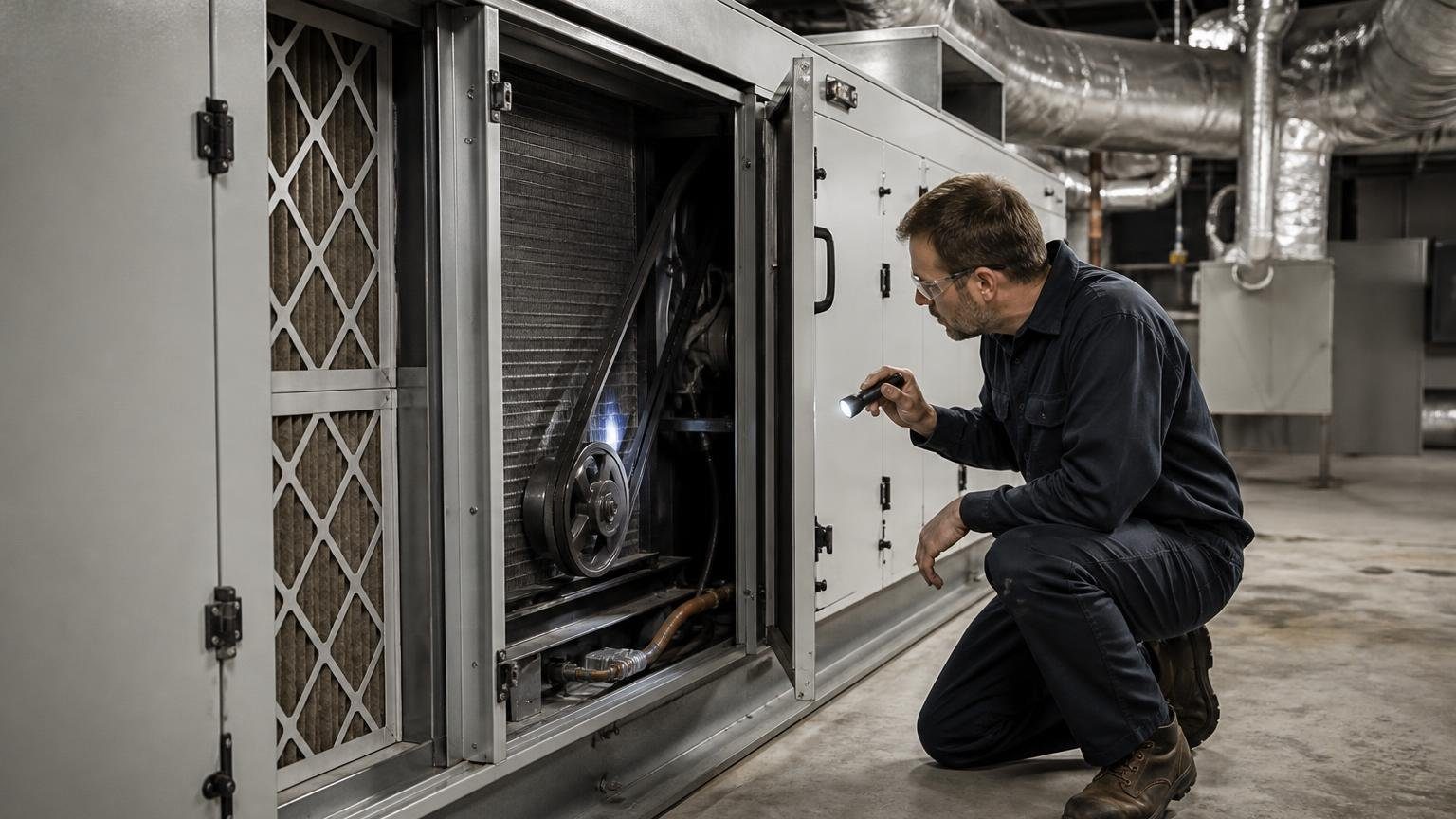
What is an air handling unit? An air handling unit (AHU) is the commercial cabinet that mixes outdoor and return air, filters it, heats or cools it and pushes it through the ducts with a supply fan, usually feeding many zones from one mechanical room or roof.
Key Takeaways
- ASHRAE defines an AHU as an assembly with “a fan or fans” plus equipment to filter, heat, cool, humidify and mix air, per ASHRAE Terminology.
- Ventilation used 18% (213 billion kWh) of US commercial building electricity in 2018, more than cooling at 14% (170 billion kWh), per EIA’s CBECS figures.
- ASHRAE 90.1-2019 requires an economizer on fan-cooling units of 54,000 Btu/h and up in most climate zones, per Addendum ci.
- IECC-based codes cap fan systems over 5 hp at cfm × 0.0011 nameplate hp (constant volume) or cfm × 0.0015 (VAV), per Washington’s code.
- ASHRAE 62.1 Section 5.8 requires MERV 8 or better filters upstream of every cooling coil, per Addendum n to 62.1-2010.
- Trane says air handlers range from 200 cfm up to 150,000 cfm (maker claim).
What is an air handling unit?
An air handling unit is the air side of a central HVAC system: a cabinet of sections that each do one job to the airstream. ASHRAE’s definition lists circulation, filtration, heating, cooling, heat recovery, humidifying, dehumidifying and mixing, driven by “a fan or fans.”
This page covers the commercial AHU. The indoor cabinet of a home heat pump is also called an air handler; that unit is covered in our guide to installing a residential air handler.
A commercial AHU usually does not make its own heat or cold. Its coils typically carry chilled water from a chiller plant and hot water or steam from boilers, although some use refrigerant (DX) coils. Trane, a maker, calls the simplest air handler “a filter, fan, motor, and coil.”
What are the components of an air handling unit, in airflow order?
Air handling unit components follow the air: dampers, mixing box, filters, coils, then the supply fan. Makers vary the order; a common arrangement:
- Outdoor air, return and relief dampers. The outdoor-air damper admits ventilation air and fails normally closed, per PNNL. The relief damper prevents over-pressurizing.
- Mixing box. Outdoor and return air blend before treatment.
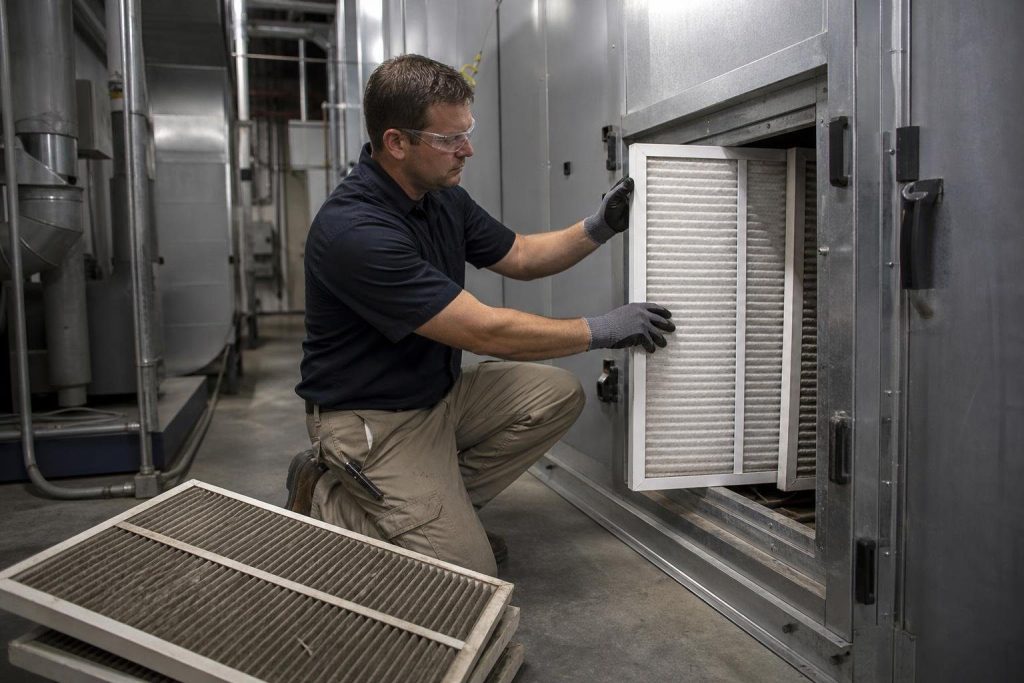
- Filters. MERV 8 minimum ahead of the cooling coil under ASHRAE 62.1; higher ratings add pressure drop, as our look at filter ratings and airflow explains.
- Energy recovery (optional). A wheel or plate passes heat, and sometimes moisture, between exhaust and incoming air, like a large home ERV or HRV.
- Heating and cooling coils. Hot water, steam or electric heat; chilled water or DX cooling over a condensate drain pan.
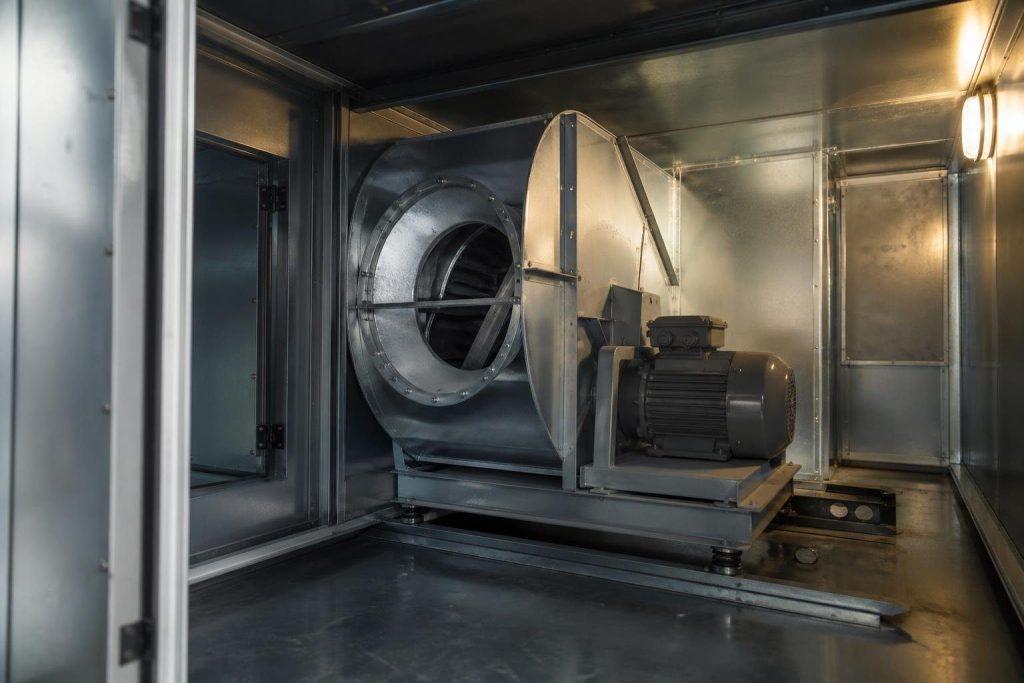
- Supply fan. Belt-driven or direct-drive, constant speed or on a variable speed drive.
- Controls. Sensors, actuators and a controller, usually tied to a building automation system.
How does an air handling unit work?
An air handling unit works by holding a supply air temperature and airflow: the controller moves dampers, opens coil valves and changes fan speed to meet setpoints.
- Minimum outdoor air. While occupied, the outdoor-air damper sits at a minimum position sized for ASHRAE 62.1 ventilation.
- Economizer. When outdoor air is cool enough, dampers open past the minimum, up to 100% outdoor air. PNNL notes buildings often need cooling even at 50 to 60°F outside, when this free cooling pays.
- Mechanical cooling. The cooling coil valve opens when outdoor air falls short.
- Heating and freeze protection. PNNL warns a faulty economizer can put hydronic coils at risk of freezing below 32°F.
A constant volume AHU moves fixed airflow and varies supply temperature. A variable air volume AHU slows its fan as VAV boxes throttle each zone, and the fan speed usually tracks a duct static pressure setpoint.
AHU vs RTU vs DOAS vs fan coil: which is which?
An AHU only moves and treats air; a packaged rooftop unit (RTU) also carries its own compressor and condenser. A DOAS supplies only outdoor air, and a fan coil is a small terminal unit serving one space.
| Unit | What is in the cabinet | Heat and cold come from | Outdoor air | Source |
|---|---|---|---|---|
| Air handling unit (AHU) | Fans, filters, coils, dampers; optional sections | Usually a central water plant; sometimes DX | Mixed with return air; economizer up to 100% | ASHRAE; PNNL |
| Packaged rooftop unit (RTU) | Fan, filter, coil, compressor, condenser, often gas heat | Its own DX refrigerant circuit | Economizer dampers often on one actuator | PNNL |
| Dedicated outdoor air system (DOAS) | Fan, filter, cooling coil; often energy recovery | DX or chilled water | 100% outdoor air | DOE |
| Fan coil unit | Small fan, coil and filter for one zone | Water loops from a central plant | Can be paired with a DOAS for ventilation | WA energy code text |
PNNL’s unitary equipment guide credits packaged units with a “smaller equipment footprint than central air handlers, chillers, and boilers.” Built-up air handlers trade that for flexibility: they typically use two separate actuators for outdoor and return dampers, PNNL notes, and take sections a packaged unit cannot.
DOE regulates small DOAS units: its DX-DOAS definition covers units that dehumidify to a 55°F dew point with moisture removal capacity under 324 lb per hour. Pairing DOAS with fan coil units splits ventilation from zone heating and cooling.
Why does the air handling unit fan matter so much for energy?
The air handling unit fan is a big electric load. EIA reports that ventilation used 213 billion kWh in US commercial buildings in 2018, more than the 170 billion kWh used for cooling, and some of that is “moving the cooled air,” EIA notes.
Fan power rises with the pressure the fan works against, and code tables admit it: Washington’s grants a 0.5 inch w.c. allowance for MERV 9 to 12 filters and 0.9 inch w.c. for MERV 13 to 15. Dirty filters and coils add pressure too.
Outdoor air is the other lever: if the outdoor-air minimum is excessive, the building wastes heating and cooling energy whenever the economizer is off, per PNNL’s economizer guidance.
What do energy and ventilation codes require of an AHU?
Three rule sets shape most new commercial AHUs: ventilation and filtration from ASHRAE 62.1 or the mechanical code, and fan power and economizer limits from ASHRAE 90.1 or the IECC, in whatever edition your jurisdiction adopted.
| Rule | Requirement | Where it comes from |
|---|---|---|
| Outdoor air | Offices: 5 cfm per person plus 0.06 cfm/sq ft; default 5 people per 1,000 sq ft | 2018 IMC Table 403.3.1.1 |
| Filtration | MERV 8 or better upstream of cooling coils | ASHRAE 62.1 Section 5.8, Addendum n |
| Economizer | 54,000 Btu/h and up; 33,000 Btu/h outdoors; none in zones 0A, 0B, 1A and 1B | ASHRAE 90.1-2019 Table 6.5.1-1, Addendum ci |
| Fan power | Over 5 hp: nameplate hp at most cfm × 0.0011 (constant) or × 0.0015 (variable) | IECC C403.8.1, WAC 51-11C-4038 |
Worked fan power check. Under the Option 1 table, a 20,000 cfm variable volume system may carry up to 20,000 × 0.0015 = 30 hp of total fan nameplate, return and relief fans included. As constant volume, the cap is 20,000 × 0.0011 = 22 hp; single zone VAV must meet that constant volume limit.
Worked outdoor air check. For a 10,000 sq ft open office at the adopted IMC defaults: 50 people × 5 cfm = 250 cfm, plus 10,000 × 0.06 = 600 cfm, for 850 cfm in the breathing zone. The code’s distribution and system efficiency factors then adjust the intake.
Correction: the economizer is not the ventilation system
Ventilation comes from the minimum outdoor-air damper position, set to 62.1 or code rates; the economizer only opens further for free cooling. A stuck economizer loses free cooling. A closed minimum damper loses ventilation.
Depending on local code and size, an AHU may also need a duct smoke detector.
What does air handling unit maintenance involve?
AHU maintenance is mostly air-side: filters, belts, coils, drain pans and dampers. This schedule takes the air-side lines from PNNL’s federal O&M guide for unitary equipment; follow the maker’s manual.
| Task | PNNL frequency |
|---|---|
| Listen and look for vibration and noise | Daily |
| Inspect outdoor air intakes for obstructions | Weekly |
| Check filters; replace when dirty | Quarterly |
| Check belts for wear, tension and alignment | Quarterly |
| Inspect and clean coils, straighten fins | Quarterly |
| Check drain pan and drain; flush and treat | Quarterly |
| Cycle dampers and actuators fully open to closed | Quarterly |
| Check fan blades for imbalance and motor condition | Annually |
Add an economizer test. PNNL’s economizer checklist says to confirm the outdoor-air dampers modulate open when it is between 45 and 65°F outside with a call for cooling, and close when the unit is off. PNNL warns such faults can go unnoticed for an extended period.
PNNL points to ASHRAE/ACCA Standard 180 for full inspection scope; contracts are covered in our guide to commercial HVAC service.
How we researched this
Research date: October 13, 2026. We read the top three ranking pages and Google autocomplete, consulted 16 primary and maker documents and cited 10. Code values come from ASHRAE addenda and Washington’s adopted code text because the full 90.1 and 62.1 standards are paywalled.
Excluded: vendor price surveys and contractor blogs (no federal AHU price series exists), untraced Wikipedia figures, and a PNNL re-tuning meta-analysis that would not download. Trane figures are labelled maker claims. No Reddit; questions came from People Also Ask. Worked examples are our arithmetic.
Frequently asked questions
What does AHU stand for in HVAC?
AHU stands for air handling unit, the air side of a central system. ASHRAE defines it as an assembly of sections containing a fan or fans plus equipment for circulation, filtration, heating, cooling, heat recovery, humidifying, dehumidifying and mixing of air, with its controls.
How much does an air handling unit cost?
No federal agency or national lab publishes installed AHU prices, so we quote none. Price follows airflow, sections and construction, and Trane says air handlers span 200 cfm to 150,000 cfm. Have bidders price the same airflow, coils, filter rating and sections.
Where is an air handling unit located?
Usually in a mechanical room, on a roof or on a pad outside. Trane lists its catalog air handlers for both indoor and outdoor use. PNNL notes outdoor equipment saves indoor space but is exposed to severe weather and vandalism.
What is the difference between an AHU and an RTU?
An RTU is a packaged rooftop unit with its own compressor and condenser beside the fan, filter and coil. An AHU usually gets chilled and hot water from a central plant. PNNL credits packaged units with a smaller footprint than central air handlers, chillers and boilers.
What is a fresh air handling unit?
A fresh air unit supplies only outdoor air, which US codes and DOE call a dedicated outdoor air system (DOAS). DOE’s DX-DOAS definition covers units that dehumidify to a 55°F dew point with moisture removal capacity under 324 lb per hour.
Does every air handling unit need an economizer?
No. ASHRAE 90.1-2019 Table 6.5.1-1, with Addendum ci, requires economizers on fan-cooling units of 54,000 Btu/h and up in climate zones 2A through 8 (33,000 Btu/h outdoors). Zones 0A, 0B, 1A and 1B have no requirement. Local code adoptions vary.
Sources
- ASHRAE. “Terminology: air-handling unit (AHU).” https://terminology.ashrae.org/?entry=air-handling%20unit%20(AHU). Accessed October 2026.
- U.S. Energy Information Administration. “How much electricity is used for air conditioning in the United States?” Updated March 15, 2024. https://www.eia.gov/tools/faqs/faq.php?id=1174. Accessed October 2026.
- ASHRAE. “Addendum ci to ANSI/ASHRAE/IES Standard 90.1-2019.” 2022. https://www.ashrae.org/file%20library/technical%20resources/standards%20and%20guidelines/standards%20addenda/90_1_2019_ci_20220429.pdf. Accessed October 2026.
- ASHRAE. “Addendum n to ANSI/ASHRAE Standard 62.1-2010.” https://www.ashrae.org/File%20Library/Technical%20Resources/Standards%20and%20Guidelines/Standards%20Addenda/62_1_2010_n_Final.pdf. Accessed October 2026.
- Washington State Legislature. “WAC 51-11C-4038, Section C403.8, Fan and fan controls.” Archived 2020 text. https://lawfilesext.leg.wa.gov/Law/WACArchive/2020/htm/WAC%20%2051%20%20TITLE/WAC%20%2051%20-%2011C%20CHAPTER/WAC%20%2051%20-%2011C-4038.htm. Accessed October 2026.
- Washington State Building Code Council. “WSR 21-05-020: Adoption of the 2018 International Mechanical Code.” 2021. https://lawfilesext.leg.wa.gov/Law/WSR/2021/05/21-05-020.htm. Accessed October 2026.
- Pacific Northwest National Laboratory. “Best Practices for Air-Side Economizers Operation and Maintenance.” https://www.pnnl.gov/projects/om-best-practices/air-side-economizers. Accessed October 2026.
- Pacific Northwest National Laboratory. “Best Practices for Unitary HVAC Equipment Operation and Maintenance.” https://www.pnnl.gov/projects/om-best-practices/unitary-hvac-equipment. Accessed October 2026.
- U.S. Department of Energy. “Direct Expansion-Dedicated Outdoor Air Systems.” https://www.energy.gov/cmei/buildings/direct-expansion-dedicated-outdoor-air-systems. Accessed October 2026.
- Trane (manufacturer). “Performance Climate Changer Air Handlers.” https://www.trane.com/commercial/north-america/us/en/products-systems/airside-equipment/performance-air-handlers.html. Accessed October 2026.
Leave a Reply