
What is an HVLS fan? An HVLS fan is a high-volume, low-speed ceiling fan with a blade span over 7 feet, which federal rules call a large-diameter ceiling fan. It cools people by moving air, not by chilling it, and in sprinklered buildings NFPA 13 caps it at 24 ft and requires shutdown on waterflow.
Key Takeaways
- DOE defines a large-diameter ceiling fan as one with a blade span greater than seven feet (10 CFR 430, Appendix U).
- Fans made on or after January 21, 2020 need a CFEI of at least 1.00 at high speed and 1.31 at 40 percent speed.
- NFPA 13 limits HVLS fans in sprinklered buildings to 24 ft, 36 in below deflectors and interlocked to stop on waterflow, per text reproduced by NFPA.
- In FM Global’s 2011 rack-storage fire tests, sprinklers performed adequately when the 24 ft fan shut down within 1 min 30 s of the first sprinkler.
- UC Berkeley’s CBE equates 100 fpm of air movement with about 4°F of cooling effect under ASHRAE 55 methods.
- A 2009 ASHRAE paper measured 19.3% average gas savings from five destratification fans in a Toronto-area warehouse in 2008.
What is an HVLS fan?
An HVLS fan is a ceiling fan big enough to move a slow column of air across a whole floor. Federal rules call it a large-diameter ceiling fan: any ceiling fan, other than highly decorative or belt-driven models, with a blade span greater than seven feet under Appendix U to 10 CFR 430.
The CBE Ceiling Fan Design Guide says large-diameter fans typically have 6 or 8 blades and variable speed. Unlike a whole house fan, which exhausts air through the attic, an HVLS fan only recirculates room air.
“Low speed” means low rotation, not slow blade tips: on one maker’s published top speeds, our arithmetic puts tips at about 49 to 58 mph.
| HVLS fan diameter | Max speed (maker) | Clearance below ceiling (maker) | Blade tip speed (our math) |
|---|---|---|---|
| Big Ass Fans Powerfoil X4, 14 ft | 116 rpm | 5 ft | 58.0 mph |
| Big Ass Fans Powerfoil X4, 18 ft | 90 rpm | 6 ft | 57.8 mph |
| Big Ass Fans Powerfoil X4, 24 ft | 62 rpm | 7 ft | 53.1 mph |
| Big Ass Fans Powerfoil X4, 30 ft | 46 rpm | 10 ft | 49.3 mph |
Source: Big Ass Fans Powerfoil X4 cut sheet, December 2022 (maker data). Tip speed is pi x diameter x rpm, divided by 88.
How does an HVLS fan cool people without cooling the air?
An HVLS fan cools people through convection and sweat evaporation; the thermometer stays put while the body feels cooler. ASHRAE Standard 55 credits this through its Elevated Air Speed Comfort method (Section 5.3.3), restated here from the CBE guide because the standard is sold. The same comfort standard underlies most advice on office temperature, though no US rule makes it binding.
The CBE guide puts the cooling effect of 100 fpm (0.5 m/s) at approximately 4°F, for a typical office worker at 76°F, 50% relative humidity, 0.6 clo and 1.13 met. About 150 fpm equals over 5°F.
Standard 55 caps average air speed at 160 fpm (0.8 m/s) where occupants cannot control the fan, per the same guide. CBE’s building models show roughly 5% HVAC savings per °F the cooling setpoint rises, which is why fans pair with a higher summer thermostat setting.
What does DOE require of an HVLS fan?
DOE requires every large-diameter ceiling fan manufactured on or after January 21, 2020 to reach a Ceiling Fan Energy Index (CFEI) of at least 1.00 at high speed and 1.31 at 40 percent speed, under 10 CFR 430.32(s)(2)(ii). CFEI is calculated under AMCA 208-18 with three fixed constants: 26,500 cfm of airflow, 0.0027 inches water gauge of pressure and a 42 percent fan efficiency.
The metric has changed once already. DOE’s January 2017 rule set a cfm-per-watt floor of 0.91D minus 30.00, then Section 1008 of the Energy Act of 2020 replaced it with CFEI, as DOE recounts in its November 2022 technical amendment. That amendment also removed a 24 ft limit on the test procedure, so the standard now reaches fans of any diameter.
Testing follows AMCA 230-15. In June 2023 DOE proposed raising the high-speed level to 1.22; the eCFR text dated October 1, 2026 still shows 1.00, so that proposal has not taken effect.
One correction: the federal rule that ceiling fans be reversible exempts fans sold for industrial applications, under 430.32(s)(1)(iii), so reverse mode depends on the model, unlike the residential case in our guide to which way a ceiling fan should spin.
What does NFPA 13 require for HVLS fans in sprinklered buildings?
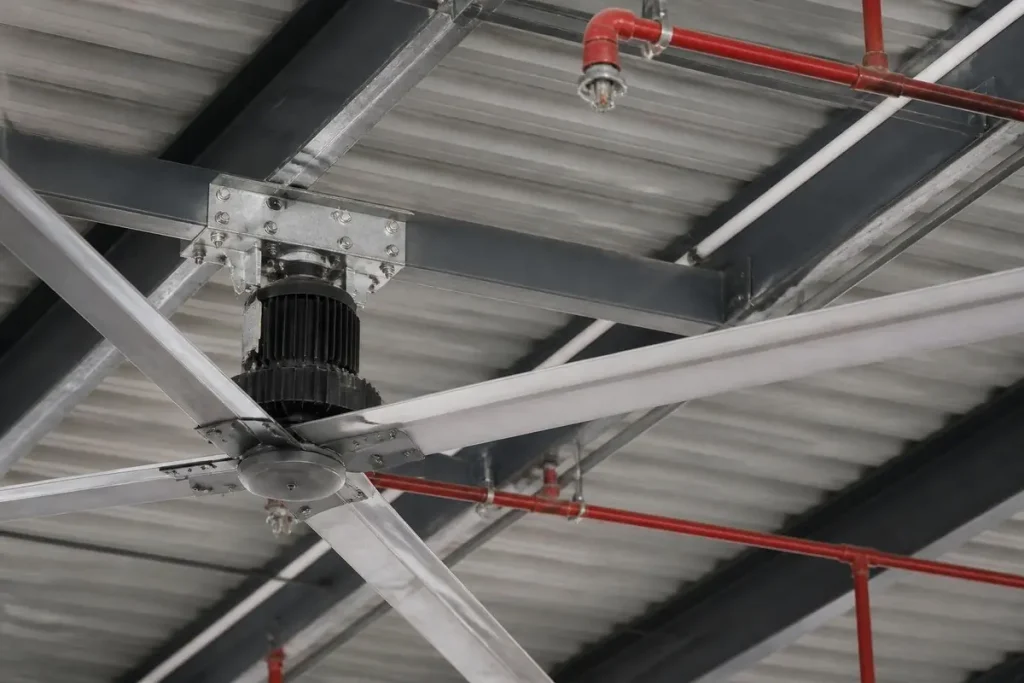
NFPA 13 sets four rules for HVLS fans in sprinklered buildings: a maximum diameter of 24 ft, the fan centered approximately between four adjacent sprinklers, at least 36 in of vertical clearance from fan to sprinkler deflector, and an interlock that shuts the fan down immediately upon a waterflow alarm. Where a fire alarm system exists, the interlock follows NFPA 72.
NFPA 13 is paywalled, so we quote that wording as reproduced in NFPA’s 2022 public input report. Fire protection engineer Joe Meyer dates the rules to the 2013 edition, at Section 11.1.7 (12.1.4 for storage) in the 2013 and 2016 editions. Later editions renumbered them; check your adopted edition.
The rules trace to fire tests. FM Global’s January 2011 report ran four large-scale tests with a 24 ft fan at 66 rpm over racked cartoned plastic. Running without shutdown caused “an unacceptable impairment to the sprinkler system,” while shutdown within 1 min 30 s (90 seconds) of the first sprinkler let the system perform adequately.
One maker’s cut sheet says its fire relay must be wired if local code requires it, and its controller accepts BACnet or Modbus from a building automation system.
Two definitions, one fan
DOE counts any ceiling fan over seven feet as large-diameter. NFPA 13’s 2013 and 2016 editions defined HVLS fans as approximately 6 to 24 ft turning approximately 30 to 70 rpm, per Meyer. Big Ass Fans sells a 30 ft model that its cut sheet says is not available for sprinklered buildings.
Do HVLS fans save heating energy in winter?
They can, but independent evidence is thin. In a 2009 ASHRAE Transactions paper, Armstrong, Chihata and MacDonald measured five large-diameter fans in a Toronto-area warehouse from February to March 2008. Ceiling temperatures fell 4.0°C, floor temperatures rose 1.5°C, and gas use dropped an average 19.3%.
The authors estimated annual savings of 5,682 therms and put fan electricity at approximately 5% of the cost savings. Forward (downward) operation destratified better than reverse. That is one building in one winter; maker percentages are marketing, not measurement.
CBE warns that a high minimum speed can cause a winter draft, which reverse operation avoids. At loading docks, destratification sits alongside overhead infrared heaters and an air curtain over the dock door in the same heat-loss plan.
How do you size and lay out HVLS fans?
Size HVLS fans by floor geometry, not coverage claims. The CBE guide splits a space into roughly square fan cells (aspect ratio up to 1.5:1), centers one fan in each, and picks a diameter between 0.2 and 0.4 times the cell’s characteristic width, the square root of its area.
- Take a 240 ft by 160 ft warehouse (38,400 sq ft).
- Split it into six 80 ft by 80 ft cells, three by two, for a 1:1 aspect ratio.
- Multiply 80 ft by 0.2 and by 0.4 for a diameter range of 16 to 32 ft.
- Cap the diameter at 24 ft if the building is sprinklered, so choose 16 to 24 ft fans.
- Check height: blades at least 10 ft above the floor, 3 ft above racks or forklifts, about 0.2 times the diameter below the ceiling and 36 in below deflectors.
Coverage ratings are maker claims with no common test: FM Global’s report quotes a rating of over 370,000 cfm at 65 rpm for a 24 ft fan, with a suggested 20,000 sq ft coverage or 110 ft spacing.
Where does an HVLS fan make sense: warehouses, gyms or barns?
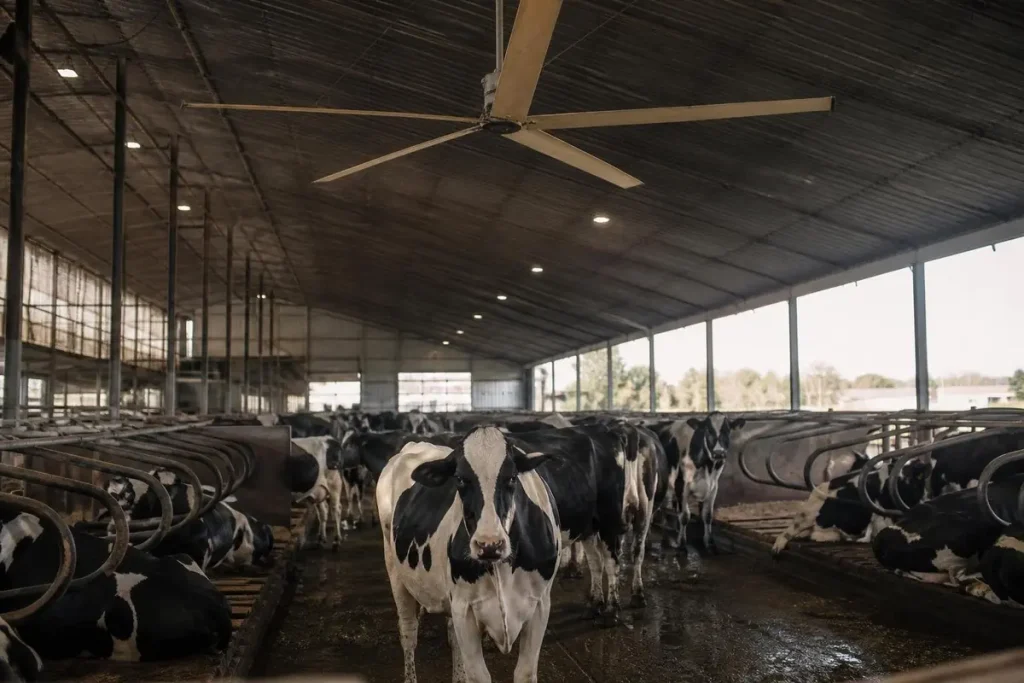
An HVLS fan fits warehouses, gyms and other tall, open spaces where people move around. FM Global credits Walter Boyd with developing the fans in 1995. For farm and grow buildings, our greenhouse heating and ventilation guide covers the ventilation side.
For heat stress, OSHA lists cooling fans among engineering controls, next to air conditioning and increased general ventilation. A fan is no substitute for local exhaust at the source.
Pair fans with a heat plan that tracks wet bulb temperature. Our analysis of heat deaths and air conditioning shows what is at stake.
How we researched this
We read 10 CFR 430.2, 430.32 and Appendix U via the eCFR versioner API (October 1, 2026 version), three DOE Federal Register documents, FM Global’s 2011 fire test report, the CBE Ceiling Fan Design Guide, NFPA’s 2022 public input report and OSHA’s heat controls page. We consulted 16 sources and cited 11. NFPA 13 is paywalled, so its wording comes from NFPA’s reproduction and Meyer’s restatement. Vendor coverage, savings and price claims were excluded; no federal series publishes HVLS installed costs. Reddit was skipped. Research date: October 30, 2026.
Frequently asked questions
How big is an HVLS fan?
Federal rules treat any ceiling fan with a blade span over seven feet as large-diameter. In sprinklered buildings, NFPA 13 caps HVLS fans at 24 ft. One maker lists sizes from 12 to 30 ft but bars its 30 ft model from sprinklered buildings.
How fast does an HVLS fan spin?
Slowly in rotation. NFPA 13’s 2013 and 2016 editions described about 30 to 70 rpm, per Joe Meyer, and one maker lists 116 rpm for a 14 ft fan and 46 rpm for a 30 ft fan. By our arithmetic the blade tips still move at roughly 49 to 58 mph.
Does an HVLS fan have to shut off when sprinklers activate?
Yes. NFPA 13 requires every HVLS fan to be interlocked to shut down immediately upon a waterflow alarm. FM Global’s 2011 tests found sprinklers performed adequately when a 24 ft fan stopped within 1 min 30 s of the first sprinkler, and inadequately when it kept running without a shutdown means.
How much cooler does an HVLS fan make you feel?
It depends on air speed at the person. Using ASHRAE 55 methods, the CBE guide equates 100 fpm with about 4°F of cooling effect and 150 fpm with over 5°F for a typical office worker. The air temperature does not drop.
Should an HVLS fan run in reverse in winter?
Not necessarily. In the Toronto-area study, forward operation destratified better than reverse. CBE says reverse helps fans whose minimum speed would cause a draft, while fans with a very low minimum speed can run forward and use less power. DOE does not require industrial fans to be reversible.
Are HVLS fans covered by DOE efficiency standards?
Yes. Large-diameter ceiling fans made on or after January 21, 2020 must reach a CFEI of at least 1.00 at high speed and 1.31 at 40 percent speed under 10 CFR 430.32. A June 2023 DOE proposal to raise the high-speed level to 1.22 is not in the October 2026 eCFR text.
Sources
- eCFR. “10 CFR 430.32, Energy conservation standards.” https://www.ecfr.gov/current/title-10/section-430.32. Accessed October 2026.
- eCFR. “10 CFR 430, Subpart B, Appendix U (ceiling fan test method).” https://www.ecfr.gov/current/title-10/chapter-II/subchapter-D/part-430/subpart-B/appendix-Appendix%20U%20to%20Subpart%20B%20of%20Part%20430. Accessed October 2026.
- U.S. Department of Energy. “Ceiling Fans,” technical amendment, 87 FR 72862. https://www.federalregister.gov/documents/2022/11/28/2022-25749/energy-conservation-program-energy-conservation-standards-for-ceiling-fans. Accessed October 2026.
- U.S. Department of Energy. “Ceiling Fans,” proposed rule, 88 FR 40932. https://www.federalregister.gov/documents/2023/06/22/2023-12957/energy-conservation-program-energy-conservation-standards-for-ceiling-fans. Accessed October 2026.
- FM Global (Benjamin Ditch). “Impact of a High Volume Low Speed Fan on Sprinkler Performance in Rack Storage Fires.” https://fm.com/-/media/project/publicwebsites/fm/files/resources/research-technical-reports/hvls_10611.pdf. Accessed October 2026.
- NFPA. “NFPA 13 Public Input Report, Public Input No. 450.” https://docinfofiles.nfpa.org/files/AboutTheCodes/13/13_A2024_AUT_SSD_PIReport.pdf. Accessed October 2026.
- MeyerFire (Joe Meyer, PE). “Requirements for Fire Sprinklers at Ceiling Fans.” https://www.meyerfire.com/blog/requirements-for-fire-sprinklers-at-ceiling-fans. Accessed October 2026.
- UC Berkeley Center for the Built Environment. “Ceiling Fan Design Guide.” https://cbe.berkeley.edu/wp-content/uploads/2020/04/CBE-Ceiling-Fan-Design-Guide-V0.pdf. Accessed October 2026.
- IIR FRIDOC abstract, Armstrong et al. “Cold weather destratification energy savings of a warehousing facility.” https://iifiir.org/en/fridoc/cold-weather-destratification-energy-savings-of-a-warehousing-facility-26667. Accessed October 2026.
- OSHA. “Heat: Controls.” https://www.osha.gov/heat-exposure/controls. Accessed October 2026.
- Big Ass Fans (maker data). “Powerfoil X4 cut sheet.” https://www.cisco-eagle.com/uploads/Big-Ass-Fans-Brochures/powerfoilx4-cutsheet.pdf. Accessed October 2026.
Leave a Reply