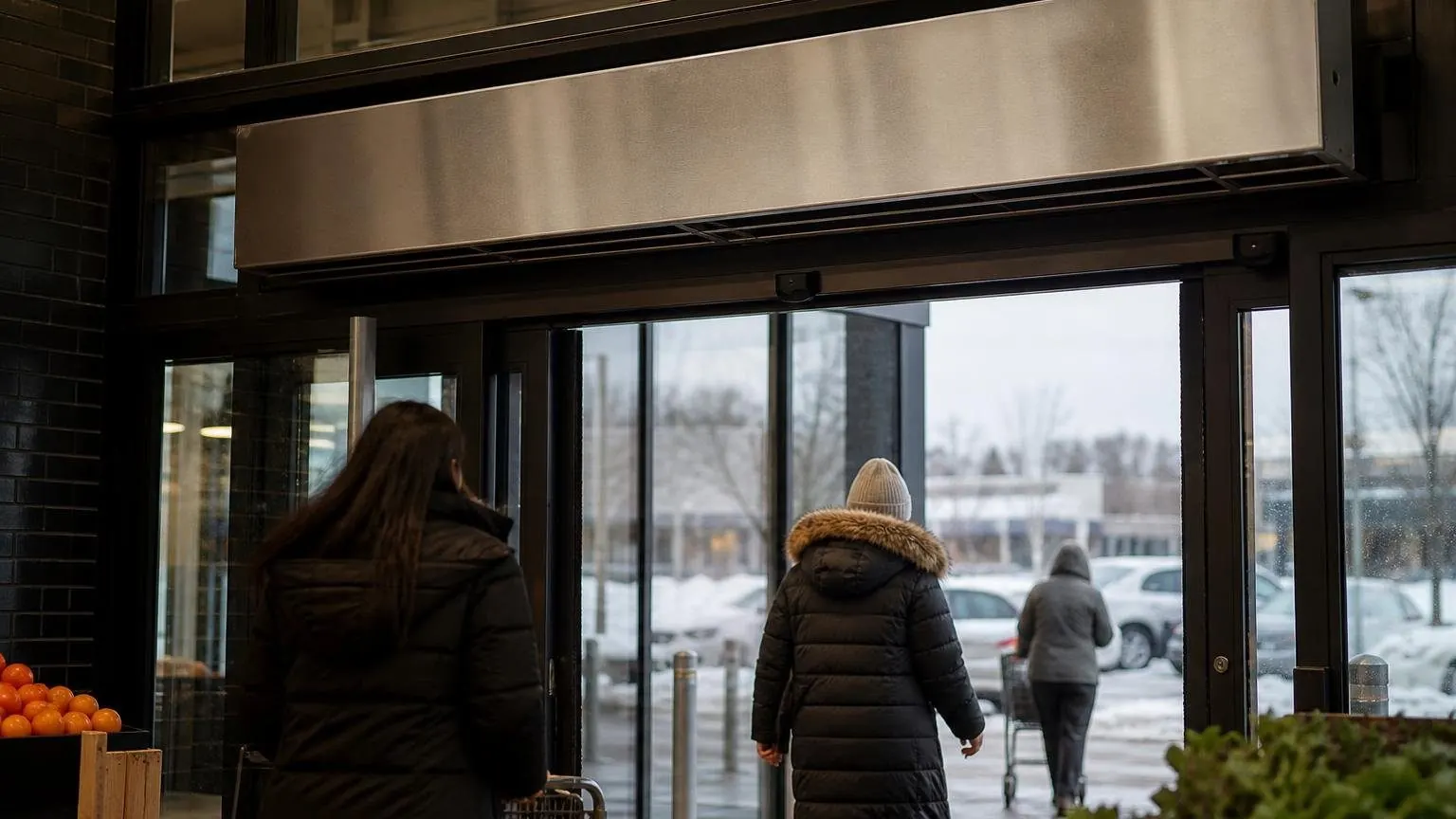
What is an air curtain? An air curtain is a fan unit mounted over a doorway that blows a downward jet of air across the opening, cutting infiltration while people walk through. Energy codes accept one in place of a vestibule when it reaches 6.56 ft/s (2 m/s) at the floor and is tested to ANSI/AMCA 220.
Key Takeaways
- The 2015 IECC lets an air curtain replace a vestibule at 6.56 ft/s at the floor, tested to AMCA 220 (ICC GEW80-14).
- ASHRAE 90.1-2019 measures the jet at 6.0 in. above the floor (ASHRAE Addendum ao).
- An AMCA-commissioned 2013 model found 0.3% to 2.2% whole-building savings versus a vestibule in climate zones 3 to 8 (AMCA study).
- In zones 1 and 2 it found 0.0% to 0.1% versus a plain door (AMCA study).
- PNNL found the vestibule rule saves 5.61% of site energy in a strip mall but 0.23% in a medium office (PNNL-20026, 2010).
- The FDA Food Code accepts “properly designed and installed air curtains” at open food establishment doors (Food Code 2022, 6-202.15).
What is an air curtain?
An air curtain, also sold as an air door, is a cabinet of fans and a long nozzle mounted above or beside an opening. It throws a flat jet across the doorway, so outdoor air, insects and dust meet moving air instead of an open hole.
ANSI/AMCA 220-21 defines the unit as a device whose air stream “width is at least five times its depth” and whose discharge is not connected to ductwork.
They are commercial equipment: retail entrances, restaurant service doors, drive-thru windows, walk-in coolers and dock doors, maintained under commercial service contracts rather than home HVAC work.
How does an air curtain work?
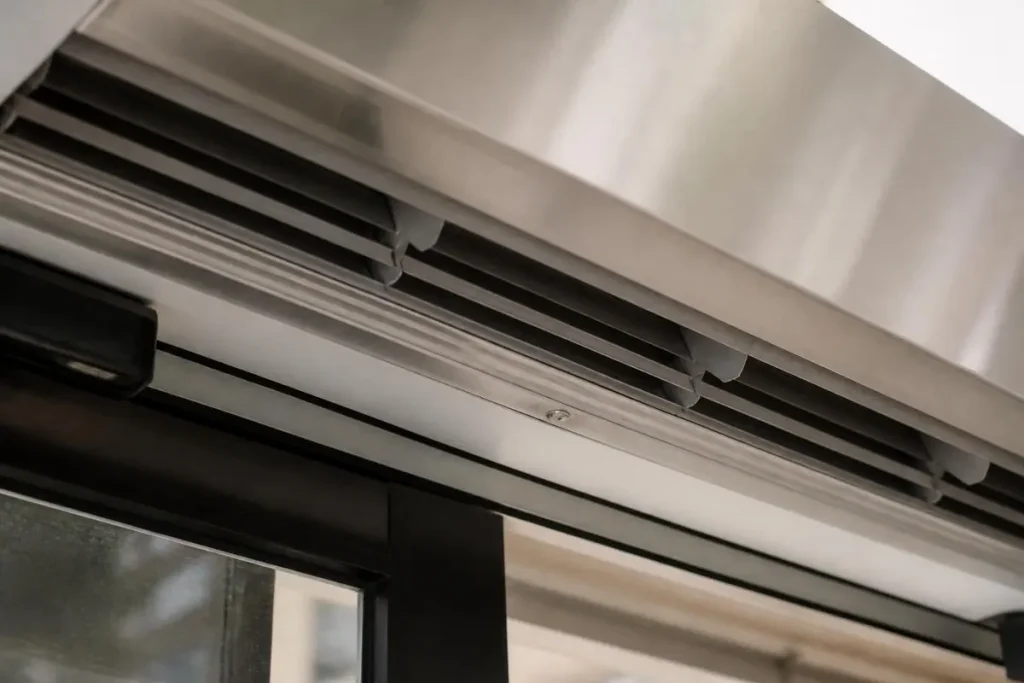
An air curtain trades a physical barrier for momentum. Fans pull room air in, a plenum spreads it along the nozzle, and the jet travels to the floor; outdoor air has to break through it.
- Intake: the fan draws air from the room.
- Discharge: the nozzle sends an even jet across the full opening.
- Floor contact: the jet must still meet code velocity near the floor.
- Split: maker Berner says about 80% of the air returns to the intake side when mounted properly (Berner FAQ).
Building pressure decides whether it holds. The AMCA study modeled a 62% cut in annual infiltration versus a single door, and found HVAC balance “as important as door usage frequency.” Check the building’s make up air before blaming the unit.
When does the energy code accept an air curtain instead of a vestibule?
The IECC and ASHRAE 90.1 require vestibules at entrances outside climate zones 1 and 2, and both let a tested, door-linked air curtain take its place. Velocity point, building limits and section numbers differ by edition and local amendment.
| Rule | Applies to | Air curtain criterion |
|---|---|---|
| 2015 IECC C402.5.7, Exception 6 | Building entrances outside climate zones 1 and 2 | 6.56 ft/s (2 m/s) at the floor, AMCA 220, door controls |
| ASHRAE 90.1-2019, 5.4.3.3 Exceptions 9 and 10 with 10.4.5 | Self-closing doors in zones 0, 3 and 4; buildings 15 stories or less in zones 5 to 8 | 6.6 ft/s at 6.0 in. above the floor, AMCA 220 or ISO 27327-1 |
| 2021 Seattle Energy Code C402.5.9, Exception 7 | Buildings under 3 stories, or spaces not connected to the elevator lobby | 6.56 ft/s at the floor, AMCA 220, door controls |
| FDA Food Code 2022, 6-202.15(D) | Food establishment doors or windows kept open | “Properly designed and installed air curtains to control flying insects” |
| Maricopa County, Arizona guidance | Food establishments in the county | NSF Standard 37; 1,600 fpm service doors; 600 fpm customer doors |
| 10 CFR 431.306(a)(2) | Walk-in coolers and freezers built on or after January 1, 2009 | “Other method of minimizing infiltration”; air curtains not named |
The IECC exception came from code change CE192-13 for the 2015 edition (ICC GEW80-14). Seattle’s 2021 Energy Code limits the option to buildings under 3 stories or spaces not connected to the elevator lobby.
ASHRAE uses a different measuring point. Section 10.4.5, as revised by Addendum ao to 90.1-2019, requires 6.6 ft/s at 6.0 in. above the floor; the addendum dropped an older 20 degrees direction rule as “overly restrictive.” In feet per minute, 2 m/s is about 394 feet per minute (our conversion).
Code point
Section numbers move. One maker’s code page cites “IECC C402.6.67” and ASHRAE “5.4.3.4”; Addendum ao puts the 2019 exceptions under 5.4.3.3 and Seattle uses C402.5.9. Confirm your adopted edition and amendments before submitting one.
What does AMCA 220 actually test?
ANSI/AMCA 220-21 is a laboratory method rating airflow, outlet velocity uniformity, power and velocity projection; it is not for “design, production or field testing.” A rated unit can still fail at a real door.
Projection is the average core velocity on planes at least 40 in. from the nozzle, with test lines no more than 4 in. apart; it tells a specifier whether the jet still has speed at the floor.
How much energy does an air curtain save?
Less than brochures say, and mostly in cold climates. A model commissioned by AMCA International, the makers’ trade group, found 0.3% to 2.2% whole-building savings versus a vestibule in climate zones 3 to 8, and 0.0% to 0.1% versus a bare door in zones 1 and 2.
Liangzhu Wang of Concordia University simulated the DOE medium office prototype at 100 people per hour. Savings against a vestibule were 1,146 kWh in Atlanta, 2,217 kWh in Baltimore, 4,169 kWh in Chicago, 7,007 kWh in Minneapolis, 8,737 kWh in Fargo and 18,986 kWh in Fairbanks.
The vestibule rule itself is small in most buildings. A 2010 Pacific Northwest National Laboratory report put savings from ASHRAE’s vestibule requirement under 1% for offices and schools, higher where small floor area meets heavy traffic.
Two corrections. Berner’s “up to 80% of energy loss at an open door” is a doorway figure, not a building figure. A retailer’s guide says the AMCA study showed “0.3-2.2 percent” savings without saying it applies only against a vestibule in zones 3 to 8.

Do air curtains keep flies out of restaurants?
Food codes accept them as one option. FDA Food Code 2022, section 6-202.15(D), says open doors or windows need 16 mesh to 1 inch screens, “properly designed and installed air curtains to control flying insects,” or other effective means.
Local health departments set the numbers. Maricopa County, Arizona requires NSF Standard 37 units, airflow within 1 inch of the doorway, 1,600 feet per minute at 3 feet above the floor at service entrances, 600 feet per minute at customer entrances, and door-activated micro-switches.
That service-door figure is roughly four times the energy code’s floor velocity. NSF’s public listing for NSF/ANSI 37, “Air Curtains for Entranceways in Food and Food Service Establishments,” showed 3 manufacturers and 20 products on October 30, 2026. Hoods pull dining rooms negative, so check the kitchen hood and its makeup air.
Heated or unheated: which air curtain do you need?
Unheated units do the barrier job; heat only fixes cold drafts. Codes cap it: ASHRAE 90.1 section 6.4.3.9 and Seattle’s C403.4.1.4 both require integral heating to shut off when outdoor air is above 45°F (7°C).
Where staff stand at an open dock door, compare electric door heat with radiant infrared heaters. In the AMCA model, the unit’s fan alone used 200 to 529 kWh a year in zones 3 to 8.
Federal rules for walk-in coolers and freezers at 10 CFR 431.306 require “strip doors, spring hinged doors, or other method of minimizing infiltration when doors are open.” Air curtains are not named; a maker calling one approved is reading “other method” broadly.
How do you size and install an air curtain?
Size the unit to the opening, then verify it at the floor. Berner says the unit “must span 100% of the opening width” and sells industrial models for doors up to 50 feet (maker data).
- Measure the opening and confirm the code edition.
- Pick an AMCA 220 rated unit whose projection reaches the floor at your mounting height.
- Mount it per the maker so the jet covers the full width.
- Interlock it to a door switch.
- Commission it, including airstream split and direction, then check velocity near the floor.
Controls are where installs drift out of code. Tie the door switch and heat lockout into the building automation system where one exists; door infiltration adds to the air changes per hour the system must condition.
Seattle exempts vehicle and material handling doors from the vestibule rule (exception 6), so dock-door units are about comfort and dust, alongside industrial ventilation and HVLS fans that move air inside the building.
How we researched this
Researched October 30, 2026. We read four ranking pages, then quoted ICC’s 2015 IECC change record, ASHRAE Addendum ao, Seattle’s 2021 Energy Code, AMCA 220-21, the FDA Food Code, eCFR and NSF’s listing; 17 sources consulted, 11 cited. codes.iccsafe.org blocked fetches, so 2021 and 2024 model IECC wording is not quoted. Excluded: maker savings claims as fact, installed prices (no federal series), Reddit.
Frequently asked questions
Can an air curtain replace a vestibule?
In many jurisdictions, yes. The 2015 IECC accepts an air curtain reaching 6.56 ft/s at the floor, tested to ANSI/AMCA 220 and controlled with the door. ASHRAE 90.1-2019 allows it on self-closing doors in zones 0, 3 and 4, and in buildings of 15 stories or less in zones 5 to 8.
Do air curtains really save energy?
Modestly, and mainly in cold climates. The AMCA-commissioned model found 0.3% to 2.2% whole-building savings versus a vestibule in zones 3 to 8. Against a bare door in hot zones 1 and 2, savings were 81 to 132 kWh a year, effectively zero.
Will an air curtain keep bugs out?
Only if built and set for insects. The FDA Food Code accepts properly designed and installed air curtains at open food establishment doors, and Maricopa County asks for NSF Standard 37 units and 1,600 feet per minute at service entrances, far above the energy code’s floor velocity.
Should an air curtain run all the time?
No. The IECC and ASHRAE 90.1 require controls that run it with the door. In the AMCA model, dropping temperature control cut Chicago savings versus a vestibule from 4,169 kWh to 3,721 kWh.
Does a house need an air curtain?
No energy code we read requires one. The 2015 IECC vestibule rule exempts doors opening directly from a sleeping unit or dwelling unit, and ASHRAE 90.1-2019 exempts doors opening directly from a dwelling unit.
Can you use an air curtain on a walk-in cooler?
Federal rules at 10 CFR 431.306 require strip doors, spring hinged doors or another method of minimizing infiltration for walk-ins built on or after January 1, 2009. Air curtains are not named, so confirm with the box maker and inspector.
Sources
- International Code Council. “GEW80-14, 605.1.2.3 (2015 IECC C402.5.7 text, CE192-13).” https://www.iccsafe.org/wp-content/uploads/GEW80.pdf. Accessed October 2026.
- ASHRAE. “Addendum ao to ANSI/ASHRAE/IES Standard 90.1-2019.” https://www.ashrae.org/file%20library/technical%20resources/standards%20and%20guidelines/standards%20addenda/90_1_2019_ao_20210930.pdf. Accessed October 2026.
- Seattle SDCI. “2021 Seattle Energy Code, Chapter 4, Commercial Energy Efficiency.” https://www.seattle.gov/documents/Departments/SDCI/Codes/SeattleEnergyCode/2021SECChapter4.pdf. Accessed October 2026.
- AMCA International. “ANSI/AMCA Standard 220-21, Laboratory Methods of Testing Air Curtain Units for Aerodynamic Performance Rating.” https://amca.org/assets/resources/public/Standards%20for%20Member%20Download/amca-220-21.pdf. Accessed October 2026.
- AMCA International (L. Wang). “Investigation of the Impact of Building Entrance Air Curtain on Whole Building Energy Use.” https://a.storyblok.com/f/152166/x/2f4055bc03/amca-air-curtain-study.pdf. Accessed October 2026.
- Pacific Northwest National Laboratory. “Energy Saving Impact of ASHRAE 90.1 Vestibule Requirements, PNNL-20026.” https://www.pnnl.gov/main/publications/external/technical_reports/pnnl-20026.pdf. Accessed October 2026.
- U.S. Food and Drug Administration. “Food Code 2022.” https://www.fda.gov/media/164194/download. Accessed October 2026.
- Maricopa County Environmental Services. “Protection of Outer Openings in Food Establishments.” https://www.esd.maricopa.gov/DocumentCenter/View/42978/Protection-of-Outer-Openings-Guidance-PDF. Accessed October 2026.
- eCFR. “10 CFR 431.306, Energy conservation standards and their effective dates.” https://www.ecfr.gov/current/title-10/chapter-II/subchapter-D/part-431/subpart-R/section-431.306. Accessed October 2026.
- NSF. “NSF/ANSI 37 Listings.” https://info.nsf.org/Certified/Food/Listings.asp?Standard=037. Accessed October 2026.
- Berner International. “FAQs” (manufacturer data). https://berner.com/faqs/. Accessed October 2026.
Leave a Reply