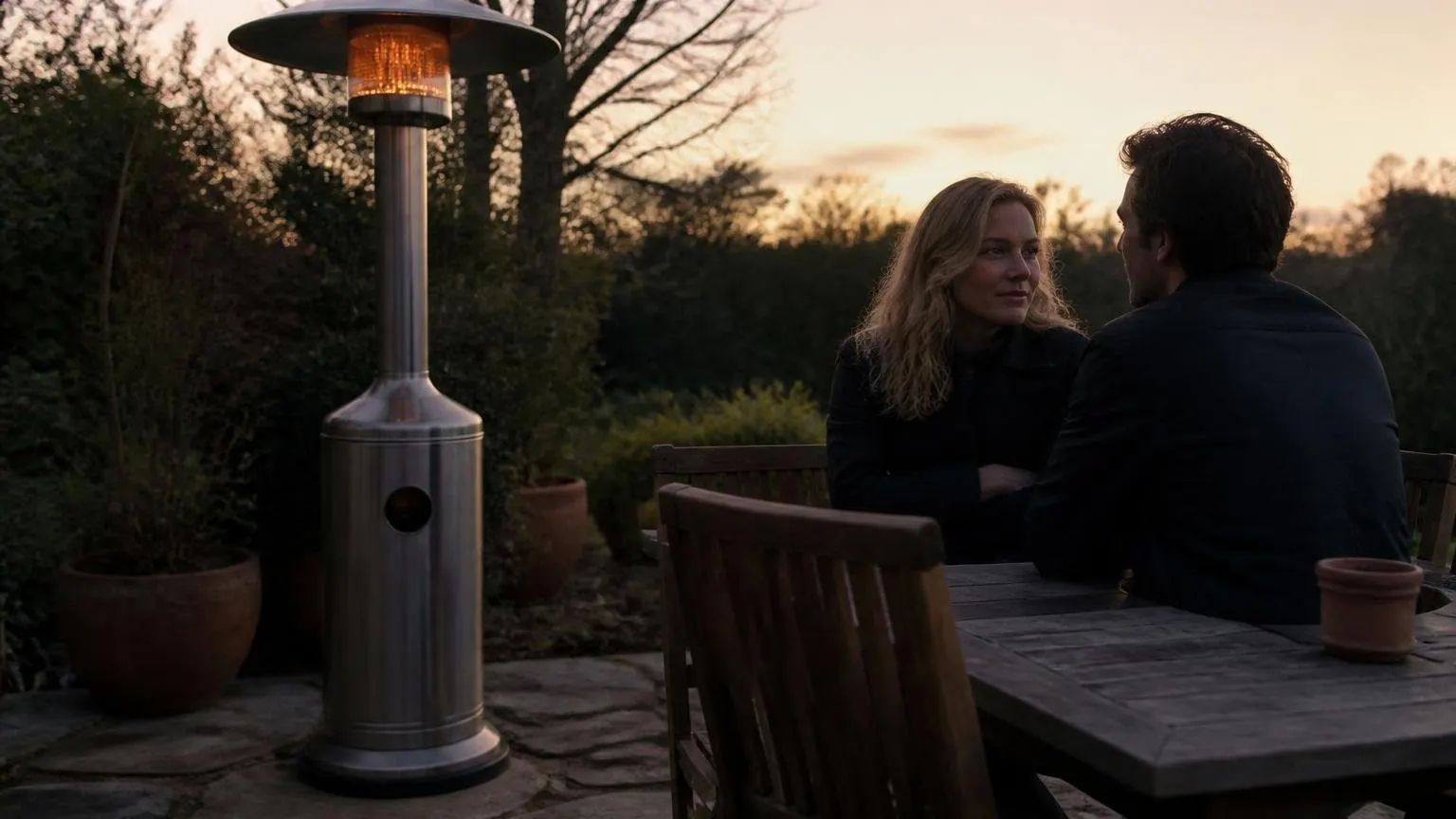
What is a patio heater? A patio heater is an outdoor radiant heater, such as a 31,000 to 48,000 Btu/h propane unit or a 2,000 to 6,000 watt electric one. At recent EIA prices a 40,000 Btu/h propane patio heater burns about $1.19 an hour; a 1,500 W electric one, about $0.27.
Key Takeaways
- A full 20 lb cylinder holds about 4.73 gallons, about 10.8 hours at 40,000 Btu/h, using NIST density and EIA’s 91,452 Btu per gallon (EIA).
- US residential propane averaged $2.730 a gallon, excluding taxes, in the week of October 26, 2026 (EIA weekly propane prices).
- Only 74.2% of cylinder exchange locations passed NIST’s net contents checks, and exchange cylinders are usually labeled 15 lb (NIST SP 2200-01).
- The 2021 International Fire Code requires portable outdoor gas heaters listed to ANSI Z83.26/CSA 2.37, 5 feet from buildings, with gas shutoff past 15 degrees of tilt (2021 SFC Chapter 6).
- The 2020 ANSI Z83.26 edition makes some heaters warn they may shut down in wind above 3 miles per hour (Intertek notice).
- Napoleon’s PTH31GT manual allows a roofed area only if at least 30% of the perimeter stays permanently open (Napoleon manual).
What is a patio heater, and which types are sold?
A patio heater is a radiant heater built for open air: it warms people and surfaces in its line of sight, not air that blows away. The main types are propane pole units, natural gas units on a fixed line and wall or ceiling mounted electric emitters.
The physics matches our guide to how infrared heaters work. Napoleon rates its propane PTH31GT at 31,000 BTU/hr, and a standing heater sold as item 96053 claims 48,000 BTUs. Natural gas versions need a fixed line built to local code or ANSI Z223.1/NFPA 54. Bromic’s Tungsten Smart-Heat Electric line runs from 2000W to 6000W on 220 to 240 V, with a 96 inch minimum ceiling mounting height.
How much does a patio heater cost to run per hour?
A propane patio heater rated 40,000 Btu/h costs about $1.19 an hour at full input, a natural gas unit of the same rating about $0.59, and a 1,500 W electric heater about $0.27. The gap is mostly size: the gas heater burns about 11.7 kW of fuel, while 1,500 W equals about 5,118 Btu/h.
Method: divide the input rating by the fuel’s heat content, then multiply by price. EIA lists 91,452 Btu per gallon of propane, 1,036 Btu per cubic foot of natural gas and 3,412 Btu per kilowatthour (EIA). Prices are EIA’s $2.730 per gallon propane, the 2025 residential natural gas average of $15.34 per thousand cubic feet (EIA natural gas prices) and August 2026 residential electricity at 18.16 cents per kWh (EIA Table 5.6.A).
| Patio heater | Input | Fuel per hour | Cost per hour |
|---|---|---|---|
| Propane, item 96053 class | 48,000 Btu/h | 0.52 gal | $1.43 |
| Propane, generic mushroom | 40,000 Btu/h | 0.44 gal | $1.19 |
| Propane, Napoleon PTH31GT | 31,000 Btu/h | 0.34 gal | $0.93 |
| Natural gas, 40,000 Btu/h | 40,000 Btu/h | 38.6 cu ft | $0.59 |
| Electric plug in | 1,500 W | 1.5 kWh | $0.27 |
| Electric, Bromic 4000W | 4,000 W | 4 kWh | $0.73 |
| Electric, Bromic 6000W | 6,000 W | 6 kWh | $1.09 |
EIA’s propane price is for bulk delivery; no federal series tracks cylinder prices, so treat $1.19 as a floor. Each extra dollar per gallon adds about 44 cents an hour at 40,000 Btu/h. Local rates are in our tables of natural gas prices in each state and residential electricity rates by state.
At EIA’s August 2026 commercial rate of 14.47 cents per kWh, a restaurant’s 6,000 W heater costs about $0.87 an hour. For whole-house heat, see our cost of heat by fuel breakdown.
How long does a 20 lb tank last on a propane patio heater?
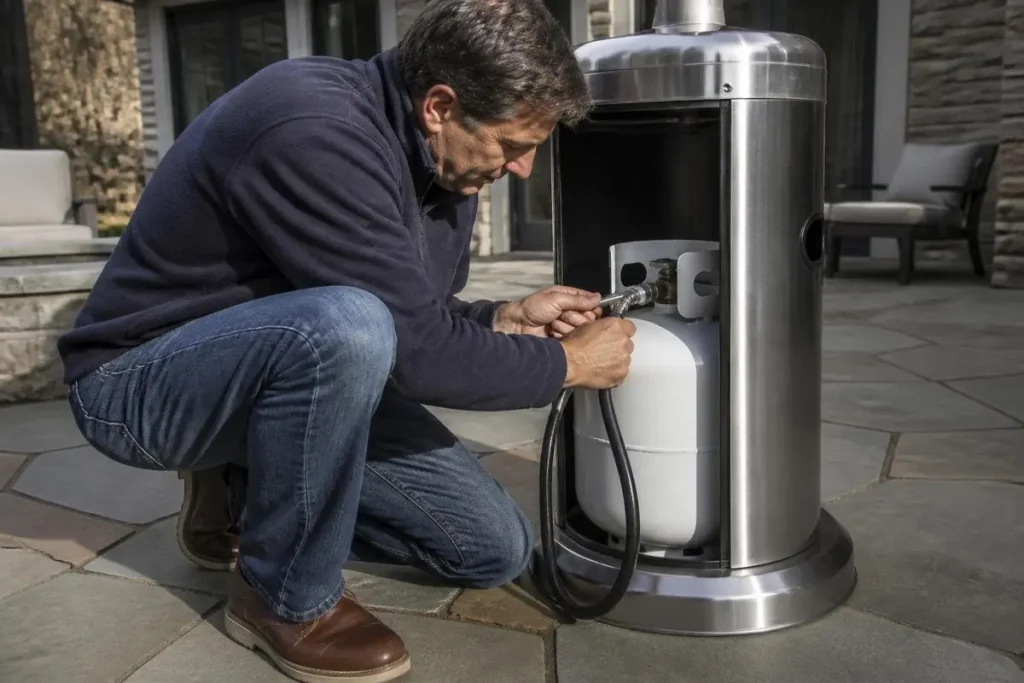
A full 20 lb cylinder runs a 40,000 Btu/h patio heater about 10.8 hours at full input, a 48,000 Btu/h unit about 9.0 hours and a heater turned down to 17,000 Btu/h about 25.4 hours. A 15 lb exchange fill cuts each by a quarter: 6.8 hours at 48,000, 8.1 at 40,000, 10.5 at 31,000 (versus 14.0 full) and 19.1 at 17,000.
Here is the math. NIST’s Chemistry WebBook gives saturated liquid propane a density of 506.59 kg per cubic meter at 60.1°F, which is 4.23 lb per gallon (NIST WebBook). So 20 lb is 4.73 gallons, and 4.73 times 91,452 is about 432,600 Btu. Divide by the heater’s input to get hours.
NIST’s 2022 survey of 20 lb cylinders notes exchange fills may follow the labeled net contents, “usually 15 lbs,” rather than the 20 lb capacity. It also found that 25.4% of consumers return a cylinder with more than 1 lb still inside (NIST SP 2200-01). For bulk tanks and delivery, see our propane heating explainer.
Propane vs natural gas vs electric patio heater: which fits your space?
Propane suits movable heat on an open patio, natural gas a fixed spot near a gas line, and electric a covered space where combustion products would not clear. Hourly cost follows input size more than fuel.
| Fuel | Example input | Cost per hour | Listing or code basis | Main limit |
|---|---|---|---|---|
| Propane | 31,000 to 48,000 Btu/h | $0.93 to $1.43 | ANSI Z83.26/CSA 2.37 | Cylinder swaps; outdoor and open areas only |
| Natural gas | 40,000 Btu/h | $0.59 | ANSI Z83.26 plus ANSI Z223.1/NFPA 54 piping | Fixed location; qualified installer |
| Electric infrared | 1,500 to 6,000 W | $0.27 to $1.09 | Bromic cites UL 2021 | Circuit size; 220 to 240 V for larger units |
Electric has a circuit cost. A 1,500 W heater on 120 V draws 12.5 amps; Bromic lists 25A at 220 to 240 V for its 6000W model and requires a licensed installer. Our watts and amps reference explains the arithmetic.
How far does a patio heater really reach?
Coverage numbers are best case figures. Bromic’s spec sheet rates its 6000W unit at up to 160 square feet, then footnotes that heat area depends on ambient temperature and wind, with optimum conditions at about 60°F in a low wind, covered space.
Wind matters most. The Hiland HLDS01 checklist asks for wind below 10 mph and warns of “reduced efficiency below 40°F.” The 2020 Z83.26 edition, effective June 1, 2023 per Intertek, makes heaters with a non-retry safety shutoff warn they may shut down above 3 miles per hour of wind.
What safety rules apply to a patio heater?
A gas patio heater should be listed to ANSI Z83.26/CSA 2.37, used only outdoors, kept at the manual’s clearances and fitted with a tip-over shutoff. Napoleon specifies 24 inches above and 18 inches to the sides, while Hiland specifies 36 inches from the sides and 24 inches from the top.
- Measure clearances from your model’s manual. The item 96053 manual gives three feet sides and two feet top on one page and the reverse on another, so use the larger figure.
- Check the tip-over switch; the fire code requires shutoff past 15 degrees from vertical.
- Leak test the gas connections whenever they are loosened or removed, as the item 96053 manual requires.
- Store cylinders outdoors; Napoleon says a disconnected cylinder must not be stored in a building or garage.
Covered patio or porch?
The Hiland manual warns: “Using it in an enclosed space can kill you.” Napoleon allows a walled area only with no roof, and a roofed one only if two side walls or 30% of the perimeter stay permanently open. A screened porch, garage or tent does not qualify; our guide to indoor-rated propane heaters covers indoor units, and our garage heating options cover that space.
For why, see our carbon monoxide death statistics and our ventless gas heater rules cover the indoor equivalent.

Can you use a patio heater on a balcony or at a restaurant?
Where the 2021 International Fire Code applies, a portable gas patio heater cannot be stored or used on an exterior balcony except as Chapter 61 permits, and must stay 5 feet from buildings, exits and combustible awnings. Local amendments vary.
The IFC text, as reprinted by Seattle, also caps each gas container at 20 pounds, bars containers from being changed “while the public is present” and requires a permanent guard on the burner (2021 SFC Section 605.5.2). The 2-1/2 pounds water capacity exception in IFC Section 308.1.4 covers open-flame cooking devices, not heaters, and Washington does not adopt it.
Restaurants may need a permit. Seattle’s conditions for LP-gas heaters at dining establishments add a 2A:40 BC fire extinguisher within 50 feet of travel (Seattle Fire Department). For an enclosed glass room, our sunroom heating guide is the better fit.
How we researched this
Research date: October 30, 2026. We consulted 25 sources and cite 14. Runtime and cost are our calculations from NIST propane density and EIA heat content and prices. Ratings and clearances come from maker manuals. Code text comes from the 2021 Seattle Fire Code reprint of the IFC, because codes.iccsafe.org blocks automated access. Excluded: retailer and blog cost estimates, which showed no primary source, and Reddit, since this is a combustion safety topic. No installed prices are given because no federal series publishes them.
Frequently asked questions
Is a propane or electric patio heater cheaper to run?
Per hour, a 1,500 W electric heater is cheaper, about $0.27 at 18.16 cents per kWh, against about $1.19 for a 40,000 Btu/h propane heater at $2.730 a gallon. The propane unit burns far more energy, about 11.7 kW of fuel against 1.5 kW.
How many hours will a 20 lb propane tank run a patio heater?
About 10.8 hours at 40,000 Btu/h and 9.0 hours at 48,000 Btu/h, assuming a true 20 lb fill at full input. The math uses NIST’s 4.23 lb per gallon and EIA’s 91,452 Btu per gallon. A 15 lb exchange fill gives about 8.1 hours at 40,000 Btu/h.
Can I use a patio heater under a covered patio?
Only if the manual allows it. Napoleon’s PTH31GT manual permits a roofed area when at least two side walls or 30% of the perimeter stay permanently open, with 24 inches of clearance above. Never use one in a screened porch, garage or tent, where carbon monoxide can build up.
Are patio heaters allowed on apartment balconies?
Usually not. The 2021 International Fire Code Section 605.5.2.1.1 prohibits storing or using portable outdoor gas-fired heaters on exterior balconies except as Chapter 61 permits, and requires 5 feet of clearance from buildings and exits elsewhere. Local amendments differ, so ask your fire marshal.
Do patio heaters work in the wind?
Poorly. The Hiland HLDS01 checklist asks that wind be below 10 mph, and the 2020 ANSI Z83.26 edition requires some heaters to warn they may shut down in wind above 3 miles per hour. Pick a sheltered spot that still keeps the 5 feet building clearance.
What safety certification should a gas patio heater have?
Look for a listing to ANSI Z83.26/CSA 2.37. The 2021 International Fire Code Section 605.5.2.2.1 requires that listing for portable outdoor gas heaters, plus a tip switch that shuts off gas past 15 degrees of tilt. The 2020 edition took effect for Intertek listings on June 1, 2023.
Sources
- U.S. EIA. “Weekly Heating Oil and Propane Prices: Residential Propane.” https://www.eia.gov/dnav/pet/pet_pri_wfr_a_EPLLPA_PRS_dpgal_w.htm. Accessed October 2026.
- U.S. EIA. “Natural Gas Prices (annual).” https://www.eia.gov/dnav/ng/ng_pri_sum_dcu_nus_a.htm. Accessed October 2026.
- U.S. EIA. “Electric Power Monthly, Table 5.6.A.” https://www.eia.gov/electricity/monthly/epm_table_grapher.php?t=epmt_5_6_a. Accessed October 2026.
- U.S. EIA. “British thermal units (Btu).” https://www.eia.gov/energyexplained/units-and-calculators/british-thermal-units.php. Accessed October 2026.
- NIST. “NIST Chemistry WebBook, Thermophysical Properties of Propane (saturation).” https://webbook.nist.gov/cgi/fluid.cgi?Action=Data&Wide=on&ID=C74986&Type=SatT&Digits=5&TLow=50&THigh=70&TInc=10&RefState=DEF&TUnit=F&PUnit=psia&DUnit=kg%2Fm3&HUnit=kJ%2Fkg&WUnit=m%2Fs&VisUnit=uPa*s&STUnit=N%2Fm. Accessed October 2026.
- NIST. “2022 NCWM/NIST National Survey of 20 lb LPG (Propane) Cylinders, SP 2200-01.” https://nvlpubs.nist.gov/nistpubs/SpecialPublications/NIST.SP.2200-01.pdf. Accessed October 2026.
- City of Seattle. “2021 Seattle Fire Code, Chapter 6.” https://seattle.gov/documents/Departments/SDCI/Codes/SeattleFireCode/2021SFCChapter6.pdf. Accessed October 2026.
- City of Seattle. “2021 Seattle Fire Code, Chapter 3.” https://seattle.gov/documents/Departments/SDCI/Codes/SeattleFireCode/2021SFCChapter3.pdf. Accessed October 2026.
- Seattle Fire Department. “Permit Conditions 8202-POH, Portable LP-gas Heaters at Drinking and Dining Establishments.” https://www.seattle.gov/documents/departments/fire/business/permitcond_8202-poh.pdf. Accessed October 2026.
- Intertek. “Standards Update Notice, ANSI Z83.26/CSA 2.37.” https://cdn.intertek.com/www-intertek-com/dms-legacy/ANSI-Z83-26-CSA-2-37-SUN-Rev-11-1-2020-ED-6-1-2023.pdf. Accessed October 2026.
- Napoleon. “PTH31GT Patio Heater Installation and Operating Instructions.” https://assets.ajmadison.com/ajmadison/itemdocs/PTH31GTSSP_user_manual.pdf. Accessed October 2026.
- Hiland. “Owner’s Manual, Patio Heater Model HLDS01.” https://cdn.shopify.com/s/files/1/1936/2105/files/User_Manual.pdf. Accessed October 2026.
- Bromic Heating. “Tungsten Smart-Heat Electric specifications.” https://cdn.shopify.com/s/files/1/0262/9232/2407/files/BH_Tungsten_Electric_Specs.pdf. Accessed October 2026.
- Standing Patio Heater, item 96053. “Owner’s Manual and Safety Instructions.” https://images.thdstatic.com/catalog/pdfImages/3d/3d2f1291-7aec-4c9c-b29e-20a9fbdeb862.pdf. Accessed October 2026.
Leave a Reply