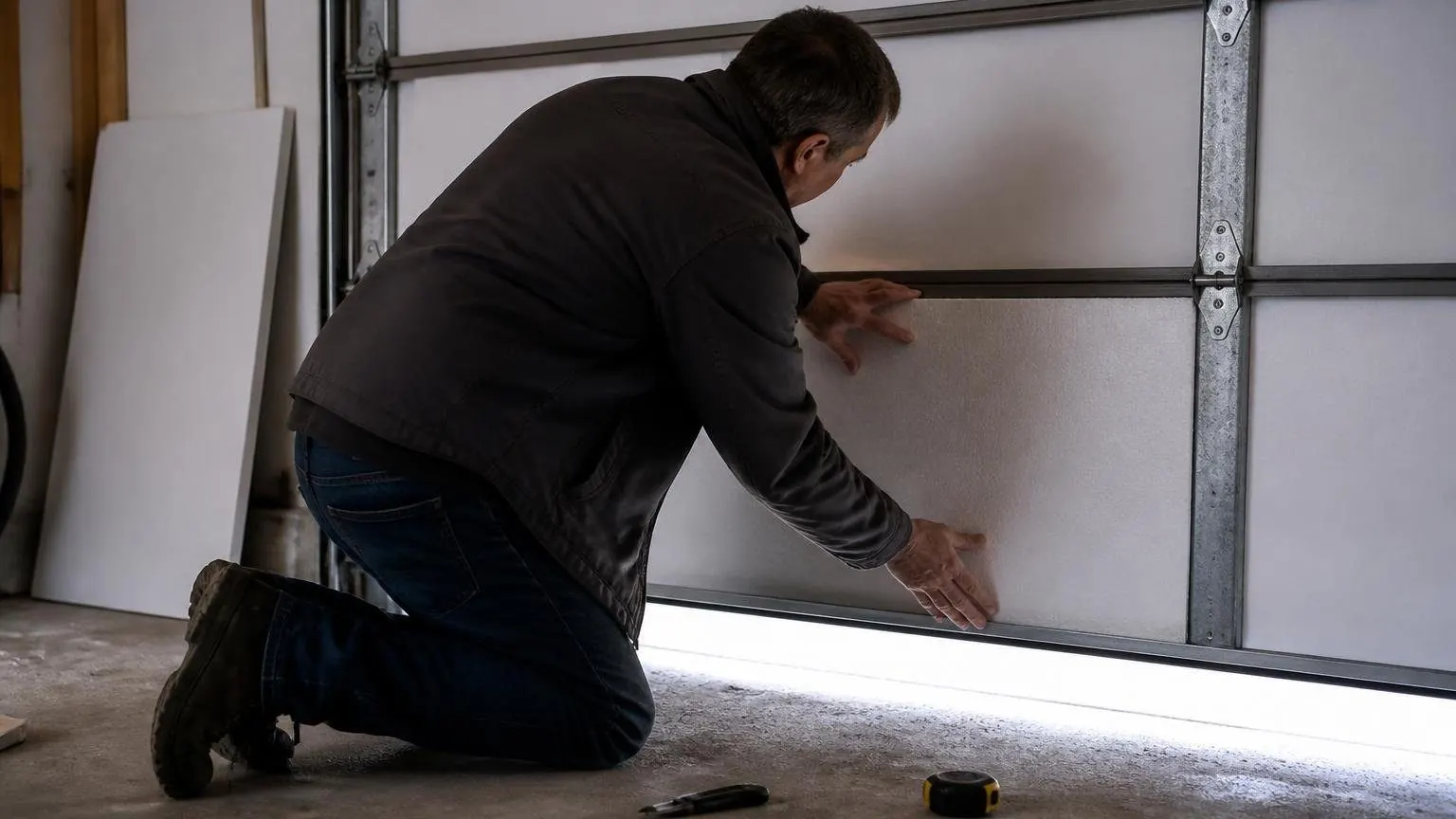
Does garage door insulation make a difference? Yes, when the garage is heated or sits under living space. A bare 16 x 7 ft steel door conducts 4,872 Btu/h at a 30°F difference, and a foam-insulated sectional door cuts that by 87.7%. Air leaking past worn seals comes on top.
Key Takeaways
- The California Energy Commission JA4 door table rates bare single-layer steel at U-1.45 and a 1-3/8 in EPS-insulated sectional door at U-0.179, both taken from ASHRAE 90.1-2007.
- At EIA’s October 2026 forecast of 18.28 cents per kWh, electric heat lost through the bare door costs $260.96 per 1,000 hours, against $32.21 through the insulated door.
- DASMA states that for garage doors “U-factor and R-value are not reciprocals” (TDS 163): R-value covers the center of one section, U-factor the whole tested door.
- Wayne-Dalton’s 1-13/16 in polyurethane steel doors test at U-0.12 under ANSI/DASMA 105 in the ICC-ES verification listing, not the U-0.0625 an R-16 label implies.
- Residential garage doors have no required U-factor; DASMA’s 2024 code summary says testing applies where the garage is heated or air conditioned.
- DOE’s Building America Solution Center places an attached garage outside the home’s thermal envelope, so the shared wall and ceiling come before the door.
What does garage door insulation actually change?
Garage door insulation slows heat moving through the largest opening in the garage, keeping the space closer to house temperature. It does not move the home’s insulated shell, which in an attached garage is the shared wall and ceiling.
The DOE Building America Solution Center, run by Pacific Northwest National Laboratory (PNNL), says insulating a bare door can “dramatically increase the thermal comfort in the garage”. Its guide pairs foam with new weatherstripping, because conduction and air leakage are separate losses.
If you plan to heat the space, our whole-garage heat loss and heater comparison sizes the room; this page stays on the door.
Why is a garage door’s R-value not its U-factor?
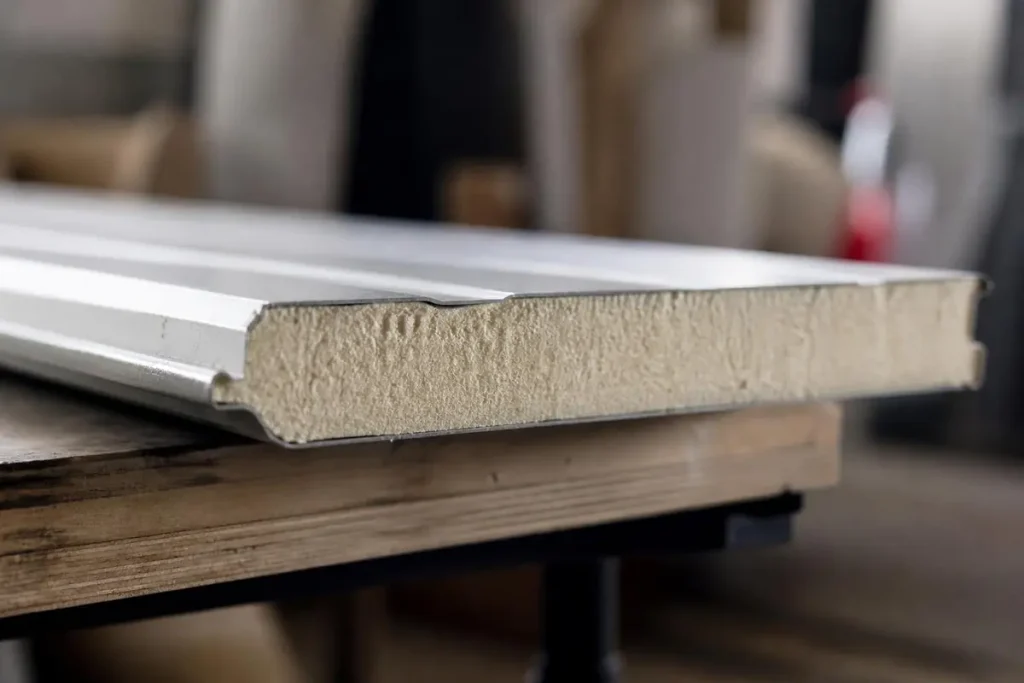
They measure different things. The Door and Access Systems Manufacturers’ Association (DASMA) says R-value is calculated for the center of one door section, while U-factor is measured on a complete installed door.
The test is ANSI/DASMA 105, which DASMA’s TDS 196 says the International Energy Conservation Code (IECC) names for garage doors. A lab measures heat flow through a full door, so joints, hardware and perimeter seals all count. Per TDS 196, a door at U-0.20 is twice as efficient as one at U-0.40.
The R-value math is short. DASMA adds air films worth 0.85 to the foam thickness divided by its conductivity; with 1-3/8 in of EPS at R-4 per inch, a section works out to R-6.35. The JA4 table gives that same door type U-0.179, the equivalent of R-5.6, so even modest labels run high.
Correction to a common belief
An “R-16” garage door does not perform like an R-16 wall. Inverted, R-16 implies U-0.0625, while the 1-13/16 in polyurethane doors in the ICC-ES listing measure U-0.12, about 1.92 times the heat flow the label suggests. Even DASMA’s worked example in TDS 163 prints a section value of R-16.47, although its formula as printed gives 13.44.
How much heat does an uninsulated garage door lose?
A bare 16 x 7 ft single-layer steel door loses about 4,872 Btu/h by conduction when the garage is held at 50°F and it is 20°F outside. That is the U-factor of 1.45 times 112 square feet times the 30°F difference.
We ran the same door through every type with a published U-factor and priced the heat as electric resistance, which DOE calls 100% efficient. One kWh equals 3,412 Btu, per EIA, and STEO Table 2 forecasts 18.28 cents per kWh for homes, our mean of October 2026 through March 2027.
| Door, 16 x 7 ft | U-factor | Btu/h at 30°F difference | Electric heat per 1,000 hours |
|---|---|---|---|
| Bare single-layer steel (JA4 default) | 1.45 | 4,872 | $260.96 |
| Uninsulated double-layer steel (JA4 default) | 0.70 | 2,352 | $125.98 |
| Wayne-Dalton 1 in polyurethane, model 9605 (tested) | 0.26 | 874 | $46.79 |
| Wayne-Dalton 1-3/8 in polyurethane vinyl, model 8700 (tested) | 0.24 | 806 | $43.19 |
| 1-3/8 in EPS single-layer sectional (JA4 default) | 0.179 | 601 | $32.21 |
| Wayne-Dalton 1-13/16 in polyurethane steel (tested) | 0.12 | 403 | $21.60 |
| “R-16” label inverted (not a test result) | 0.0625 | 210 | $11.25 |
Method: Btu/h = U x 112 sq ft x 30°F. Cost = Btu/h ÷ 3,412 x $0.18275 per kWh x 1,000 hours. Conduction only; air leakage and solar gain are excluded.
Bare steel to EPS removes 87.7% of the door’s conduction loss, worth $228.74 per 1,000 heating hours. Moving on to thicker tested polyurethane saves only $10.62 more, so the first inch or so of foam does most of the work.
Which garage door insulation route works: foam kit, foil or a new door?
Rigid foam fitted into the door’s pans is the only retrofit with a published reference U-factor, and a factory polyurethane door is the only route with tested whole-door numbers. Reflective foil kits work on radiant heat and depend on an air space.
| Route | What it is | Thermal evidence | Catch |
|---|---|---|---|
| Rigid foam panels (EPS kit or cut board) | Foam cut to fit the pans of a single-layer steel door | CEC JA4: 1-3/8 in EPS at R-4 per inch gives U-0.179 | Thickness is capped by the depth of the door’s channels (PNNL) |
| Fiberglass batt kit | Faced batts pinned to each panel | No tested U-factor found in federal or ICC-ES data | Unrated; judge by fit and facing only |
| Reflective foil or bubble kit | Foil-faced bubble sheet taped to the panels | DOE: reflects radiant heat, does not reduce conduction like insulation | Needs an air space facing the foil to work (DOE) |
| Factory polyurethane door | Polyurethane core between door skins | ICC-ES: U-0.12 at 1-13/16 in, U-0.26 at 1 in | Means replacing the door |
Thickness is the limit for a retrofit. The PNNL guide says to measure the depth of the pans first, cut foam to fit the C-channel framing and fill leftover gaps with canned spray foam. For anything beyond gap filling, read our guide to closed-cell spray foam first.
For foil, DOE’s radiant barrier guidance (archived copy) says the reflective surface “must face an air space,” which a sheet glued flat to steel lacks on that side. Field results for attic radiant barriers show where the product does pay.
Factory doors vary widely: the same ICC-ES listing shows a 3 in polyurethane model at U-0.07 and an insulated-glass aluminum model at U-0.31. Ask for the tested U-factor.
Does air leakage matter more than garage door insulation?
Often it does, and none of the U-factors above include it. DASMA’s TDS 196 says air infiltration is outside its thermal verification program; ANSI/DASMA 105 tests leakage separately.
For commercial buildings, DASMA’s 2024 code summary says garage doors tested to ANSI/DASMA 105 must leak no more than 0.40 cfm per square foot and, under 14% glazing, meet U-0.31. On our 112 sq ft door that is 44.8 cfm at test conditions. Residential doors face no such limit.
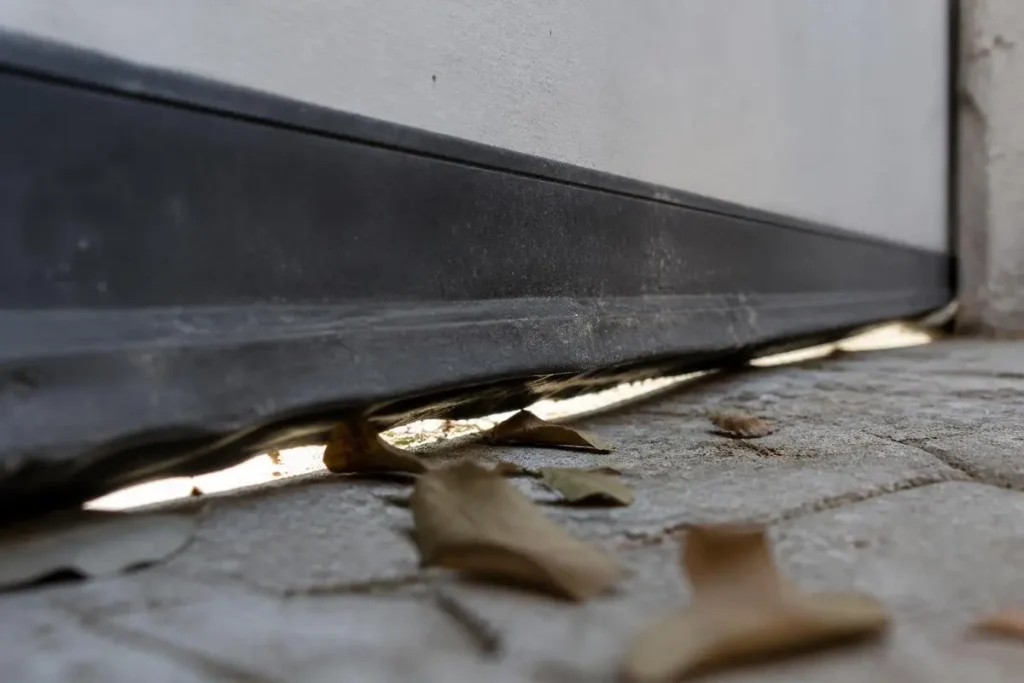
Seals deserve the first look. PNNL’s photo of one bottom seal shows a 4-inch gap in a corner, where the gasket was cut short and rodents chewed it. If you see daylight under the closed door, replace the bottom gasket and side stops before buying foam; a blower door test during an energy audit shows how much air the garage trades with the house.
Sealing also protects air quality. PNNL says the air barrier between garage and house keeps “car exhaust and chemical fumes” out of the home; pair it with the ventilation rules for attached garages and correct CO alarm placement.
When does insulating a garage door pay off?
It pays when the garage is heated, cooled or shares a wall or floor with bedrooms, and fastest on a bare single-layer door. In an unheated detached garage the energy return is small.
Fix the true boundary first. PNNL says an attached garage “is still outside the thermal envelope of the home,” so shared walls and floors above need insulation and air sealing. Check how much ceiling insulation your climate zone calls for and how many US homes fall short.
- Heated workshop or gym: insulate the door and replace the seals; in our example the bare door alone costs $260.96 per 1,000 hours of electric heat.
- Bedroom over the garage: air seal and insulate that floor first, then add door insulation to cut heat moving into the house.
- Unheated garage with plumbing or a freezer: an insulated, sealed door keeps the space closer to house temperature.
- Mild climate with a parked car only: weatherstrip first, and leave foam for the day the door is replaced.
A plug-in heater pays the same per kWh as the table, as our space heater running costs show. For water lines in garage walls, check the temperature at which pipes freeze.
How we researched this
Research date: October 30, 2026. We opened 18 sources, including three ranking articles (Bob Vila, Family Handyman, PNNL), and cite 11. U-factors come from the CEC JA4 door table (ASHRAE 90.1-2007 defaults) and ICC-ES TPVP-102 (ANSI/DASMA 105 tests); the arithmetic is ours.
Excluded: vendor installed prices (no federal series), unsourced “12 degrees warmer” claims on ranking pages, and heat carried by leaking air, for lack of a federal source for the air heat constant. Reddit returned no usable threads.
Frequently asked questions
What R-value should a garage door have?
No residential code sets one. DASMA’s 2024 code summary says residential garage doors need not meet any U-factor; testing applies where the garage is heated or air conditioned. Compare tested U-factors instead: a 1-3/8 in EPS door at U-0.179 cuts conduction 87.7% against bare steel.
Is it worth insulating a garage door if the garage is not heated?
Usually only a little. PNNL treats an attached garage as outside the home’s thermal envelope, so the shared wall and ceiling protect the house. An insulated door still keeps the garage closer to indoor temperature and, per PNNL, lessens heat transfer into the house. Start with the seals.
Do garage door insulation kits work?
Rigid foam kits do. The California Energy Commission JA4 table rates a single-layer steel sectional door with 1-3/8 in of expanded polystyrene at U-0.179, against U-1.45 bare. On a 16 x 7 ft door at a 30°F difference, conduction drops from 4,872 to 601 Btu/h. Foam can only be as thick as the door’s pans.
Does foil or bubble insulation work on a garage door?
Only partly. DOE says radiant barriers reflect radiant heat but do not reduce conduction like thermal insulation, and the reflective surface must face an air space. DOE also says that in cool climates more thermal insulation is usually more cost-effective than a radiant barrier.
Is polyurethane better than polystyrene in a garage door?
Per inch, yes. DASMA’s worked example uses a polyurethane conductivity of 0.12, about R-8.3 per inch, while the JA4 table assumes R-4 per inch for expanded polystyrene. Tested 1-13/16 in polyurethane doors measure U-0.12, against U-0.179 for the JA4 EPS door. Thickness and thermal breaks matter too.
How do I stop drafts under my garage door?
Replace the bottom seal. PNNL says to replace weatherstripping that is cracked or peeling, or if daylight shows under the closed door. Steel doors usually hold a U-shaped rubber gasket in a two-channel aluminum strip; brush out the grooves and use silicone lubricant to slide the new one in.
Sources
- DOE/PNNL Building America Solution Center. “Insulate and Weatherstrip a Garage Door.” https://basc.pnnl.gov/diy-guides/insulate-and-weatherstrip-garage-door. Accessed October 2026.
- DOE/PNNL Building America Solution Center. “Floor Above Garage.” https://basc.pnnl.gov/resource-guides/floor-above-garage. Accessed October 2026.
- DASMA. “TDS #163: U-factor and R-value for Residential and Commercial Garage Doors.” https://www.dasma.com/wp-content/uploads/2022/09/TDS163..pdf. Accessed October 2026.
- DASMA. “TDS #196: U-factor on Garage Doors and the Thermal Performance Verification Program.” https://dasma.com/wp-content/uploads/2024/07/TDS196.pdf. Accessed October 2026.
- DASMA. “Tech Corner: Doors in the energy codes.” Door + Access Systems, Spring 2024. https://www.dasma.com/wp-content/uploads/2024/03/TechCorner_Spring2024.pdf. Accessed October 2026.
- ICC Evaluation Service. “TPVP-102: Wayne-Dalton Thermal Performance Ratings, reissued March 2026.” https://icc-es.org/wp-content/uploads/report-directory/TPVP-102.pdf. Accessed October 2026.
- California Energy Commission. “2025 Reference Appendices JA4, Table 4.5.1 Doors” (via Energy Code Ace). https://energycodeace.com/content/cy25-ja45-miscellaneous-construction-table-451-doors. Accessed October 2026.
- EIA. “Short-Term Energy Outlook, October 2026, Table 2.” https://www.eia.gov/outlooks/steo/xls/STEO_m.xlsx. Accessed October 2026.
- EIA. “British thermal units (Btu).” https://www.eia.gov/energyexplained/units-and-calculators/british-thermal-units.php. Accessed October 2026.
- DOE Energy Saver. “Radiant Barriers” (archived copy). https://web.archive.org/web/2025id_/https://www.energy.gov/energysaver/radiant-barriers. Accessed October 2026.
- DOE Energy Saver. “Electric Resistance Heating” (archived copy). https://web.archive.org/web/2025id_/https://www.energy.gov/energysaver/electric-resistance-heating. Accessed October 2026.
Leave a Reply