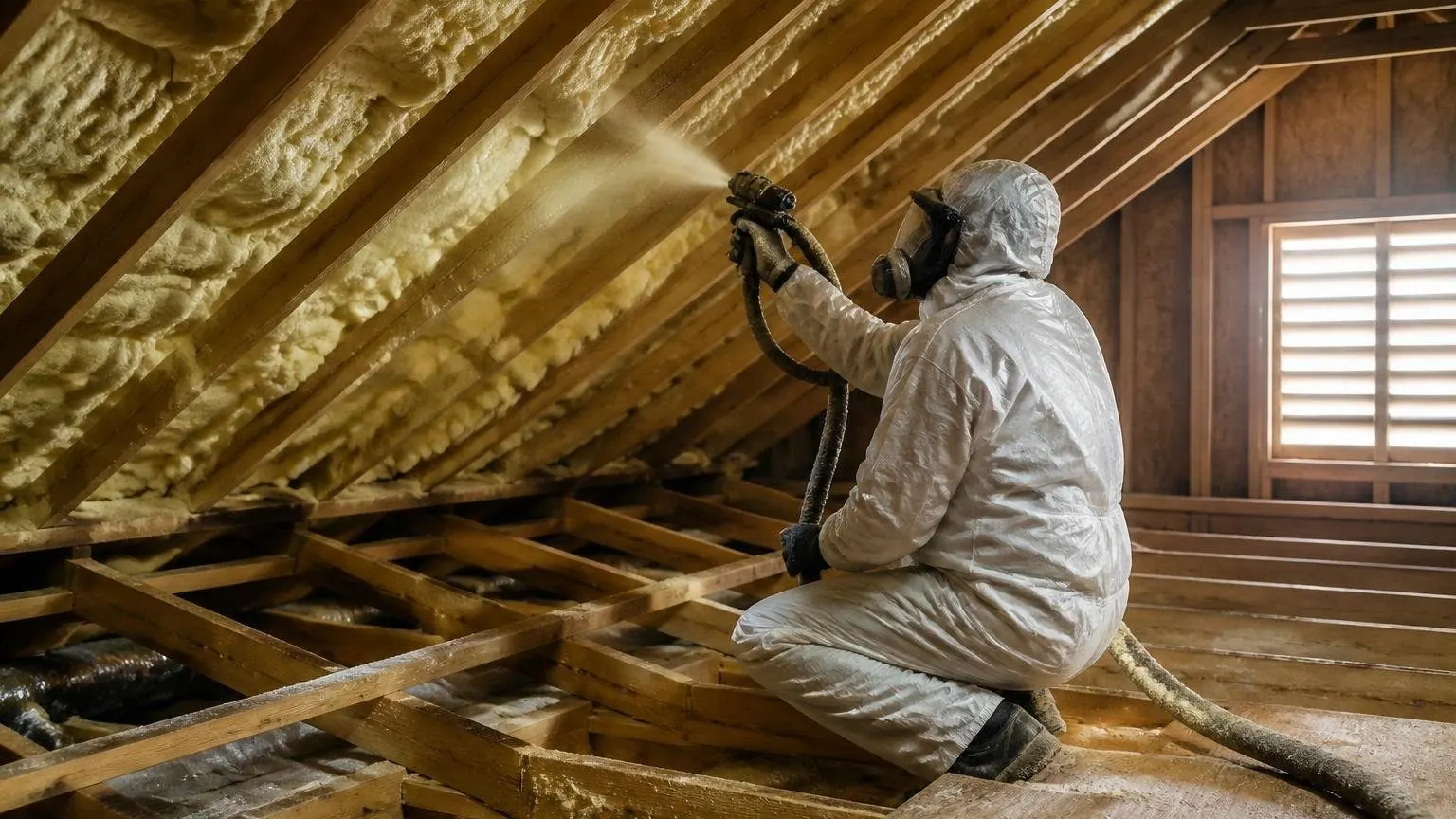
What is spray foam insulation? Spray foam insulation is polyurethane sprayed on as a liquid that expands, sticks and seals air leaks as it insulates. Open cell foam weighs about 0.5 lb per cubic foot and gives about R-3.6 per inch; closed cell weighs about 2 lb and gives about R-6.1 per inch, per a DOE Building America guide.
Key Takeaways
- A DOE Building America guide lists open cell foam at 0.5 lb/cf and R-3.6 per inch, closed cell at 2.0 lb/cf and R-6.1 per inch, both aged values (DOE Building America, 2009).
- The FTC R-value Rule makes installers list coverage area, thickness and R-value on a signed receipt, and bars multiplying the 1-inch R-value by the inches installed (16 CFR 460.17).
- Huntsman rates its HEATLOK HFO Pro closed cell foam at R-7.4 at 1 inch but R-23 at 3.5 inches, maker data (HFO Pro data sheet).
- Unless a product is tested otherwise, foam sits behind a 15-minute thermal barrier such as 1/2-inch gypsum board, with an ignition barrier path in service-only attics and crawl spaces under 2021 IRC R316.5.3 and R316.5.4 (ICC-ES ESR-1826).
- EPA notes some manufacturers recommend 24 hours before re-occupancy; that is maker guidance, not an EPA rule (EPA Safer Choice, archived).
- DOE’s Building America Solution Center says roof sheathing should be dry below 19% moisture before foam goes on (BASC).
What is spray foam insulation and how does it work?
Spray foam insulation is spray polyurethane foam (SPF): an isocyanate A side and a polyol blend B side, mixed at the gun so they react, expand and cure in place. It fills gaps as it rises, so it insulates and air seals in one step.
The DOE Building America guide says closed cell foam expands about 35 to 50 times its liquid volume and open cell about 150 times, so open cell can reach full thickness in one pass, generally up to 10 inches.
CPSC staff describe three product families: high-pressure two-part systems, low-pressure two-part kits, and one-component cans. Air sealing is the point: a blower door test shows where a house leaks, and our federal insulation numbers show how many homes are drafty.
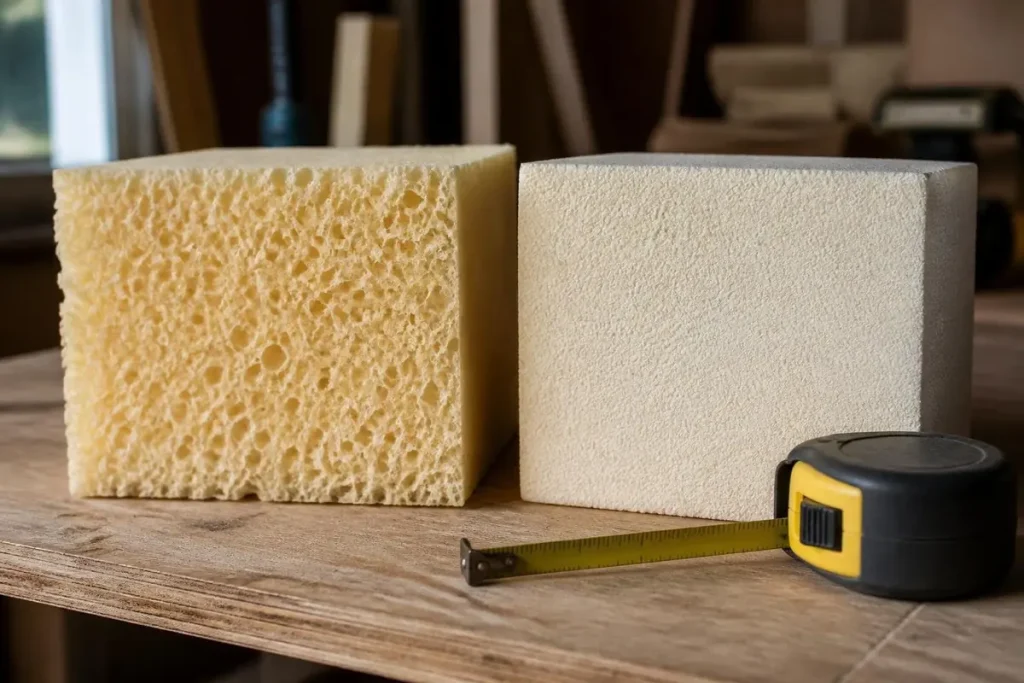
Open cell vs closed cell spray foam: how do they compare?
Closed cell foam is about four times denser, gives more R per inch, blocks vapor and stiffens framing. Open cell foam is cheaper per R, stays vapor open and can hold water. The DOE guide calls the two “not interchangeable in all applications.”
| Property | Open cell (half pound) | Closed cell (2 lb) |
|---|---|---|
| Density (ASTM D1622) | 0.5 lb/cf nominal | 2.0 lb/cf nominal |
| Aged R-value (ASTM C518) | R-3.6 per inch | R-6.1 per inch |
| Vapor permeance (ASTM E96) | 10 perms at 5 in | under 1 perm at 2 in |
| Liquid water | Can hold up to one-third of its volume | Hydrophobic, will not absorb water |
| Compressive strength | under 2.0 psi | 22 psi |
| Air barrier, named product | Classic Ultra: 3 inch minimum (ESR-1826) | HFO Pro: under 0.02 L/s·m² at 1 in (maker) |
| Cost per R, 2009 dollars | about $0.12 per R-1 per sq ft | about $0.20, about 60 percent more |
Row 6: ICC-ES and Huntsman; other rows: DOE Building America typical values.
What R-value does spray foam insulation really deliver?
Spray foam delivers the R-value in the maker’s tested table at the installed thickness, not the 1-inch figure multiplied out. The FTC R-value Rule spells it out for installers: “Do not multiply the R-value for one inch by the number of inches you installed.”
Huntsman’s HFO Pro data sheet shows why. It lists an aged R-7.4 at 1 inch but R-23 at 3.5 inches, where straight multiplication would claim R-25.9. Closed cell values also drift: DOE says most thermal drift happens within the first two years, while open cell foam blown with air holds its R-value.
Myth check
Top-ranking pages quote “R-7 per inch” as if any depth scales from it. Under 16 CFR 460.17 your receipt must state coverage area, thickness and R-value from the maker’s data. Check it against the product’s ICC-ES report.
Worked example: 1,000 sq ft of roof deck
A board foot is 1 square foot of foam 1 inch thick. Spraying 3.5 inches of closed cell under 1,000 sq ft of roof deck takes 3,500 board feet; 5.5 inches of open cell takes 5,500 board feet. Measure the deck, not the attic floor below it.
From the maker tables, HFO Pro at 3.5 inches is R-23 and Huntsman Classic Ultra open cell at 5.5 inches is R-20 (ESR-1826, Table 1). Both fall short of the attic targets in our climate zone R-value guide, so IRC R806.5 lets air-permeable insulation go under the foam.
The 2009 DOE guide quoted retail installed prices of $0.35 to $0.40 per board foot for open cell and $1.10 to $1.25 for closed cell, in 2009 dollars with no sample stated. Its lasting point: closed cell cost about 60 percent more per R. Our attic insulation cost review covers what the federal record says now.
What do building codes require for spray foam insulation?
Model codes treat spray foam as a combustible foam plastic that needs fire protection, and roofline foam must follow the unvented attic rules. Details depend on your local code edition and the product’s evaluation report.
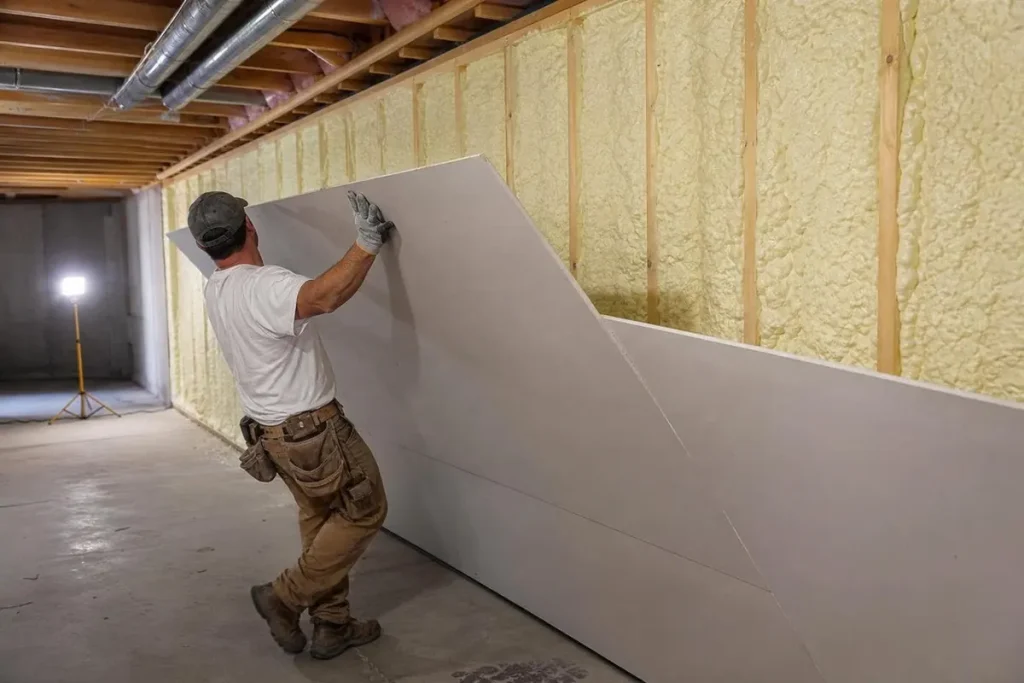
ICC-ES report ESR-1826 says the foam “must be separated from the interior of the building by an approved thermal barrier, such as 1/2-inch (12.7 mm) gypsum wallboard,” or an equivalent 15-minute barrier. In attics and crawl spaces entered only to service utilities, an ignition barrier under 2021 IRC R316.5.3 and R316.5.4 can serve instead. Some products are tested to go bare, but only with no storage and no air shared with the house.
For unvented attics, the BASC summary of IRC R806.5 says the attic must sit completely within the thermal envelope, and in Climate Zones 5, 6, 7 and 8 the foam must be a Class II vapor retarder or carry a Class II coating. Open cell foam usually needs that coating. Our guides to attic ventilation rules and sealed crawl spaces cover the vented alternatives.
- Confirm which IRC edition your jurisdiction enforces and whether the job needs a permit.
- Get the product’s ICC-ES report and check its minimum air barrier thickness and barrier rules.
- Have the roof sheathing measured below 19% moisture content before spraying.
- Plan the thermal or ignition barrier before the drywall schedule.
- Keep the signed FTC receipt with thickness and R-value for each area.
Is spray foam insulation safe to live with?
Cured spray foam is considered relatively inert, but installation is a chemical exposure event. EPA says inhalation exposures during SPF insulation “will typically exceed” OSHA occupational limits, so applicators need skin, eye and respiratory protection.
Re-occupancy time is maker guidance. EPA notes some manufacturers recommend 24 hours for professional high-pressure foam, but the time “may vary,” and some estimate 8 to 24 hours for one-component cans. CPSC staff say residents should vacate for at least 24 hours, and people with asthma or prior isocyanate sensitization may want other insulation.
The long-term risk is heat: EPA warns that drilling, sawing or welding on foam can release isocyanates and hydrogen cyanide.
Why is spray foam insulation called a red flag?
The “red flag” story is mostly British. In 2023 RICS, the UK surveyors’ body, noted concern in equity release lending “which is now having a wider impact on lenders.” This desk found no US federal lending rule that treats spray foam as a defect.
The US issue is building science. Foam under a roof deck hides the sheathing and slows drying. Building America modeling found foamed roofs dried out seasonally with wood moisture up to 18% or leaks up to 1%, but damage could occur beyond that. In Climate Zones 6, 7 and 8, Building Science Corporation recommends winter indoor humidity below 35%; see our indoor humidity targets.
CPSC staff add that there are “no standard processes for removal” of misapplied foam, so get the install right the first time.
When does spray foam make sense for your HVAC system?
Spray foam pays off for HVAC when it brings ducts and equipment inside the envelope. BASC says that with equipment and ducts inside the envelope, “conductive thermal losses are minimized” and duct leakage still conditions the house.
If ducts stay in a vented attic, sealing and insulating the ducts is the cheaper fix. In hot climates a radiant barrier is another option.
Envelope work shrinks the load, so insulate before you size new equipment.
Blowing agents changed too. Under 40 CFR 84.54, since January 1, 2025 no one may make or import rigid polyurethane spray foam that uses a regulated HFC with a GWP of 150 or greater.
How we researched this
Researched October 28, 2026. We read 15 sources and cite the 10 below; two more BASC guides, a Huntsman open cell sheet, an EPA product-type sheet and a DOE insulation-types page were consulted but not cited. Maker R-values are labeled maker data. Excluded: contractor cost surveys (no federal series), UK lender anecdotes, and Reddit, because the topic involves chemical exposure. The 2009 DOE prices are dated history.
Frequently asked questions
Does spray foam need a vapor barrier?
It depends on foam and climate. DOE Building America lists closed cell at under 1 perm at 2 inches, a vapor retarder, while open cell runs about 10 perms at 5 inches. Under IRC R806.5, roofline foam in Climate Zones 5 to 8 must be a Class II vapor retarder or be coated with one.
How long does spray foam take to cure?
Foam can feel tack free within seconds to minutes, but EPA says it is still curing and holds unreacted chemicals at that stage. Some manufacturers recommend 24 hours before re-entry for professional high-pressure foam, and estimate 8 to 24 hours for one-component cans.
Can spray foam go into existing walls?
Yes, with the right product. DOE Energy Saver (archived copy) says slow expanding foam is intended for cavities in existing homes, because it expands slowly and reduces the chance of damaging the wall. Standard open and closed cell foam goes into open cavities.
How thick must spray foam be to stop air?
It is product specific. ICC-ES ESR-1826 rates Huntsman Classic Ultra open cell foam as air impermeable at a minimum of 3 inches. Huntsman’s HFO Pro data sheet lists air permeance under 0.02 L/s·m² at 1 inch for its closed cell foam. Check the report for your exact product.
Does closed cell spray foam lose R-value over time?
Some. DOE Energy Saver (archived copy) says closed cell polyurethane can lose R-value as blowing gas escapes and air replaces it, and that most of this thermal drift occurs in the first two years. Open cell foam blown with air holds its R-value, per the same page.
Can I install spray foam myself?
Small jobs, with care. CPSC staff say the two-component high-pressure system should only be used by a trained applicator. Low-pressure kits and one-component cans are sold to consumers, but CPSC says the same precautions apply, and isocyanate safety data sheets recommend medical surveillance before working with them.
Sources
- DOE Building America (CARB, Steven Winter Associates). “Which Spray Foam Is Right For You?” 2009. www1.eere.energy.gov. Accessed October 2026.
- U.S. DOE Energy Saver. “Insulation Materials.” Archived copy. web.archive.org. Accessed October 2026.
- eCFR. “16 CFR 460.17, What installers must tell their customers.” ecfr.gov. Accessed October 2026.
- Huntsman Building Solutions. “HEATLOK HFO Pro Technical Data Sheet.” huntsmanbuildingsolutions.com. Accessed October 2026.
- ICC Evaluation Service. “ESR-1826,” reissued March 2026. icc-es.org. Accessed October 2026.
- U.S. EPA Safer Choice. “Potential Chemical Exposures From Spray Polyurethane Foam.” Archived. archive.epa.gov. Accessed October 2026.
- U.S. CPSC staff. “Spray Polyurethane Foam Insulation: Health and Safety Recommendations for Consumers.” cpsc.gov. Accessed October 2026.
- PNNL Building America Solution Center. “Unvented Conditioned Attic with Spray Foam Insulation Below Roof Deck.” basc.pnnl.gov. Accessed October 2026.
- RICS. “RICS release new spray foam consumer guide.” 2023. rics.org. Accessed October 2026.
- eCFR. “40 CFR 84.54, Restrictions on the use of hydrofluorocarbons.” ecfr.gov. Accessed October 2026.
Leave a Reply