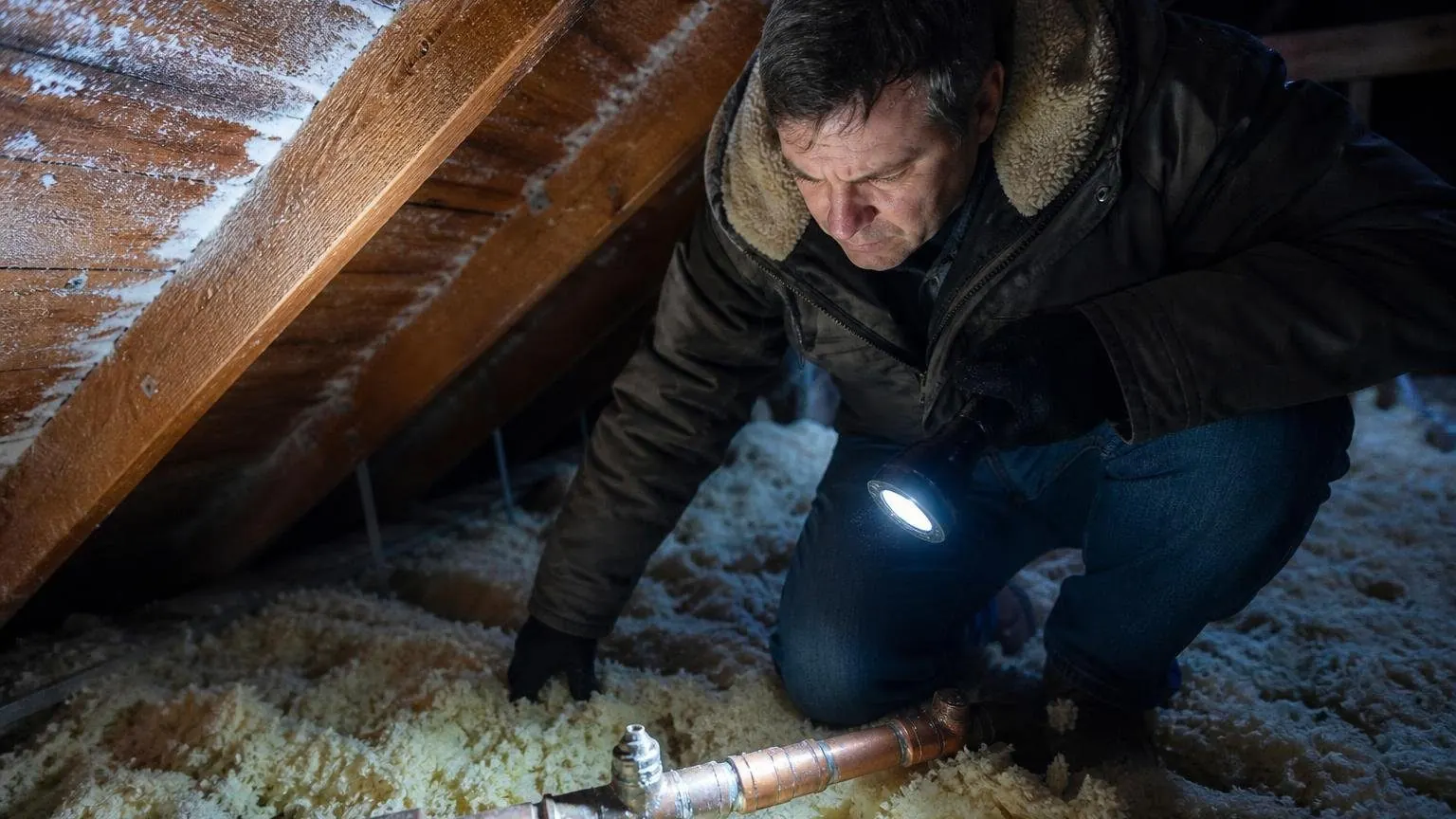
What temperature do pipes freeze? Water freezes at 32°F, but in University of Illinois field tests an uninsulated attic pipe did not start to freeze until the outdoor air fell to between 15.4°F and 20.1°F. That is where the 20°F rule comes from, and it describes a worst case, not a guarantee.
Key Takeaways
- The 20°F rule traces to University of Illinois Research Report 96-1 (1996), which proposed 20°F as a “temperature alert threshold” for the southern US.
- In 11 attic freeze events in 1995, the outdoor temperature when the uninsulated pipe began to freeze averaged 18.8°F.
- Pipes burst from water pressure trapped between an ice blockage and a closed faucet; one test pipe reached a maximum 4000 psi.
- The report still expects “isolated, infrequent” freezes between 20 and 32 °F.
- The American Red Cross and IBHS both say to keep the heat no lower than 55°F when you are away.
- Water damage and freezing claims averaged $15,400 over 2019 to 2023, per ISO data from Triple-I.
What temperature do pipes freeze at, exactly?
There is no single number. Water changes to ice at 32°F, but the air around a pipe is usually warmer than outdoors, and pipe water often cools below 32°F before any ice forms. The useful question is what outdoor temperature puts a given pipe at risk.
That depends on where the pipe runs. A pipe inside heated space can sit through a hard freeze; a pipe in a drafty crawl space can freeze well above 20°F. The 1996 University of Illinois report names outdoor temperature, placement in the shell, insulation, wind and indoor temperature as the factors.
What temperature do pipes freeze in the research behind the 20°F rule?
The 20°F figure comes from Research Report 96-1 by Jeffrey R. Gordon of the University of Illinois Building Research Council, written for the Insurance Institute for Property Loss Reduction, the 1990s name of today’s IBHS, per the IBHS history page. The report says State Farm Fire and Casualty sponsored the 1994 and 1995 tests.
Phase 2 ran pipes through a vented attic above R-30 fiberglass in early 1995. The report found “a remarkable consistency”: the uninsulated pipe started to freeze “just at or below 20 °F” outdoors. It proposed 20°F as an alert threshold for the southern US, based on this “worst case” pipe.
| Freeze event (1995) | Outdoor °F | Attic °F | Attic warmer by °F |
|---|---|---|---|
| 23 Jan | 16.5 | 21.0 | 4.5 |
| 29 Jan | 19.4 | 20.8 | 1.4 |
| 5 Feb | 19.9 | 23.5 | 3.6 |
| 7 Feb | 18.1 | 20.2 | 2.1 |
| 9 Feb | 15.4 | 19.5 | 4.1 |
| 11 Feb | 19.6 | 23.4 | 3.8 |
| 14 Feb | 19.2 | 23.9 | 4.7 |
| 1 Mar | 19.0 | 21.4 | 2.3 |
| 3 Mar | 19.6 | 23.5 | 4.0 |
| 8 Mar | 19.8 | 22.5 | 2.7 |
| 9 Mar | 20.1 | 22.3 | 2.2 |
| Average | 18.8 | 22.0 | 3.2 |
Source: Research Report 96-1, Table 5.
The report also expects freezes “between 20 and 32 °F,” noting that “holes in the exterior shell of a house can play a major role.” So 20°F is a warning trigger, not the temperature at which every pipe freezes.
Why do frozen pipes burst?
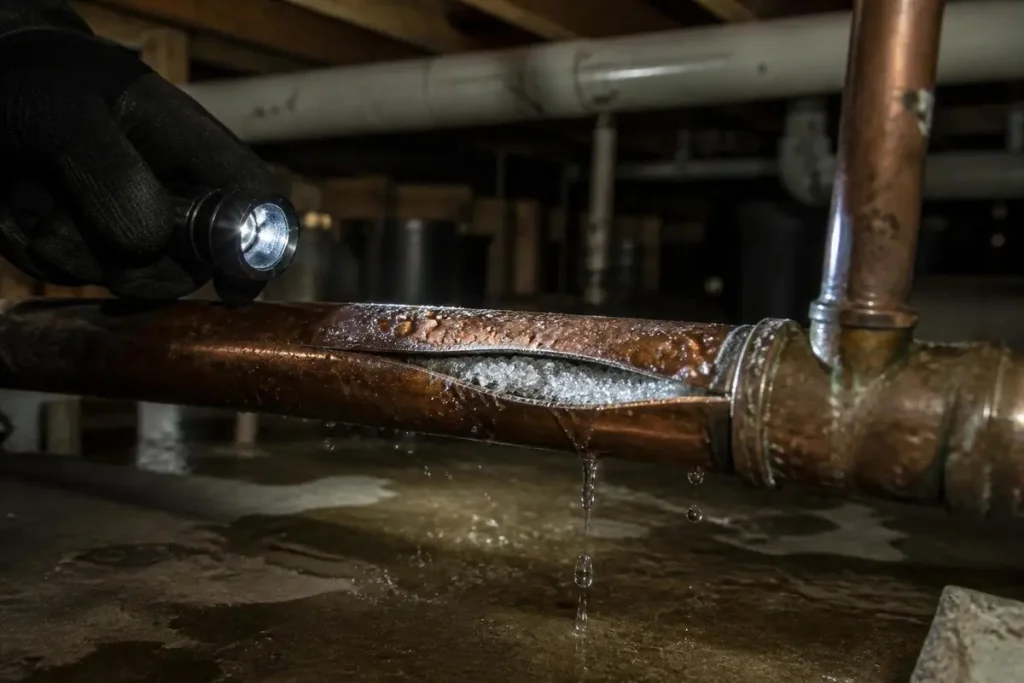
Frozen pipes burst from water pressure, not from ice pushing on the wall. The report: “freezing water pipes do not burst directly from physical pressure applied by growing ice, but from excessive water pressure.” Once ice blocks a pipe, water trapped between the blockage and a closed faucet has nowhere to go.
Ice expands by “approximately 8%,” and water barely compresses. In Figure 15, a 3/4 inch Type M copper pipe held about 42 psi for two and a half hours of ice growth, then climbed to a maximum 4000 psi and burst. The failure can come “even within the heated space of a building.”
Correction: why dripping works
Moving water does freeze. The report says flow “will delay freezing, but it may not prevent it in all cases.” A slightly open tap works because it relieves pressure at the far end of the line, so keep it open even if the drip stops.
How long does it take pipes to freeze and then burst?
Hours, and colder air shortens them. In freezer tests, a 1/2 inch PVC pipe with 3/8 inch foam insulation formed a full blockage in 11-1/2 hours at 20°F, 6 1/2 hours at 10°F and around 4-3/4 hours at 0°F.
In the 1995 attic tests, blockage to the start of deformation averaged 3 hours and 27 minutes for 3/4 inch Type M copper, with bursting “around four hours after blockage.” Water can also stay liquid below 32°F: attic pipes supercooled “for up to 80 hours at a time.”
Which pipes freeze first?
Pipes in unheated spaces and along exterior walls freeze first. The Red Cross lists hose bibs, pool and sprinkler lines, supply pipes in basements, crawl spaces, attics, garages and cabinets, and pipes against poorly insulated exterior walls. IBHS notes power outages can lead to frozen pipes, so a heated garage is only as safe as its heater.
| Risk factor | What the evidence shows | Source |
|---|---|---|
| Location in the shell | Placement in conditioned, heated space “remains the principal strategy” | Report 96-1 |
| Wind and air leaks | Many burst losses “are probably associated with wind and air leakage on uninsulated pipes” | Report 96-1 |
| Pipe insulation | Store sleeves of 1/8 to 5/8 inch rate R-0.5 to R-2.5; the report favors R-6 to R-8 | Report 96-1 |
| Region | Southern homes put more plumbing along exterior walls | IBHS, 2024 |
| Outdoor faucets | Homes built before 2010 typically lack frost-proof outdoor faucets | IBHS Winter Ready |
| Indoor setback | Turning the thermostat down while away multiplies the risk to vulnerable pipes | Report 96-1 |
A crawl space with open vents is the drafty case; see our guide to vented versus sealed crawl spaces. The IBHS Winter Ready guide says older homes, especially in Southern states, are more likely to have inadequate insulation.
Does pipe material change the temperature pipes freeze at?
Only slightly. Material changes how fast a pipe freezes and whether it survives the pressure. The report found PVC beat copper on thermal resistance, but “the difference is not overwhelming,” and “no bursts occurred in any of the PVC pipe tested.”
| Pipe (3/4 inch) | Working pressure | Burst pressure | Source |
|---|---|---|---|
| Type L copper | 1099 PSI | 5900 PSI | Copper Development Association, in Report 96-1 |
| Type M copper | 769 PSI | 4715 PSI | Copper Development Association, in Report 96-1 |
| PVC Type 1120 | 480 PSI | 6202 PSI (10 hour rating) | Plastic Pipe Institute, in Report 96-1 |
| Uponor PEX-a | Not compared | Maker says it expands “up to three times its diameter” | Uponor (manufacturer claim) |
The PEX row is a maker claim, not independent testing; Uponor also says its pipe withstood “400+ freeze/thaw cycles.” PEX still freezes, and its fittings still see the trapped pressure.
What does the building code require to stop pipes freezing?
In jurisdictions that adopt the International Residential Code, Section P2603.5 is the freeze protection section. The 2021 IRC sprinkler section, as reprinted by Seattle, says piping “shall be protected from freezing as required by Section P2603.5.”
The International Code Council’s summary of the 2012 IRC says buried water service pipe must sit at least 12 inches deep and 6 inches below the frost line, and quotes the IPC Commentary: “Insulation itself (without a heat source) cannot protect a pipe from freezing.” Section P2903.10 requires an inside stop-and-waste valve for hose bibbs subject to freezing. Local amendments vary.
How do you keep pipes from freezing, and what if one does?
Keep the pipe warm, give it pressure relief, and drain what you cannot heat:
- Keep the heat at 55°F or higher, even when nobody is home, as IBHS advises.
- Hold the same setting day and night during severe cold, the Red Cross advises.
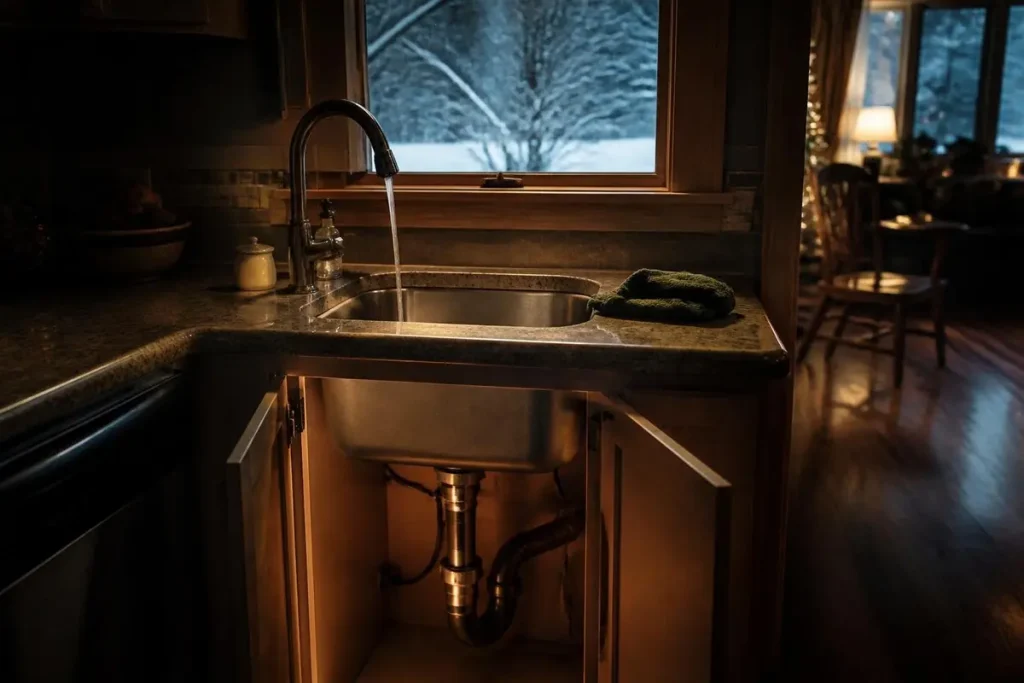
- Open sink cabinets on outside walls and let faucets drip, both hot and cold lines.
- Insulate attic, crawl space and garage pipes, and add UL-listed heat cable on exposed runs.
- Close the inside valve to each hose bib and leave the outside faucet open to drain.
- Away longer than a week in subfreezing weather? IBHS suggests closing the main valve slowly and draining faucets on the lowest floor.
A deep night setback is the wrong move in a cold snap (see our winter thermostat setback guide), and heat cable needs care; read our notes on installing heat tape on exposed pipe.
Heat is the first defense: work through a pre-season heating checklist, and give a plumbed basement its own basement heat source if it runs cold.
If the heat fails during a freeze, start with a furnace that will not ignite and what counts as an HVAC emergency.
To thaw a pipe, the Red Cross says to keep the faucet open and warm the section with a heating pad, hair dryer, hot wet towels or a space heater kept away from flammables, never an open flame; our space heater fire data shows why. A burst can hide: the report says the rupture is “initially sealed by the ice blockage,” and flooding starts at thaw.
Water damage and freezing made up 22.6 percent of homeowners losses in 2023, per Triple-I, a category that also counts other leaks and mold. Coverage turns on wording; see what homeowners policies cover.
How we researched this
Researched October 30, 2026. We downloaded and read the full 52-page text of Research Report 96-1 from the University of Illinois IDEALS repository, checking Tables 2 to 5 against page images. We consulted about 20 source pages and cited 9. Insurance figures come only from Triple-I’s ISO tables; contractor and plumber blogs were excluded as number sources. We found no national freeze-only claim series. Reddit was not used.
Frequently asked questions
Will pipes freeze at 32 degrees?
Usually not from that temperature alone, though exposed outdoor lines can. Research Report 96-1 expects only “isolated, infrequent” freezes at overnight lows between 20 and 32 °F, typically where wind or a hole in the building shell reaches a pipe.
How cold does it have to be for pipes to freeze in a house?
In the University of Illinois tests, an uninsulated pipe in a vented attic started freezing at outdoor lows from 15.4°F to 20.1°F, averaging 18.8°F. Pipes inside heated rooms need far colder weather or a heating failure.
Should I drip the hot or cold faucet?
Both, where both lines run through cold spaces. Report 96-1 notes hot and cold reach fixtures in separate lines, each of which can freeze. The Red Cross advises dripping cold water from faucets served by exposed pipes.
What temperature should I leave my house at in winter when I am away?
No lower than 55°F, say the American Red Cross and IBHS. For trips longer than a week with subfreezing weather forecast, IBHS also suggests closing the main valve slowly and draining faucets on the lowest floor.
Do PEX pipes freeze and burst?
PEX freezes like any water pipe. Uponor says its PEX-a expands up to three times its diameter without cracking, a manufacturer claim, not independent data. Fittings and valves on a PEX line can still fail under trapped pressure.
Can a pipe burst in a heated room?
Yes. The blockage can form in a cold attic or wall while pressure builds all the way to the closed faucet. Report 96-1 found failures “can occur in a part of the pipe section where almost no ice has formed.”
Sources
- Gordon, Jeffrey R., Building Research Council, University of Illinois. “An Investigation into Freezing and Bursting Water Pipes in Residential Construction,” Research Report 96-1 (1996). https://www.ideals.illinois.edu/items/54859. Accessed October 2026.
- American Red Cross. “Frozen Pipes.” https://www.redcross.org/get-help/how-to-prepare-for-emergencies/types-of-emergencies/winter-storm/frozen-pipes.html. Accessed October 2026.
- Insurance Institute for Business & Home Safety. “Among most common insurance claims, frozen pipes, leaky roofs cause interior water damage” (November 14, 2024). https://ibhs.org/ibhs-news-releases/ibhs-winter-weather-ready-guide-provides-easy-to-do-actions-to-help-prevent-property-damage-from-colder-temperatures/. Accessed October 2026.
- Insurance Institute for Business & Home Safety. “Winter Ready.” https://ibhs.org/winter-ready. Accessed October 2026.
- Insurance Institute for Business & Home Safety. “Our Story.” https://ibhs.org/our-story/. Accessed October 2026.
- Insurance Information Institute (Triple-I). “Facts + Statistics: Homeowners and renters insurance.” https://www.iii.org/fact-statistic/facts-statistics-homeowners-and-renters-insurance. Accessed October 2026.
- International Code Council. “Build It to Code to Minimize Damage from Frozen Water Pipes,” ICC eNews (2014). https://media.iccsafe.org/news/eNews/2014v11n3/techsvcs.html. Accessed October 2026.
- City of Seattle. “2021 Seattle Residential Code, Chapter 29: Water Supply and Distribution.” https://www.seattle.gov/documents/Departments/SDCI/Codes/SeattleResidentialCode/2021SRCChapter29.pdf. Accessed October 2026.
- Uponor. “The Incredible Resilience of Uponor PEX-a in Freezing Conditions.” https://www.uponor.com/en-us/solutions/uponor-pex/freeze-resilience. Accessed October 2026.
Leave a Reply