How much heat tape do you need for pipes? A thermostat cable such as EasyHeat AHB is bought to match the pipe length and runs straight along it, valves included. Self-regulating Raychem Frostex needs 1 to 3 straight runs of the pipe length, set by pipe size, insulation and the coldest night, plus 1 foot per valve. Plug either into a GFCI outlet.
Key Takeaways
- CPSC estimated 3,300 residential heat tape fires a year, with 20 deaths and 160 injuries, in release 90-162 (1990).
- Its 1996 estimate was 1,500 fires a year, and it urged replacing uncertified tapes more than 3 years old (CPSC 96-062).
- Self-regulating Raychem Frostex cable puts out 3 watts per foot at 50°F, and more as the pipe cools (Chemelex).
- Constant wattage EasyHeat AHB cable runs at 7 watts per foot whenever its thermostat closes at 38°F (distributor spec).
- At 18.04 cents per kWh (EIA, 12 months to August 2026), 20 feet of 7 W/ft cable running 30 days nonstop costs about $18.18.
- Frostex needs 1 straight run on 3/4 in metal pipe under 1/2 in insulation down to 0°F, but 2 runs on the same size in plastic, per the Chemelex sizing table.
- NEC Section 427.22 requires ground-fault protection on pipeline heat trace, as EC&M restates it.
What is heat tape for water pipes, and how does it work?
Heat tape for water pipes is an electric cable that lies against a pipe and warms it just enough to stop the water freezing. Most residential kits plug into a 120 volt outlet and switch on through a built-in thermostat or a self-regulating core. The same cable is one fix for a furnace condensate line frozen where it runs through a cold space, along with rerouting or insulating that section. Before a line freezes, a condensing furnace often gives an audible warning, and furnace exhaust pipe gurgling traces that sound to water held in a sagging or flat vent run.
It belongs on the pipes the American Red Cross says freeze most often: supply lines in unheated basements, crawl spaces, attics, garages and cabinets, and pipes against poorly insulated exterior walls. How a crawl space is vented or sealed decides how cold its pipes get. University of Illinois field tests on attic pipes are the source of the usual rule of thumb for what temperature pipes freeze at.
How much heat tape do I need?
It depends on the cable. Thermostat-controlled constant wattage kits are sold by pipe length and run once, straight along the pipe; EasyHeat’s AHB owner’s manual says to measure “straight along the bottom of a horizontal pipe or on the ‘weather side’ of a vertical pipe (including valves)” and buy the model whose range covers it. Self-regulating cable is cut to length, and Chemelex’s Frostex data sheet gives the number of straight runs from pipe material, pipe size, insulation and the lowest expected temperature, noting the cable “is designed to be run straight along the pipe, not spiraled.”
Then add the extras. The Frostex 9800 FlexFit plug kit instructions say to “add one extra foot (30 cm) for each valve in your line,” one more foot for the power connection, and 2 feet for a crock, and never more than 50 feet of cable per plug. Their worked example lands at 27 feet for 10 feet of 1-1/2 inch plastic pipe with one ball valve, using that 2013 edition’s spiral factor of 2.5 feet per foot; the 2025 data sheet’s straight-run table gives 3 runs, or 32 feet, for the same pipe at -20°F.
Heat tape length and running cost calculator
Pick the cable type, describe the pipe, then set your electricity price. Length follows each maker’s own sizing rules; cost is watts × hours × your price.
Self-regulating: straight runs from the Chemelex Frostex data sheet H57419 Table 1, plus 1 ft per valve or spigot and 1 ft for the power connection from the Frostex 9800 FlexFit plug kit instructions, 50 ft maximum per plug. Thermostat cable: the EasyHeat AHB model whose pipe range covers your length (owner’s manual Rev 12, Appendix A), valves included in the measured length, 7 W/ft (EasyHeat catalog). Default price: EIA residential average, 12 months to August 2026. 24 hours is a ceiling: a thermostat cable is off above 45°F and a self-regulating one draws less as the pipe warms.
| Insulation | Pipe size | Metal pipe: runs at 20 / 0 / -20 / -40°F | Plastic pipe: runs at 20 / 0 / -20 / -40°F |
|---|---|---|---|
| 1/2 in | 1/2 in | 1 / 1 / 2 / 2 | 1 / 2 / 2 / x |
| 1/2 in | 3/4 in | 1 / 1 / 2 / 2 | 1 / 2 / 2 / 3 |
| 1/2 in | 1 in | 1 / 2 / 2 / 2 | 1 / 2 / 3 / 3 |
| 1/2 in | 1-1/4 in | 1 / 2 / 2 / 3 | 2 / 2 / 3 / x |
| 1/2 in | 1-1/2 in | 1 / 2 / 3 / 3 | 2 / 3 / 3 / x |
| 3/4 in | 1/2 in | 1 / 1 / 1 / 2 | 1 / 2 / 2 / 2 |
| 3/4 in | 3/4 in | 1 / 1 / 2 / 2 | 1 / 2 / 2 / 3 |
| 3/4 in | 1 in | 1 / 1 / 2 / 2 | 1 / 2 / 2 / 3 |
| 3/4 in | 1-1/4 in | 1 / 2 / 2 / 2 | 1 / 2 / 3 / 3 |
| 3/4 in | 1-1/2 in | 1 / 2 / 2 / 3 | 2 / 3 / 3 / x |
| 1 in | 3/4 in | 1 / 1 / 1 / 2 | 1 / 1 / 2 / 2 |
| 1 in | 1 in | 1 / 1 / 2 / 2 | 1 / 1 / 2 / 2 |
| 1 in | 1-1/4 in | 1 / 1 / 2 / 2 | 1 / 2 / 2 / 3 |
| 1 in | 1-1/2 in | 1 / 1 / 2 / 2 | 1 / 2 / 3 / 3 |
| 1 in | 2 in | 1 / 2 / 2 / 2 | 1 / 2 / 3 / 3 |
| 1-1/2 in | 3/4 in | 1 / 1 / 1 / 1 | 1 / 1 / 1 / 2 |
| 1-1/2 in | 1 in | 1 / 1 / 1 / 1 | 1 / 1 / 2 / 2 |
| 1-1/2 in | 1-1/4 in | 1 / 1 / 1 / 1 | 1 / 1 / 2 / 2 |
| 1-1/2 in | 1-1/2 in | 1 / 1 / 1 / 2 | 1 / 1 / 2 / 2 |
| 1-1/2 in | 2 in | 1 / 1 / 2 / 2 | 1 / 2 / 2 / 3 |
Compiled by The HVAC Brief from Chemelex Raychem Frostex data sheet H57419 (2025), Table 1. One run equals the pipe length; x means Chemelex shades the box “Increase insulation thickness.”
| Pipe length, valves included | EasyHeat AHB single cable |
|---|---|
| 3 to 4 ft | AHB013 |
| 3 to 7 ft | AHB016 |
| 6 to 10 ft | AHB019 |
| 9 to 13 ft | AHB112 |
| 12 to 16 ft | AHB115 |
| 15 to 19 ft | AHB118 |
| 21 to 25 ft | AHB124 |
| 27 to 31 ft | AHB130 |
| 37 to 41 ft | AHB140 |
| 57 to 61 ft | AHB160 |
| 77 to 81 ft | AHB180 |
Compiled by The HVAC Brief from the EasyHeat AHB owner’s manual, Rev 12, Appendix A. Lengths in the gaps need two cables on opposite sides of the pipe, per the manual. AHB covers pipe from 3/8 to 1-1/2 in.
Two rules cap what one cable can do. AHB cable may double back up to 3 feet on the opposite side of the pipe and must never touch or cross itself, and the manual lists pipe from 3/8 to 1-1/2 inches only. Frost King’s heat cable instruction sheet uses the same idea with its own chart of one or two cables by pipe length and diameter, and says the cable “must not be wrapped or spiraled.”
Can you leave heat tape plugged in all winter?
Yes for thermostat and self-regulating cables, if you check them. EasyHeat’s AHB manual says the cable “can remain installed year round. The thermostat will shut off the cable when heat is not needed,” and asks for an inspection at the start of the season and monthly during operation. The Frostex instructions say the system “can be left plugged in all year, but you will save energy by unplugging the system when the weather is not freezing.”
The exception is cable with no control. EasyHeat says to disconnect HB cable at season’s end once air stays above 50°F. CPSC’s 1990 release found heat tapes “plugged in year-round” in many homes, and that some owners did not know a heat tape was installed at all, which is why the yearly inspection matters more than the plug. A light in the AHB plug shows the cable has power; if it is out, the GFCI may have tripped and the pipe is unprotected. If that line has already frozen, how to thaw frozen pipes starts by opening the faucet it feeds and warming it with a heating pad, a hair dryer or hot wet towels, never an open flame. For a house that will sit empty with the heat off, winterizing a house with no heat drains the lines instead, so a tripped cable or lost power leaves no water behind to freeze.
How hot does heat tape get, and can it start a fire?
Heat tape is meant to hold a pipe just above freezing, not to get hot. The AHB thermostat switches on below 38°F and off once the pipe reaches about 45°F, per its EasyHeat catalog page. Frostex has no thermostat; its output graph falls from about 5 W/ft with a 0°F pipe to about 1 W/ft at 100°F (read from Chemelex’s Graph 1), and the instructions warn that exposure above 150°F “will shorten the life” of the cable.
It can start a fire when damaged or buried in too much insulation. CPSC’s 1989 release says “Over-insulation can cause a fire,” and Chemelex requires ground-fault protection because arcing from a damaged cable “may not be stopped by conventional circuit protection.” EasyHeat and Frost King both specify tape rated at least 176°F to hold the cable, and EasyHeat caps insulation at 1/2 inch of fiberglass or non-flammable foam.
Is heat tape safe? What the CPSC fire data shows
Heat tape is safe when it is certified, matched to the pipe and installed to its instructions; the federal fire record comes from tapes that were not. CPSC estimated about 3,300 residential fires a year in 1990 and 1,500 a year in 1996.
The 1990 estimate, built from US Fire Administration and NFPA data, also counted 20 deaths and 160 injuries a year (CPSC release 90-162, dated October 18, 1990, filed on CPSC’s site under 1991). The 3,300 figure first appeared a year earlier, in release 89-088 of October 6, 1989, which CPSC files under 1990. The 1990 release adds that data were gathered over six years and that “over half the fires involved mobile homes and trailers.” These are the newest CPSC heat tape estimates we could find, so treat them as a historical baseline. Our heating fire statistics by equipment type cover other heating equipment.
The 1996 release followed a Philadelphia Zoo fire that killed 23 primates. CPSC’s advice: replace uncertified tapes more than 3 years old with ones certified by UL, CSA or FMRC. CPSC also tracks cooling equipment, and its air conditioner fire statistics show fans starting more home fires each year than air conditioners.
We also searched all 10,039 records in CPSC’s recall database, June 1973 to October 1, 2026. None was a heat tape or pipe heating cable recall, so the risk lies in installation and age, not in a recall list.
Self-regulating vs constant wattage heat tape for water pipes: which should you buy?
Self-regulating cable is the safer pick for most homes, because its output falls as the pipe warms. Constant wattage cable puts out the same heat per foot whenever it is on, so its spacing, overlap and insulation rules are stricter. Heavier electric cable set in concrete does a different job, melting snow on a heated driveway.
Chemelex’s Frostex data sheet puts it plainly: “As the environment becomes colder, cable resistance decreases to generate greater heat.” The products below are examples, not endorsements.
| Cable type (example) | How output is controlled | Rated output | Plastic pipe | Insulation over it |
|---|---|---|---|---|
| Self-regulating (Raychem Frostex) | Polymer core adjusts output along its length | 3 W/ft at 50°F, 120 V | Yes; more runs needed | Designed for insulated pipe; run straight, not spiraled |
| Constant wattage, built-in thermostat (EasyHeat AHB) | On at 38°F or below, off at 45°F and above | 7 W/ft, 120 V | Yes, up to 1-1/2 in. | Per the instructions in the box |
| Constant wattage, no thermostat (EasyHeat HB) | Separate thermostat or a watched pilot light | 7 W/ft, 120 V | No; metal only | Never |
The HB installation instructions say the cable is for “metal water pipes only” and must never be energized above 50°F.
Which is the best heat tape for water pipes? For most houses, a self-regulating or thermostat-controlled cable that is listed for the pipe material, sized to the pipe, and protected by a GFCI. On the documents we read: Frostex carries a UL listing as “Residential and Mobile Home Pipe-Heating Cable” and ships with a 27 mA ground-fault plug; AHB is “UL Listed to Canadian Safety Standards and CSA Certified” for water-filled metal or plastic pipe up to 1-1/2 in, with a one-year limited warranty. Skip any cable whose label does not name your pipe, and never use pipe cable on gutters, driveways or fuel lines, as CPSC warns.
How to install heat tape on water pipes, step by step
To install heat tape on water pipes, lay a certified cable directly on the bare pipe, keep it from crossing itself, tape it down, insulate only as allowed and plug it into ground-fault protection. This order follows CPSC and EasyHeat HB guidance. Air leaks near the pipe matter as much as the cable, and spray foam insulation seals those gaps as it insulates, though code generally wants it behind a thermal barrier.
- Buy the right cable. Look for a UL, CSA or FM mark, sized to the pipe’s diameter and length, as CPSC advises.
- Prepare the pipe. Remove old tape, file sharp edges, clear combustibles and fix leaks.
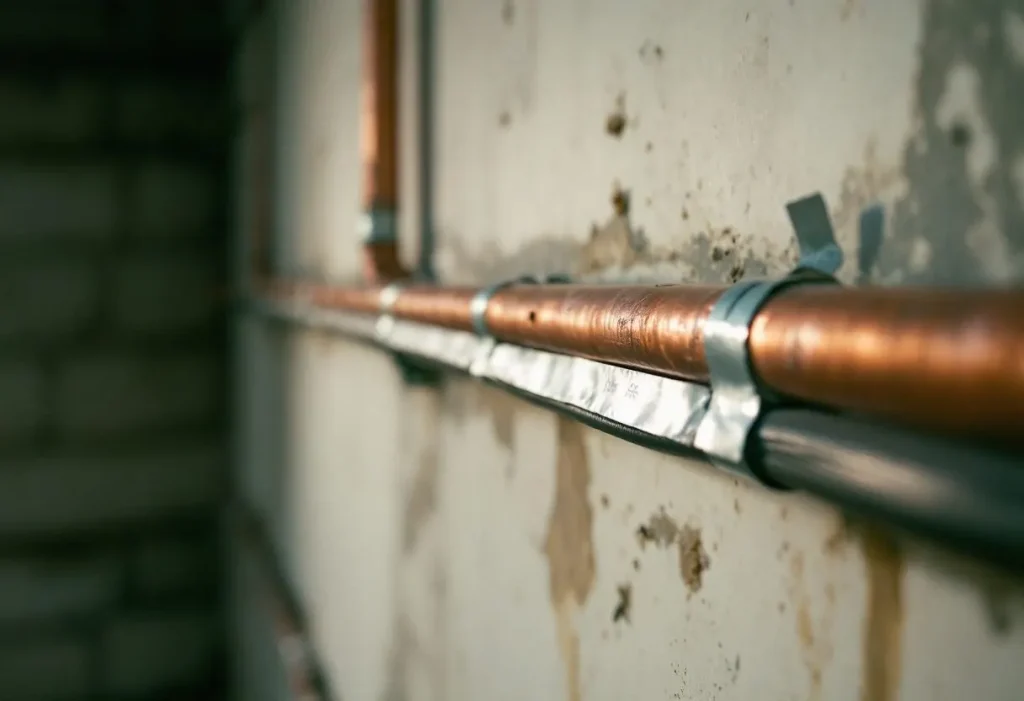
- Lay it on bare pipe. Never on top of pipe insulation. Run it straight or spiral it only as the instructions show.
- Never wrap it over itself unless the instructions permit it. HB cable needs a 1/2 inch minimum gap between spiral turns.
- Tape it down with electrical tape, about every six inches for HB cable, never metal binding.
- Insulate only if allowed. CPSC says use non-flammable fiberglass, not foam or vinyl, and keep the end cap sealed and off the ground.
- Plug in and inspect. Use a grounded GFCI outlet, and check the cable each year for charring, cuts or bare wire.
Safety correction
Sliding a foam sleeve on first and wrapping tape over it is backwards. CPSC says tape goes on the bare pipe, and its 1989 release 89-088 warned that “Over-insulation can cause a fire.”
Can you put heat tape on PVC or PEX plastic pipe?
You can put heat tape on PVC or PEX only if its label says it is rated for plastic pipe. EasyHeat’s HB sheet says “Do not use on plastic pipes,” while its AHB line is listed for metal and plastic pipe up to 1-1/2 inches.
Plastic spreads heat poorly, so it needs more cable. In the Frostex sizing table, a 3/4 inch pipe under 1/2 inch of insulation needs one run at 0°F if metal but two runs if plastic.
Sometimes the better fix is warmth, not cable: keeping an attached garage above freezing, as in our garage heating and cooling guide, or adding the insulation our home insulation data shows many houses lack.
Does heat tape need a GFCI outlet, and can you use an extension cord?
Yes, heat tape needs ground-fault protection. CPSC’s 1996 guidance says to plug heat tapes into a GFCI-protected outlet using the 3-prong plug, and EasyHeat warns that fault current from a damaged cable “may not be large enough” to trip a conventional circuit breaker. Space heaters raise the reverse puzzle, and a space heater tripping the breaker explains why a GFCI outlet can trip while the breaker in the panel holds. Electric floor heating builds the same protection into its thermostat, and electric floor heating not working explains when a single reset of that red light is enough and when a trip on the next heat call points to the cable.
EC&M’s 2025 code quiz restates NEC Section 427.22 as requiring ground-fault protection of equipment on pipeline heat trace. Chemelex builds a 27 mA ground-fault plug into each Frostex kit. Adopted NEC editions vary, so check with your local inspector.
Extension cords are a gray area: popular guides say never, while EasyHeat’s HB sheet allows only a properly sized, grounded, certified outdoor cord. A GFCI outlet within reach is safer, the same logic as our space heater safety advice. A GFCI that keeps tripping is a warning, like a breaker that keeps tripping.
What’s better than heat tape?
Heat, insulation and a moving trickle of water, where you can get them. The American Red Cross’s frozen pipe guidance (archived copy) lists adding insulation to attics, basements and crawl spaces, a pipe sleeve, letting cold water drip from a faucet served by exposed pipes in very cold weather, and keeping the heat at 55°F or higher when you are away; it names UL-listed heat tape or heat cable as one option among those. Our guide to the temperature pipes freeze at explains why a pipe in an unheated space freezes before the house does. A long outage removes that protection, and South Carolina customers averaged 52.6 hours without power in 2024, per EIA reliability data ranked by state.
Insulation also cuts how much cable you need. In the Frostex table, a 1 in metal pipe at -20°F needs 2 runs under 1/2 in insulation but 1 run under 1-1/2 in. Where a pipe can be moved inside the heated envelope, nothing needs to be plugged in at all.
How much does heat tape cost to run?
Heat tape costs about $0.91 per foot per month if a 7 W/ft cable runs nonstop for 30 days at the US average residential price of 18.04 cents per kWh for the 12 months to August 2026. Self-regulating cable at its 3 W/ft rating costs well under half that.
The method: watts per foot times feet times hours, divided by 1,000, gives kWh; multiply by your price. Ours is from EIA’s Electric Power Monthly Table 5.3, which now lists the final 2025 average at 17.23 cents; the calculator above takes any price; swap in your local rate from our electricity prices by state.
| Cable and length | Watts drawn | kWh per 30 days, nonstop | Cost at 18.04 cents/kWh |
|---|---|---|---|
| 7 W/ft constant wattage, 10 ft | 70 W | 50.4 | $9.09 |
| 7 W/ft constant wattage, 20 ft | 140 W | 100.8 | $18.18 |
| 7 W/ft constant wattage, 50 ft | 350 W | 252.0 | $45.46 |
| 3 W/ft self-regulating at 50°F, 20 ft | 60 W | 43.2 | $7.79 |
Those are ceilings for constant wattage cable, since the AHB thermostat shuts off at 45°F, and floors for self-regulating cable in hard cold. Unplugging at season’s end, as the HB sheet advises once air stays above 50°F, ends the cost.
Cheaper protection comes first, as the section above on alternatives sets out. The Red Cross advises keeping the house at 55°F or warmer when you travel in cold weather; our winter thermostat settings guide covers the tradeoff. A home energy audit finds the air leaks that chill pipe runs.
How we researched this
Research date: October 8, 2026, updated November 12, 2026. For this update we re-read CPSC releases 89-088 and 90-162 to settle which carries the 3,300 fires figure (both do; 90-162 adds deaths, injuries and losses), read the Frostex data sheet sizing table and the Frostex 9800 plug kit instructions, the EasyHeat AHB owner’s manual (Rev 12) and catalog page, Frost King’s heat cable sheet, the Red Cross frozen pipe page (archived copy) and EIA’s latest Table 5.3. Earlier we read four CPSC heat tape releases (1989 to 1996), cited three, and queried all 10,039 records in CPSC’s recall web service ourselves. Ratings come from the Chemelex Frostex data sheet and EasyHeat documents; products are examples, not recommendations. Costs use EIA’s residential average for the 12 months to August 2026 (preliminary). The calculator’s Frostex lengths combine the 2025 data sheet’s straight-run table with the valve and plug allowances in the 2013 plug kit instructions, which used a spiral method; we flag that mix rather than hide it.
Excluded: contractor and lead-generation pages, law firm pages repeating unsourced fire counts, and vendor price surveys; no federal series publishes installed heat tape prices. NFPA 70 is not openly readable, so NEC 427.22 is attributed to EC&M. Reddit was skipped for this electrical fire safety topic.
Frequently asked questions
Does heat tape go under or over pipe insulation?
Under. CPSC says to apply heat tape directly on the pipe, never on top of the insulation covering it. Insulation then goes over the tape only if the manufacturer allows it, and CPSC recommends non-flammable fiberglass rather than foam or vinyl. Some cables, such as EasyHeat HB, must never be insulated at all.
Does heat tape raise your electric bill?
Some. Twenty feet of 7 W/ft cable drawing power around the clock uses 100.8 kWh in 30 days, about $18.18 at the 18.04 cent US average for the 12 months to August 2026 (EIA). A thermostat cable runs only below about 38°F, and self-regulating cable at 3 W/ft uses less than half as much.
How long does heat tape last?
No federal source sets a lifespan, but CPSC urged owners to replace uncertified heat tapes more than 3 years old with certified ones. It also says to inspect heat tapes each year and replace any showing discolored surfaces, especially at the plug, charring, cuts, breaks in the insulation or bare wires.
Can you cut heat tape to length?
Not constant wattage cable. EasyHeat’s HB sheet says never to alter the cable, because if it is made shorter it will overheat, and once cut it cannot be repaired. Self-regulating systems such as Frostex use a separate plug kit and end seal on each circuit, so follow that kit’s instructions exactly.
Can water pipe heat tape be used on gutters or a roof?
No. CPSC’s 1996 guidance says not to use heat tapes designed for water pipes on gutters, driveways or fuel lines. Roof and gutter de-icing cable is a separate product class with its own listing. Buy the cable that names your exact use on its label.
How much heat tape do I need for 100 feet of pipe?
More than one circuit. Frostex allows at most 50 feet of cable per plug, so 100 feet of 3/4 in metal pipe under 1/2 in insulation needs at least 100 feet of cable at 0°F (one run) and 200 at -20°F (two runs), split across 3 or more plugs once the plug allowance is added. The longest single EasyHeat AHB cable covers 77 to 81 feet of pipe.
How do you thaw a frozen pipe safely?
Keep the faucet open and warm the pipe with an electric heating pad, a hair dryer, a space heater kept clear of flammables, or hot wet towels, the American Red Cross advises. Never use a blowtorch, kerosene or propane heater, or any open flame. Call a licensed plumber if you cannot reach or thaw it.
Sources
- US Consumer Product Safety Commission. “Mobile Homes: Have Heat Tapes, Cables Checked For Fire Hazards” (release 90-162, October 18, 1990). https://www.cpsc.gov/Newsroom/News-Releases/1991/Mobile-Homes-Have-Heat-Tapes-Cables-Checked-For-Fire-Hazards. Accessed November 2026.
- US Consumer Product Safety Commission. “CPSC Re-Issues Heat Tape Guidelines In Wake Of Zoo Fire” (release 96-062, January 22, 1996). https://www.cpsc.gov/Newsroom/News-Releases/1996/CPSC-Re-Issues-Heat-Tape-Guidelines-In-Wake-Of-Zoo-Fire. Accessed November 2026.
- US Consumer Product Safety Commission. “Check Heat Tapes, Cables For Possible Fire Hazards” (release 89-088, October 6, 1989). https://www.cpsc.gov/Newsroom/News-Releases/1990/Check-Heat-Tapes-Cables-For-Possible-Fire-Hazards. Accessed November 2026.
- US Consumer Product Safety Commission. “Recalls REST web service” (SaferProducts.gov, queried October 8, 2026). https://www.saferproducts.gov/RestWebServices/Recall?format=json. Accessed October 2026.
- US Energy Information Administration. “Electric Power Monthly, Table 5.3: Average Price of Electricity to Ultimate Customers.” https://www.eia.gov/electricity/monthly/epm_table_grapher.php?t=epmt_5_3. Accessed November 2026.
- American Red Cross. “Frozen Pipes.” https://www.redcross.org/get-help/how-to-prepare-for-emergencies/types-of-emergencies/winter-storm/frozen-pipes.html (archived copy read November 2026). Accessed November 2026.
- Chemelex (Raychem). “Frostex Residential Pipe Freeze Protection System” data sheet H57419. https://cdn.chemelex.com/Product%20Documents/Data%20Sheets/RAYCHEM-DS-H57419-FrostexPipeFreezeProtection-EN.pdf. Accessed November 2026.
- EasyHeat. “HB Heating Cable Installation Instructions” (11001-001 Rev. 8). https://morelectricheating.com/media/assets/product/documents/EasyHeat_HB_Heating_Cable_Installation_Instructions.pdf. Accessed October 2026.
- Morelectric Heating. “AHB013 EasyHeat 3ft Pipe Heating Cable” (EasyHeat AHB specification). https://morelectricheating.com/easy10074-easy-heat-ahb013-easyheat-3ft-pipe-heating-cable. Accessed October 2026.
- Morelectric Heating. “New Product Introduction: EasyHeat HB/HB2 Series” (7 W/ft rating). https://blog.morelectricheating.com/heating-cable/new-product-introduction-easyheat-hb-hb2-series-120240v-freeze-protection-cable-heating-cables-pre-assembled-ready-to-install-no-thermostat-no-plug-7-watts-per-foot/. Accessed October 2026.
- Chemelex (Raychem). “Frostex Plus Pipe Heating System Using the 9800 FlexFit Plug Kit, Installation Instructions” (EN-Frostex9800-IM-H53985, 03/13; distributor copy). https://morelectricheating.com/media/assets/product/documents/Raychem_Frostex_9800_FlexFit_Plug_Kit_Installation_Instructions.pdf. Accessed November 2026.
- EasyHeat. “Automatic Electric Water Pipe Heating Cable, Owner’s Manual” (AHB, 11001-118 Rev 12; retailer copy). https://pdf.lowes.com/productdocuments/0d84c614-3d4b-47df-8097-fd818b60ed97/60883883.pdf. Accessed November 2026.
- EasyHeat (Emerson). “EasyHeat AHB Cable” catalog page (October 2017; distributor copy). https://hydrapro.biz/wp-content/uploads/2022/02/H04_JSE_0922-page-1.pdf. Accessed November 2026.
- Frost King (Thermwell Products). “Instructions for Use: Automatic Electric Heat Cable.” https://www.frostking.com/attachments/Product/155/documents/Instruction-Sheet-Heat-Cables.pdf. Accessed November 2026.
- EC&M. “Code Quiz: Ground-Fault Protection Requirements for Electric Heat Trace Cable” (John Lupacchino, August 21, 2025). https://ecmweb.com/national-electrical-code/quizzes/article/55311141/code-quiz-ground-fault-protection-requirements-for-electric-heat-trace-cable. Accessed October 2026.
Leave a Reply