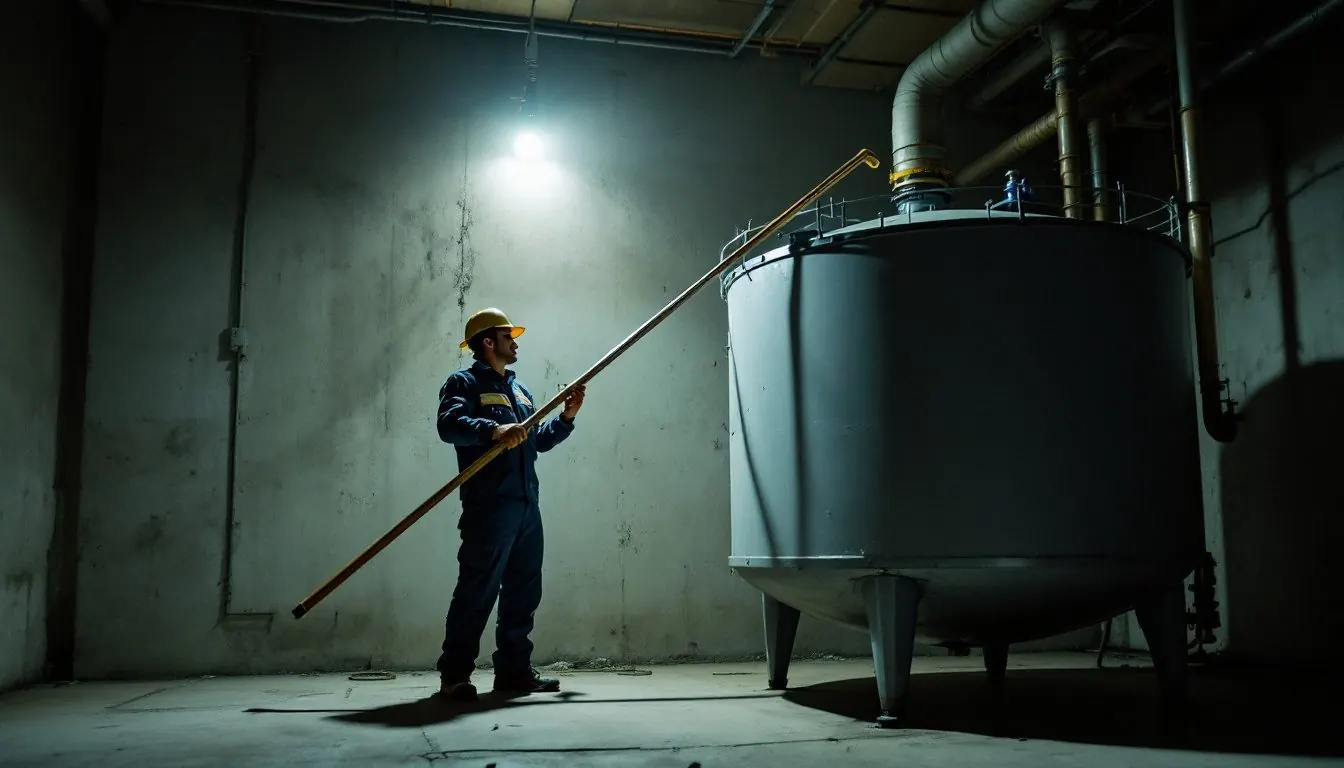
Water in a heating oil tank sinks under the No. 2 oil, so it stays hidden until it reaches the supply line. There it plugs the filter and nozzle, trips burner lockouts, freezes in outdoor lines and rusts the tank from inside. Test with water-finding paste on a stick lowered to the bottom; a red band means it should be pumped off.
Tank sizes, gauge readings, state rules and leak signs live on our heating oil tank guide. If the burner locked out tonight, read the oil burner reset button limits first.
Where does water in a heating oil tank come from: condensation, a cap or the tank wall?
Most water is condensation or rain past a cap, vent or fitting; less often, a failing tank. Beckett’s bulletin on preventing water in the fuel system describes the outdoor cycle: sun heats a partly filled tank, the oil expands and pushes air out, then at night the oil shrinks and pulls in damp air that condenses on the cool walls and collects at the bottom. It repeats, perhaps daily, until water reaches the supply piping.
For rain, Beckett names a fill box gasket, an unshielded vent cap, a vent below the snow line or near a downspout, and loose pipe threads; on buried tanks, groundwater can seep through a leak when the oil is low. Tennessee’s storage tank water guide lists the same entry points (damaged fill cap gaskets, loose plugs, vents) and says its advice applies even to small residential No. 2 heating oil tanks.
Can a heating oil delivery put inches of water in the tank?
No. A delivery that meets the fuel standard cannot carry more than a few ounces. Brookhaven National Laboratory’s fuel storage guide for the Department of Energy restates the ASTM D396 limit for No. 2 heating oil as 0.05 percent water and sediment by volume. Beckett calls water from the dealer’s bulk storage a rare contributor that the industry has “virtually eliminated.”
| Delivery size | Max water and sediment at 0.05% | 1 in of tank-bottom water is |
|---|---|---|
| 100 gal | 0.05 gal (6.4 fl oz) | 36 times that |
| 150 gal | 0.075 gal (9.6 fl oz) | 24 times that |
| 200 gal | 0.1 gal (12.8 fl oz) | 18 times that |
| 250 gal | 0.125 gal (16.0 fl oz) | 14 times that |
Method: delivery x 0.0005. One inch of water in a Granby 275 gal vertical tank (44 x 27 x 60 in on Granby’s spec table) models as 1.8 gal, treating the oval end as a 13.5 in radius curve. What a fill does do, per Brookhaven, is stir bottom sludge so it “can get re-suspended in the fuel” and reach the burner.
What does water in a heating oil tank do to the burner this winter?
In winter it shows up first as a burner that will not stay lit. Beckett lists 4 effects: rust in the tank that can damage the fuel pump, ice blocking the supply line on some outside tanks, bacterial growth and sludge, and filter blockage, erratic firing, nozzle clogging and safety lockout.
| What you see | Likely water problem | Test | Fix |
|---|---|---|---|
| Lockout after a cold snap, outdoor tank | Water frozen in the supply line | Paste on the tank bottom; check line for ice vs wax | Pump off water, pressure-clean the line, new filter and nozzle (Beckett) |
| Repeated lockouts, new filter plugs fast | Water plus sludge reaching the filter | Bottom sample in a clear jar: haze or drops (ASTM D4176 pass/fail) | Pump off; clean filter, pump strainer and nozzle line |
| Black slime in the filter, rotten-egg odor | Microbes living in the water layer | Field microbe test kit on a bottom sample (Brookhaven) | Clean the tank, then an EPA-registered biocide |
| Water depth climbs within hours | Leak in fill, vent or tank wall | Re-measure: over 1/2 in in 8 to 12 hours (PA DEP, underground tanks) | Fix caps and fittings; a leaking tank is replaced |
| Weeps or rust spots on the tank shell | Corrosion from the inside out | Visual check of seams and bottom | Replacement, per MassDEP for outdoor tanks bare 10 years |
Brookhaven notes that haze “usually indicates water, or in cold weather, wax,” so a cloudy sample in January is not proof of water. Beckett’s AF/AFG burner manual has the technician confirm at each annual service that supply lines “should be free of water, sludge and other restrictions.” A smell of raw oil near the tank is a different problem, covered in our heating oil smell guide.

How do you test for water with paste and a stick, and what reading matters?
Smear water-finding paste on the bottom few inches of a clean stick, lower it through the fill or gauge opening until it touches the bottom, wait, and pull it out. Kolor Kut’s product sheet says the brown paste turns “brilliant red” where it touches water, and the red band height is the depth. Beckett recommends the check “preferably before each fill-up, but at least annually.”
Test at the low end: Beckett pitches outdoor tanks toward the fill so water pools there, and BNL warns a fill opening away from the low end can miss it. BNL’s schedule for a homeowner tank is a water check monthly and a bottom sample, drawn with a check-valve “fuel thief”, once a year.
How much water is too much before the burner pulls it in?
Any measurable water should come out, but the real limit is the height of the oil pickup. Beckett describes installers soldering a short copper tube into the tank valve so oil is always drawn at least 3 in above the tank bottom. With a bottom outlet and no standpipe, the first ounces can reach the filter.
| Red band on the stick | Water in the tank | What it means |
|---|---|---|
| 1/2 in | 0.6 gal | Pennsylvania’s rise threshold if it appears in 8 to 12 hours |
| 1 in | 1.8 gal | 18 spec-limit 200 gal deliveries’ worth: not from the truck |
| 2 in | 5.0 gal | Pump off before the next fill stirs it up |
| 3 in | 9.0 gal | At Beckett’s 3 in pickup: the next gallon goes to the burner |
| 4 in | 13.7 gal | Above a 3 in pickup: lockout and line cleaning likely |
Check on the model: it gives 268 gal for the full tank against Granby’s 275 gal nameplate. The curved bottom holds little at first, so each extra inch adds more gallons than the last.
How is water removed: pump-off, a water-absorbing filter, a biocide or a new tank?
Pump-off by the oil company is the fix; filters and additives only handle what is left. Beckett says any accumulation “should be pumped out,” and if water reached the supply tubing, the line should be pressure-cleaned with a hand pump or CO2 charge, the filter, pump and nozzle line cleaned, the nozzle replaced and the pump tested for damage. See the oil burner nozzle swap.
A water-absorbing filter catches traces. General Filters’ catalog says its Gar-Ber R2000 cartridge with Water Block polymer “removes water from fuel oil and captures it deep within its pleated design,” rated for 10 gph at 10 microns. It is a backstop for traces, not for a 1.8 gal layer.
Additives come last. Brookhaven warns that once sludge has formed, an additive “will not restore the fuel’s quality,” and that fuel biocides must be registered with the EPA under FIFRA, with a registration number on the label. For heavy growth or old sludge, Brookhaven and Tennessee both put mechanical cleaning first, then a biocide.
Replacement is the answer when the water is the tank’s own fault. Beckett says a leaking tank must be replaced under local codes. MassDEP’s fact sheet (archived copy) says outdoor tanks “rust from the inside out” and should be replaced after 10 years uncovered, and that any heating oil tank be cleaned out at least every 10 years because condensation water and sludge cause corrosion.
How do you keep water out of the tank after it is pumped?
Keep the tank fuller in summer and keep the openings tight. Beckett’s AF/AFG manual tells owners to keep the tank full “especially during the summer” to prevent condensation inside it. Our heating oil usage figures help size a summer fill so the tank is not sitting a quarter full until October.
For outdoor tanks, Beckett adds silver paint and shade to cut solar heating, and a shielded vent cap away from roof drip. Pennsylvania DEP’s checklist adds a vent check for ice, snow and insect nests.
Frequently asked questions
What happens if a little water gets in an oil tank?
A little water sits under the oil, out of the line, but it does not stay harmless. Brookhaven National Laboratory (BNL) notes that water promotes microbes that feed on the fuel and speeds internal corrosion. Its guide asks homeowners to check for water monthly, so a small layer gets pumped off before it grows.
What are the symptoms of rain water in a heating oil tank?
Rain water gives the same burner symptoms as condensation: a plugged filter, a clogged nozzle, erratic firing and safety lockouts, per Beckett. The tell is the speed. Pennsylvania DEP’s underground tank checklist flags a water level that rises more than 1/2 in over 8 to 12 hours, which points to a leaking fill, vent or tank wall rather than slow condensation.
Does water in a heating oil line freeze?
Yes. Beckett lists water freezing and blocking the supply line as a problem in some outdoor tank installations. No. 2 oil itself can also gel in hard cold: ASTM D396 allows a pour point up to 20°F, and Beckett says the cloud point, where wax crystals start to form, typically sits 20 to 35°F above the pour point, so a cold line can be ice, wax or both.
Can you remove water from a heating oil tank yourself?
You can find it yourself with paste and a stick; removal is usually the oil company’s job. Brookhaven’s guide reminds owners to know local laws on disposing of water bottoms, and in New York a hauler of tank sludge needs a NYSDEC Regulated Waste Transport License. Beckett also says lines with water in them should be cleaned and the nozzle replaced.
How we researched this
On 24 November 2026 we read the 10 documents in Sources and ran a short script for the two calculation tables. We excluded contractor blogs, forums and videos as sources for figures and quote no installed or cleaning price, because the only lab figure we found dates from 1992. The ASTM D396 limit is Brookhaven’s restatement; we did not read the paywalled standard. Burner basics are in our oil heating system explainer.
Sources
- R.W. Beckett Corporation. “Preventing Water From Entering The Fuel System.” https://www.beckettcorp.com/bulletins/preventing-water-from-entering-the-fuel-system/. Accessed November 2026.
- R.W. Beckett / Weil-McLain. “Beckett Model AF/AFG Burners Instruction Manual (Ultra Oil).” https://www.weil-mclain.com/wp-content/uploads/RW-Beckett-AFG-Burner-Manual-for-Ultra-Oil-VBL-0321.pdf. Accessed November 2026.
- Litzke, W.L., Brookhaven National Laboratory for U.S. Department of Energy. “Maintenance and Storage of Fuel Oil for Residential Heating Systems” (BNL-48406, 1992). https://www.osti.gov/servlets/purl/6646860. Accessed November 2026.
- Tennessee Department of Environment and Conservation. “Keeping Water Out of Your Storage System.” https://www.tennessee.gov/content/dam/tn/environment/ust/doc/toolbox/other/ust_other-keeping-water-out.pdf. Accessed November 2026.
- Pennsylvania Department of Environmental Protection. “Helpful Tips for Heating Oil Tanks” (2620-BO-DEP6125, rev. 9/2025). https://files.dep.state.pa.us/EnvironmentalCleanupBrownfields/SiteRemediation/SiteRemediationPortalFiles/Home%20Heating%20brochure.pdf. Accessed November 2026.
- Massachusetts Department of Environmental Protection. “Tips For Maintaining Your Home Heating System: Prevent Heating Oil Leaks and Spills” (archived copy). https://web.archive.org/web/2025id_/https://www.mass.gov/doc/tips-for-maintaining-your-home-heating-system-prevent-heating-oil-leaks-and-spills-1/download. Accessed November 2026.
- Atkinson Equipment. “Kolor Kut Water Finding Paste, Product Specification Sheet WFP-1000.” https://www.atkinsonequipment.com/wp-content/uploads/2024/08/WFP-1000_Kolor-Kut-Water-Finding-Paste_ATK.pdf. Accessed November 2026.
- General Filters. “General 2000 Catalog.” https://res.cloudinary.com/wholesale-plumbing/image/upload/Documents1/General_2000_Catalog.pdf. Accessed November 2026.
- Granby Industries. “Standard residential oil tank: Available Models.” https://www.granbyindustries.com/en-us/petroleum-tanks/products/standard/. Accessed November 2026.
- R.W. Beckett Corporation. “Oil Quality: Some Facts To Consider” (archived copy). https://web.archive.org/web/2025id_/https://www.beckettcorp.com/bulletins/oil-quality-some-facts-to-consider/. Accessed November 2026.
Leave a Reply