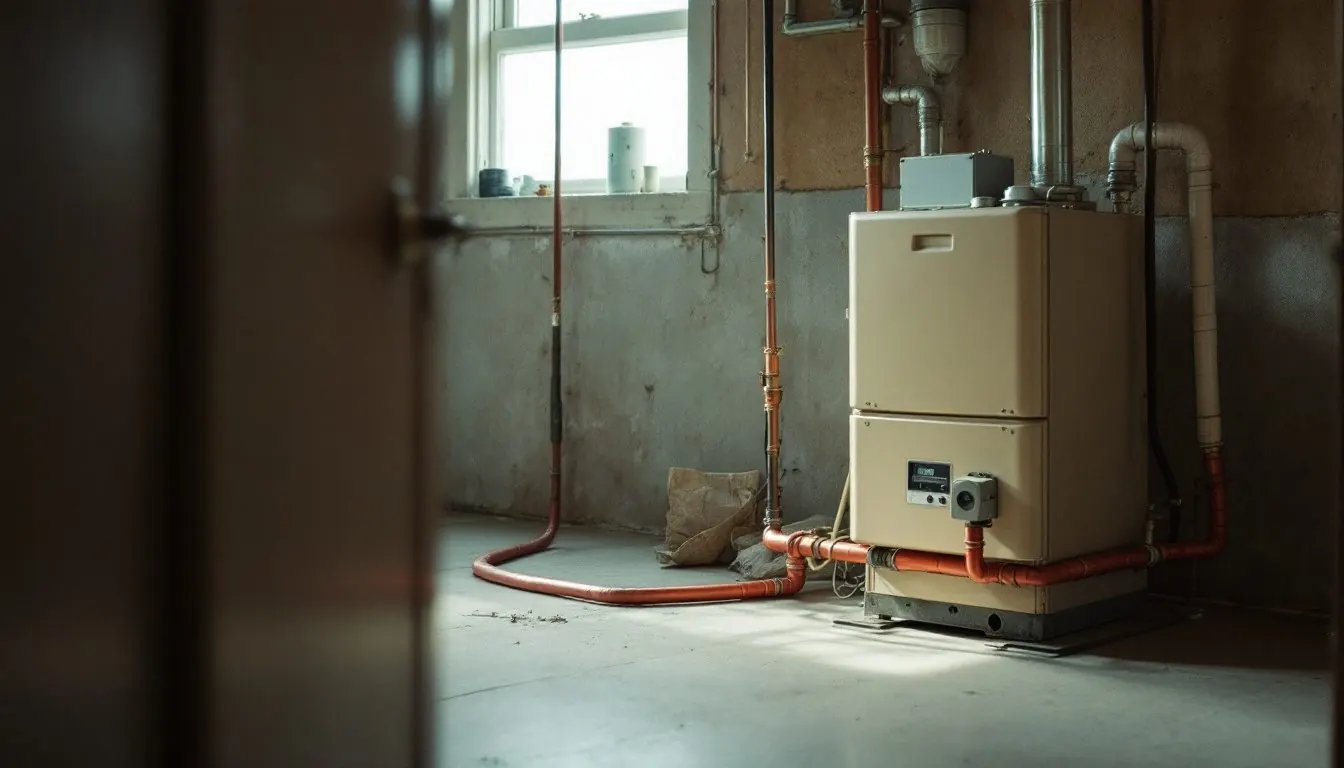
An oil burner reset button that keeps tripping means the primary control could not prove flame through its cad cell during the trial for ignition, 15 seconds on a Beckett 7505, or kept losing flame while running. Press it once. If it trips again, stop: the fault is fuel, ignition or flame sensing, and each extra press sprays more oil.
The red button is on the primary control, the box on the burner that runs the motor, igniter and oil valve. Beckett’s GeniSys 7505 serves “boiler, furnace, and water heater applications” (Beckett 7505 manual). So the oil boiler, oil furnace and oil water heater reset button is the same device. Beckett lists the 7505 as the replacement for the Honeywell R7184 and Carlin 40200.
What does the red light on the primary control mean when it trips?
It means lockout: the control shut the burner down until someone presses the button. Beckett’s 7505 manual gives three reasons: the trial for ignition “expired without flame being established”, the cad cell “detected flame at the end of the Valve On Delay state”, or flame was lost while firing too many times. Honeywell’s R7184 does the same, entering a 60 second recycle when flame drops out and locking out after flame is lost three times in a row (Honeywell R7184 guide 69-1384).
| Light | Control | Meaning | Your move |
|---|---|---|---|
| Red flashing | Beckett 7505 | Soft lockout | One reset press |
| Red solid | Beckett 7505 | Restricted (hard) lockout | Technician reset |
| LED flashing 1/2 sec on, 1/2 sec off | Honeywell R7184 | Lockout or restricted lockout | One press, then service |
| Green flashing, or R7184 LED 2 sec on, 2 sec off | Both | Recycle after flame loss | Wait; it retries itself |
| Green on while idle | Both | Flame sensed (7505: “could be stray light during standby”) | Burner will not start |

How many times can you press the oil burner reset button?
Once. Beckett says to “click the button 1-second”, and on the R7184 three lockouts in a row become a restricted lockout “in order to prevent repetitious resetting by the homeowner.” Beckett’s troubleshooting guide says a solid red GeniSys light “means the control has locked out 3 times” (Beckett troubleshooting guide, archived copy).
The reason is oil. Beckett’s hard lockout exists “to limit accumulation of unburned oil in the combustion chamber”, and its AF/AFG burner manual tells technicians to let a vapor-filled appliance “cool off and all vapors to dissipate before attempting another start” (Beckett AF/AFG manual). Our page on oil furnace puffback works out the oil volume per failed start.
Clearing restricted lockout takes a 30 second hold on the R7184 “until the LED flashes twice”, or 15 seconds on the 7505; Beckett says that state “must be reset only by a qualified service technician.” Our guide to resetting a furnace or oil burner covers the single press itself.
What did the burner do in the 40 seconds after you pressed it once?
Time it with a watch: the moment it quits points to the cause. An R7184B runs a 2 to 6 second safe start check, a 15 second valve-on delay with motor and igniter but no oil, then a 15 second trial in which flame must be proven.
| After one press | Control’s verdict | Maker-listed causes | First check |
|---|---|---|---|
| Nothing: no motor, no lights | No power or no heat call | No power; limit open | 120 V at L1 to L2, then the limit |
| 7505 lights on for 1 second, then off | No heat call | Boiler control not powering the limit; thermostat open | Boiler control, thermostat |
| Green light on while idle; burner never starts | Cad cell sees light | Stray light, pinched wires, bad cell | Unplug cad cell leads: green should go out |
| Locks out at 17 to 21 s, before oil should spray | Flame seen at end of valve-on delay | Stray light or shorted cell | Same unplug test |
| Motor hums, no flame, red light at 32 to 36 s | Trial for ignition expired | No oil, shut valve, plugged filter or nozzle, air, weak spark, cold oil | Tank gauge, both oil valves |
| Flame visible, still locks out at 32 to 36 s | Cad cell never read the flame | Dirty or misaligned cell, poor flame adjustment | Cad cell ohms with flame |
| Runs, stops, retries after about 60 s, then locks out | Flame lost while firing | Fuel supply, draft, nozzle and air, electrodes | Combustion test |
| Fine for days, then lockouts come closer together | Partial restriction | Filter, suction line leak, wax in cold oil | Filter, vacuum test |
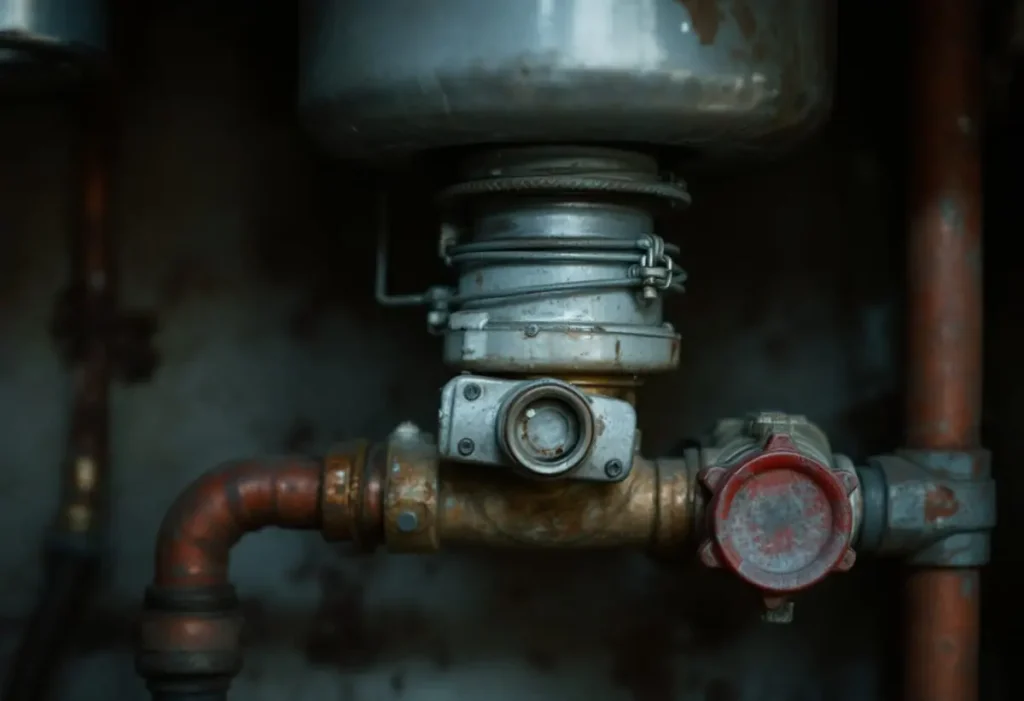
Motor runs but no flame: out of oil, clogged filter or air in the line?
A burner that hums for half a minute and locks out unlit is usually not getting oil to the nozzle. Read the gauge first (our heating oil tank guide explains it), then confirm both shutoff valves Beckett calls for, one close to the tank and one close to the burner, are open.
The AF/AFG manual calls for a line filter “rated for 50 microns or less”, adds a secondary filter of at least 10 microns for firing rates below 0.75 gph to cut nozzle plugging, and lists filter replacement in the annual service. Suntec’s fuel unit sheet adds a pump strainer to clean yearly and warns that oil lines must be “absolutely air tight” to prevent “air binding, after drip, rough burner starts and stops, loss of prime” (Suntec A/B fuel unit instructions, Sid Harvey).
A tank that ran dry leaves air in the pump, and resetting will not fix that. Both controls have a technician priming mode, with lockout stretched to 4 minutes while oil is bled through a clear hose, and Beckett warns “Do not allow oil to spray into a hot combustion chamber while bleeding air from the pump.” That is a service call. If you smell raw oil at the filter or pump, our page on heating oil smell in the house sorts leak smells from combustion smells.
No spark gives the same symptom; Beckett’s AF/AFG maintenance list replaces cracked, chipped or round-tipped electrodes and corroded igniter spring contacts.
Flame lights, then dies: is the cad cell the reason the reset keeps tripping?
Often, yes. Beckett’s cad cell bulletin says that with a properly adjusted burner, resistance during operation “should be approximately 300-1000 ohms, but not more than 1600 ohms.” The control needs 1,600 ohms or less with flame “to prevent random lock-out” (Beckett cad cell bulletin, archived copy). Its chart blames higher readings on a “defective or dirty cad cell, misaligned sighting of flame, or improper flame adjustment.”
The R7184 shows the band without a meter: while it fires and after the igniter shuts off, tap the button (1/2 second or less) and count LED flashes.
| LED flashes | Cad cell resistance | Against Beckett’s numbers |
|---|---|---|
| 1 | 0 to 400 ohms | Within limit |
| 2 | 400 to 800 ohms | Typical band |
| 3 | 800 to 1,600 ohms | Under limit, above typical |
| 4 | 1,600 ohms or more | Over limit: expect lockouts |
The 7505 has no flash readout; Beckett uses its 52082U Contractor Tool or a meter on the leads “with flame present”, and calls anything above 1,600 ohms “Limited (1600 ohms to lockout)”. A weak flame reads high too, so Beckett’s guide also lists settings, draft and electrodes for a burner that “runs, ignites, then stops.”
Why does the oil furnace reset button trip mostly on the coldest nights?
Cold oil flows and sprays worse. Beckett’s oil quality bulletin reports a maximum pour point of 20°F for No. 2 oil under ASTM D396, with the cloud point, where wax crystals form, typically 20 to 35°F above the pour point. Those crystals “can form and clog filters and strainers thus causing restriction of oil flow”, and viscosity problems “become amplified as the ambient temperatures drop below 50°F” (Beckett oil quality bulletin, archived copy). The usual fix is about 25% No. 1 oil (kerosene) blended in; ask whether an outdoor tank gets a winter blend.
Beckett’s 7505 manual warns that a lockout in an unattended house in severe cold “could result in frozen plumbing and water damage in a matter of hours.” If that has started, see how to thaw frozen pipes.
What will the oil service technician test, and which readings matter?
These numbers, from the documents above:
- Cad cell resistance with flame present: under 1,600 ohms (Beckett).
- Pump inlet pressure no more than 3 psi; return line no more than 10 psi on two-pipe systems (Suntec).
- Nozzle cutoff: holds at no lower than about 80% of operating pressure (Suntec).
- Vacuum test and a clear hose on the bleeder to find air (Beckett guide).
- Over-fire draft, typically -0.01 or -0.02 in. w.c. on natural draft units; smoke “should be Zero”; CO under 50 PPM, usually 10 PPM or less (Beckett).
The 7505 “has no serviceable internal parts”: a control that fails checkout is replaced. Our oil heating system explainer covers annual service. If the burner smoked or puffed before locking out, see our notes on furnace exhaust smell in the house before anyone restarts it.
Frequently asked questions
Where is the oil furnace reset button located?
It is the red button on the primary control, the box on the oil burner itself. Beckett says the GeniSys 7505 mounts on a 4 in. x 4 in. junction box on the burner or inside the appliance cabinet, on furnaces and boilers alike.
Why is my oil burner reset button not working?
Either it is in hard lockout, which a short press will not clear, or nothing is asking it to run. A solid red light on a Beckett 7505 means restricted lockout, cleared only by a 15 second technician hold. If nothing lights, Beckett’s guide checks 120 V across L1 and L2, then the limit and thermostat.
Is the oil boiler reset button the same as the oil furnace one?
Yes. The Beckett GeniSys 7505 manual shows boiler and furnace wiring for the same control, rated for burners under 20 GPH. On a boiler, an idle burner can also mean the boiler control is not calling, which Beckett’s guide checks first.
Can I hold the reset button to shut the burner off?
Only briefly. Both makers describe a disable function: while the motor runs, holding the button keeps the burner off until you release it. A 15 second hold on a 7505 enables pump priming and 30 seconds on an R7184 zeroes its lockout counter, so use the service switch instead.
How we researched this
On November 19, 2026 we read the seven documents under Sources in full. Lockout times are our arithmetic from R7184 timings. The top-ranking contractor FAQ and oil dealer blog cite no maker document, so we used none of their figures; forum and video results were excluded. ASTM D396 values are Beckett’s restatement; we did not read the standard.
Sources
- R. W. Beckett Corporation. “120V GeniSys 7505 Advanced Burner Control, Installation and Operation Manual.” https://zoro.com/static/cms/enhanced_pdf/Metropac%20Industries%20Inc_61649xxGeniSysxx7505xxControlxxManualxx144726.pdf. Accessed November 2026.
- Honeywell (Resideo legacy document). “R7184 Series Primary Controls, Technician’s Quick Reference Guide 69-1384.” https://inspectapedia.com/heat/Honeywell-R7184-Guide-69-1384.pdf. Accessed November 2026.
- R. W. Beckett Corporation / Weil-McLain. “Ultra Oil AF/AFG Burner Manual.” https://www.weil-mclain.com/wp-content/uploads/RW-Beckett-AFG-Burner-Manual-for-Ultra-Oil-VBL-0321.pdf. Accessed November 2026.
- R. W. Beckett Corporation. “Troubleshooting Guides” (archived copy). https://web.archive.org/web/2025id_/https://www.beckettcorp.com/support/troubleshoot/. Accessed November 2026.
- R. W. Beckett Corporation. “Troubleshooting The CAD Cell” (archived copy). https://web.archive.org/web/2025id_/https://www.beckettcorp.com/bulletins/troubleshooting-the-cad-cell/. Accessed November 2026.
- R. W. Beckett Corporation. “Oil Quality: Some Facts To Consider” (archived copy). https://web.archive.org/web/2025id_/https://www.beckettcorp.com/bulletins/oil-quality-some-facts-to-consider/. Accessed November 2026.
- Suntec Industries, via Sid Harvey. “Suntec Model A, B Fuel Units.” https://www.sidharvey.com/documents/SuntecA,BFUELUNITS.pdf. Accessed November 2026.
Leave a Reply