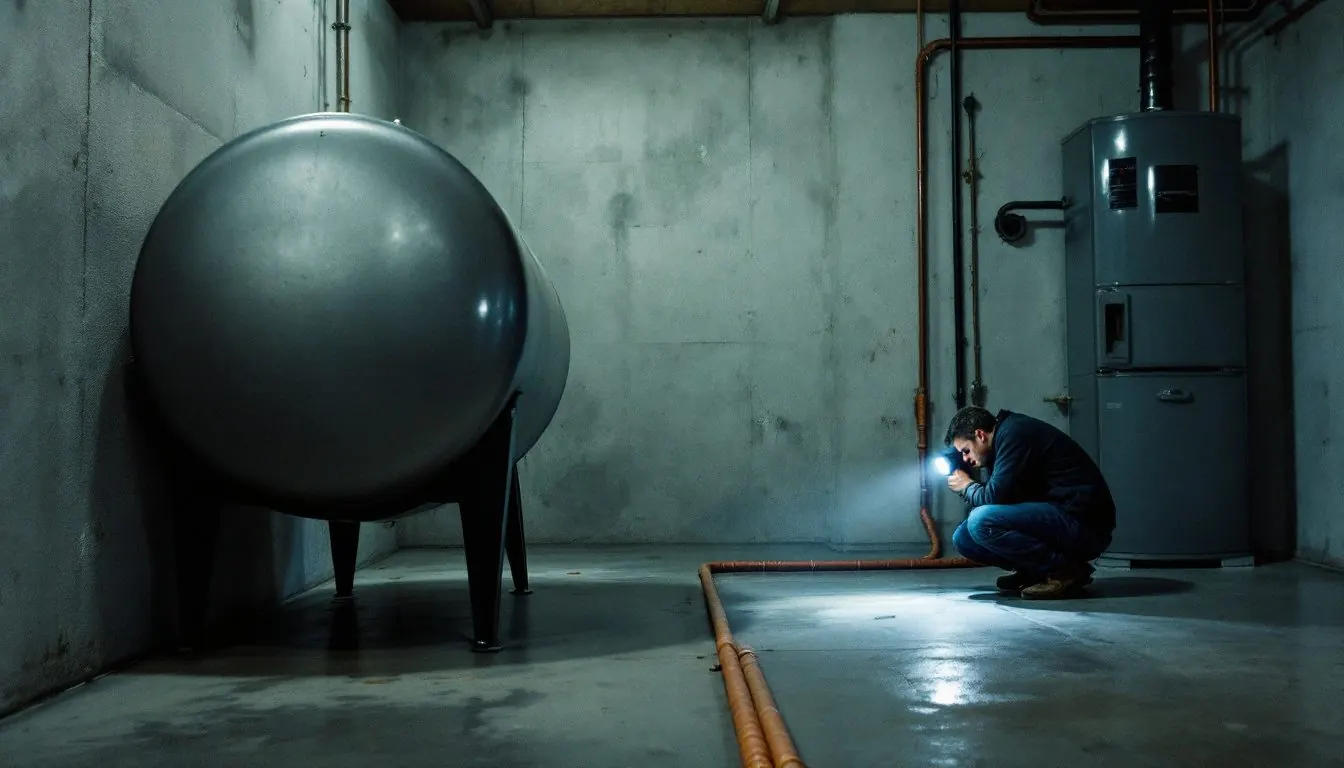
A heating oil smell in the house is either raw No. 2 oil or burnt oil. A raw smell that stays with the burner off means liquid oil at the tank, filter, line fittings or pump. A smoky smell that comes and goes with burner cycles points to after-drip, late ignition or a flue problem.
Raw oil or burnt oil: which heating oil smell is in your basement?
Sort by timing first. With the thermostat down and the burner off, walk the oil path in the order of our guide to how an oil heating system works: fill pipes, tank, filter, copper line, burner. A raw, diesel-like smell with the burner silent is liquid oil; a smoky smell right after the burner starts or stops is combustion.
| When and where you smell it | Likely source | What the document says | Next step |
|---|---|---|---|
| All the time, strongest at the tank | Tank seam, bottom or fitting | CT DPH: look for “blisters, wet spots, rust, dents, bulges, or drips” | Call the oil company today |
| Started right after a tune-up | Filter bowl gasket | Beckett: damaged filter or pump seals “could cause oil leakage” | Wipe dry, recheck, call back |
| Wet copper line or flare nut | Line or fitting leak | Beckett: “Never use compression fittings” | Service call |
| Oil on the burner or under the pump | Pump seal | Beckett: supply pressure “cannot exceed 3 psig” | Burner off; service call |
| Smoky for a minute after the burner stops | Nozzle after-drip | Beckett: air in the line, heat expansion, failed shut-off valve | Ask about a solenoid valve |
| Puff, rumble or soot smell at start | Late ignition, puffback | Beckett: flame proven within a 15 second lockout time | Do not keep pressing reset |
| Exhaust smell while firing | Blocked flue or chimney | Beckett: gases can vent out the barometric damper | Burner off, check the CO alarm |
| Strong smell right after a delivery | Overfill, or oil pumped into an abandoned fill pipe | NY DOH: “a fill pipe present but no tank connected” | Call the dealer and the state spill line |
| Oil smell in faucet water | Oil in groundwater or the well | CT DPH lists it as a contamination sign | Report it; bottled water until tested |
Compiled by The HVAC Brief from CT DPH (2013), NY DOH and R.W. Beckett’s manual and troubleshooting guide.
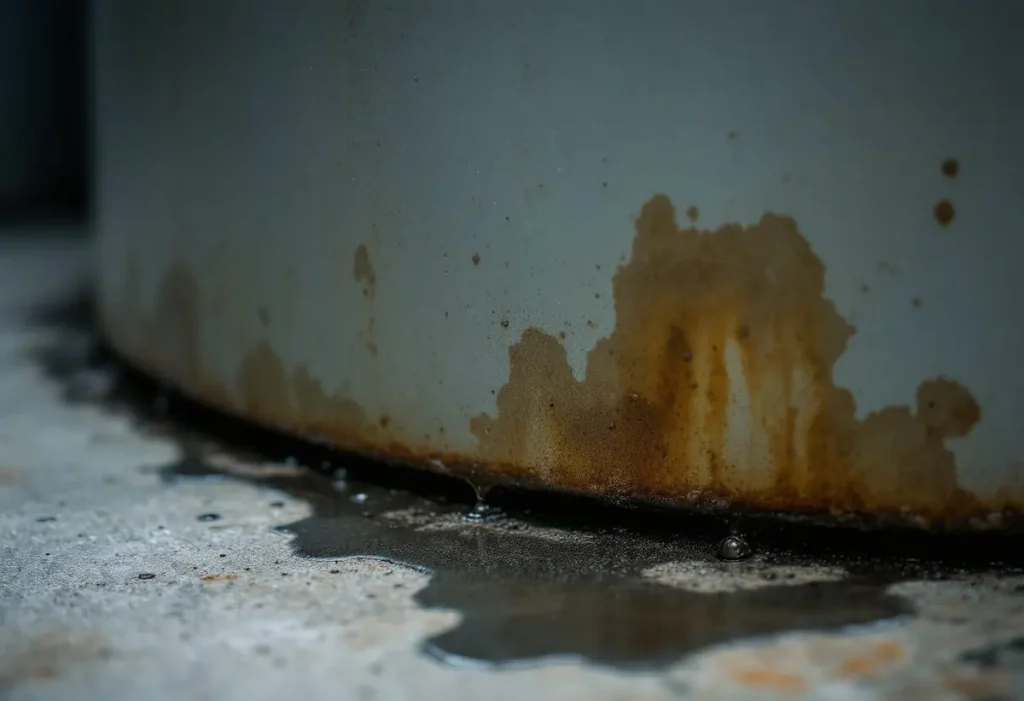
Where does a raw oil leak start: tank, filter, copper line or pump?
Raw smells usually start at a joint. The Connecticut Department of Public Health names “cracks in the oil tank, line to the furnace, gaskets & fittings,” and New York’s Department of Health adds “manifolded tank piping” and “leaky or ruptured gaskets.”
The filter is the joint opened most often. Beckett’s AF/AFG manual calls for a filter “rated for 50 microns or less” near the burner, and its annual checklist says “Replace the oil supply line filter.” So a smell that begins the day after a tune-up points first at the bowl gasket; a damp ring that returns after wiping confirms it.
Beckett also says to use flare fittings and to “Never use Teflon tape on fuel oil fittings.” A copper line buried in the slab weeps into soil, not onto the floor; the heating oil tank leak signs and state rules cover the Massachusetts line protection rule and who pays.
A smell with no visible leak still has a source. The ATSDR fuel oils fact sheet lists basement air “contaminated with fuel oil vapors entering from the soil,” and CT DPH notes that a neighbor’s leak can reach your home through groundwater.
Why does the house smell like burnt oil when the burner starts or stops?
A smoky smell tied to burner cycles is unburned oil. Beckett’s troubleshooting guide lists three causes of nozzle after-drip: air in the nozzle line, “oil expansion in the nozzle line assembly, due to radiated heat at shutdown,” and a defective pump shut-off valve or stuck solenoid.
Beckett’s 1998 bulletin says a solenoid valve “virtually eliminates smoke at shutdown” and backs up the pump “if the pump cutoff ever fails.”
A smell at start-up is more serious. On the Beckett 7505 control the motor and igniter run a 15 second valve-on delay, then the cad cell must see flame within a 15 second lockout time. Oil that does not light can ignite late, the oil furnace puffback sequence, and each press of the red button adds oil, the trap behind an oil burner reset button that keeps tripping.
An exhaust smell while firing is venting. Beckett warns that flue acid attacks “chimney mortar, brick and clay liners,” and that a blockage can push flue gases out the barometric damper into the living space. That carries carbon monoxide risk; the furnace exhaust smell checklist covers it step by step.
Why does the house smell like heating oil right after a delivery?
NY DOH lists “overfilling a tank” first among spill causes and warns that “hundreds of gallons of oil can be pumped into the basement” when a fill pipe has no tank behind it. Wisconsin’s health department lists the same case: “Someone tries to fill a tank that has been removed.”
New York says an abandoned fill pipe “should be physically removed or filled in with concrete as required by NYS Law and the Building Code.” After each delivery, check the outside fill and vent pipe ends and the floor around the tank, and call the dealer first if you find oil; CT DPH notes that whoever caused a spill “may be legally responsible” for cleanup.
New York wants “any fuel oil spill, no matter how small” reported to the NYSDEC hotline at (800) 457-7362. Connecticut’s line is 1-866-DEP-SPIL, Wisconsin’s is 800-943-0003; other states set their own rules.
Is a heating oil smell in the house dangerous?
The vapor is an irritant and a fire risk, not an odorless poison like CO. CT DPH says heating oil vapors are “less toxic than gasoline” and that headaches, nausea, dizziness and eye, nose and throat irritation “go away when the odor is gone.” ATSDR adds increased blood pressure and poor coordination from short-term breathing of some fuel oils.
Long exposure differs. NY DOH says breathing heating oil odors over a long period can raise the risk of “liver and kidney damage,” and CT DPH says households with young children or chronic illness may need to move out until cleanup is done.
Treat a spill as a fire hazard first. Wisconsin DHS says to put out pilot lights, kill spark sources and never use a shop vac on spilled oil. A burnt smell with smoke, soot or an alarm is the combustion case: leave, call 911, and check alarms sit where the carbon monoxide detector placement rules put them.
How do you get rid of a heating oil smell, including on a concrete floor?
Remove the oil, then move the air. North Dakota’s environmental agency says cleanup “is not complete until odors are gone” and that chemical air fresheners are “not recommended” because they add volatile chemicals, which contradicts the air freshener and vinegar tips in the top-ranking dealer article.
- Isolate the basement. NY DOH and CT DPH: turn off forced air heat or central AC, cover the grilles, seal basement door gaps with a plastic shower liner.
- Ventilate with two fans. NY DOH: one fan bringing outdoor air in, one blowing air out of the spill area.
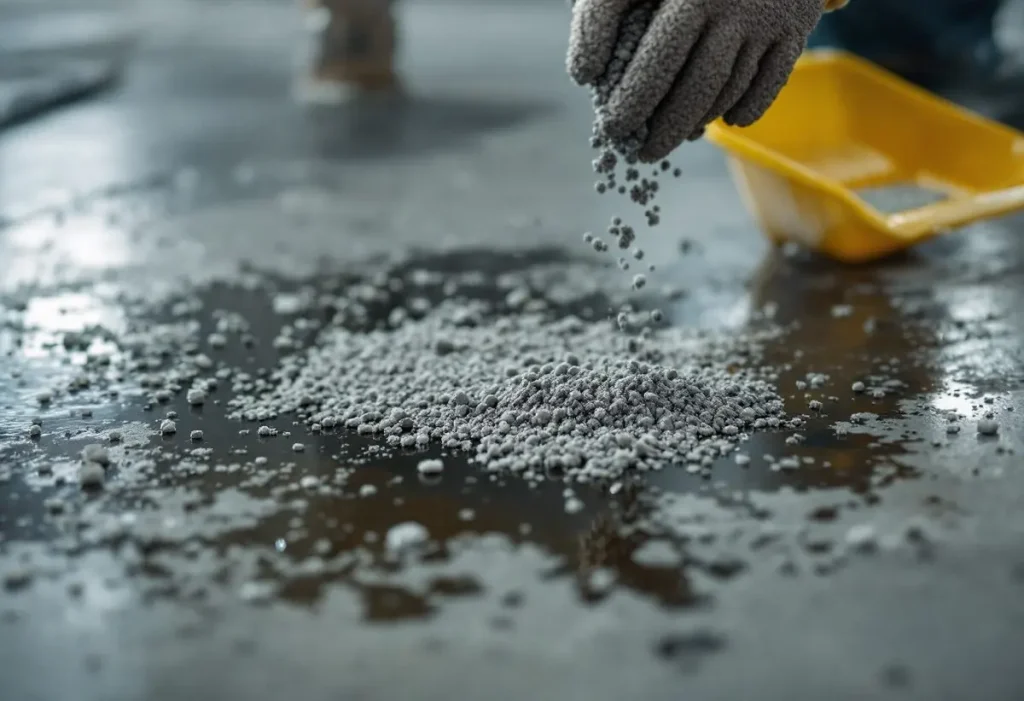
- Soak up small spills. Wisconsin DHS says a spill under one gallon is usually a homeowner job: cat litter or sawdust, shoveled into heavy plastic bags kept outside.
- Wash the concrete. North Dakota says detergent on concrete stains helps “break down the remaining oil stain”; then scrub with detergent and hot water, more than once.
- Discard what soaked it up: carpet, clothing, drywall, wood, per Wisconsin DHS.
Expect days, not hours: North Dakota says odors from a promptly cleaned spill fade “after several days,” CT DPH says “days or weeks.” A lingering smell means a source remains, such as “saturated cinder blocks,” soil, drywall or a sump. Larger spills need a cleanup company.
What will the oil technician check, and which readings matter?
A technician proves the fault with tests. Beckett’s annual checklist covers what a smell implicates: a new line filter, fittings that are “leak-tight,” the pump’s “cutoff function,” lockout timing, and chimney soot. For after-drip, Beckett’s guide says to loosen the 1/8 inch high pressure line at shutdown; oil still coming means the pump valve or solenoid. For combustion, Beckett recommends flue CO “less than 50 PPM, and usually 10 PPM or less,” and a smoke reading that “should be Zero.”
Frequently asked questions
Why does my house smell like heating oil but there is no leak?
Check the burner first: Beckett’s troubleshooting guide lists nozzle after-drip from air in the line, heat expansion at shutdown or a failed shut-off valve, which leaves a smell with no puddle. If the burner is clean, ATSDR lists fuel oil vapor entering basements from contaminated soil, so a buried tank or line is next.
How long does it take for heating oil smell to go away?
North Dakota’s DEQ says odors from a spill that is promptly and completely cleaned up should disappear after several days; Connecticut DPH says it can take days or weeks, depending on spill size. A smell that lasts longer means oil remains in block, soil, wood, drywall, a sump or a floor drain.
Why does heating oil smell outside the house?
Look at the fill and vent pipe ends after a delivery and at any outdoor or buried tank. CT DPH lists oily patches or stains on the ground as a contamination sign, and NY DOH asks that any fuel oil spill, no matter how small, be reported to the NYSDEC Spill Hotline at (800) 457-7362.
Does homeowners insurance cover a heating oil spill?
Often not in full. NY DOH warns that in many cases cleanup costs may not be covered by homeowner’s insurance, and that delays in reporting raise them. CT DPH notes that if a delivery company or someone else caused the spill, they may be legally responsible for the cleanup costs.
How we researched this
On November 19, 2026 we read the CT DPH spill fact sheet, the NY DOH spill page, Wisconsin DHS and North Dakota DEQ cleanup guidance, ATSDR’s fuel oils ToxFAQs (archived copy), the R.W. Beckett AF/AFG manual, and archived copies of Beckett’s troubleshooting guide and solenoid bulletin. We excluded NFPA 31 (paywalled), Beckett’s gas burner odor section, and any cost or insurance figure without a primary source.
Sources
- Connecticut Department of Public Health. “Home Heating Oil Spills” fact sheet, September 2013. https://portal.ct.gov/-/media/Departments-and-Agencies/DPH/dph/environmental_health/eoha/pdf/Heatingoilspillsfactsheetpdf.pdf. Accessed November 2026.
- New York State Department of Health. “Home Heating Oil Spills.” https://healthweb-back.health.ny.gov/environmental/oil_spills/. Accessed November 2026.
- Wisconsin Department of Health Services. “Home Heating Oil Spills.” https://www.dhs.wisconsin.gov/node/1857. Accessed November 2026.
- North Dakota Department of Environmental Quality. “Home Heating Oil Safety.” https://www.deq.nd.gov/flood/Residential_Factsheets/Home_HeatingOilSafety_Factsheet.pdf. Accessed November 2026.
- ATSDR. “ToxFAQs: Fuel Oils,” 1996 (archived copy). https://web.archive.org/web/2023id_/https://www.atsdr.cdc.gov/toxfaqs/tfacts75.pdf. Accessed November 2026.
- R.W. Beckett (via Weil-McLain). “AF/AFG Burner Manual for Ultra Oil.” https://www.weil-mclain.com/wp-content/uploads/RW-Beckett-AFG-Burner-Manual-for-Ultra-Oil-VBL-0321.pdf. Accessed November 2026.
- R.W. Beckett. “Troubleshooting Guides” (archived copy). https://web.archive.org/web/2025id_/https://www.beckettcorp.com/support/troubleshoot/. Accessed November 2026.
- R.W. Beckett. “Oil Solenoid Valves Are Useful,” 1998 (archived copy). https://web.archive.org/web/2025id_/https://www.beckettcorp.com/bulletins/oil-solenoid-valves-are-useful/. Accessed November 2026.
Leave a Reply