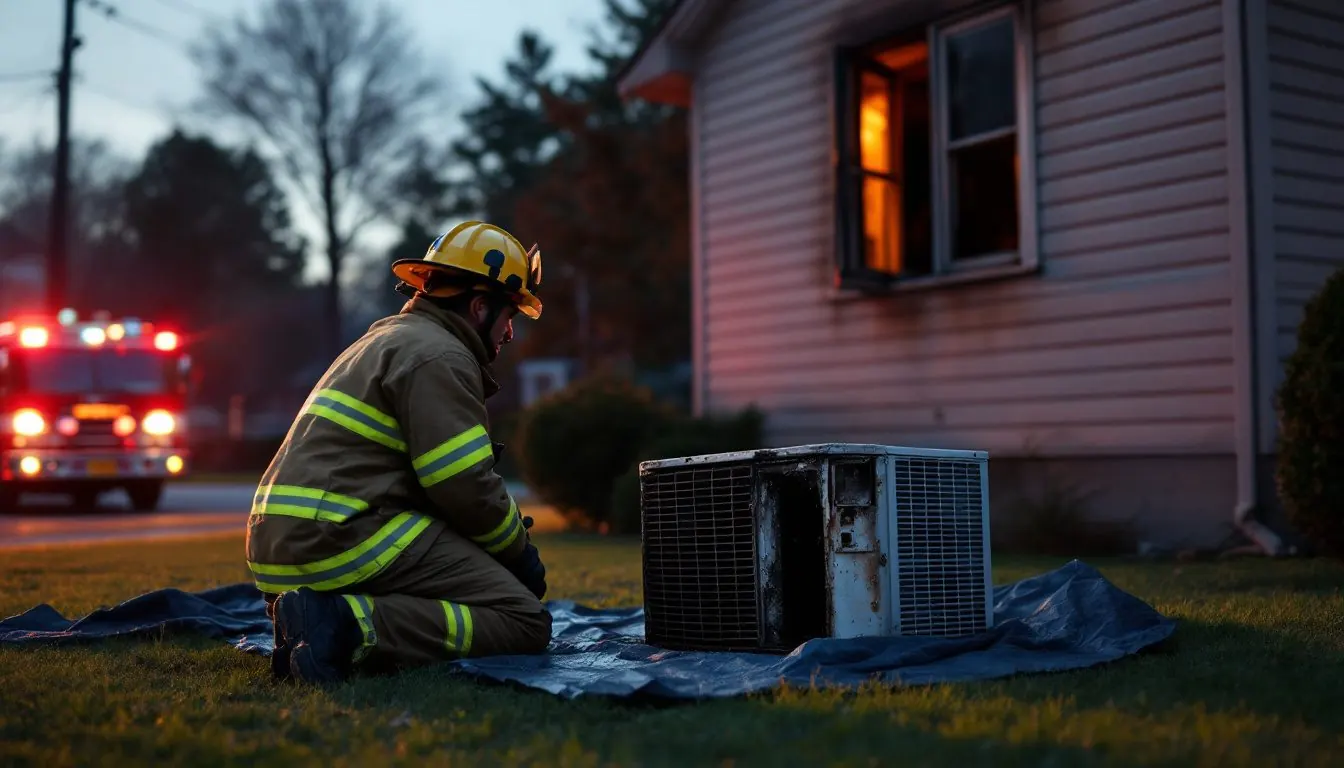
How often does an air conditioner fire happen in US homes? About 1,500 times a year. The US Consumer Product Safety Commission estimates air conditioning was the equipment that started 1,500 unintentional home fires a year in 2021 to 2023, injuring about 70 people and causing $91.5 million in property loss annually.
Key Takeaways
- Air conditioning started about 1,500 US home fires a year in 2021 to 2023 (CPSC, 2026).
- Fans started more home fires than ACs: 2,700 a year (CPSC, 2026).
- Portable units were one in three AC fires but carried $54.0 million of yearly AC property loss, more than fixed and central systems (CPSC Tables 3a and 3d).
- NFPA’s 2012 to 2016 estimate of 2,900 AC fires a year is an upper bound (NFPA, 2018).
- Failed cords and plugs caused 2,200 home fires and 110 deaths a year in 2015 to 2019 (NFPA, 2021).
- About 2,000 Friedrich KÜHL window ACs were recalled in September 2026 after two motor ignitions (CPSC recall).
How many air conditioner fires happen each year?
The freshest national estimate is 1,500 home fires a year started by air conditioning in 2021 to 2023, from the CPSC report published in October 2026. Those fires caused about 10 civilian deaths, 70 injuries and $91.5 million in property loss per year, not inflation adjusted.
CPSC builds the estimate from federal NFIRS fire reports weighted to NFPA’s fire department survey. Air conditioning is a small slice of 350,700 unintentional home fires a year, inside a heating and cooling group of 36,400. The heating side of those tables is broken out in our heating fire statistics by equipment type.
| Year | AC fires | Civilian deaths | Civilian injuries | Property loss |
|---|---|---|---|---|
| 2021 | 1,500 | fewer than 10 | 80 | $91.6 million |
| 2022 | 1,600 | fewer than 10 | 90 | $97.9 million |
| 2023 | 1,500 | 10 | 40 | $85.1 million |
| 2021 to 2023 average | 1,500 | 10 | 70 | $91.5 million |
Source: CPSC, Tables 1a to 1d. Fires rounded to the nearest 100, deaths and injuries to the nearest 10.
Why do air conditioner fire numbers disagree?
Published totals run from 1,500 to more than 7,000 a year because they measure different things. The large figures on insurance and contractor sites combine air conditioners with fans and related equipment, often without a year.
NFPA’s 2012 to 2016 tables, the newest full NFPA equipment breakdown we could open, run higher. NFPA spreads fires with unknown equipment across the known categories and says its equipment “estimates shown should be considered upper bounds.” CPSC drops intentionally set fires and keeps confined fires out of its product lines, which pushes its count lower.
| Period | Publisher | AC fires a year | Deaths | Injuries | Property loss | Scope |
|---|---|---|---|---|---|---|
| 1996 to 1998 | USFA (NFPA and NFIRS) | 2,300 | fewer than 5 | 60 | $23.8 million | Residential AC fires |
| 2007 to 2011 | NFPA (Hall, 2013) | 2,350 | 9 | 98 | $58 million | Home fires, AC as equipment involved |
| 2012 to 2016 | NFPA (Ahrens, 2018) | 2,900 | 30 | 130 | $77 million | Unknowns allocated; upper bound |
| 2015 to 2019 | NFPA (Campbell, 2021) | 1,600 | 30 | 60 | $47 million | Electrical failure fires only |
| 2021 to 2023 | CPSC (Miller, 2026) | 1,500 | 10 | 70 | $91.5 million | Unintentional fires only |
The rows are not a trend line, because the rules for unknowns, confined fires and intent differ. Read them as a range: roughly 1,500 to 2,900 reported AC home fires a year, with losses in each period’s dollars.
Are window and portable air conditioners a bigger fire risk?
By damage per fire, yes. CPSC splits electric air conditioning by portability: fixed or central units started 1,000 fires a year in 2021 to 2023 and portable units 500, yet portable units carried $54.0 million in yearly property loss against $37.2 million for fixed and central systems.
Dividing CPSC’s rounded estimates (our arithmetic) gives roughly $108,000 of loss per portable-unit fire versus about $37,000 per fixed or central fire. Injuries were 40 a year for portable units and 30 for fixed and central.
The pattern is old. A 2001 US Fire Administration report on 1996 to 1998 data found window and wall units were 35% of residential air conditioning equipment but caused 55% of air conditioning fires, and suggested undersized wiring not designed for the load as a reason. In that period the bedroom (23%) was the leading room of origin. If you run a room unit, our window unit installation checklist covers support, cords and outlets, and the efficiency tradeoffs are in our look at single-hose portable units.
What causes an air conditioner fire?
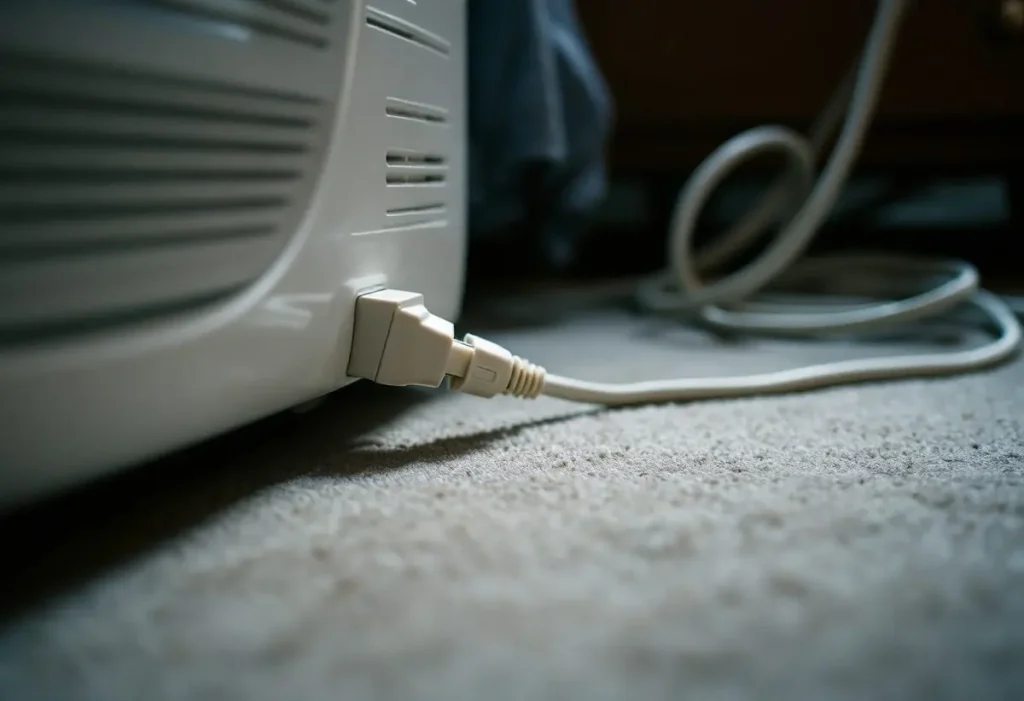
Most AC fires trace to equipment failure. The 2001 USFA report found 86% of residential AC fires were caused by mechanical failure or malfunction, and half of those were short circuits. NFPA’s 2021 analysis counted 1,600 home fires a year in 2015 to 2019 where an air conditioner suffered an electrical failure or malfunction.
Those electrical-failure AC fires caused 30 deaths, 60 injuries and $47 million in damage a year, and air conditioners were 3% of the 46,700 home fires a year involving electrical failure. Across all equipment, electrical wire or cable insulation was the first item ignited in 33% of those fires. Our explainer on how an AC capacitor fails covers one electrical part technicians test, though no federal series counts capacitor fires separately.
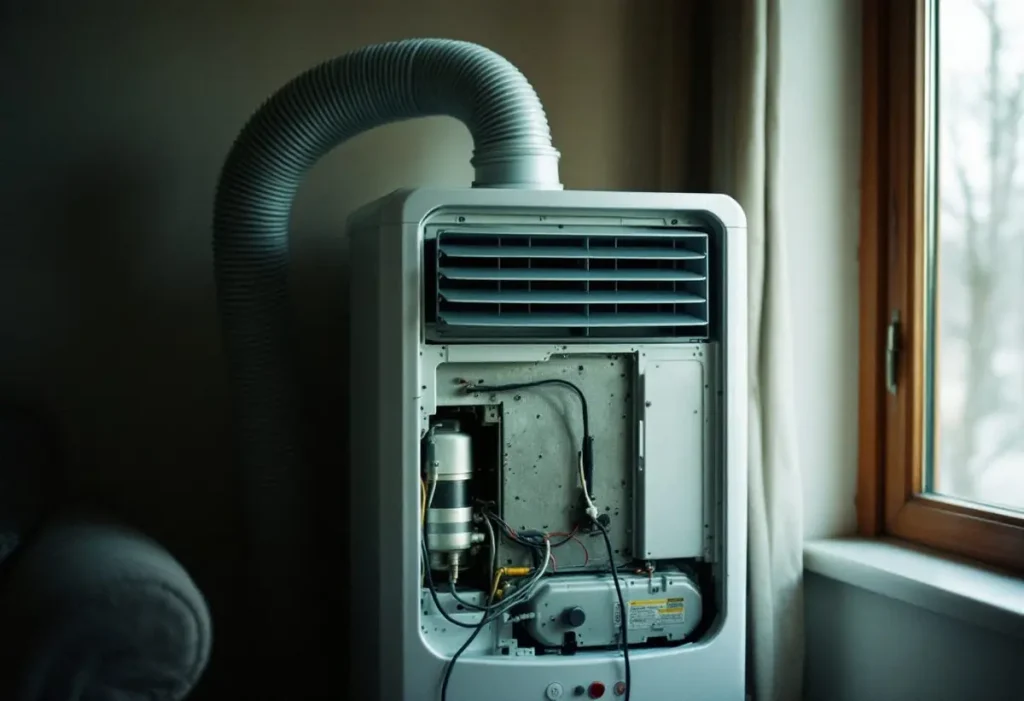
Recall notices name the failure points: a window unit’s motor control board, a portable unit’s drain motor, and portable units that overheat. No national series isolates AC fires from lightning, condenser debris or wildfire embers, so those are not quantified here.
Which air conditioners have been recalled for fire?
CPSC recall notices are the best record of defects behind AC fires. The table lists four fire recalls, with the unit counts and incidents CPSC published. Our HVAC recall registry tracks every heating and cooling recall since 2015.
| Recall date | Product | Units | Reported incidents | Hazard, per CPSC |
|---|---|---|---|---|
| September 2026 | Friedrich KÜHL Q and KÜHL S window ACs | About 2,000 | Two reports of the motor igniting; one caused smoke and fire damage to a home | Control board inside the motor can fail |
| December 2021 | Royal Sovereign portable ACs, sold 2008 to 2014 | About 33,570 | 11 reports of fire or smoking; over $1 million in damage; two injuries; one death | Faulty drain motor can ignite the plastic enclosure |
| December 2016 | LG 7,000 and 8,000 BTU portable ACs | About 466,000 | Four fires; $380,000 in damage | Units can overheat |
| November 2016 | Midea-made dehumidifiers sold under dozens of brands | About 3.4 million | 38 reports of smoke and fire; about $4.8 million in damage | Units can overheat, smoke and catch fire |
The Royal Sovereign death was from smoke inhalation, per the CPSC notice. The LG and Midea recalls each covered more than five years of sales. NFPA files dehumidifiers in the same air conditioning, fan or related equipment group, with 217 home fires a year in 2007 to 2011 (NFPA, 2013). Our dehumidifier sizing guide covers running cost and capacity.
Do fans start more fires than air conditioners?
Yes. CPSC estimates fans started 2,700 unintentional home fires a year in 2021 to 2023, nearly twice the 1,500 for air conditioning, with $76.4 million in yearly property loss. NFPA’s 2012 to 2016 tables show the same order: 5,100 fan fires against 2,900 air conditioner fires.
NFPA’s combined “fan or air conditioner” line was 8,000 home fires, 50 deaths, 270 injuries and $197 million a year in 2012 to 2016, the kind of total behind many headlines. For the winter equivalent, see our space heater fire data.
Correction to a common claim
Headline totals of 7,000 or more “air conditioner fires” a year are NFPA counts for air conditioning, fans and related equipment combined, such as 8,000 a year in 2012 to 2016. Air conditioners alone: 2,900 a year (NFPA, 2012 to 2016) and 1,500 (CPSC, 2021 to 2023).
How to prevent an air conditioner fire: what fire officials say
Fire officials repeat one rule above the others: plug the air conditioner straight into a wall outlet. In August 2022 the Massachusetts State Fire Marshal said “Extension cords and power strips are for temporary use and can’t safely handle the high current that air conditioners, space heaters, and other heavy appliances use.”
The warning followed a Palmer house fire that started where an AC cord met an extension cord, itself plugged into a power strip. Four days earlier, a Webster fire began with an AC cord pinched behind a bedframe; the breaker had tripped several times in the hours before. The Massachusetts Department of Fire Services counted 128 AC fires in the state’s homes over 10 years, with five civilian deaths and $6.1 million in damage.
- Plug the unit directly into a wall outlet, never an extension cord or power strip (Massachusetts DFS).
- Keep the cord where doors and furniture cannot pinch it (Massachusetts DFS).
- Treat repeated breaker trips, sparks or a burning smell as a call for an electrician or the fire department (Webster Fire Chief).
- Check older units’ model numbers against CPSC recall notices.
- Keep working smoke alarms; the Palmer home had none.
A tripping breaker is a symptom, and our guide to why an AC keeps tripping the breaker explains why resetting it repeatedly is a mistake. Surge devices are built for voltage spikes rather than overloaded cords, as our surge protector explainer sets out.
Whether insurance pays after a fire depends on policy wording; see our review of homeowners insurance and HVAC claims.
How we researched this
Research date: October 31, 2026. We consulted 22 sources and cited 10. Statistics were read in the original PDFs: CPSC (October 2026), three NFPA reports (2013, 2018, 2021; archived copies, as nfpa.org no longer serves them) and USFA (2001). Recall details come from CPSC’s public recall database. Freshness: 2 sources from 2026, 3 from 2021 to 2022, 5 from 2016 or earlier, each dated in the text.
Excluded: contractor, retailer and insurance blogs (unsourced or undated numbers), reposts of a 2006 to 2010 NFPA fact sheet we could not open at NFPA, non-US data, non-fire recalls, and Reddit (skipped for a safety topic). Limitations: NFIRS reporting is voluntary, small estimates are rounded, and losses are not inflation adjusted. Update schedule: each new CPSC three-year estimate.
Frequently asked questions
Can an air conditioner catch fire?
Yes. CPSC estimates air conditioning was the equipment involved in 1,500 unintentional US home fires a year in 2021 to 2023. A 2001 USFA report found 86% of residential AC fires came from mechanical failure or malfunction, half of them short circuits.
How many deaths do air conditioner fires cause?
CPSC estimates about 10 civilian deaths a year from air conditioning fires in 2021 to 2023, rounded to the nearest 10. NFPA’s 2012 to 2016 tables, which allocate unknown causes and are an upper bound, put the figure at 30 deaths a year. Both are small next to the 2,480 total residential fire deaths a year CPSC estimated for 2021 to 2023.
Is it safe to plug a window air conditioner into an extension cord?
No. The Massachusetts State Fire Marshal said in August 2022 that extension cords and power strips are for temporary use and cannot safely handle the high current air conditioners use. The Palmer fire that prompted the warning started where an AC cord met an extension cord. NFPA counted 2,200 home fires a year from cord or plug failures in 2015 to 2019.
Are portable air conditioners more likely to catch fire?
Portable units cause fewer AC fires but more damage per fire. CPSC estimates 500 portable AC fires a year in 2021 to 2023 against 1,000 for fixed and central units, yet portable units carried $54.0 million in yearly loss versus $37.2 million. Older USFA data showed window and wall units caused 55% of AC fires while making up 35% of units.
Do fans cause more house fires than air conditioners?
Yes. CPSC estimates fans started 2,700 unintentional home fires a year in 2021 to 2023, compared with 1,500 for air conditioning. NFPA’s 2012 to 2016 tables show 5,100 fan fires against 2,900 AC fires a year. Many headline AC fire totals are actually NFPA’s combined fan and air conditioner figure.
How do I check if my air conditioner has been recalled for fire?
Find the model number on the nameplate, then search CPSC recall notices for the brand. Recent fire recalls include about 2,000 Friedrich KÜHL window units in September 2026 and about 466,000 LG portable units in December 2016. Royal Sovereign’s portable AC recall covered about 33,570 units sold from 2008 to 2014.
Sources
- US Consumer Product Safety Commission. “2021 to 2023 Residential Fire Loss Estimates.” https://www.cpsc.gov/s3fs-public/2021-to-2023-Residential-Fire-Loss-Estimates-Annual-Fire-Loss-Report.pdf. Accessed October 2026.
- NFPA. “Home Structure Fires: Supporting Tables,” December 2018, archived copy. https://web.archive.org/web/20190416042005/https://www.nfpa.org/-/media/Files/News-and-Research/Fire-statistics-and-reports/Building-and-life-safety/oshomefirestables.pdf. Accessed October 2026.
- NFPA. “Home Fires Caused by Electrical Failure or Malfunction: Supporting Tables,” November 2021, archived copy. https://web.archive.org/web/20220401120141/https://www.nfpa.org//-/media/Files/News-and-Research/Fire-statistics-and-reports/Electrical/osHomeFiresCausedbyElectricalFailureMalfunction_Supporting-Tables.pdf. Accessed October 2026.
- NFPA. “Home Structure Fires by Equipment Involved in Ignition,” February 2013, archived copy. https://web.archive.org/web/20220615110130/https://www.nfpa.org/-/media/Files/News-and-Research/Fire-statistics-and-reports/Building-and-life-safety/oshomefiresequipmentignition.ashx. Accessed October 2026.
- US Fire Administration. “Residential Air Conditioner Fires,” Topical Fire Research Series Vol. 2 Issue 5, July 2001 (rev. March 2002). https://apps.usfa.fema.gov/downloads/pdf/statistics/v2i5-508.pdf. Accessed October 2026.
- Massachusetts Department of Fire Services. “Palmer Fire Caused by Air Conditioner Plugged into Extension Cord,” August 11, 2022, archived copy. https://web.archive.org/web/20250901005615/https://www.mass.gov/news/palmer-fire-caused-by-air-conditioner-plugged-into-extension-cord. Accessed October 2026.
- US Consumer Product Safety Commission. “Friedrich Air Conditioning Recalls KÜHL Window Air Conditioners Due to Risk of Serious Injury or Death from Fire and Burn Hazards,” September 17, 2026. https://www.cpsc.gov/Recalls/2026/Friedrich-Air-Conditioning-Recalls-K%C3%9CHL-Window-Air-Conditioners-Due-to-Risk-of-Serious-Injury-or-Death-from-Fire-and-Burn-Hazards. Accessed October 2026.
- US Consumer Product Safety Commission. “Royal Sovereign Recalls Portable Air Conditioners Due to Fire and Burn Hazards; One Death Reported,” December 22, 2021. https://www.cpsc.gov/Recalls/2022/Royal-Sovereign-Recalls-Portable-Air-Conditioners-Due-to-Fire-and-Burn-Hazards-One-Death-Reported. Accessed October 2026.
- US Consumer Product Safety Commission. “LG Electronics Recalls Portable Air Conditioners Due to Fire Hazard,” December 16, 2016. https://www.cpsc.gov/Recalls/2017/LG-Electronics-Recalls-Portable-Air-Conditioners. Accessed October 2026.
- US Consumer Product Safety Commission. “Dehumidifiers Made by Midea Recalled Due to Serious Fire and Burn Hazards; $4.8 Million in Property Damage Reported,” November 2, 2016. https://www.cpsc.gov/Recalls/2017/Dehumidifiers-Made-by-Midea-Recalled. Accessed October 2026.
Leave a Reply