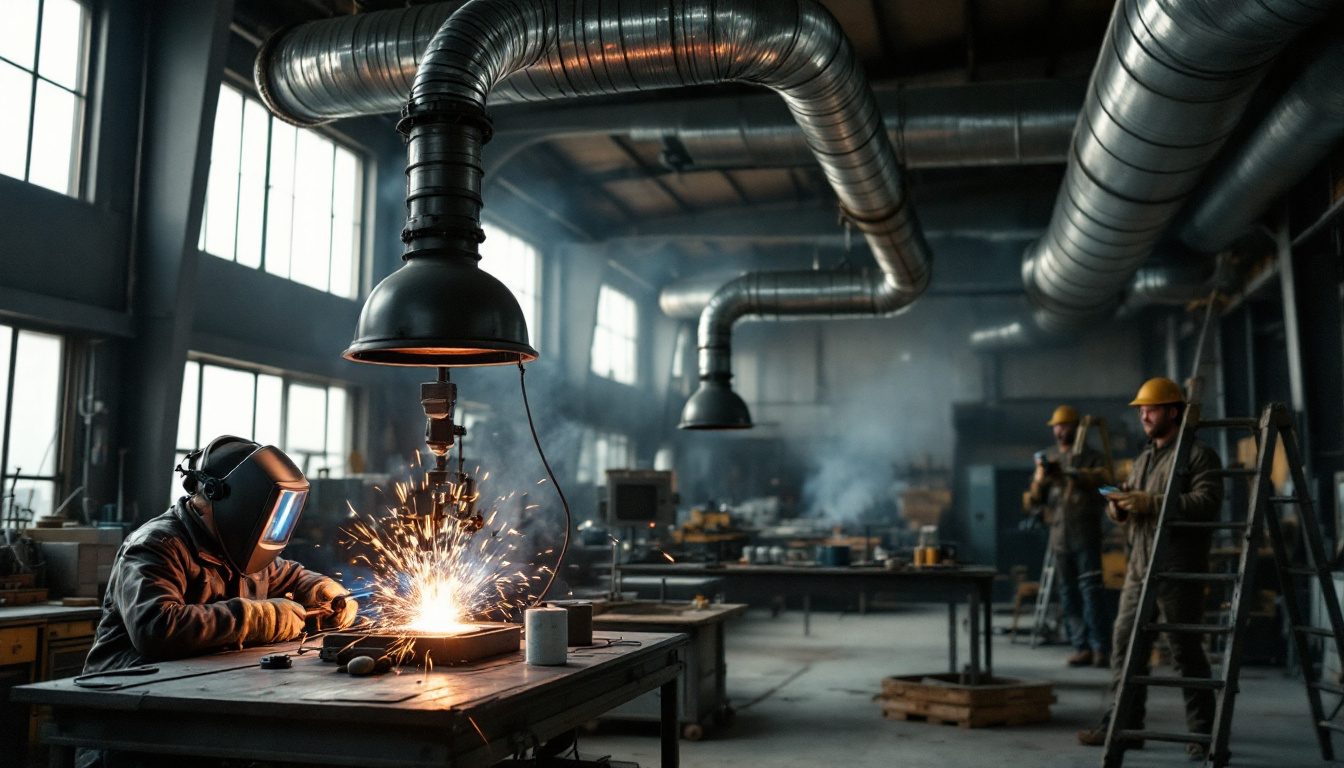
What is an industrial ventilation system? An industrial ventilation system is engineered exhaust plus make-up air that removes fumes, dust and vapors at work. The two kinds are dilution ventilation, which flushes the whole room, and local exhaust ventilation, which captures contaminants at the source with a hood, duct, air cleaner, fan and stack.
Key Takeaways
- OSHA’s Technical Manual says a typical local exhaust system has five parts: fans, hoods, ducts, air cleaners and stacks.
- Capture velocity drops by a factor of 10 between one and two duct diameters from a plain hood, per the same OSHA manual.
- 29 CFR 1910.252(c) requires 2,000 cfm per welder under 10,000 cubic feet per welder or a 16 ft ceiling, or hoods holding 100 fpm.
- OSHA’s hexavalent chromium limit is 5 micrograms per cubic meter (8-hour average); manganese fume has a 5 mg/m3 ceiling.
- Spray booths need clean make-up air equal to the air exhausted, under 29 CFR 1910.94(c)(7).
What is an industrial ventilation system?
An industrial ventilation system is a set of fans, ducts and hoods built to keep airborne contaminants below exposure limits, not to keep people comfortable. That purpose is the main difference from the comfort side of ventilation in ordinary HVAC work, where the goal is fresh air and odor control.
OSHA’s Technical Manual lists five types: general exhaust for dilution, local exhaust, make-up air, HVAC for comfort, and recirculation, usually combined. The fans, sheet metal and controls look like commercial HVAC, but the design target is an exposure limit in federal regulation, and the employer answers to OSHA if the system falls short.
What are the five parts of a local exhaust ventilation system?
A local exhaust ventilation system has five parts: a hood that captures the contaminant, ducts that carry it, an air cleaner that removes it, a fan that moves the air, and a stack that discharges it. OSHA says it captures a contaminant “at or near its source” before it disperses.
OSHA’s manual puts duct velocity between 2,000 and 6,000 feet per minute, and 29 CFR 1910.94(b) recommends 4,500 fpm in grinding branches and 3,500 fpm in the main, so sizing differs from comfort duct design. The six-and-three rule calls for six diameters of straight duct at the fan inlet and three at the outlet; with an elbow 2.5 diameters from the inlet, the manual puts the loss at 20% of the cfm. A centrifugal fan wired backward delivers only 30 to 50% of rated flow.

Dilution or local exhaust: which industrial ventilation system fits the job?
Use local exhaust when the contaminant is highly toxic, comes from point sources, or is a heavier particulate; dilution fits low-hazard vapors released evenly. That is Table III:3-5 of the OSHA Technical Manual, summarized below.
| Factor | Dilution (general exhaust) | Local exhaust ventilation |
|---|---|---|
| Hazard of the material | Relatively low | Relatively high |
| Form of the contaminant | Vapors, gases, small respirable aerosols | Larger particulates likely to settle |
| Emission pattern | Uniform and widely dispersed | Point sources; emissions vary over time |
| Worker position | Can be upwind of the dilution zone | Works right beside the source |
| Climate | Moderate | Severe |
| Typical OSHA welding rule | 2,000 cfm per welder, 1910.252(c)(2) | 100 fpm at the hood’s farthest point, 1910.252(c)(3) |
The climate row is about energy: outside air brought in for dilution must be tempered, and OSHA lists “minimizing air turnover” as a reason to choose local exhaust. Heat recovery, the logic behind energy and heat recovery ventilators, is a design call for the engineer of record on contaminated exhaust.
Why does a hood stop working a few inches too far away?
A hood stops working a few inches out because suction falls off sharply with distance. In OSHA’s worked example, a plain hood with 3,000 fpm in the duct gives a capture velocity of 300 fpm one duct diameter in front of the opening, and only 30 fpm at two diameters, a drop by a factor of 10.
OSHA’s rule of thumb: keep the source within 1.5 duct diameters of a simple capture hood, so no more than 9 in away on a 6 in duct, with capture velocity no lower than 50 fpm. Strong cross-drafts “can easily reduce a hood’s effectiveness by 75%,” the manual adds, so a pedestal fan near a welding bench can defeat a well-sized system.
Myth: a strong fan pulls from across the room
OSHA calls this a common misconception: a fan’s ability to blow a jet of air is not its ability to draw air in, so hoods must be close to the source. Nor do heavy vapors reliably sink to a floor hood; at 1,000 ppm the mixture’s density is close to that of air.
What does OSHA require for welding ventilation?
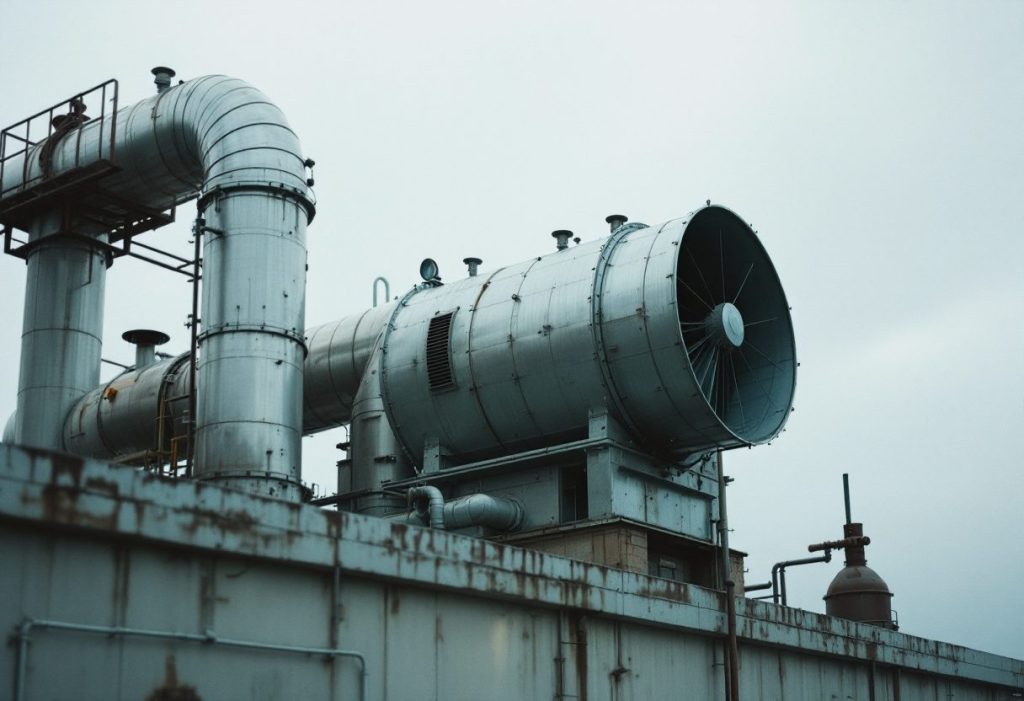
OSHA requires mechanical ventilation for general welding when there is less than 10,000 cubic feet of space per welder, the ceiling is under 16 ft, or partitions and confined spaces block cross ventilation. That ventilation must run at 2,000 cfm per welder unless local exhaust hoods, booths or approved airline respirators are used, under 29 CFR 1910.252(c)(2).
With movable hoods, airflow depends on hood distance from the arc, per 29 CFR 1910.252(c)(3)(i) for a 3 in flanged opening (duct sizes assume 4,000 fpm).
| Hood distance from arc or torch | Minimum airflow (cfm) | Duct diameter (in) |
|---|---|---|
| 4 to 6 in | 150 | 3 |
| 6 to 8 in | 275 | 3.5 |
| 8 to 10 in | 425 | 4.5 |
| 10 to 12 in | 600 | 5.5 |
Moving the hood from 4 to 6 in out to 10 to 12 in quadruples the airflow, from 150 to 600 cfm. The metal can override the room-size test: indoors, lead-bearing metals require local exhaust or airline respirators, cadmium and mercury the same unless air tests show safe exposure, and beryllium requires both. BLS counted 437,700 jobs for welders, cutters, solderers and brazers in 2025.
OSHA’s welding fact sheet notes that chromium in stainless steel converts to hexavalent chromium during welding, and that prolonged manganese fume exposure can cause Parkinson’s-like symptoms. NIOSH recommends 1 mg/m3 for manganese as a time-weighted average. On construction sites, 29 CFR 1926.353 requires general mechanical or local exhaust ventilation and says contaminated air must discharge clear of intake air.
Which other OSHA rules shape an industrial ventilation system?
The OSHA ventilation standard, 29 CFR 1910.94, sets design rules for three operations in its current text: abrasive blasting, grinding, polishing and buffing, and spray finishing. Beyond those, the general duty is to keep exposures under the limits in 29 CFR 1910.1000, using engineering controls first wherever feasible.
Spray finishing is closest to HVAC work. Under 1910.94(c)(7), make-up air must equal the air the booth exhausts, and air through self-closing doors, dampers or louvers may not exceed 200 feet per minute. Where outdoor temperatures stay below 55°F for appreciable periods, make-up air must be heated to at least 65°F at entry, and the heater may not sit inside the booth. Booth filters need a pressure gauge marked with the drop at which they must be replaced.
What should an HVAC contractor check before bidding industrial ventilation work?
Before bidding, confirm who owns the exposure target, what the hoods must achieve, and how the system will be tested. A scope that only says “install fume exhaust” leaves the shop holding performance risk with no measurable standard. A firm already selling commercial service agreements has the fan and controls skills; the gap is design criteria and test records.
- Get the process and contaminant in writing. Stainless, cadmium or lead changes the rules under 1910.252(c); spray finishing brings in 1910.94(c).
- Ask for the design basis. OSHA’s manual says hoods must meet the ACGIH Industrial Ventilation Manual or the applicable OSHA standard. If nobody has set hood airflows, price design separately or decline.
- Price make-up air. Without it the room goes slightly negative and exhaust airflow falls, OSHA notes; garage exhaust is a small residential version of the same problem.
- Lay out the fan and stack to the rules. Follow the six-and-three duct rule and keep the stack 10 ft above any roof line or air intake within 50 ft.
- Commission with numbers. Measure hood static pressure 4 to 6 duct diameters downstream in straight duct and record face velocities. Abrasive blasting exhaust must be checked at completion and periodically under 1910.94(a).
- Check licensing and permits. Requirements vary by state; see our state license guide and mechanical permit rules.
Commissioning overlaps with air balancing, but the pass mark is capture velocity at the source, not cfm at a diffuser. We found no federal series for installed LEV costs, so we publish none.
How we researched this
We read the regulation text for 29 CFR 1910.94, 1910.252, 1910.1000 Table Z-1, 1910.1026 and 1926.353 directly from the eCFR versioner API (version dated October 1, 2026), plus the OSHA Technical Manual Section III Chapter 3, OSHA fact sheet FS-3647, the NIOSH Pocket Guide entry for manganese and the BLS Occupational Outlook Handbook. We consulted 14 sources and cited 9. Vendor guides, Canadian and UK guidance and secondary welding summaries were excluded for numbers; ACGIH figures are not quoted because we could not read them at the source. Reddit was skipped: safety topic. Research date: October 8, 2026.
Frequently asked questions
What is the difference between local exhaust and general ventilation?
Local exhaust captures a contaminant at its source through a hood, while dilution ventilation mixes clean air into the whole room to lower the concentration. OSHA’s Technical Manual recommends local exhaust for relatively high-hazard materials, point sources and workers who stand right beside the process.
What is capture velocity?
Capture velocity is the air speed at the contaminant source needed to pull it into the hood. It falls quickly with distance: in OSHA’s example, 300 fpm at one duct diameter becomes 30 fpm at two. OSHA’s rule of thumb keeps the source within 1.5 duct diameters and capture velocity at no less than 50 fpm.
How many cfm does a welder need?
Where mechanical ventilation is required, 29 CFR 1910.252(c)(2) sets a minimum of 2,000 cfm per welder. With a movable hood, the required airflow depends on distance: 150 cfm with the hood 4 to 6 in from the arc, rising to 600 cfm at 10 to 12 in, for a 3 in flanged opening.
Is natural ventilation ever enough for welding?
Yes. OSHA treats natural ventilation as sufficient when none of the triggers in 1910.252(c)(2)(i) apply: at least 10,000 cubic feet per welder, a ceiling of 16 ft or more, and no barriers blocking cross ventilation. Toxic metals such as lead and beryllium have stricter rules, and OSHA warns that open spaces do not guarantee adequate ventilation.
What kind of fan does an industrial ventilation system use?
OSHA’s Technical Manual says ventilation fans fall into two classes, axial flow and centrifugal, and points to the ACGIH Industrial Ventilation Manual for selection detail. A common field fault is a centrifugal fan running backward after a wiring change, which delivers only 30 to 50% of rated flow.
What is the OSHA limit for welding fume from stainless steel?
Stainless welding can release hexavalent chromium, which OSHA limits to 5 micrograms per cubic meter as an 8-hour average under 29 CFR 1910.1026. The standard also sets an action level of 2.5 micrograms per cubic meter, which triggers periodic monitoring at least every six months.
Sources
- Occupational Safety and Health Administration. “OSHA Technical Manual, Section III: Chapter 3, Ventilation Investigation.” https://www.osha.gov/otm/section-3-health-hazards/chapter-3. Accessed October 2026.
- Electronic Code of Federal Regulations. “29 CFR 1910.252, General requirements (welding, cutting and brazing).” https://www.ecfr.gov/current/title-29/section-1910.252. Accessed October 2026.
- Electronic Code of Federal Regulations. “29 CFR 1910.94, Ventilation.” https://www.ecfr.gov/current/title-29/section-1910.94. Accessed October 2026.
- Electronic Code of Federal Regulations. “29 CFR 1926.353, Ventilation and protection in welding, cutting, and heating.” https://www.ecfr.gov/current/title-29/section-1926.353. Accessed October 2026.
- Electronic Code of Federal Regulations. “29 CFR 1910.1026, Chromium (VI).” https://www.ecfr.gov/current/title-29/section-1910.1026. Accessed October 2026.
- Electronic Code of Federal Regulations. “29 CFR 1910.1000, Air contaminants (Table Z-1).” https://www.ecfr.gov/current/title-29/section-1910.1000. Accessed October 2026.
- Occupational Safety and Health Administration. “Controlling Hazardous Fume and Gases during Welding” (FS-3647). https://www.osha.gov/sites/default/files/publications/OSHA_FS-3647_Welding.pdf. Accessed October 2026.
- National Institute for Occupational Safety and Health. “NIOSH Pocket Guide to Chemical Hazards: Manganese compounds and fume (as Mn).” https://www.cdc.gov/niosh/npg/npgd0379.html. Accessed October 2026.
- US Bureau of Labor Statistics. “Welders, Cutters, Solderers, and Brazers,” Occupational Outlook Handbook. https://www.bls.gov/ooh/production/welders-cutters-solderers-and-brazers.htm. Accessed October 2026.
Leave a Reply