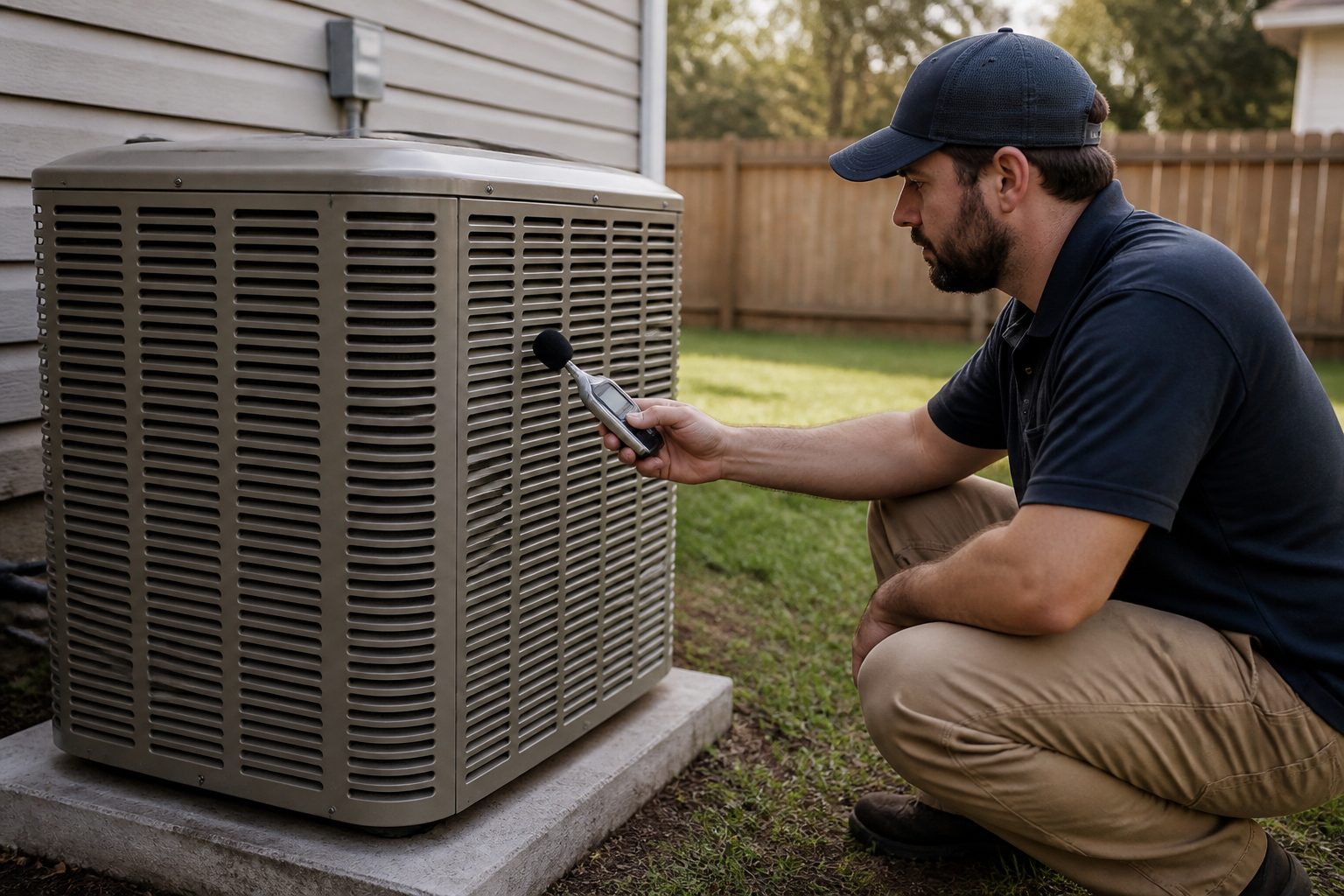
What do air conditioner decibel levels actually mean? Air conditioner decibel levels are laboratory ratings on a logarithmic scale, not a promise about your patio. A 10 dB rise sounds roughly twice as loud, and outdoor units mostly publish sound power, not pressure.
Key Takeaways
- The National Park Service states that “an increase of 10 dB causes a doubling of perceived loudness.”
- Carrier rates the Infinity 24VNA6 under the heading Sound Power Level (dBA), to AHRI 270-2008: 51 dBA at minimum speed, 68 dBA at maximum.
- Mitsubishi lists the MSZ-FS09NA indoor head at 40 down to 20 dB(A) in cooling.
- ENERGY STAR caps certified range hoods and bath fans at 2.0 sones to 200 cfm, but sets no sound criterion for ceiling fans.
- New York City Administrative Code 24-227 limits one circulation device to 42 dB(A) inside a neighboring dwelling; Chicago Municipal Code 8-32-090 caps a mechanical stationary source at 55 dB(A) at 100 feet overnight.
What do air conditioner decibel levels actually measure?
Air conditioner decibel levels report acoustic energy under a laboratory procedure, as a ratio against a fixed reference. They describe the machine, not the room.
For residential outdoor equipment the procedure is ANSI/AHRI Standard 270, covering outdoor sections of air conditioners, heat pumps and VRF systems at 40 kW or less. Larger air cooled equipment falls under ANSI/AHRI Standard 370. Both are Air-Conditioning, Heating, and Refrigeration Institute standards, not federal rules, so no agency enforces the label figure.
So a spec sheet sound figure is a competitive claim under a trade association test, unlike the federally set minimum efficiency floors printed beside it.
Why are air conditioner decibel levels logarithmic, and what does that do to the arithmetic?
Because the decibel is a ratio scale, air conditioner decibel levels cannot be added or averaged. The National Park Service states the rule plainly: “Decibels are measured on a logarithmic scale, so an increase of 10 dB causes a doubling of perceived loudness and represents a ten-fold increase in sound level”.
The arithmetic that follows is ours, applied to that rule. The gap between a 72 dBA unit and a 68 dBA unit is under half the step that doubles apparent loudness. Two identical units double the acoustic energy, which adds about 3 dB, not 68 plus 68: two matched condensers on one pad give roughly 71 dBA.
The same 3 dB step appears in federal hearing guidance. CDC and NIOSH set a recommended exposure limit of 85 A-weighted decibels over an eight hour workday, and state that “for each 3 dBA increase in noise level, NIOSH recommends reducing the exposure duration by half.”
Do air conditioner decibel levels report sound power or sound pressure?
Sound power, in most cases, and that is not something you can repeat with a meter on your patio. Carrier’s product data for the Infinity 24VNA6 heads its table “Sound Power Level (dBA)” with the note “Tested in compliance with AHRI 270-2008 but not listed with AHRI.”
Sound power is the total acoustic energy a machine emits. Sound pressure is what arrives at a point: it falls off with distance, changes with reflective surfaces and mixes with everything else outside. A 68 dBA sound power rating is not 68 dBA at the property line.
The comparison that fails
Do not measure your outdoor unit with a phone app and compare it to the spec sheet. That sets a sound pressure reading against a laboratory sound power rating, and the mismatch is the most common reason homeowners conclude a new unit is louder than advertised. If the complaint is a rattle, squeal or bang rather than a level, see which HVAC sounds mean stop using the system.
Where does a federal program set a sound limit at all?
Only in ventilation, and only in sones. ENERGY STAR caps certified range hoods and bath or utility fans at 2.0 sones up to 200 cfm and 3.0 sones from 201 to 500 cfm, with no sound requirement at all for in-line fans. Nothing equivalent exists for central cooling equipment.
That limit constrains what gets certified, so check it when sizing a bathroom exhaust fan or specifying a range hood and its ducting. The test method is HVI 915-06.
Ceiling fans are the case people get wrong. Those criteria are stated entirely in cubic feet per minute per watt and minimum airflow, with no sone or decibel threshold. A certified ceiling fan is efficient, not quiet, so the direction and speed you run it at matter more than the label.
What are typical air conditioner decibel levels by equipment class?
Each class uses a different metric, so the table pairs each with its rating basis.
| Equipment class | Metric published | Rating basis | Example published figure |
|---|---|---|---|
| Central outdoor unit, residential | Sound power level, dBA | ANSI/AHRI Standard 270 | Carrier 24VNA6: 51 dBA (2 ton, min speed) to 68 dBA (4 ton, max speed) |
| Mini split indoor head | Sound pressure level, dB(A) | Manufacturer test, AHRI 210/240 | Mitsubishi MSZ-FS09NA: 40, 36, 29, 23, 20 dB(A), five cooling speeds |
| Bathroom or utility fan | Sones | HVI 915-06, via ENERGY STAR | 2.0 sones max to 200 cfm; 3.0 sones to 500 cfm |
| Kitchen range hood | Sones | HVI 915-06, via ENERGY STAR | 2.0 sones max, up to 500 cfm |
| Ceiling fan | None | ENERGY STAR: cfm per watt only | No sound threshold |
| Gas furnace | Usually none | No AHRI sound rating standard | Carrier 59MN7C product data has no decibel figure; Lennox lists “Quiet Operation” for the SLP99V with no number |
Outdoor units publish sound power, indoor heads sound pressure, ventilation sones, heating equipment mostly nothing. A ductless head is the only residential class publishing a per speed dB(A) table.
What is a sone, and can you convert it to decibels?
A sone is a loudness unit, not an energy unit, and there is no reliable general conversion to decibels. ENERGY STAR defines it as a unit translating “laboratory logarithmic decibel readings into a linear scale that corresponds to the way people sense loudness,” equal in loudness to “a pure tone of 1,000 cycles per second at 40 decibels above the listener’s threshold of hearing.”
Sones are linear where decibels are not: two sones is twice as loud as one, while ten decibels more is twice as loud. Any sone-to-decibel table is an approximation tied to one spectrum.
How do EPA and NIOSH noise numbers relate to air conditioner decibel levels?
They do not set equipment limits. EPA’s 1974 levels document, produced under the Noise Control Act of 1972, identified a yearly outdoor day-night level below 55 dB and an indoor level below 45 dB as protective against activity interference and annoyance, while warning that they “must not be viewed as standards, criteria, regulations, or goals.”
The NIOSH 85 dBA figure is narrower still: an occupational limit over an eight hour workday, aimed at hearing loss in workers. No residential outdoor unit above approaches it at a normal listening distance. Use both as context, not as a test your equipment passes.
What rule actually binds an outdoor unit?
The local noise ordinance, written as a property line or receiving property limit rather than an equipment rating. New York City Administrative Code 24-227 states that no person shall operate a circulation device “in such a manner as to create a sound level in excess of 42 dB(A)” inside a receiving dwelling unit, measured three feet from the open portion of a window or terrace door.
Chicago takes the other approach. Municipal Code 8-32-090 caps a mechanical stationary source, defined to include air handling and refrigeration units, at 55 dB(A) at 100 feet or 70 dB(A) at 10 feet, from the nearest adjacent public way or property, 8:00 p.m. to 8:00 a.m. Both cities regulate sound crossing a boundary, not the number on the box, so placement decides compliance more often than model choice, usually when the mechanical permit is pulled.
What makes equipment louder in the field than its rating suggests?
Installation, not the machine. New York City’s Department of Environmental Protection guidance sheet on exterior HVAC noise lists source controls first: keep equipment away from noise sensitive receptors, attach rooftop units to stiff or massive structural elements, mount them on inertial blocks or rails, and use vibration isolation springs or pads.
Four conditions cause most complaints. A unit bolted to a light deck or shared wall turns the structure into a sounding board. A missing isolation pad sends compressor vibration into the slab. Restricted airflow makes a fan work harder at higher static pressure, usually a duct problem, not an equipment problem. A failing motor changes the character of the sound before the level, which is where blower motor symptoms beat a decibel reading.
The condenser fan is the loudest moving part outdoors, and a coil packed with cottonwood makes it run longer and harder, so what the outdoor unit is doing explains seasonal noise changes better than a spec sheet.
How we researched this
Research date: September 2026. Federal and program documents came first: the National Park Service sound primer, CDC and NIOSH hearing material, the EPA 1974 levels document, and the ENERGY STAR ventilating and ceiling fan criteria. Municipal code came second, in the published text for New York City and Chicago. Manufacturer ratings came third, from each maker’s own product data or service manual.
The logarithmic arithmetic here, including the roughly 3 dB increase from two identical units, is ours, applied to the National Park Service rule. We measured no equipment. We excluded contractor blogs, lead generation sites and retailer sone-to-decibel conversion charts, because no standards body publishes a general conversion. AHRI Standards 270 and 370 are paywalled, so we cite only AHRI’s scope descriptions. No Reddit material was used.
Frequently asked questions
What is a quiet air conditioner decibel level?
For a residential outdoor unit, published sound power ratings in the low 50s dBA sit at the quiet end. Carrier’s Infinity 24VNA6 lists 51 dBA at minimum cooling speed on the 2 ton and 68 dBA at maximum on the 4 ton.
How many decibels is twice as loud?
Ten. The National Park Service states that an increase of 10 dB causes a doubling of perceived loudness and a tenfold increase in sound level. A 3 dB increase doubles the acoustic energy but is a far smaller perceptual step.
Do sones and decibels measure the same thing?
No. ENERGY STAR defines a sone as a linear loudness scale translated from logarithmic decibel readings, anchored to a 1,000 cycle per second tone at 40 decibels above the hearing threshold.
Does ENERGY STAR limit how loud a ceiling fan can be?
No. The ceiling fans criteria are cubic feet per minute per watt with minimum airflow by blade diameter. Only the ventilating fans program carries a sone ceiling.
Why do gas furnaces not publish a decibel rating?
There is no AHRI sound rating standard for furnaces. Carrier’s product data for the 59MN7C contains no decibel figure, and Lennox lists “Quiet Operation” among the SLP99V specifications without a number.
What noise limit applies to my outdoor unit?
Whatever your municipality writes, measured at a boundary rather than at the equipment. New York City limits one circulation device to 42 dB(A) inside a neighboring dwelling; Chicago limits a mechanical stationary source to 55 dB(A) at 100 feet.
Sources
- National Park Service. “Understanding Sound.” https://www.nps.gov/subjects/sound/understandingsound.htm. Accessed September 2026.
- CDC and NIOSH. “Noise and Hearing Loss.” https://www.cdc.gov/niosh/noise/about/noise.html. Accessed September 2026.
- US EPA. “Protective Noise Levels” (1974, condensed). https://www.nonoise.org/library/levels/levels.htm. Accessed September 2026.
- ENERGY STAR. “Ventilation Fans Key Product Criteria.” https://www.energystar.gov/products/ventilation_fans/key_product_criteria. Accessed September 2026.
- ENERGY STAR. “Residential Ventilating Fans V3.0.” https://www.energystar.gov/sites/default/files/specs/private/Ventilating_Fans_Final_Version_3.0_Product_Specification.pdf. Accessed September 2026.
- ENERGY STAR. “Ceiling Fans Key Product Criteria.” https://www.energystar.gov/products/ceiling_fans/key-product-criteria. Accessed September 2026.
- AHRI. “ANSI/AHRI Standard 270.” https://www.ahrinet.org/search-standards/ahri-270-sii-p-sound-performance-rating-outdoor-unitary-equipment. Accessed September 2026.
- AHRI. “ANSI/AHRI Standard 370.” https://www.ahrinet.org/search-standards/ahri-370-sii-p-sound-performance-rating-large-air-cooled-outdoor-refrigerating-and-air-conditioning. Accessed September 2026.
- Carrier. “Product Data, 24VNA6.” https://www.shareddocs.com/hvac/docs/1009/public/0f/24vna6-02pd.pdf. Accessed September 2026.
- Carrier. “Product Data, 59MN7C.” https://www.shareddocs.com/hvac/docs/1009/Public/0E/59MN7C-01PD.pdf. Accessed September 2026.
- Mitsubishi Electric. “Service Manual OBH872A, MSZ-FS06NA to FS18NA.” http://www.mitsubishitechinfo.ca/sites/default/files/SH_MSZ-FS06_18NA_OBH872A.pdf. Accessed September 2026.
- Lennox. “SLP99V Product Specifications.” https://www.lennox.com/residential/products/specifications/slp99v. Accessed September 2026.
- New York City. “Administrative Code 24-227.” https://codelibrary.amlegal.com/codes/newyorkcity/latest/NYCadmin/0-0-0-209181. Accessed September 2026.
- NYC DEP. “Noise Control for Exterior HVAC Equipment.” https://www.nyc.gov/assets/dep/downloads/pdf/air/noise/exterior-hvac-noise-control-guidance-sheet.pdf. Accessed September 2026.
- City of Chicago. “Municipal Code 8-32-090.” https://nonoise.org/regulation/ordinance/Chicago,%20Illinois.pdf. Accessed September 2026.
Leave a Reply