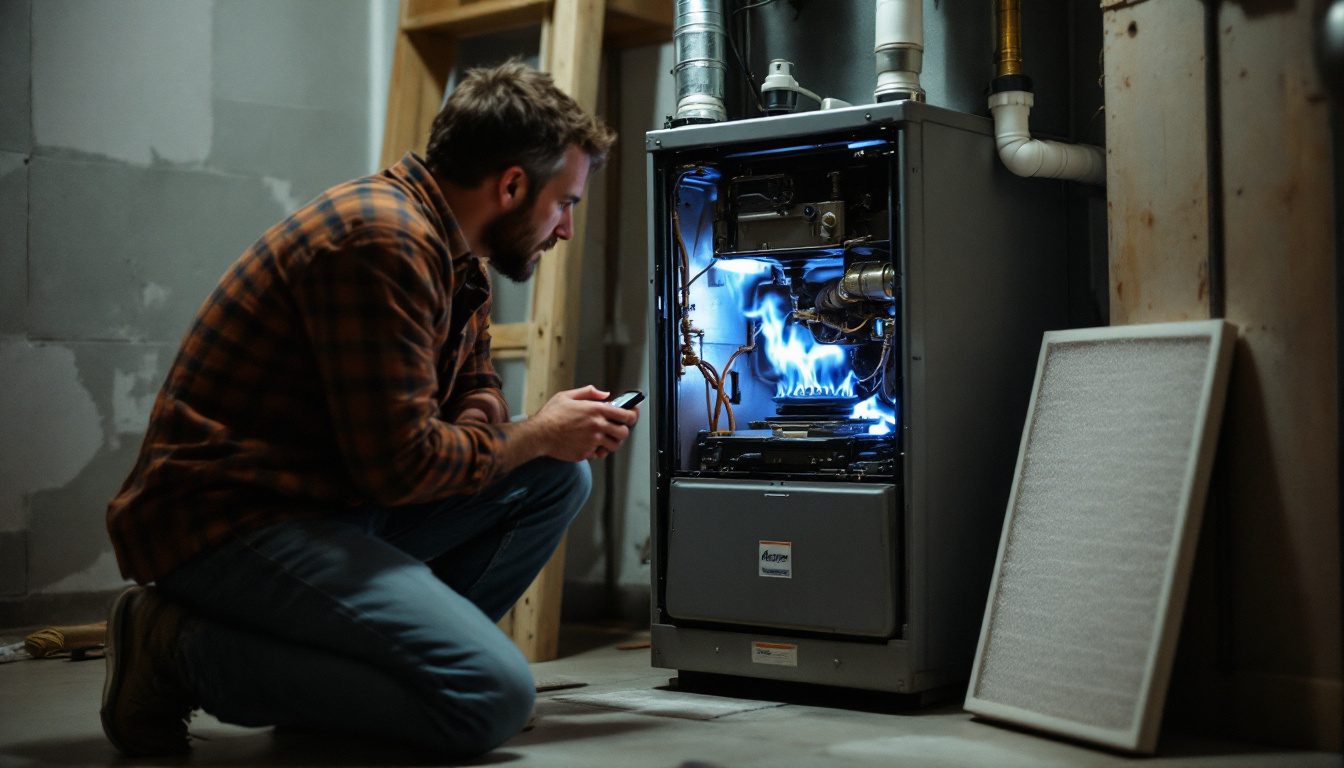
What is furnace short cycling? Furnace short cycling means the burners shut off before the house reaches the setpoint, then restart. Timing names the cause: seconds after ignition means flame proving, minutes in with the blower running means the high limit, and an early normal shutdown means sizing or the thermostat.
Key Takeaways
- Goodman’s control allows a 4 second trial for ignition and locks out after 3 retries total (Goodman RS6612022).
- On the Resideo S9200U1000 board, an open high limit cuts the gas while the blower keeps running; repeated trips end in a 60 minute lockout (Resideo 69-2075).
- Honeywell Home puts a typical mid-efficiency furnace at 5 CPH, so about 6 minutes on at half load is normal (Honeywell Home).
- ENERGY STAR, applying ACCA Manual S, caps a heating-only furnace at 100 to 140% of design heat loss, but allows 400% when paired with cooling (ENERGY STAR).
- The ASHRAE 103 rating test already assumes a 70% oversized furnace (NREL 2015, archived copy).
- Airflow problems can cut efficiency by up to 15 percent (ENERGY STAR checklist).
What is furnace short cycling, and what is a normal cycle?
Furnace short cycling is a heating cycle that ends early, because a safety control cut the burners or the thermostat was satisfied too fast, then restarts within minutes. Normal cycles are short: Honeywell Home says a typical mid-efficiency system cycles “about five times in an hour (5CPH).”
Honeywell Home defines cycle rate as “the maximum number of times a system will run, in an hour, when using 50% of its capacity” (Honeywell Home). At 5 CPH that is a 12 minute cycle: about 6 minutes on, 6 off. For 90%+ furnaces Honeywell recommends a cycle rate of 3, roughly 10 minutes on.
So a 6 minute burn on a mild day can be normal. Warning signs are burners that die within seconds or minutes, or a house that never reaches the setpoint. Cooling has its own version, covered in our guide to air conditioner short cycling.
Why does my furnace keep shutting off? Start with the timing
When a furnace keeps shutting off, the clock tells you which control ended the cycle. Note how long the burners stay lit and whether the blower keeps running afterward, then match the pattern below.
| When it shuts off | What you see | Control that ended the cycle | Usual causes |
|---|---|---|---|
| A. Before any flame | Inducer runs, burners never light | Pressure switch or igniter | Blocked vent, condensate, weak inducer, failed igniter |
| B. Seconds after ignition | Burners light, die, retry, lock out | Flame proving (flame sensor) | Coated sensor rod, poor ground, reversed polarity, gas pressure |
| C. A few minutes in | Burners out, blower keeps running | High limit (auto reset) | Dirty filter, closed registers, too few returns, slow blower, high static |
| D. Normal shutdown, too soon | Normal stop, no fault code, rooms uneven | Thermostat satisfied early | Oversized furnace, thermostat near a register, sun or draft, high cycle rate |
| E. Shuts off and stays off | No restart until reset or power cycled | Rollout or manual-reset limit | Flame rollout, blocked heat exchanger or vent (technician only) |
What if the furnace shuts off seconds after the burners light?
Burners that light and die within seconds mean the control could not prove flame, so it closed the gas valve on purpose. Goodman allows a 4 second trial for ignition; without proof of flame the control will “retry” or lock out, after 3 retries total (Goodman).
The Resideo S9200U1000 retries when flame is lost less than 10 seconds after the trial, and after three failed trials waits out an Auto Restart Delay of 60 minutes (Resideo). On a healthy Goodman cycle the blower starts 30 seconds after flame, the inducer runs a 15 second post purge, and the blower stops 90 seconds after the thermostat is satisfied.
A coated or loose sensor rod is the usual suspect; our flame sensor troubleshooting guide covers it, plus grounding and polarity faults.
If the burners never light and the inducer keeps running, check the pressure switch that proves the vent is clear, then the hot surface igniter. Resideo waits 150 seconds for the pressure switch, then idles for five minutes.
Why does a furnace short cycle after a few minutes with the blower still running?
When the burners go out after a few minutes but the blower keeps blowing, the high limit has opened because the heat exchanger ran too hot. On the Resideo S9200U1000, “the gas valve is immediately de-energized” while the circulator runs at heat speed.
The cause is usually airflow; Goodman says input and CFM must stay “within the limits shown to prevent short cycling.” Resideo’s limit code 5 lists “restricted airflow through heat exchanger; clogged filters; slow circulator fan speed,” with the advice to “open more ducts, add more returns.” Blocked supply and return vents count; Goodman also warns that too much external static pressure causes “excessive temperature rise, resulting in limit tripping.”
On Goodman’s GC9S960403B at blower tap F02, airflow drops from 727 CFM at 0.1 in. w.c. to 510 CFM at 0.5 in. w.c., and temperature rise climbs from 48°F to 65°F, the top of its 35 to 65°F range. Goodman cites approximately 0.5 in. w.c.; a 2015 NREL study reports 0.7 to 0.9 in. w.c. “is commonly observed in the field.”
Goodman primary limits are automatic reset, so the pattern repeats. Resideo relights if the limit closes within three minutes and allows three recycles per call for heat before lockout. Our limit switch explainer separates it from the rollout switch; the first fix is a clean furnace air filter of the right size.
Can an oversized furnace or the thermostat cause short cycling?
Yes. If everything stops normally with no fault code but rooms feel uneven, the thermostat is satisfied too quickly: the furnace is far larger than the load, or the thermostat reads unrepresentative air.
ENERGY STAR’s HVAC design report, applying ACCA Manual S, sets a heating-only furnace at 100 to 140% of the calculated heat loss (ENERGY STAR). Paired with air conditioning, up to 400% is allowed because the blower must also move cooling airflow. Rule-of-thumb sizing can overshoot; our guide to sizing a heating and cooling system shows the math.
Oversizing costs comfort more than efficiency. The NREL study notes the ASHRAE 103 rating test simulates “a 70% oversized unit,” and earlier Building America work found oversizing “not a significant factor for high-efficiency furnaces” (NREL). DOE still names a “significantly oversized” furnace as a reason to replace (DOE, archived copy). Furnaces with a low-fire stage, compared in our single stage vs two stage explainer, are one answer.
Thermostat placement is the cheaper suspect. DOE says it must sit “on an interior wall away from direct sunlight, drafts, doorways, skylights, and windows” to prevent “ghost readings” or unnecessary furnace cycling (DOE, archived copy). Honeywell Home says the installer can adjust the cycle rate; our explainer on how thermostats decide when to call for heat covers the setting.
What can you check safely before calling a technician?
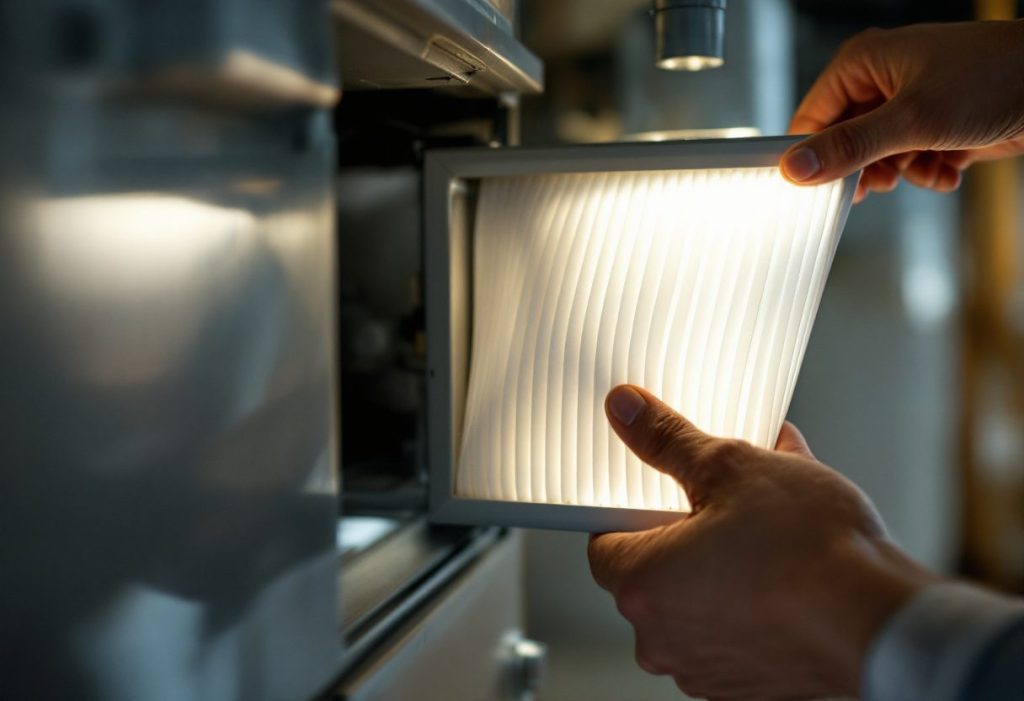
A homeowner can safely check timing, fault codes, the filter, registers and thermostat. Gas pressure, burner combustion and the heat exchanger are contractor checks on ENERGY STAR’s list, and so is any rollout trip.
- Time one cycle; note whether the blower runs on after the burners stop.
- Read the status light through the sight glass first; Goodman warns that opening the blower door can erase the stored failure code. The White-Rodgers 50M56D-751 board keeps up to 5 codes, auto-erased after 14 days.
- Check the filter; ENERGY STAR advises inspecting it once a month.
- Open closed registers and clear furniture off the returns.
- Check thermostat batteries, location and cycle rate.
- Still short cycling? Call a technician with the timing and code.
Safety point
Never jumper a limit, rollout or pressure switch. Goodman’s manual is blunt: “Never by-pass or alter furnace controls.” Repeated rollout trips call for an inspection that rules out a cracked heat exchanger. If you smell gas, leave the house and call the gas utility from outside.
Is furnace short cycling dangerous, and what does it cost you?
Short cycling is usually a safety control doing its job. The risk lies in the underlying fault, such as blocked venting, and in jumpered switches. No federal source publishes repair prices, so we quote none.
Airflow faults carry a measurable energy penalty: ENERGY STAR says “airflow problems can reduce your system’s efficiency by up to 15 percent” (ENERGY STAR). NREL’s 2015 report names furnaces “cycling off the high limit controller” as a poor-installation case worth testing. DOE suggests every home have a working carbon monoxide alarm; see our guide to where to place CO alarms.
How we researched this
Researched October 8, 2026. We consulted 13 sources and cite 10: five manufacturer documents, two ENERGY STAR documents, one NREL study and two archived DOE pages. Timings differ by model; your furnace’s manual governs.
Excluded: repair prices (no federal series), contractor blogs and content farms ranking for this query, and Reddit, which we skip for gas safety topics. ACCA Manual S is cited only through ENERGY STAR’s published restatement.
Frequently asked questions
Why does my furnace keep shutting off after a few minutes?
Most often the high limit opened because the heat exchanger overheated. The Resideo S9200U1000 lists restricted airflow, clogged filters and slow circulator fan speed for limit code 5. If the blower runs on after the burners stop, start with the filter and registers.
Why is my furnace short cycling with a new filter?
A denser filter adds resistance. ENERGY STAR counts a MERV 6 or higher filter in a system’s design external static pressure, and Goodman warns that too much static causes limit tripping. Use the size and type the installer specified, seated correctly.
Why does my furnace keep shutting off before reaching the set temperature?
If the burners stop but the blower keeps running, a safety limit ended the cycle. If everything stops normally, the thermostat thinks it is satisfied. DOE says thermostats belong on an interior wall away from sunlight, drafts, doorways and windows to avoid ghost readings.
Why is my furnace short cycling with no error code?
A thermostat satisfied early, from oversizing or poor placement, produces no fault code because nothing failed. Codes can also be lost: Goodman says removing the blower door without holding the door switch erases the stored code, and White-Rodgers erases stored codes after 14 days.
Why does my furnace shut off and need to be reset?
That is a lockout. Goodman locks out after 3 ignition retries, and the White-Rodgers 50M56D-751 resets automatically after 1 hour in lockout. A rollout trip is different: Resideo ignores heat calls until power is cycled, and a technician should find out why it tripped before anyone resets it.
Is it safe to keep running a furnace that short cycles?
Usually the controls are shutting the gas off, the safe direction, but the cause still needs fixing and switches must never be jumpered. DOE suggests every home have a working carbon monoxide alarm. If you smell gas, leave and call the gas utility from outside.
Sources
- Goodman Manufacturing. “Service and Troubleshooting GM9S92/GM9S96/GC9S96, RS6612022r1.” https://mobile.goodmanmfg.com/mobileapp/stellent/pdf/infoPdf/Lit/RS6612022R1.pdf. Accessed October 2026.
- Resideo. “S9200U1000 Installation Instructions 69-2075EF-07.” https://www.cochranesupply.com/media/assets/product/documents/Honeywell/S9200U1000.pdf. Accessed October 2026.
- White-Rodgers (Copeland). “50M56D-751 Installation Instructions.” https://media.copeland.com/7b1c16cb-45cd-45fe-8e23-b16b0109fc57/0037-7757001%20-%2050M56D-751%20Instruction%20Sheet%20(EF).pdf. Accessed October 2026.
- Honeywell Home (Resideo). “What is a cycle rate?” https://honeywellhome.com/us/en/support/wi-fi-7-day-programmable-thermostat-install-7. Accessed October 2026.
- Honeywell Home (Resideo). “My system turns on and off too fast. What should I do?” https://honeywellhome.com/us/en/support/7-day-programmable-thermostats-5. Accessed October 2026.
- U.S. EPA ENERGY STAR. “National HVAC Design Report, Rev. 13.” https://www.energystar.gov/sites/default/files/asset/document/National%20HVAC%20Design%20Report_Rev%2013.pdf. Accessed October 2026.
- U.S. EPA ENERGY STAR. “Maintenance Checklist.” https://www.energystar.gov/saveathome/heating-cooling/maintenance-checklist. Accessed October 2026.
- NREL (Brand, Yee and Baker). “Improving Gas Furnace Performance: A Field and Laboratory Study at End of Life,” 2015 (archived copy). https://web.archive.org/web/2024id_/https://www.nrel.gov/docs/fy15osti/63702.pdf. Accessed October 2026.
- U.S. Department of Energy, Energy Saver. “Programmable Thermostats” (archived copy). https://web.archive.org/web/2025id_/https://www.energy.gov/energysaver/thermostats. Accessed October 2026.
- U.S. Department of Energy, Energy Saver. “Furnaces and Boilers” (archived copy). https://web.archive.org/web/2025id_/https://www.energy.gov/energysaver/furnaces-and-boilers. Accessed October 2026.
Leave a Reply