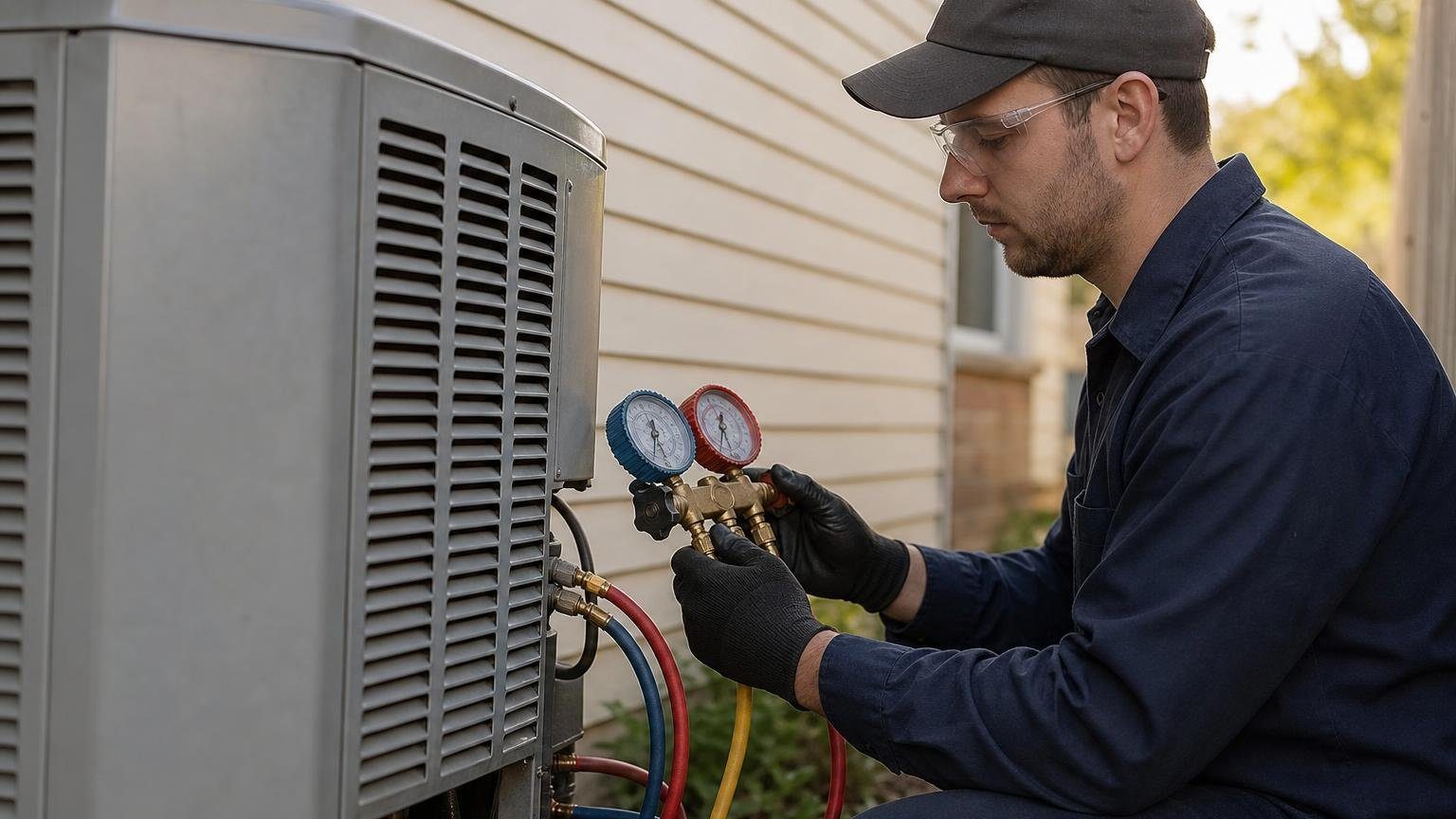
What is a manifold gauge? A manifold gauge is a valved block with a blue low side gauge, a red high side gauge and three or four hoses that lets a certified technician read refrigerant pressures, convert them to saturation temperatures, and evacuate or charge a system. Pressure alone never tells you the charge.
Key Takeaways
- EPA’s definition of “technician” in 40 CFR 82.152 names “attaching or detaching hoses and gauges” as work that can breach the refrigerant circuit.
- Home R-410A systems are “high-pressure appliances” (170 psia to 355 psia at 104°F), which require Type II or Universal certification under 40 CFR 82.161.
- A 120 psig reading means 40.5°F saturation on R-410A (BPA chart) but a 45.7°F dew point on R-454B (Honeywell chart).
- Yellow Jacket rates its PLUS II hoses at 800 psi working and 4,000 psi minimum burst (maker spec sheet).
- Testo lists ±0.5% of full scale and about 90 refrigerants for its 550s digital manifold (manual); Yellow Jacket’s analog A2L gauges list 1%.
- EPA’s SNAP list classes R-32 (GWP 675) and R-454B (GWP 470) as A2L, against 2,090 and A1 for R-410A.
What is a manifold gauge?
A manifold gauge is a service tool that connects to an air conditioner’s or heat pump’s service ports and shows low side (suction) and high side pressure at the same time. The manifold itself is the valved block that routes refrigerant between the hoses, the gauges and a center port.
Technicians use it for four jobs: reading operating pressures, evacuating with a vacuum pump, charging, and pressure or tightness testing. Testo’s 550s manual lists both pressures, evaporating and condensing temperature, pipe temperatures, superheat and subcooling. Our HVAC tool list, with the rule behind each item, covers the wider kit; this page stays on the gauge set.
Car AC (R-134a, R-1234yf) is a different job: paid motor vehicle AC work is certified under 40 CFR part 82 subpart B, not Section 608.
What do the blue, red and yellow hoses on a manifold gauge set do?
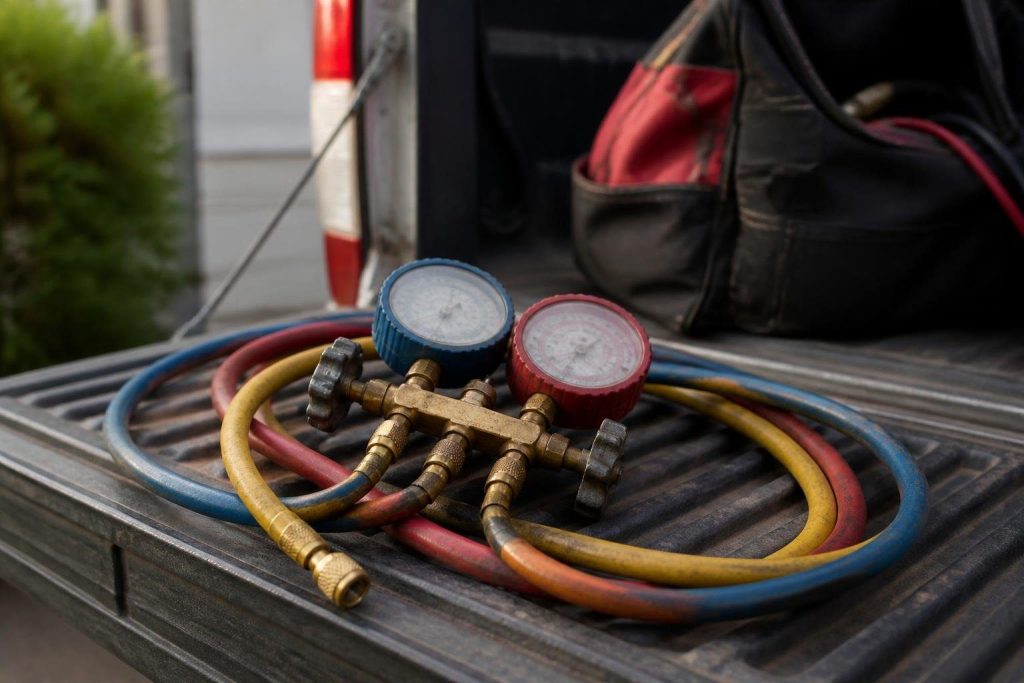
On an HVAC manifold gauge set, blue is the low side, red is the high side and yellow is the center utility hose. Testo’s manual names the “low-pressure side (blue) and high-pressure side (red)” hoses; Yellow Jacket sells red, yellow and blue three-packs.
| Hose or gauge | Connects to | What it reads or does |
|---|---|---|
| Blue (compound gauge) | Low side (suction) service port | Low side pressure and vacuum; a digital set adds evaporating temperature |
| Red (high side gauge) | High side (liquid line) service port | High side pressure; a digital set adds condensing temperature |
| Yellow (center) | Vacuum pump, recovery machine or cylinder | Utility path; reads nothing by itself |
| Fourth port (4-valve sets) | Vacuum pump or refrigerant | Separate path; Yellow Jacket TITAN and Fieldpiece SM480V are 4-port designs |
Hoses carry their own ratings. Yellow Jacket states its PLUS II hose assemblies are UL recognized for 800 psi working pressure and 4,000 psi burst, and sells a version for the 5/16 in flare service ports used on R-410A equipment (maker data). Fieldpiece’s SM480V flyer lists a maximum manifold pressure of 800 psig.
Who is allowed to connect manifold gauges?
Under federal law, connecting gauges is technician work. The 40 CFR 82.152 definition lists “attaching or detaching hoses and gauges to and from the appliance” among activities “reasonably expected to violate the integrity of the refrigerant circuit.” R-410A equipment is a high-pressure appliance, and 40 CFR 82.161 requires Type II or Universal certification to service it.
Two limits apply. Apprentices are exempt only while “closely and continually supervised by a certified technician” (82.161(a)(2)). And 40 CFR 82.154(a) bars anyone servicing an appliance from knowingly venting refrigerant, so the center hose goes to certified recovery equipment, which 40 CFR 82.158 requires to have low-loss fittings on all hoses. Our breakdown of the four EPA 608 certification types covers the exams.
How to hook up AC manifold gauges, in order
Hooking up AC manifold gauges follows one rule: valves closed before anything touches a service port. This sequence, from Testo’s manual and FJC’s guidance, is certified technician work.
- Identify the refrigerant on the nameplate and confirm the gauge set is rated for it; R-454B and R-32 call for an A2L-rated set.
- Inspect hoses and seals. Testo says to check before each measurement that hoses are intact and seals clean.
- Zero a digital manifold with every connection open to ambient pressure.
- Close both manifold valves.
- Connect blue to the low side port and red to the high side port, hand tight only; Testo gives a maximum of 3.7 ft-lb.
- Select the refrigerant (digital) or read its scale (analog), clamp pipe probes on the suction and liquid lines, and run the system until readings stabilize.
FJC’s automotive manifold guide adds a caution that carries over: never open the high side valve while the system is operating. To disconnect, close the valves first; any refrigerant removed goes to recovery, as our refrigerant recovery guide explains.
How do you read AC manifold gauges?
To read AC manifold gauges, convert each pressure to a saturation temperature for the exact refrigerant, then compare it with a measured pipe temperature. The gap is superheat on the low side and subcooling on the high side. The worked inputs below are illustrations, not targets.
| Reading | Chart value | Pipe temp | Result |
|---|---|---|---|
| R-410A, blue 120 psig | 40.5°F (BPA) | Suction 50.5°F | Superheat 10.0°F |
| R-410A, red 340 psig | 105.1°F (BPA) | Liquid 95.0°F | Subcooling 10.1°F |
| R-454B, blue 120 psig | 45.7°F dew (Honeywell) | Suction 50.5°F | Superheat 4.8°F |
| R-454B, red 340 psig | 108.5°F bubble (Honeywell) | Liquid 95.0°F | Subcooling 13.5°F |
The arithmetic is simple: 50.5 minus 40.5 is 10.0°F of superheat on the Bonneville Power Administration R-410A chart. The same gauge reading on R-454B gives a 45.7°F dew point on Honeywell’s Solstice 454B chart, 5.2°F higher, so a gauge set to the wrong refrigerant misreads superheat by about that much.
R-454B is a blend with glide, so use the dew column for superheat and the bubble column for subcooling. Testo’s manual does the same, showing evaporation temperature “after complete evaporation” for zeotropic blends. Our superheat and subcooling walkthrough explains metering devices, and the full R-410A pressure chart lists every row.
What should my AC manifold gauge read?
There is no single correct reading. Gauge pressure tracks the saturation temperature inside each coil, which moves with indoor load and outdoor temperature, so the reference is the equipment maker’s charging chart for superheat or subcooling at the measured conditions.
Myth: low pressure means it needs a top-up
A gauge reading does not measure charge. Low suction pressure also follows a colder evaporator, which restricted indoor airflow produces, and a system that has lost refrigerant has a leak. Our explainer on why an AC should never need a recharge and the leak detection methods compared cover the next step.
Owners can check symptoms with a thermometer instead: see our AC temperature split guide.
Analog vs digital manifold gauge: what changes?
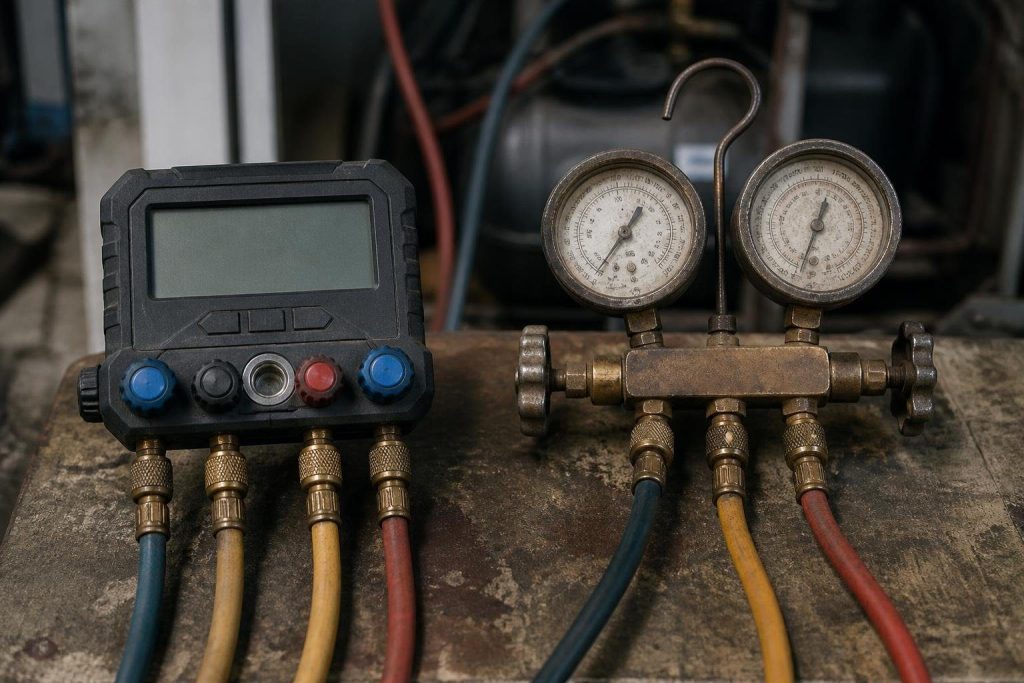
A digital manifold gauge does the saturation lookup for you; an analog set prints it on the dial, which limits it to a few refrigerants. Figures below are maker claims.
| Feature | Yellow Jacket Series 41 A2L (analog) | Testo 550s (digital) | Fieldpiece SM480V (digital) |
|---|---|---|---|
| Saturation temperature | Printed scales for R-32, R-454B, R-410A | Calculated, about 90 refrigerants | Not detailed in the flyer |
| Stated accuracy | 1% (Class 1) | ±0.5% of full scale | Not listed in the flyer |
| Pressure limit | Not listed in the spec sheet | -14.7 to 870 psi | 800 psig |
| Superheat and subcooling | By hand with a thermometer | Automatic with pipe probes | Pipe temperature jacks |
| Extras | Field recalibration | Pressure leak test, Bluetooth app | Tightness test, 1,000 ft wireless, 168 hour logging |
Sources: Yellow Jacket A2L spec sheet, Testo manual, Fieldpiece flyer. Percent of full scale ties the error band to the gauge range, not the reading.
Which manifold gauge works with R-454B and R-32?
For R-454B and R-32, use a manifold gauge set the maker rates for A2L refrigerants and that lists both. EPA’s SNAP table classes HFC-32 (GWP 675) and R-454B (GWP 470) as A2L, acceptable with use conditions, while R-410A is A1 at GWP 2,090.
Copeland’s A2L service guidance says to use tools “designed and certified for use with A2Ls, such as gauges, vacuum pumps, leak detection and refrigerant recovery machines.” It adds that A2L cylinders carry a red band or red top and most likely a left-hand thread. Fieldpiece lists its SM480V as “A2L Refrigerant Compatible”, and Testo’s manual says its instruments (as of July 2020) can be used with A2L refrigerants.
See what changes on an R-454B job and our R-32 refrigerant explainer.
How we researched this
Research date: October 13, 2026. We read the regulation text of 40 CFR 82.152, 82.154, 82.158 and 82.161 through the eCFR API, two pressure temperature charts (BPA for R-410A, Honeywell for R-454B), EPA’s SNAP table, and maker documents from Testo, Fieldpiece, Yellow Jacket, FJC and Copeland. We consulted 16 regulatory and maker documents and cite 13; competitor pages were read for gaps only. Maker specifications are labelled as claims. Excluded: retail tool prices (no federal price series), contractor blogs, and Reddit, because refrigerant handling is a regulated safety topic.
Frequently asked questions
How much does a manifold gauge cost?
We do not publish tool prices: no federal series tracks them. Cost scales with features. An analog A2L set like Yellow Jacket’s Series 41 prints three refrigerant scales, while a digital set like the Testo 550s stores about 90 refrigerants and calculates superheat. Compare distributor quotes for the exact model.
Can a homeowner hook up AC gauges?
Federal rules treat it as technician work. 40 CFR 82.152 lists attaching or detaching hoses and gauges among activities expected to breach the refrigerant circuit, and 40 CFR 82.161 requires Type II or Universal certification for R-410A and other high-pressure systems.
Can I use R-410A gauges on R-454B?
Pressures overlap, but the temperature conversion does not. At 120 psig, R-410A saturates at 40.5°F while R-454B has a 45.7°F dew point, per the BPA and Honeywell charts. Use a set whose maker rates it for A2L refrigerants and lists R-454B; Yellow Jacket’s A2L manifolds, for example, are scaled for R-32, R-454B and R-410A.
What is the difference between psig and psia?
Manifold gauges read psig, pressure above the atmosphere, so an open gauge reads zero. Psia adds atmospheric pressure back in. EPA’s classes use psia: a high-pressure appliance is 170 psia to 355 psia at 104°F. Testo’s range starts at -14.7 psi, a full vacuum.
What is a 4-valve manifold gauge?
A 4-valve manifold adds a separate port, usually for the vacuum pump, alongside the low side, high side and center ports. Yellow Jacket’s TITAN A2L is a 4-valve design, and Fieldpiece’s SM480V flyer lists both a vacuum port and a refrigerant port that its SM380V sibling lacks.
Should AC pressures equalize when the system is off?
Yes. After shutdown both sides drift toward one pressure, near the saturation pressure at the coolest point holding liquid refrigerant. For R-410A at 80°F the BPA chart gives about 236 psig. Matching readings show the gauges agree; they do not confirm the charge.
Sources
- eCFR (US Government Publishing Office). “40 CFR 82.152 Definitions.” https://www.ecfr.gov/current/title-40/chapter-I/subchapter-C/part-82/subpart-F/section-82.152. Accessed October 2026.
- eCFR. “40 CFR 82.154 Prohibitions.” https://www.ecfr.gov/current/title-40/chapter-I/subchapter-C/part-82/subpart-F/section-82.154. Accessed October 2026.
- eCFR. “40 CFR 82.158 Standards for recovery and/or recycling equipment.” https://www.ecfr.gov/current/title-40/chapter-I/subchapter-C/part-82/subpart-F/section-82.158. Accessed October 2026.
- eCFR. “40 CFR 82.161 Technician certification.” https://www.ecfr.gov/current/title-40/chapter-I/subchapter-C/part-82/subpart-F/section-82.161. Accessed October 2026.
- US EPA. “Substitutes in Residential and Light Commercial Air Conditioning and Heat Pumps (SNAP).” https://www.epa.gov/snap/substitutes-residential-and-light-commercial-air-conditioning-and-heat-pumps. Accessed October 2026.
- Bonneville Power Administration. “R-410A Pressure-temperature chart.” https://www.bpa.gov/-/media/Aep/energy-efficiency/residential/residential-ptcs-essentials/r-410a-pressure-temperature-chart.pdf. Accessed October 2026.
- Honeywell. “PT Chart, Solstice 454B (R-454B).” https://prod-edam.honeywell.com/content/dam/honeywell-edam/pmt/oneam/en-us/refrigerants/documents/hon-ess-am-3161690-adm-tds-pt-chart-solstice-454b-ltr-en.pdf. Accessed October 2026.
- Testo. “testo 550s / testo 557s Digital Manifold Instruction Manual (copy hosted by Testo-Direct.ca).” https://www.testo-direct.ca/pdfs/cache/www.testo-direct.ca/0564-5501-01/manual/0564-5501-01-manual.pdf. Accessed October 2026.
- Fieldpiece Instruments. “SM480V / SM380V SMAN Refrigerant Manifold flyer, v18.” https://resources.fieldpiece.com/wp-content/uploads/2023/07/SM380V-SM480V-Flyer-V18.pdf. Accessed October 2026.
- Ritchie Engineering (Yellow Jacket). “A2L Manifolds R-32/454B/410A product spec sheet.” https://yellowjacket.com/wp-content/uploads/2023/04/A2L-Manifolds-Product-Spec-Sheet-2023-4-2.pdf. Accessed October 2026.
- Ritchie Engineering (Yellow Jacket). “PLUS II 1/4 in Hose for 5/16 in Flare Service Ports for R-410A.” https://yellowjacket.com/product/plus-ii-14-hose-for-flare-service-ports-for-r-410a/. Accessed October 2026.
- FJC Inc. “Mr. Fixit: How to Use Manifold Gauges.” https://fjcinc.com/mr-fixit-how-to-use-manifold-gauges/. Accessed October 2026.
- Copeland. “Safety best practices for servicing A2L refrigerants and systems.” https://www.copeland.com/en-us/news/safety-best-practices-for-servicing-a2l-refrigerants-and-systems. Accessed October 2026.
Leave a Reply