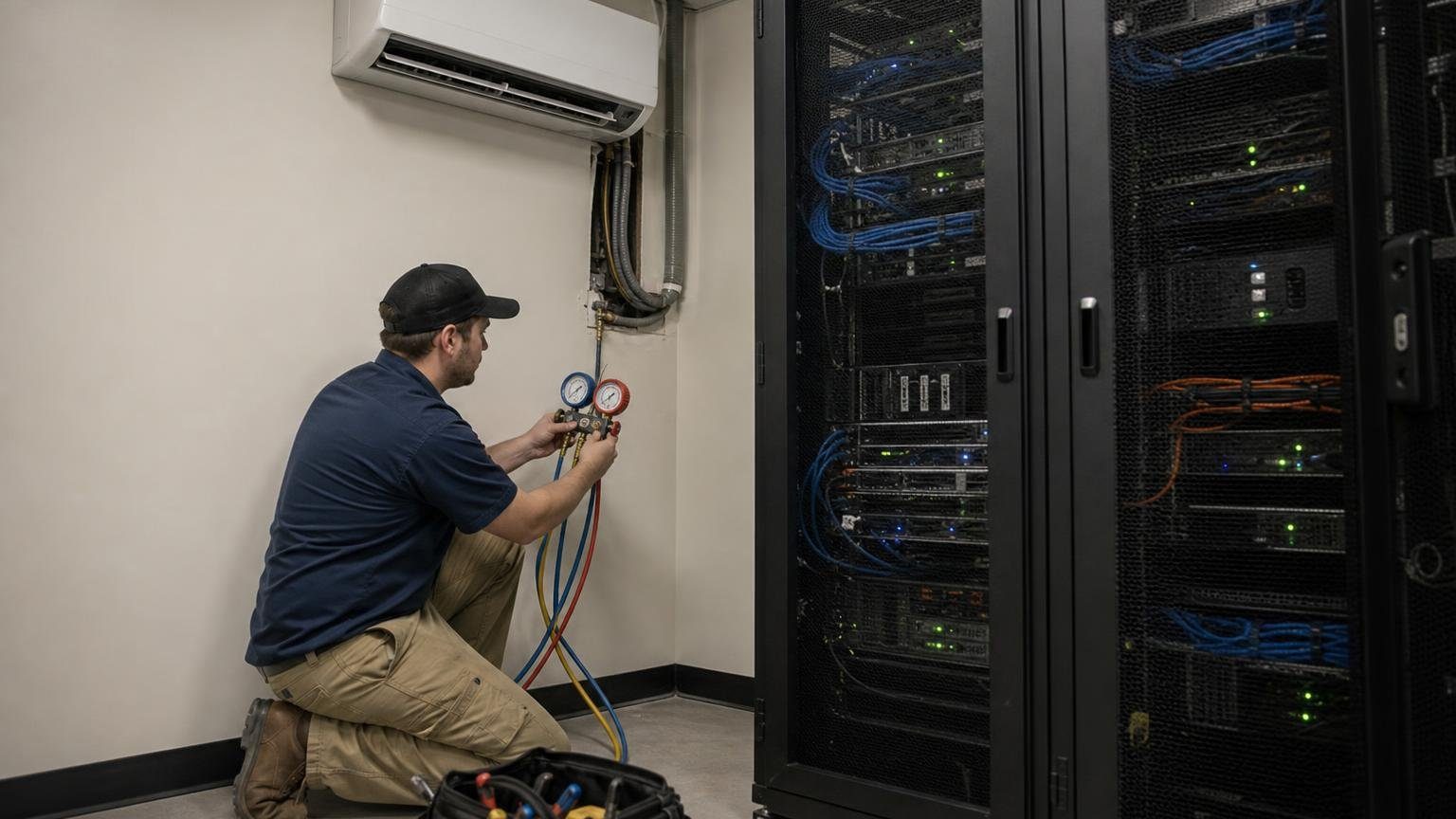
How much server room cooling do you need? Enough sensible capacity to remove every watt the equipment draws, at 3.412 Btu/h per watt, while holding server inlet air at 64.4 to 80.6°F around the clock, ideally from cooling dedicated to the room.
Key Takeaways
- ASHRAE TC 9.9’s recommended inlet range is 18 to 27°C (64.4 to 80.6°F), per its 2021 reference card. 59 to 89.6°F is the allowable range, not a target.
- 1 W of IT load is 3.412 Btu/h and 1 ton is 12,000 Btu/h, per NIST conversion factors. A 5 kW rack needs about 17,060 Btu/h.
- Berkeley Lab found most small server spaces over-cooled at 74°F or lower in a survey of 30 rooms (2014).
- ENERGY STAR estimates each 1°F warmer saves 4% to 5% in energy costs (ENERGY STAR).
- DOE’s FEMP guide (2024) says office units spend capacity on latent load IT rooms lack.
- A Mitsubishi Electric submittal claims cooling to minus 40°F with wind baffles, yet its footnote advises against equipment cooling in low ambient conditions (maker submittal).
What temperature should a server room be?
Server room temperature should sit between 64.4 and 80.6°F (18 to 27°C) at the server air inlet, the recommended envelope for Classes A1 to A4 in ASHRAE TC 9.9’s 2021 thermal guidelines. Measure at the rack front, not a wall thermostat.
The Department of Energy’s Federal Energy Management Program (FEMP) restates the table in its 2024 design guide and says to operate to the recommended range. The allowable range marks what manufacturers tested for function, not reliability.
Correction
A top-ranking vendor guide gives 59 to 89.6°F as the server room range and credits the narrower band to unnamed experts. Both come from ASHRAE, and 59 to 89.6°F (15 to 32°C) is the Class A1 allowable range: an excursion limit, not a target.
Colder is not safer. Lawrence Berkeley National Laboratory (LBNL) found most small server spaces over-cooled at 74°F or lower, from a belief that rooms belong near 72°F. LBNL’s 2017 guide for FEMP says inlets of 65 to 70°F are commonly seen and can rise to 80°F or higher.
What is the ideal server room humidity?
The ideal server room humidity is set by dew point, not a single percentage. ASHRAE’s recommended envelope runs from a 15.8°F to a 59°F dew point (minus 9 to 15°C) with relative humidity capped at 70%. The cap drops to 50% where corrosion test coupons show pollutants in the air.
The “45 to 50%” target repeated on vendor pages is not the current ASHRAE envelope. FEMP’s guide says most data centers do not need humidification to stay above the 15.8°F dew point floor. Where moisture must be added, FEMP puts an electric resistance humidifier at about 430 watts per pound of water against about 30 watts for ultrasonic. Keep the room’s moisture targets separate from a home’s indoor humidity guidance for occupants, which is set for people, not hardware.
How much server room cooling capacity do you need?
Server room cooling capacity equals the room’s electrical load converted to heat. Nearly every watt the IT gear draws becomes heat, and 1 watt equals 3.412 Btu per hour (the inverse of NIST’s 0.2930711 W per Btu/h). One ton is 12,000 Btu/h, so the rule of thumb is about 0.28 ton per kilowatt.
Use measured draw, not nameplate; LBNL’s server closet fact sheet suggests reading it from the UPS display. The server room BTU calculator method for one 5 kW rack:
| Step | Input | Result |
|---|---|---|
| IT load (UPS or PDU reading) | 5,000 W | 5,000 × 3.412 = 17,060 Btu/h |
| Lighting | 200 W | 682 Btu/h |
| Total sensible load | 5,200 W | 17,742 Btu/h |
| Convert to tons | ÷ 12,000 | 1.48 tons |
| N+1 redundancy | 2 units | Each able to carry 17,742 Btu/h alone |
Compare sensible output at room conditions, not nominal tonnage. A square-footage BTU chart is built for people and sun, not kilowatts of electronics, and tonnage from a model number is nominal only.
Which server room cooling system fits your room?
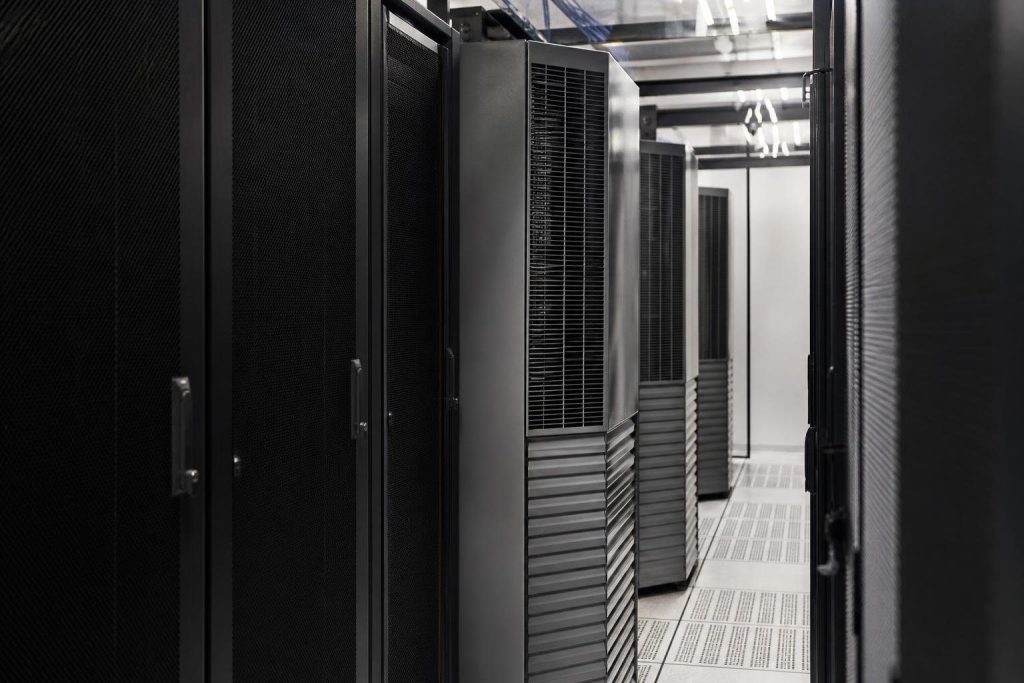
The best server room cooling system is dedicated to the room, sized on sensible load and able to run all year. For one or two racks that usually means a ductless split; for several, a computer room air conditioner (CRAC) or in-row unit.
| System | Built for IT load? | Best fit | Watch out for |
|---|---|---|---|
| Building AC (central or rooftop) | No. Capacity reserved for latent load (FEMP) | Light network gear in a building cooled 24/7 | Night and weekend shutdowns |
| Ductless mini split, dedicated | Partly. Some list 24-hour cooling (maker claim) | One or two racks | Low-ambient kit; return air limits |
| Portable spot cooler | No | Temporary backup | Exhaust must leave the room |
| CRAC, in-row or rear-door coil | Yes. Rated on net sensible cooling | Several racks or high density | Needs commercial service |
Computer room air conditioners are covered equipment under 10 CFR 431.97. Units made on or after May 28, 2024 must meet a minimum NSenCOP, a net sensible metric: 2.70 for an air-cooled downflow unit under 80,000 Btu/h. ENERGY STAR says in-row cooling can use 3 times less energy than conventional cooling in high-density racks. Larger rooms on chilled water tie into the building’s chiller plant through computer room air handlers.
A portable is only as good as its venting, and single-hose portables underperform in a closed room. Whatever you pick, commercial service terms set response times when the room heats up at 2 a.m.
Can a mini split cool a server room around the clock?
A mini split for a server room can run around the clock if the model is listed for continuous cooling and fitted for winter operation. Check the submittal for continuous duty, minimum outdoor cooling temperature and maximum indoor return air.
Mitsubishi Electric Trane’s 2021 submittal for the PKA-A36KA7 and PUY-A36NKA7 cooling-only pair claims “24-hour continuous operation (cooling mode)” and full-capacity cooling down to minus 40°F with wind baffles. The same note says wind baffles are required below 23°F. It also says applications should be restricted to comfort cooling, with equipment cooling not recommended in low ambient conditions. Get the maker to confirm a server room application in writing.
That submittal also caps indoor return air at 95°F dry bulb, so backup must start before the room passes it. See how a ductless split works, then the scope of a proper mini split installation, including condensate routing away from racks.
What do DOE and LBNL say saves energy in small server rooms?
DOE and LBNL say the cheapest server room cooling savings come from raising inlet setpoints and stopping hot and cold air mixing, then dedicated cooling with an economizer. LBNL’s guide for FEMP puts small data centers at about 40 billion kWh a year.
Cooling can rival the IT load. At the City of Walnut Creek, California, LBNL measured 15.1 kW of IT load and 14.9 kW of cooling, a PUE of 2.1. Its fact sheet says PUE over 2 leaves significant room for improvement; 1.5 is good and 1.1 excellent. For that room LBNL estimated $11,600 a year from an air-side economizer, at an assumed $0.12 per kWh, plus an $8,700 PG&E first-year rebate (2012 terms).
LBNL’s measures, in rough order of cost:
- Raise inlet setpoints toward the ASHRAE recommended top, after fixing airflow.
- Fit blanking panels and contain aisles; ENERGY STAR cites a DOE estimate of 20% to 25% lower fan energy.
- Turn off unused servers and consolidate.
- Install dedicated cooling so the building system need not run around the clock.
- Add an air-side economizer where the room has an exterior wall or roof.
A building automation system can log inlet temperatures and cooling power to track PUE.
How do you keep cooling running when a unit fails?
Use N+1: one more cooling unit than the load needs, so any one unit can fail while the rest carry the room. In a one-rack room that means two units, each able to carry the whole load, with automatic changeover and an alarm that reaches a person.
ASHRAE also limits inlet temperature change to 5°C (9°F) in any 15 minutes and 20°C in an hour for most IT equipment. A backup that starts on its own protects that limit.
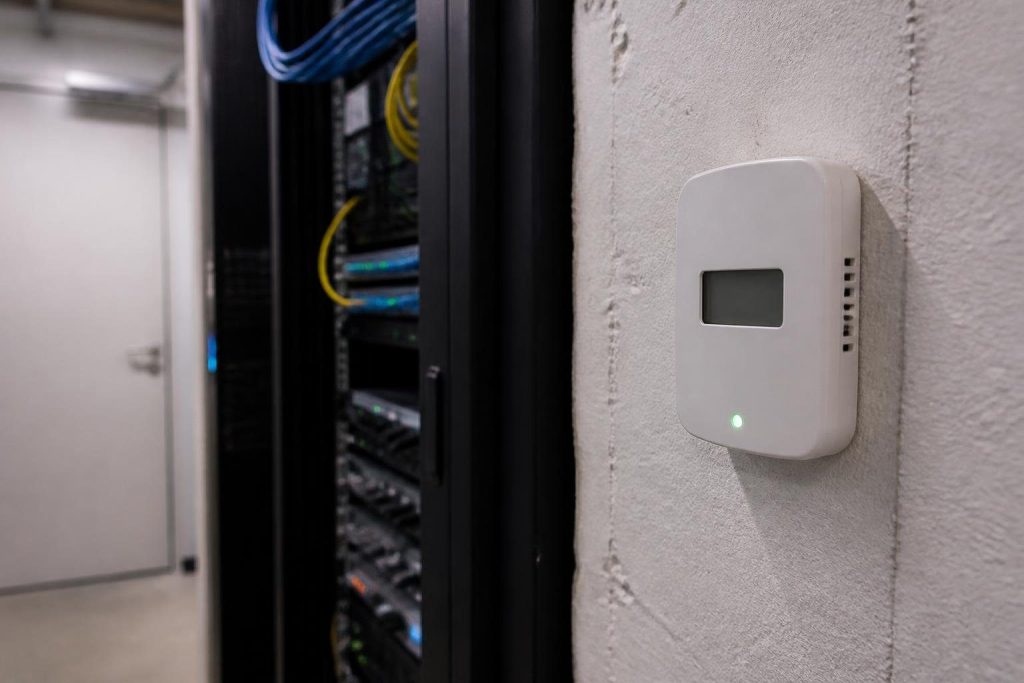
- Put sensors at the rack fronts, top and middle.
- Set the first high alarm near 80.6°F, the recommended top.
- Know the control point: LBNL notes many CRAC units control on return air, which reads higher than inlet.
- Check the building AC schedule for night and weekend shutoffs.
- Test changeover and alarms on a schedule written into your service agreement.
How we researched this
We fetched the top-ranking pages for “server room cooling” and Google autocomplete on October 13, 2026, and found no federal, lab or standards source among them.
We then read the primary documents: the ASHRAE TC 9.9 reference card, DOE FEMP and LBNL reports, two ENERGY STAR pages, NIST conversion factors, 10 CFR 431.97 and a Mitsubishi Electric Trane submittal, labelled as maker claims. We consulted 14 sources and cite 10. Excluded: vendor price ranges (no federal series), unsourced vendor humidity targets, and forum threads, used only to shape questions. Research date: October 2026.
Frequently asked questions
What is the best way to cool a server room?
Install cooling dedicated to the room, sized to measured IT load at 3.412 Btu/h per watt, with a second unit for N+1. LBNL and FEMP recommend dedicated cooling so the building system does not run around the clock. Fix airflow with blanking panels before raising setpoints.
What is the cheapest way to cool a server room?
Raise the setpoint and fix airflow first; LBNL lists both as no or low cost measures. ENERGY STAR estimates each 1°F warmer saves 4% to 5% in energy costs. Keep server inlets at or below 80.6°F, the top of ASHRAE’s recommended range.
What is the ideal server room humidity?
ASHRAE’s 2021 recommended envelope is a 15.8°F to 59°F dew point with relative humidity no higher than 70%, or 50% where corrosion testing shows pollutants. FEMP says most data centers need no added humidity to stay above the 15.8°F dew point floor.
Can a portable air conditioner cool a server room?
As a temporary backup, yes, if its hot exhaust leaves the room. Size it with the same arithmetic, 3.412 Btu/h per watt of IT load, and check the maker’s manual for continuous duty language. For permanent cooling, LBNL recommends dedicated room cooling.
What is the server room cooling load rule of thumb?
Each kilowatt of IT load is about 3,412 Btu/h, or roughly 0.28 ton, using NIST’s conversion factors and 12,000 Btu/h per ton. A 5 kW rack works out to 17,060 Btu/h, about 1.42 tons, before lighting and people.
At what temperature should a server room alarm?
Set a first alarm near 80.6°F at the server inlet, the top of ASHRAE’s recommended range. The Class A1 allowable ceiling is 89.6°F. ASHRAE also limits change to 5°C (9°F) in any 15 minutes for most IT equipment, so alarm on fast rises too.
Sources
- ASHRAE TC 9.9. “2021 Equipment Thermal Guidelines for Data Processing Environments, Reference Card.” https://www.ashrae.org/file%20library/technical%20resources/bookstore/supplemental%20files/therm-gdlns-5th-r-e-refcard.pdf. Accessed October 2026.
- U.S. DOE FEMP. “Best Practices Guide for Energy-Efficient Data Center Design,” July 2024. https://www.energy.gov/sites/default/files/2024-07/best-practice-guide-data-center-design.pdf. Accessed October 2026.
- LBNL. “Energy Efficiency in Small Server Rooms: Field Surveys and Findings,” ACEEE 2014. https://www.aceee.org/files/proceedings/2014/data/papers/9-109.pdf. Accessed October 2026.
- LBNL and NRDC. “Fact Sheet: Improving Energy Efficiency for Server Rooms and Closets,” 2012. https://datacenters.lbl.gov/sites/default/files/SmallServerRoomFactSheet2012.pdf. Accessed October 2026.
- LBNL for FEMP. “Small Data Centers, Big Energy Savings,” 2017. https://datacenters.lbl.gov/sites/default/files/Small%20Data%20Centers,%20Big%20Energy%20Savings.pdf. Accessed October 2026.
- ENERGY STAR. “5 Simple Ways to Avoid Energy Waste in Your Data Center.” https://www.energystar.gov/products/data_center_equipment/5-simple-ways-avoid-energy-waste-your-data-center. Accessed October 2026.
- ENERGY STAR. “16 More Ways to Cut Energy Waste in the Data Center.” https://www.energystar.gov/products/data_center_equipment/16-more-ways-cut-energy-waste-data-center. Accessed October 2026.
- NIST. “SP 811 Appendix B.9: Conversion Factors.” https://www.nist.gov/pml/special-publication-811/nist-guide-si-appendix-b-conversion-factors/nist-guide-si-appendix-b9. Accessed October 2026.
- Mitsubishi Electric Trane HVAC US. “Submittal PKA-A36KA7 and PUY-A36NKA7,” 2021, distributor-hosted copy. https://resource.gemaire.com/is/content/Watscocom/Gemaire/mitsubishi_pka-a36ka7_article_1494405099075_en_subs.pdf?fmt=pdf. Accessed October 2026.
- eCFR. “10 CFR 431.97, Energy efficiency standards.” https://www.ecfr.gov/current/title-10/chapter-II/subchapter-D/part-431/subpart-F/section-431.97. Accessed October 2026.
Leave a Reply