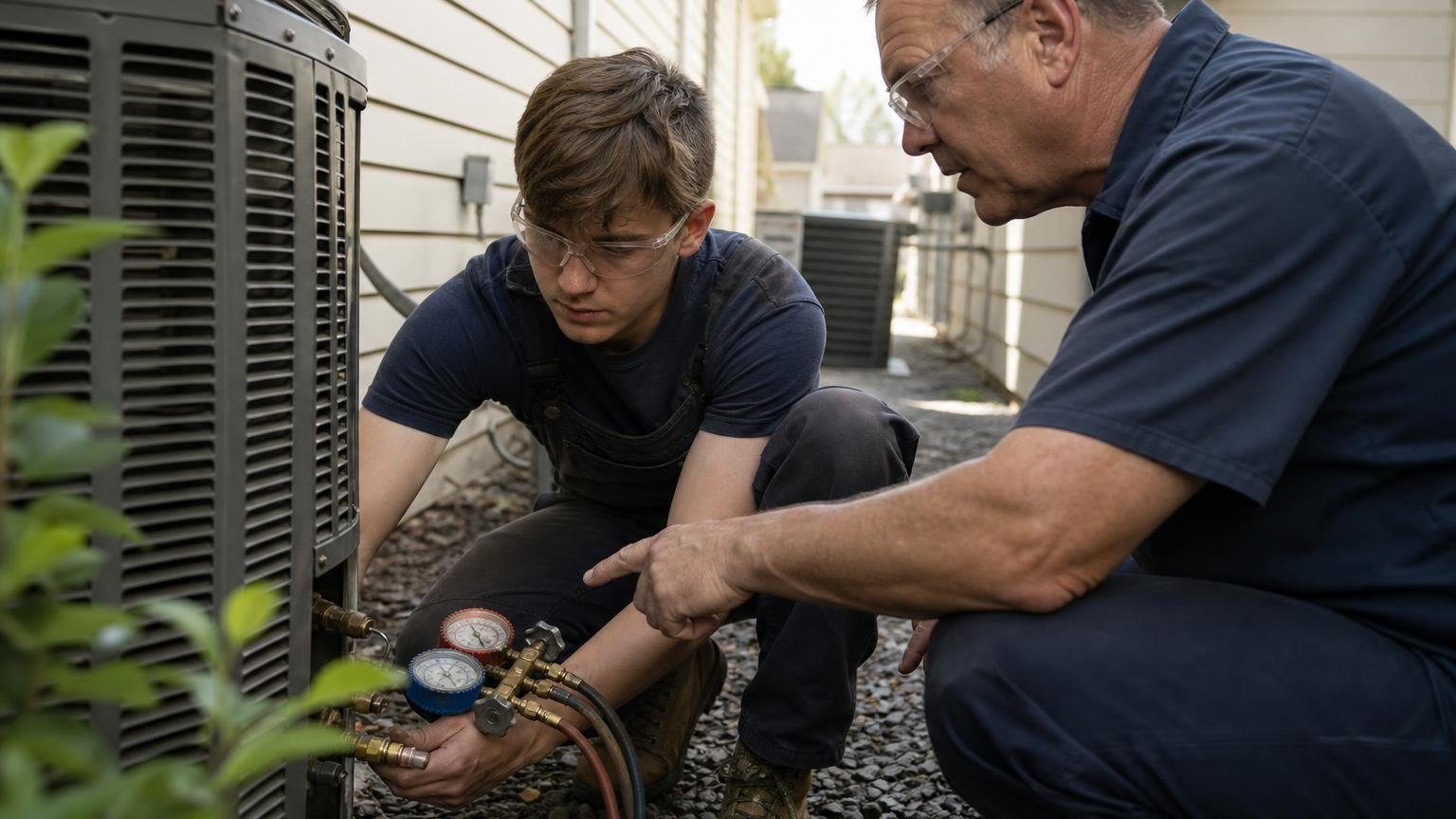
What is an HVAC apprenticeship? A paid job with a written training contract: supervised work hours (8,000 to 10,000 in the three registered HVAC programs we read), yearly classroom instruction, and pay that climbs on a set schedule from 40 to 50 percent of the journey-level rate.
Key Takeaways
- The federal standard, 29 CFR 29.5, sets a floor of 2,000 hours of on-the-job learning and only recommends 144 classroom hours a year.
- Washington-registered HVAC programs run 8,000 hours (non-union CITC), 9,000 hours (Sheet Metal JATC, SMART Local 66) and 10,000 hours (UA Local 32).
- Step one pays 40 percent of the journey-level rate at the CITC HVAC program, 45 percent at the Sheet Metal JATC and 50 percent at UA Local 32 program.
- BLS puts the May 2025 median for HVAC mechanics at $29.33 an hour; helpers at building equipment contractors earned a median $19.17.
- BLS projects about 40,600 HVAC openings a year from 2025 to 2035, per the Occupational Outlook Handbook.
- Under 40 CFR 82.161, a registered apprentice may open a refrigerant circuit without EPA 608 certification only while closely and continually supervised.
What is an HVAC apprenticeship?
An HVAC apprenticeship is a job with training built in: you work under journey-level technicians, log hours across set work processes and attend classes. A registered apprenticeship has written standards approved by a federal or state agency, and 29 CFR 29.5 lists what those standards must contain.
Every registered program must include:
- A term of at least 2,000 hours of on-the-job learning, or a competency-based or hybrid term.
- Related technical instruction, with a minimum of 144 hours per year recommended.
- A progressively increasing wage schedule, starting at or above the federal minimum wage where it applies.
- An apprentice-to-journeyworker ratio and a probationary period of no more than 25 percent of the program or 1 year.
- An eligible starting age of at least 16.
Many shops hire an “apprentice” or helper with no registered standards behind the title. That can be a fine first job, but the hours and raises are not guaranteed in writing. Our guide on the main routes into the HVAC trade covers the wider picture.
Correction: 144 hours is a recommendation
Many guides call 144 classroom hours a year a federal requirement. The regulation says a minimum of 144 hours “is recommended.” Sponsors set the real number, and all three Washington HVAC programs we read require more: 200 or 216 hours a year.
How long is an HVAC apprenticeship?
Most registered HVAC apprenticeships take four to five years. The federal floor is 2,000 hours, but the sponsors we read set 8,000 to 10,000 hours, which at roughly 2,000 paid hours a year means four or five years plus classes.
Washington’s Department of Labor and Industries publishes registered program standards, so HVAC programs can be compared on the official documents.
| Program | Committee type | HVAC occupation | Term | Classroom per year | Standards last amended |
|---|---|---|---|---|---|
| Construction Industry Training Council of Washington, HVAC | Group non-joint (no union side) | Heating/Air Conditioning Installer and Servicer | 8,000 hours | 200 hours | October 15, 2020 |
| Western Washington Sheet Metal JATC | Joint: union contractors and Sheet Metal Workers Local Union No. 66 (SMART) | HVAC Service Technician | 9,000 hours | 200 hours | July 16, 2026 |
| Seattle Area Plumbers and Pipefitters committee | Joint: United Association Local No. 32 and Mechanical Contractors of Western Washington | HVAC Service Controls Technician/Refrigeration Mechanic | 10,000 hours | 216 hours | April 18, 2024 |
| Federal minimum, 29 CFR 29.5 | Any sponsor | Any apprenticeable occupation | 2,000 hours | 144 hours recommended | Current rule |
Classroom time can be unpaid. The CITC standards state that it “shall not be considered as hours of work and the apprentice is not required to be paid,” so budget evenings or school weeks on top of a full work schedule.
Union vs non-union HVAC apprenticeship: which route fits?
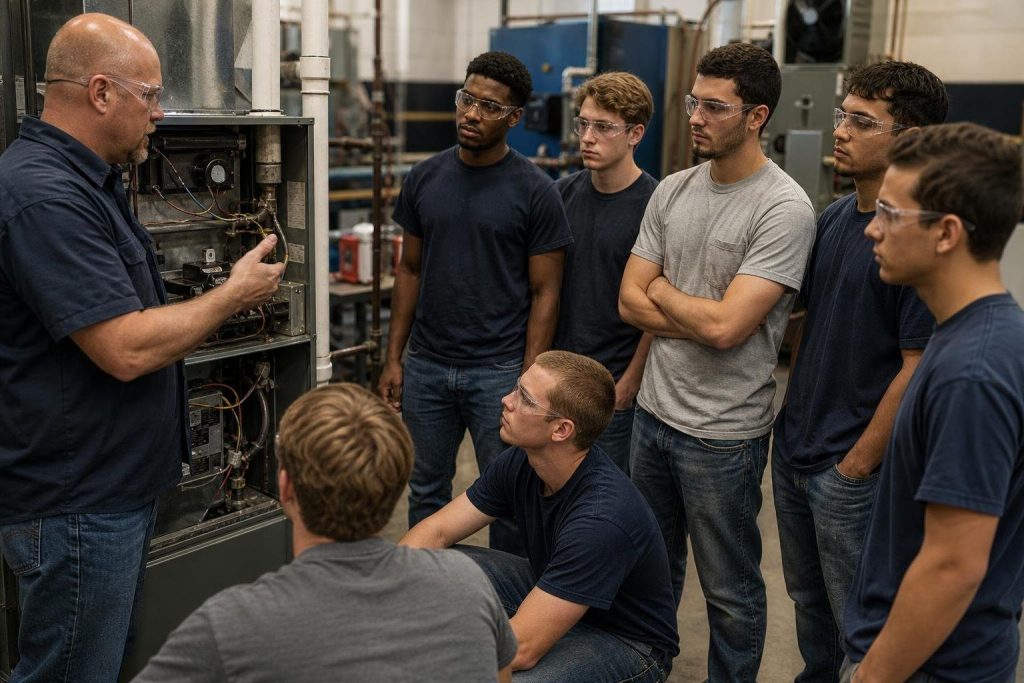
Union and non-union HVAC apprenticeships follow the same federal rules; the difference is who sits on the committee and how wages are set. A union program is run by a joint apprenticeship and training committee (JATC) of a local union and its contractors; non-union programs are run by a contractor group or a single employer.
| Route | Who runs it | How you get in | How the wage is set |
|---|---|---|---|
| Union JATC (UA pipefitters, SMART sheet metal) | Equal numbers of union and contractor members | Apply online, sit a math and reading test, interview, join a ranked list, then get dispatched to a contractor | Percent of the bargained journey rate, plus fringe benefits in the SMART Local 66 schedule |
| Non-union group program (for example CITC) | Contractor association committee | Get hired by, or referred to, a participating contractor | Percent of a sponsor-set journey rate; CITC averages its employers’ rates yearly |
| Single-employer program | One company registers its own standards | Apply for the apprentice job itself | The employer’s registered schedule |
| School first, then a job | A college or trade school, then any employer | Finish a certificate, then apply as an entry-level tech | No registered schedule |
All three Washington programs require applicants to be at least 18 with a high school diploma or equivalent, and the UA Local 32 committee asks HVAC applicants for a driving record with no accidents or violations in the last 5 years. Associated Builders and Contractors, the national merit-shop (non-union) group, has 67 chapters; ask the nearest one about HVAC training. Community college programs are mapped in our study of where HVAC technicians are trained, and the shortfall between school output and openings is in our HVAC training gap analysis.
How much does an HVAC apprenticeship pay?
HVAC apprenticeship pay is a percentage of the sponsor’s journey-level rate that rises as you log hours. In the three registered programs we read, apprentices start at 40 to 50 percent and finish at 85 to 90 percent, so dollars depend on the local journey rate.
CITC climbs from 40 to 90 percent in eight 1,000-hour steps. The Sheet Metal JATC runs from 45 percent to 85 percent in nine steps, plus fringe benefits. The UA Local 32 committee schedule pays 50, 55, 62.5, 70 and 85 percent in 2,000-hour steps.
For a national yardstick, the BLS median for HVAC mechanics was $61,010 a year in May 2025, and the lowest-paid tenth earned under $19.25 an hour.
Worked example: if a sponsor’s journey rate equaled the national median of $29.33, a 50 percent first step would pay $14.67 an hour and an 85 percent final step $24.93. Washington sponsors must file their journey rate with the state at least annually, so ask for the current figure before you sign. State-level pay is in our HVAC technician salary rankings by state.
How to get an HVAC apprenticeship, step by step
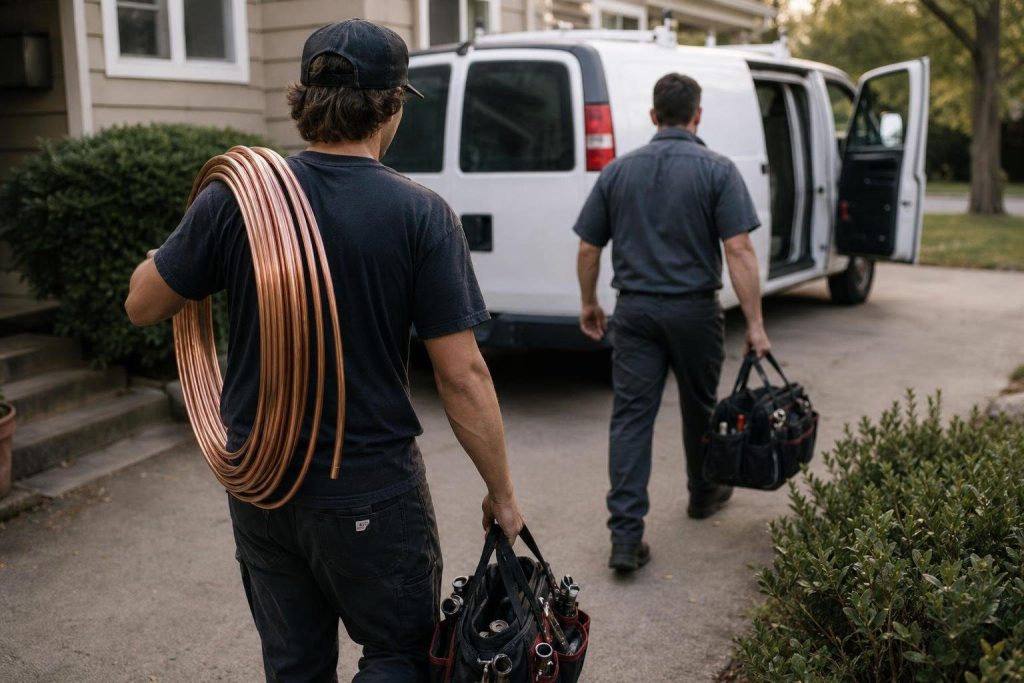
To get an HVAC apprenticeship, meet the minimums, find programs through federal and local channels, and apply to more than one route. None of the three Washington programs lists prior HVAC experience among its minimum qualifications, so you can start with none.
- Check the minimums. Expect age 18 and a high school diploma or equivalent; the UA Local 32 committee also requires a valid US driver’s license.
- Prepare for a test. The Sheet Metal JATC schedules a math and reading assessment before interviews and ranks applicants by score.
- Find openings near you. Search the Apprenticeship Finder on apprenticeship.gov by ZIP code, then contact your state apprenticeship agency, local UA and SMART union halls and HVAC contractors, the channels the BLS handbook lists.
- Apply on parallel tracks. The Sheet Metal JATC calls applicants from its ranked list as industry need allows, so apply for contractor helper jobs while you wait.
- Start the federal credential. Study for EPA Section 608, explained in our guide to which 608 type you need, and compare it with other options in our HVAC certification overview.
- Gear up. Ask the sponsor which tools you must supply; our HVAC tools list by job separates first-year tools from later purchases.
- Sign the agreement and log every hour. Your registration, hour logs and transcript are your proof for licensing and transfers.
Do apprenticeship hours count toward an HVAC license?
Usually, yes. License boards count documented experience, and some credit DOL-approved training directly. Michigan requires 3 years or 6,000 hours of experience for a mechanical contractor license, and MCL 339.5807 credits a 2-year DOL-approved HVAC training program for up to 1 year or 2,000 hours of it.
Rules differ widely; see our HVAC license requirements by state before you pick a program in a state you may leave.
The federal refrigerant rule has a clock. EPA defines an apprentice as someone registered with the DOL Office of Apprenticeship or a recognized state council, and 40 CFR 82.152 limits that status to two years from first registration. After that, you need your own Section 608 card to work on refrigerant circuits, so pass it early.
How we researched this
On October 9, 2026, we read 29 CFR 29.5 and 40 CFR 82.152 and 82.161 through the eCFR versioner, three registered HVAC standards filed with Washington L&I, the BLS Occupational Outlook Handbook, BLS OEWS May 2025 profiles for 49-9021 and 49-9098 by industry, Michigan’s MCL 339.5807, and the UA and ABC websites. We cite 11 of the 14 sources we opened.
Excluded: apprentice pay ranges on vendor and lead-generation blogs (no traceable source), the UA’s national page (no hour or wage schedule), and DOL’s apprentice dashboards, which are interactive and offered no HVAC table we could verify. Code 49-9098 covers helpers in every repair trade, and building equipment contractors include plumbing and electrical firms. No Reddit content was used.
Frequently asked questions
How much do HVAC apprentices make?
A set percentage of the journey-level rate: 40 percent at the start of the CITC program, 45 percent at the Sheet Metal JATC and 50 percent at UA Local 32 program. For scale, BLS reports a May 2025 median of $29.33 an hour for HVAC mechanics and $19.05 for all installation and repair helpers.
Are apprentices paid for classroom time?
Often not. The CITC standards in Washington state that classroom time is not counted as hours of work and the apprentice is not required to be paid for it. Read your own program’s standards.
Can you get an HVAC apprenticeship with no experience?
Yes. None of the three Washington programs we read lists HVAC experience as a minimum qualification. They require age 18 and a high school diploma or equivalent; the federal rule allows a starting age of 16. Expect a math and reading test at union committees.
Is a union HVAC apprenticeship better than non-union?
It depends on the market. Union JATCs pay a percentage of a bargained journey rate, plus fringe benefits in the SMART Local 66 schedule, but can run longer: 10,000 hours at UA Local 32 against 8,000 at the non-union CITC program. Compare actual journey rates.
Can an HVAC apprentice handle refrigerant without EPA 608 certification?
Only a registered apprentice, closely and continually supervised by a certified technician, under 40 CFR 82.161. EPA limits apprentice status to two years from first registration, so pass Section 608 early.
Is there demand for HVAC apprentices?
Yes. BLS projects about 40,600 openings a year for HVAC mechanics and installers from 2025 to 2035, with 11 percent growth. Our state-by-state HVAC job outlook shows where growth is concentrated.
Sources
- eCFR. “29 CFR 29.5 Standards of apprenticeship.” https://www.ecfr.gov/current/title-29/subtitle-A/part-29/section-29.5. Accessed October 2026.
- eCFR. “40 CFR 82.152 Definitions.” https://www.ecfr.gov/current/title-40/chapter-I/subchapter-C/part-82/subpart-F/section-82.152. Accessed October 2026.
- eCFR. “40 CFR 82.161 Technician certification.” https://www.ecfr.gov/current/title-40/chapter-I/subchapter-C/part-82/subpart-F/section-82.161. Accessed October 2026.
- BLS. “Occupational Outlook Handbook: HVAC Mechanics and Installers.” https://www.bls.gov/ooh/installation-maintenance-and-repair/heating-air-conditioning-and-refrigeration-mechanics-and-installers.htm. Accessed October 2026.
- BLS. “OEWS Profile, 49-9021, May 2025.” https://data.bls.gov/oesprofile/?year=2025&major_group=490000&occupation=499021&measure=08&areas=INDUSTRY. Accessed October 2026.
- BLS. “OEWS Profile, 49-9098, May 2025.” https://data.bls.gov/oesprofile/?year=2025&major_group=490000&occupation=499098&measure=08&areas=INDUSTRY. Accessed October 2026.
- Washington L&I. “Apprenticeship Program Standards, CITC of Washington, HVAC (WSATC-0635).” https://www.lni.wa.gov/licensing-permits/apprenticeship/_docs/0635.pdf. Accessed October 2026.
- Washington L&I. “Apprenticeship Program Standards, Western Washington Sheet Metal JATC (WSATC-0074).” https://www.lni.wa.gov/licensing-permits/apprenticeship/_docs/0074.pdf. Accessed October 2026.
- Washington L&I. “Apprenticeship Program Standards, Seattle Area Plumbers Committee (WSATC-0115).” https://www.lni.wa.gov/licensing-permits/apprenticeship/_docs/0115.pdf. Accessed October 2026.
- Michigan Legislature. “MCL 339.5807.” https://www.legislature.mi.gov/Laws/MCL?objectName=mcl-339-5807. Accessed October 2026.
- Associated Builders and Contractors. “About ABC.” https://www.abc.org/ABC/About-ABC. Accessed October 2026.
Leave a Reply