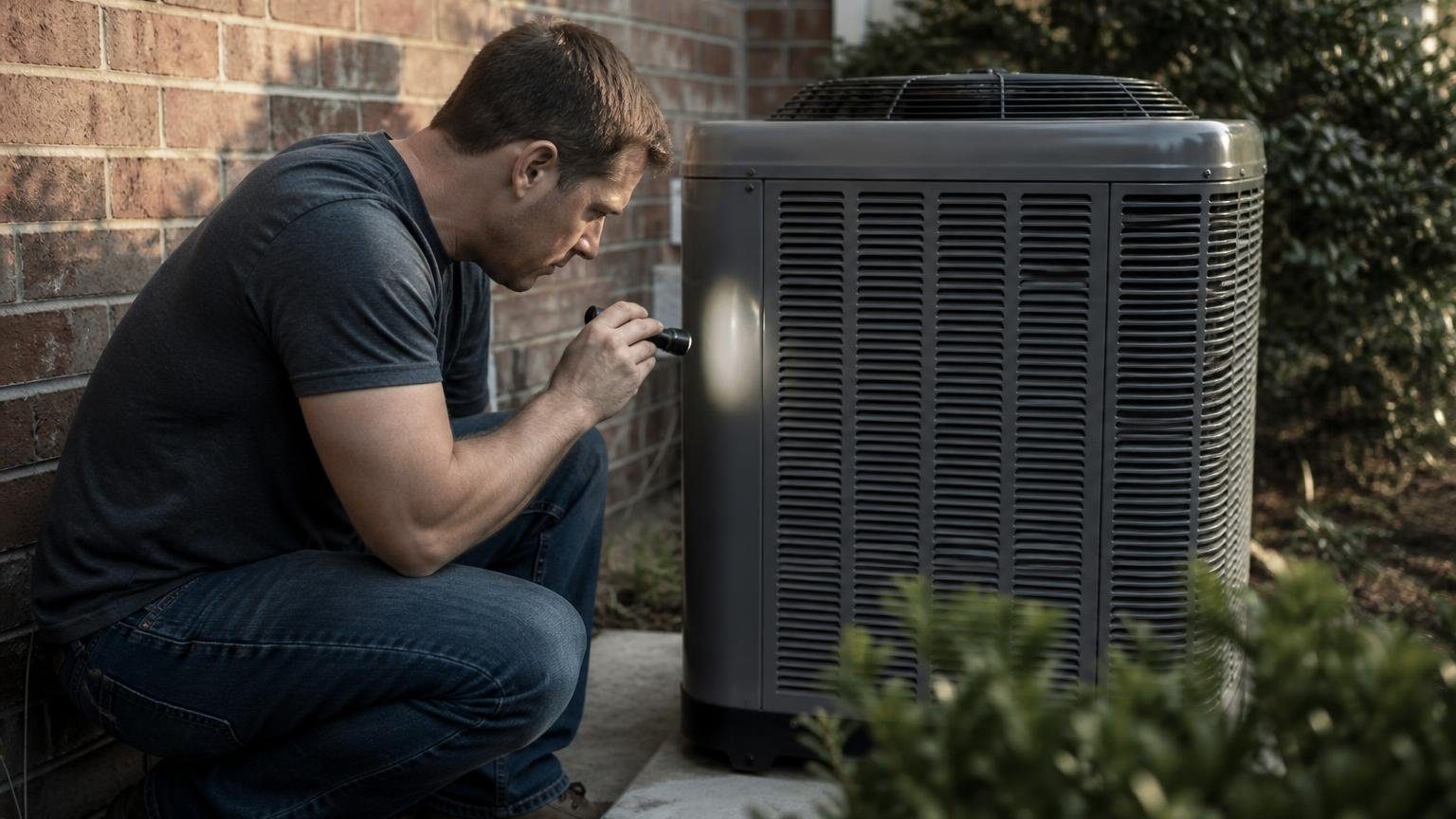
How to tell AC tonnage? Find the model number on the outdoor unit’s data plate and look for the capacity code in thousands of Btu/h: 18, 24, 30, 36, 42, 48 or 60. Divide it by 12. A 36 means 36,000 Btu/h, a nominal 3 tons. The certified rating is usually a few percent lower.
Key Takeaways
- One ton of refrigeration is 12,000 Btu/h, or 3,516.853 watts, in NIST Special Publication 811.
- Goodman, Carrier, Trane, Rheem and Daikin print the capacity code at characters 7 and 8 of the outdoor model number; Goodman’s SS-GSXN4 sheet decodes 36 as 3.0 tons.
- Lennox uses three digits after the first hyphen: in Bulletin 210959, 036 = 3 tons.
- Rheem rates its nominal 3-ton RA14AZ36 at 34,200 Btu/h with a matched coil at AHRI conditions, which is 2.85 tons, in its Form A11-337 spec sheet.
- Capacity ratings come from a 95°F outdoor, 80°F/67°F indoor test, the AFull condition in AHRI 210/240 Table 8.
- Federal rules define a residential central AC as single-phase and rated below 65,000 Btu/h (10 CFR 430.2), so home lines stop at code 60.
How to tell AC tonnage from the model number
To tell AC tonnage, read the model number, not the serial number. Makers write the outdoor unit’s nominal cooling capacity into the model number in thousands of Btu per hour, and one ton equals 12,000 Btu/h, so the code divided by 12 gives tons.
- Find the data plate (rating plate) on the outdoor condenser cabinet. You do not need to open any panel to read it.
- Copy the line marked model or M/N. The serial number is a separate line that encodes the build date; our serial number decoder covers that.
- Find the two-digit group from 18 to 60 (or three digits such as 036) and divide it by 12.
- Confirm the position in the brand table below; other digit pairs can look like a size.
The same plate carries the compressor and fan electrical data. For parts, our guide to the AC condenser fan motor shows which fields matter.
How to tell AC tonnage by brand: where is the capacity code?
Five of the six brands we checked put the capacity code at characters 7 and 8 of the outdoor model number; Lennox uses three digits after the first hyphen. Every row comes from the maker’s own product data.
| Brand | Maker’s example | Capacity characters | Decoded | Maker document |
|---|---|---|---|---|
| Goodman | GSXN403610 | 7 and 8 (36) | 3.0 tons | SS-GSXN4 spec sheet, 5/22 |
| Carrier | 24ACC636A003 | 7 and 8 (36) | Size 36 in a 1.5 to 5 ton line | 24ACC6 Product Data, Catalog 24ACC6-4PD, 09/12 |
| Trane | 4TTR6036B1000AA | 7 and 8 (36) | 36,000 Btu/h, 3 tons | XR16 Product Data, Pub. 22-1889-01 |
| Rheem | RA14AZ24AJ1NALHP | 7 and 8 (24) | 24,000 Btu/h, 2.0 tons | RA14AZ spec sheet, Form A11-337 |
| Daikin | DX7TCA3610AA | 7 and 8 (36) | 3.0 tons | 2023 Unitary Product Nomenclature |
| Lennox | ML14XC1-036-233A01 | 3 digits after first hyphen (036) | 3 tons | ML14XC1 Bulletin 210959, Oct 2023 |
Carrier’s 24ACC6 product data labels characters 7 and 8 “Cooling Capacity”. Trane’s XR16 product data calls the field “Nominal Capacity in 000s of BTUs”, placed after a connection digit, so a Trane string reads 6036. Daikin’s 2023 nomenclature uses the same 12 to 60 scale for outdoor units and air handlers.
If your brand is not listed, find its parent company in our HVAC brand ownership table, then check that parent’s product data for the capacity field.
AC tonnage chart: how many Btu are in a ton?
One ton of cooling is 12,000 Btu/h. NIST lists the ton of refrigeration as 12,000 Btu/h and converts it to 3,516.853 watts, so tons = Btu/h divided by 12,000, and kilowatts = tons times 3.517.
| Code in model number | Btu/h | Tons | kW |
|---|---|---|---|
| 12 | 12,000 | 1.0 | 3.52 |
| 18 | 18,000 | 1.5 | 5.28 |
| 24 | 24,000 | 2.0 | 7.03 |
| 30 | 30,000 | 2.5 | 8.79 |
| 36 | 36,000 | 3.0 | 10.55 |
| 42 | 42,000 | 3.5 | 12.31 |
| 48 | 48,000 | 4.0 | 14.07 |
| 60 | 60,000 | 5.0 | 17.58 |
Daikin’s 2023 nomenclature runs from 12 (1.0 ton) to 60 (5.0 tons). The arithmetic is the same for ductless equipment labeled in Btu/h, so a 24,000 Btu/h head is 2 tons; our mini split installation guide explains how those systems are split by zone. Room air conditioners use a separate Btu/h scale, covered by our room AC BTU calculator.
Why is a “3-ton” AC rated below 36,000 Btu/h?
The model code is a nominal size; the rating is a measured capacity at a fixed test condition with a specific indoor coil. Rheem’s data at AHRI standard conditions puts its nominal 3-ton RA14AZ36 with the RCFZ3617STAN coil at 34,200 Btu/h, which is 2.85 tons, or 95.0% of nameplate.
The federal test procedure, 10 CFR 430 Appendix M1, sends manufacturers to Table 8 of AHRI 210/240 for cooling capacity. That table’s AFull test runs at 95.0°F dry bulb outdoors with 80.0°F dry bulb and 67.0°F wet bulb air entering the indoor coil. AHRI defines nominal cooling capacity as “approximately equal” to the capacity tested at that condition.
| Rheem model | Nominal Btu/h | Rated Btu/h | Rated tons | Share of nominal |
|---|---|---|---|---|
| RA14AZ18 | 18,000 | 17,100 | 1.43 | 95.0% |
| RA14AZ24 | 24,000 | 22,800 | 1.90 | 95.0% |
| RA14AZ30 | 30,000 | 28,600 | 2.38 | 95.3% |
| RA14AZ36 | 36,000 | 34,200 | 2.85 | 95.0% |
| RA14AZ42 | 42,000 | 39,500 | 3.29 | 94.0% |
| RA14AZ48 | 48,000 | 46,000 | 3.83 | 95.8% |
| RA14AZ60 | 60,000 | 55,500 | 4.63 | 92.5% |
Outdoor temperature moves the number too. Goodman’s expanded data for the GSXN403610 with a CA*TA3626*4A* coil at 1,150 CFM shows 36,670 Btu/h at 75°F outdoors, 34,200 at 95°F and 30,550 at 115°F. The indoor coil matters too: a mismatched evaporator coil replacement can change both capacity and the efficiency rating that must meet the SEER2 minimums.
Correction
AHRI 210/240 section 6.3.1 requires capacity in Btu/h at standard rating conditions and states that “Horsepower, tons or other units shall not be used as capacity designation.”
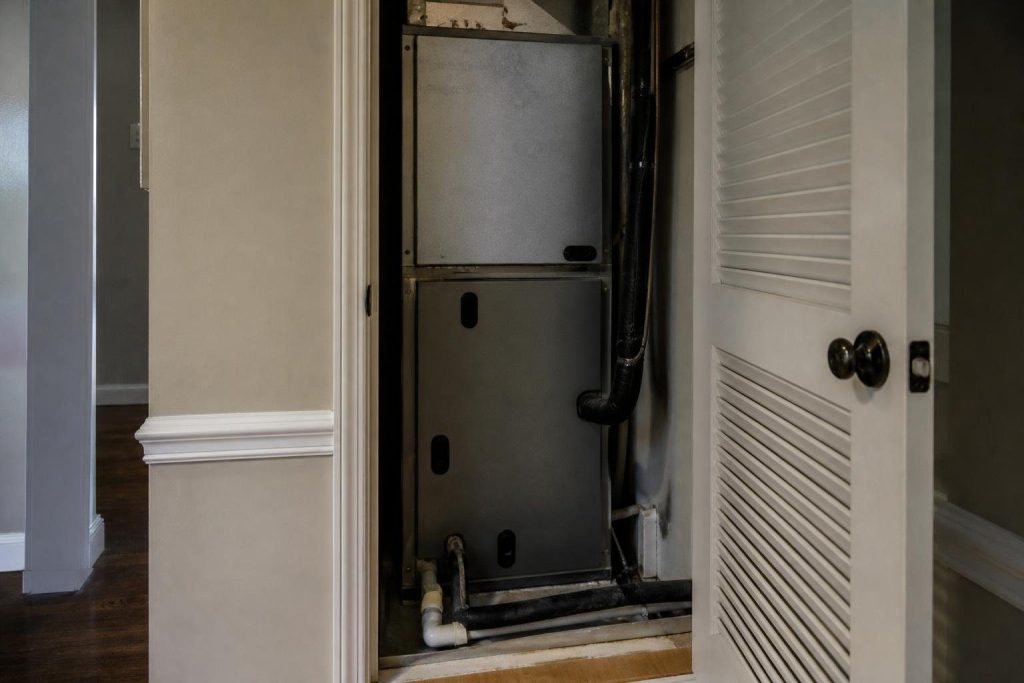
How can you tell AC tonnage if the model number is unreadable?
Use the indoor unit’s label first, then the paperwork, and treat amperage as a last cross-check. None is as direct as the outdoor model code.
- Air handler or coil label. Indoor model numbers can carry a capacity code too: Daikin’s air handler example DMVT36BP1400AA has 36 at characters 5 and 6. Coils can span sizes, though. Rheem rates both the RA14AZ18 and RA14AZ24 with the same RCFZ2417STAN coil, so a coil code gives a range, not the condenser’s size.
- Tested airflow. The 3-ton test points above ran at 1,030 CFM (Rheem) and 1,150 CFM (Goodman). Our CFM per ton guide explains how blower settings track tonnage.
- Install invoice or AHRI certificate. Carrier and Rheem both direct buyers to the AHRI Directory (ahridirectory.org) for the certified match-up, which lists the rated Btu/h for your exact outdoor and indoor pair.
- Compressor RLA, with caution. Rated load amps rise with size but differ by brand. Goodman lists 16 RLA for its 3-ton GSXN403610; Trane lists 14.1 RL amps for its 3-ton 4TTR6036. At 2.5 tons the figures are 11.6 and 9.1. Read RLA from the data plate only; our HVAC watts and amps guide explains the electrical fields.
Why does residential AC tonnage stop at 5 tons?
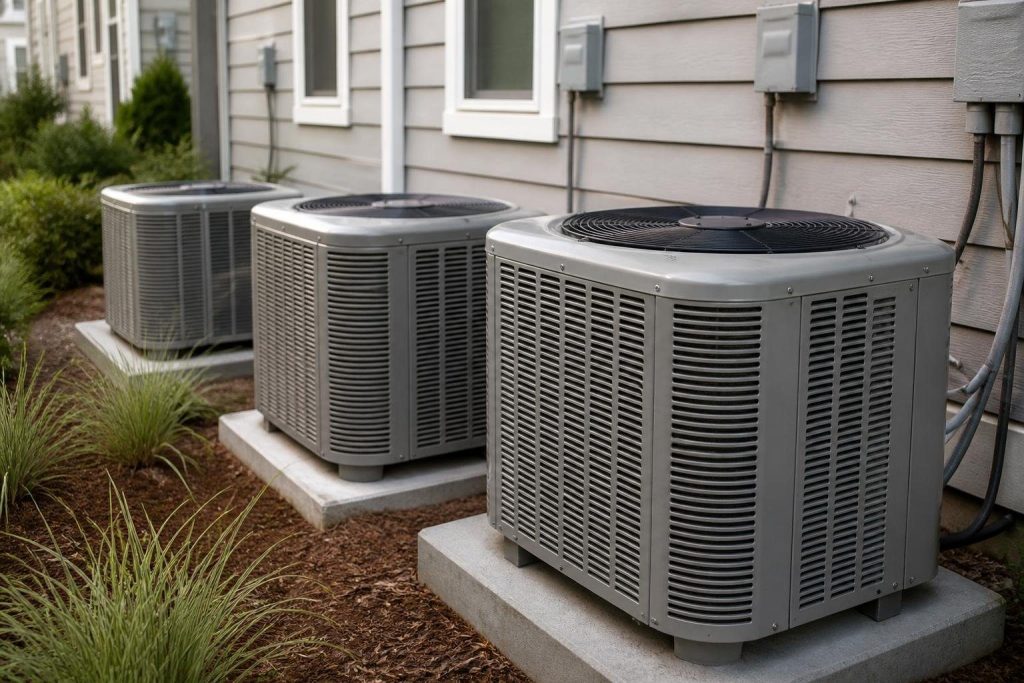
Residential AC tonnage stops at 5 tons because federal rules treat a central air conditioner as a consumer product only if it is single-phase, air-cooled and “rated below 65,000 Btu per hour” under 10 CFR 430.2. Five tons is 60,000 Btu/h, the last standard step under that line.
Every residential line we checked (Goodman GSXN4, Carrier 24ACC6, Trane XR16, Rheem RA14AZ) runs from 1.5 to 5 tons. Lennox publishes its three-phase ML14XC1, 3 to 5 tons, as commercial literature, consistent with that single-phase cutoff.
What does AC tonnage tell you about sizing?
AC tonnage tells you what was installed, not whether it was the right size. The correct size comes from a room-by-room load calculation, which our guide to what size HVAC system you need walks through; matching the old tonnage simply repeats the old decision.
Tonnage also hides how the capacity is split. Rheem’s 3-ton RA14AZ36 delivers 25,000 Btu/h of sensible cooling and 9,200 Btu/h of latent (moisture) removal at rating conditions, a split the ton figure alone never shows. When quotes arrive priced by the ton, our AC unit cost analysis shows which federal and national lab figures exist to check them.
How we researched this
Research date: October 9, 2026. We consulted 15 documents and cite 10: NIST, two eCFR sections, the AHRI 210/240-2023 text (Appendix M1 now cites the 2024 edition, which we could not open) and six maker documents. A brand row counted only if the maker’s own document named the capacity field, so York and Bryant were left out. Blogs, decoder sites and forums were excluded. Rated tons and shares are our arithmetic.
Frequently asked questions
Can you tell AC tonnage from the serial number?
No. In the serial layouts makers publish, the characters record build date and production sequence, not capacity. Capacity lives in the model number: in Goodman’s SS-GSXN4 nomenclature, nominal capacity is characters 7 and 8. If the model line is unreadable, check the indoor unit’s label or the original install invoice.
How many tons is my AC unit if the model number has 036?
Three tons. A three-digit 036 means 36,000 Btu/h, and Lennox’s Bulletin 210959 decodes 036 as 3 tons in its ML14XC1 model numbers. Divide any capacity code by 12 to get tons: 024 is 2, 048 is 4 and 060 is 5. Expect the certified rating to come in slightly under the nominal figure.
Is a bigger outdoor unit always a higher tonnage?
No. Cabinet size does not track capacity one for one. Goodman’s SS-GSXN4 sheet lists the same 226 lb equipment weight for its 3.5-ton GSXN404210 and its 4-ton GSXN404810. Two condensers that look alike can differ by half a ton, so read the model number rather than judging by size.
Do heat pumps use the same tonnage code as air conditioners?
Yes, in the documents we checked. Goodman’s nomenclature uses X for a condenser and Z for a heat pump in the same model layout, with the capacity code still at characters 7 and 8. Daikin’s 2023 nomenclature likewise flags X for AC and Z for heat pump while keeping one 12 to 60 capacity scale.
How many tons is a 24,000 Btu mini split?
Two tons. One ton is 12,000 Btu/h in NIST’s conversion table, so 24,000 divided by 12,000 equals 2. Daikin’s 2023 nomenclature uses the same scale, listing 24 as 2.0 tons. The rated capacity of a specific system can differ from the nominal figure, so check its AHRI listing for the exact pairing.
Why does my 3-ton AC not deliver 36,000 Btu/h?
Because 3 tons is a nominal size class. Capacity is measured at 95°F outdoors with 80°F/67°F indoor air under AHRI 210/240, and Rheem rates its nominal 3-ton RA14AZ36 at 34,200 Btu/h with its matched coil. Goodman’s data shows a similar 3-ton unit losing capacity as outdoor temperature climbs, reaching 30,550 Btu/h at 115°F.
Sources
- National Institute of Standards and Technology. “NIST Guide to the SI, Appendix B.8: Factors for Units Listed Alphabetically.” https://www.nist.gov/pml/special-publication-811/nist-guide-si-appendix-b-conversion-factors/nist-guide-si-appendix-b8. Accessed October 2026.
- eCFR. “10 CFR 430.2, Definitions.” https://www.ecfr.gov/current/title-10/chapter-II/subchapter-D/part-430/subpart-A/section-430.2. Accessed October 2026.
- eCFR. “10 CFR Part 430, Subpart B, Appendix M1: Uniform Test Method for Central Air Conditioners and Heat Pumps.” https://www.ecfr.gov/current/title-10/chapter-II/subchapter-D/part-430/subpart-B/appendix-Appendix%20M1%20to%20Subpart%20B%20of%20Part%20430. Accessed October 2026.
- AHRI. “Standard 210/240-2023 (2020): Performance Rating of Unitary Air-conditioning and Air-source Heat Pump Equipment” (Public.Resource.Org copy). https://law.resource.org/pub/us/cfr/ibr/inc/ansi/ahri.0210-0240.2020.2023.pdf. Accessed October 2026.
- Goodman. “GSXN4 Split System Air Conditioner, SS-GSXN4” (retailer-hosted copy). https://cdn.shopify.com/s/files/1/0766/1171/5363/files/GSXN402410.pdf. Accessed October 2026.
- Carrier. “24ACC6 Product Data, Catalog No. 24ACC6-4PD” (distributor-hosted copy). https://wizard.youngsupply.com/files/5-8447.pdf. Accessed October 2026.
- Trane. “XR16 4TTR6 Split System Cooling Product Data, Pub. 22-1889-01” (distributor-hosted copy). https://wizard.youngsupply.com/files/51-9175.pdf. Accessed October 2026.
- Rheem. “RA14AZ Air Conditioners, Form No. A11-337” (retailer-hosted copy). https://www.budgetheating.com/content/files/downloadables/ra14az%20technical%20specifications.pdf. Accessed October 2026.
- Daikin. “2023 Unitary Product Nomenclature.” https://daikincomfort.com/docs/default-source/dx7tc/nom-pf-2023_nomenclature_04-22.pdf. Accessed October 2026.
- Lennox. “ML14XC1 Product Specifications, Bulletin No. 210959.” https://www.lennox.com/dA/4ea87d468c/ehb_ml14xc1-3ph_2310.pdf. Accessed October 2026.
Leave a Reply